Value brands lead early holiday sales growth
Generated by Klaviyo AI
Klaviyo brands’ same-site sales rose 9% year over year on Thanksgiving even as discounts fell by 2 percentage points. Season to date, value brands outpaced higher-priced peers, and brands offering the smallest discounts grew faster than those offering deeper cuts.
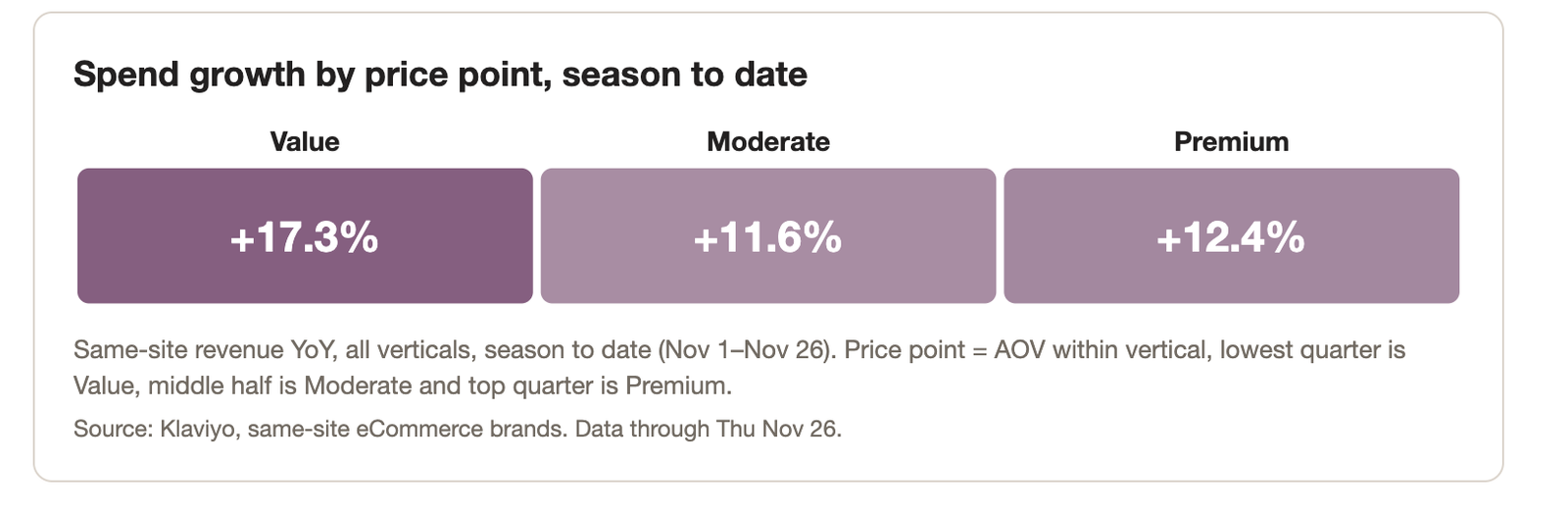
- Value brands lead: Season-to-date spend rose 17.3% at brands with the lowest average order values in their categories, compared with 12.4% at premium brands and 11.6% at moderate brands.
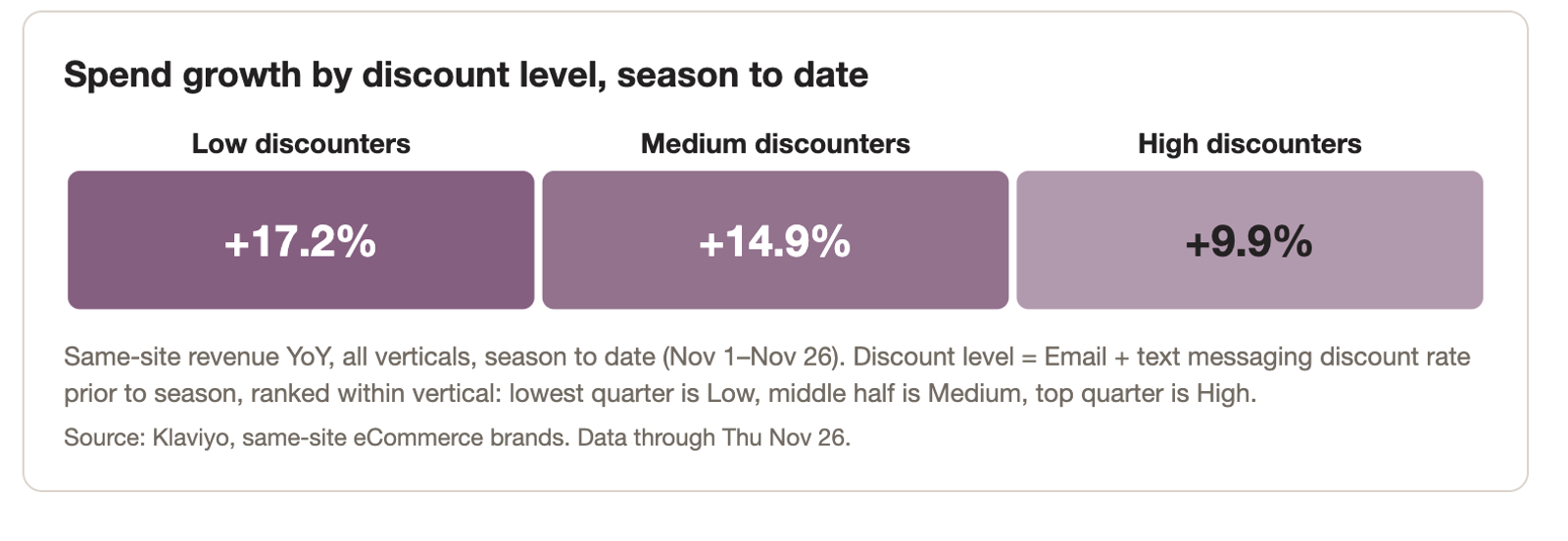
- Smaller discounts win: Same-site revenue grew 17.2% season to date for the lightest discounters, compared with 9.9% for the heaviest discounters.
- First-time buyers lead: First-time buyers accounted for just over half of Thanksgiving revenue, though repeat-customer spending grew faster year over year, at 9.8% versus 8.2%.
- Text outpaces email: Revenue from text messaging rose 18% season to date, compared with 11.2% for email and 13.3% for other site revenue.
Holiday shopping started early this year, and the data shows where the money is going: to value brands, to brands that discount lightly. And, as of Thanksgiving, spend is increasingly coming from first-time buyers, though revenue from repeat purchasers is growing faster YoY.
Thanksgiving kicked off Black Friday Cyber Monday (BFCM) 2026 with 9% year-over-year (YoY) growth in same-site sales for Klaviyo brands. And brands didn't need deep price cuts to get there: discounts dipped 2 percentage points from last Thanksgiving.
For the 4 days still ahead, this data suggests retailers should keep prices accessible, hold their discounts steady, and get ready for the new customers the biggest selling days of the year are about to bring them.
Thanksgiving picked up where November left off
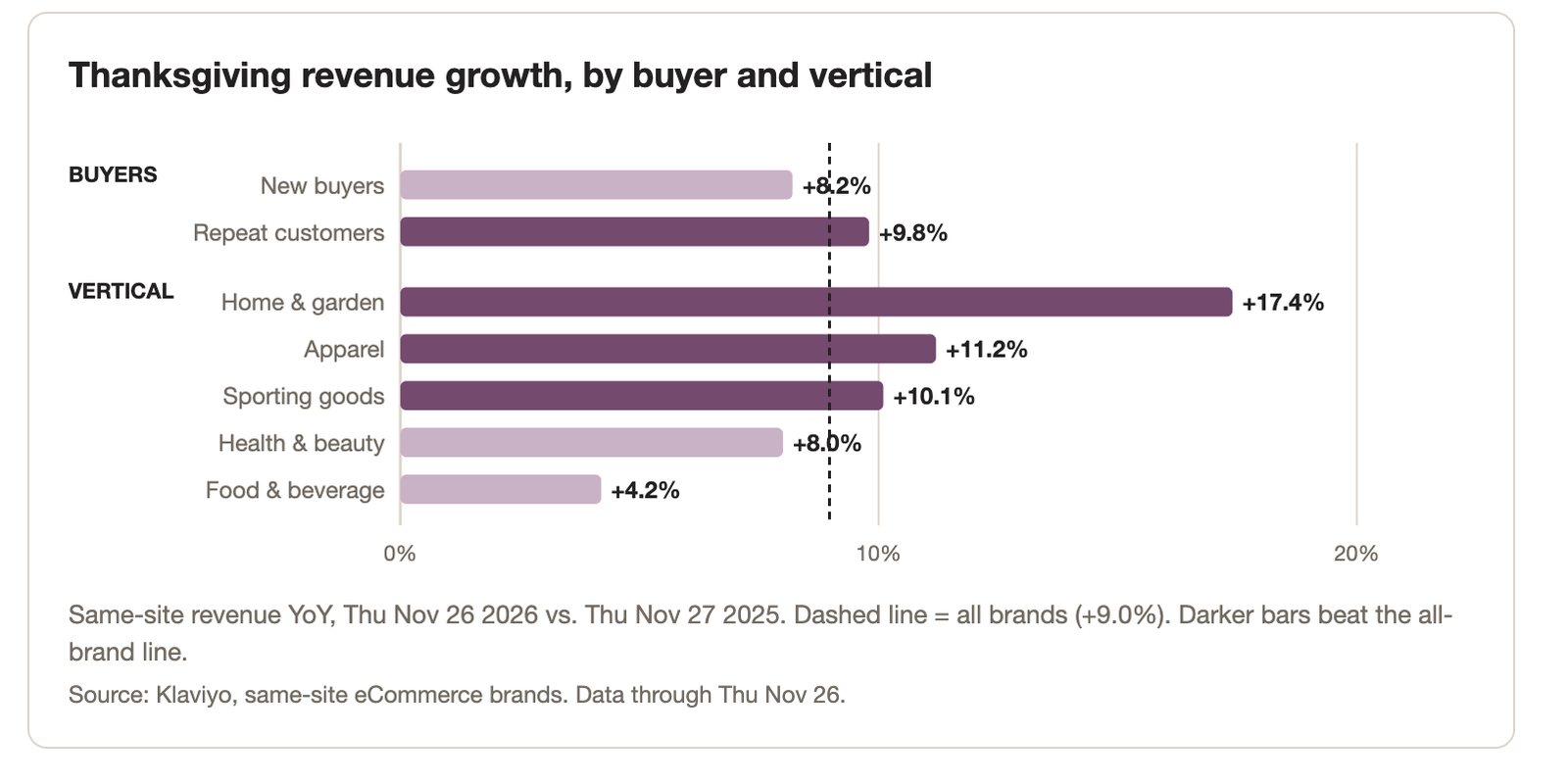
Home and garden led Thanksgiving with 17.4% YoY growth, nearly twice the 9% average across all Klaviyo brands. Apparel (11.2%) and sporting goods (10.1%) also beat the average.
When looking at who did the buying, a pattern from earlier in the month holds up. Repeat customers spent 9.8% more than they did last Thanksgiving, ahead of the 8.2% growth from new buyers.
This means that while first-time shoppers are claiming a bigger share of each day's revenue as the season peaks (more on that below), brands built this November by growing the customers they already know.
New shoppers took the lead on Thanksgiving
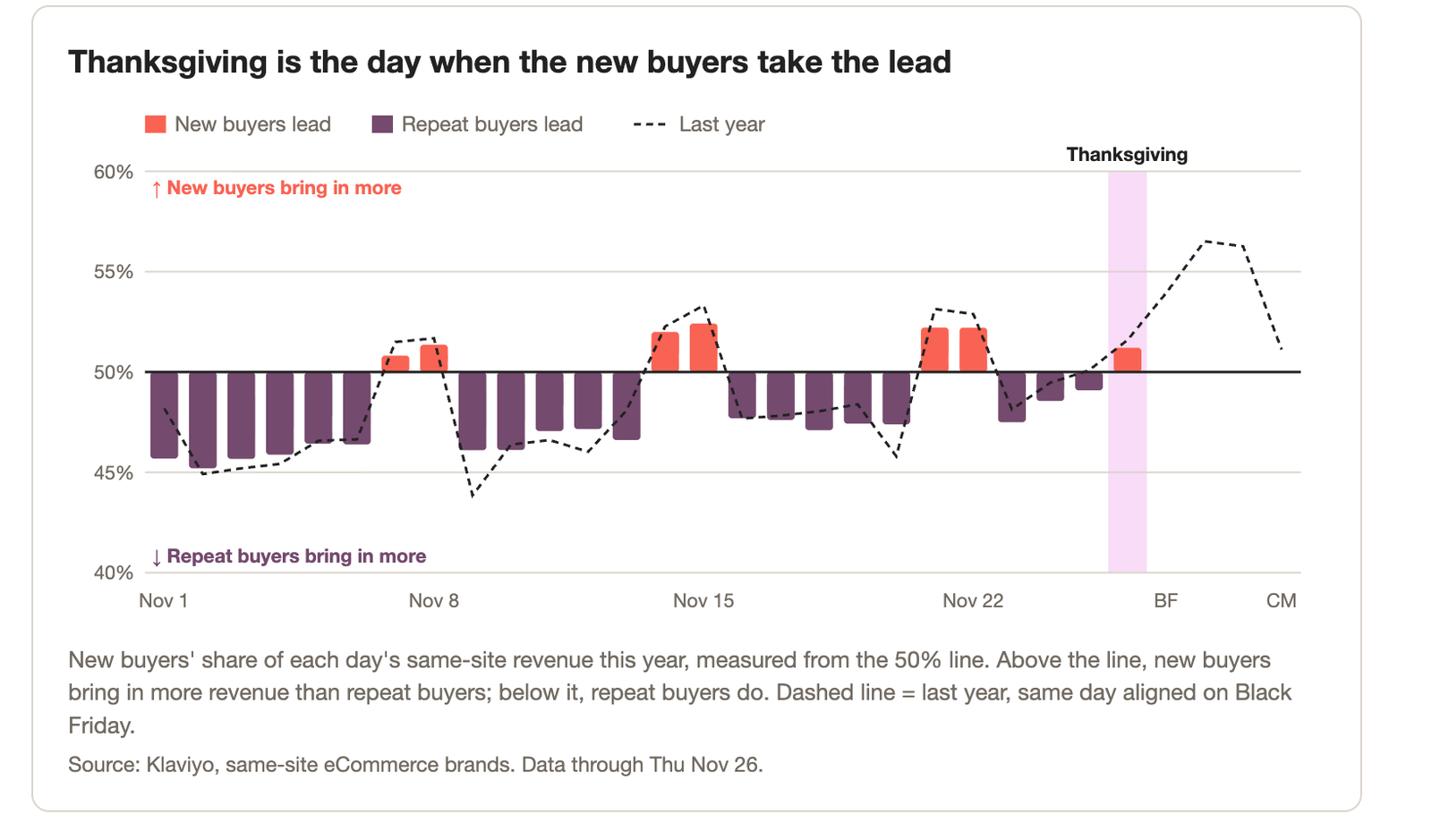
Thanksgiving was the first weekday this season when new buyers brought in more same-site revenue than repeat customers. Until then, new buyers had only out-spent repeat customers on weekends.
Their share on Thanksgiving landed just above half of the day's revenue, a little under where it sat on the same day last year. Expect the share of new customer purchases to climb from here through Cyber Monday.
That makes the biggest selling days of the year your biggest chance to start new customer relationships, too. A shopper who finds you on Black Friday hasn't decided yet whether you're a one-time deal or a brand worth coming back to. What you send after their first order goes a long way toward answering that.
Value brands are winning the season
Same-site spend with value brands has grown 17.3% season to date (November 1–26), ahead of premium brands at 12.4% and moderate brands at 11.6%.
What are value brands? The ones whose average order value (AOV) falls in the lowest quarter of their vertical. Because the ranking happens within each vertical, value is relative to the category. A value home and garden brand and a value apparel brand can sell at very different prices. What they share is a price that's accessible next to their competitors.
Repeat customers are leading the shift here, too. They spent 22% more with value brands than they did last year, more than double their increase at premium brands. That makes value a loyalty story as much as a price story: the customers who already know these brands are the ones spending more with them. Meanwhile, the middle of the market is the softest spot. Moderate brands, the middle half of each vertical by AOV, grew the slowest of the three.
The lightest discounters are growing fastest
Shoppers want value, and they're finding it with the brands that discount the least. Low discounters have grown same-site revenue 17.2% season to date, compared with 14.9% for medium discounters and 9.9% for high discounters.
To sort brands, Klaviyo ranked them within each vertical by the discount rate in their email and text messages (SMS, MMS, and RCS) before the season started. The lowest quarter are low discounters, the middle half are medium, and the top quarter are high.
This is the second BFCM in a row where restraint has paid off. In BFCM 2025, brands offering the smallest discounts saw some of the healthiest sales growth, and overall discounts fell, breaking a multi-year trend of rising promotional intensity.
The takeaway here is clear: revenue is following value, not the deepest discount. Light discounting at accessible prices is the combination to beat this year, and it's the one to protect as Black Friday tempts you to go deeper.
Text messaging leads a holiday season that started early
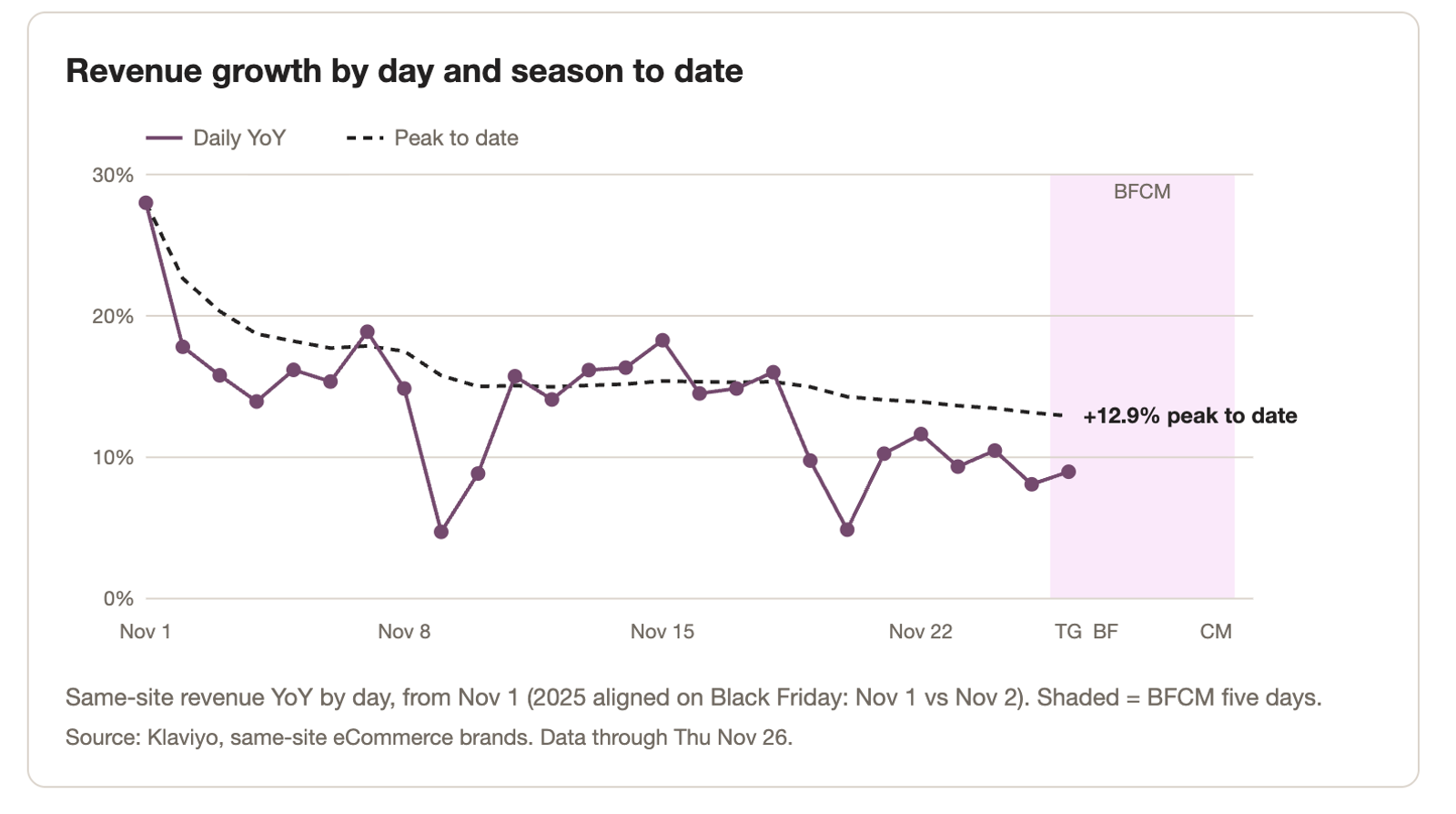
Same-site revenue is up 12.9% season to date, with double-digit growth on 16 of the first 18 days of November. Shoppers have already spent 42% of what they spent across all of last November and December. Thanksgiving alone brought in 14% of last year's five-day BFCM total.
Growth ran hottest in the first days of the month and has settled closer to 10% in the run-up to Thanksgiving.
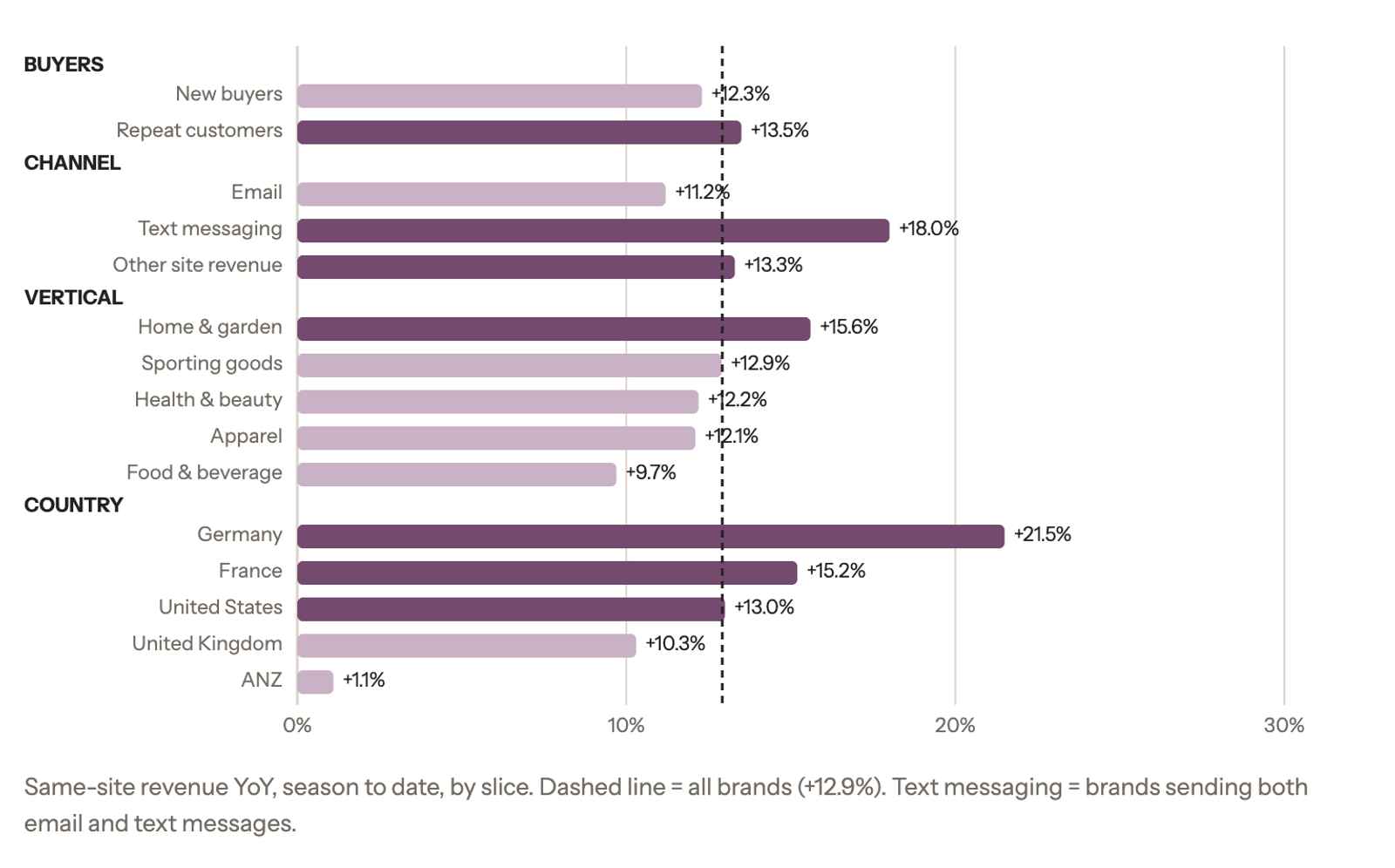
Text messaging has outpaced email and other channels. Revenue from text messaging has grown 18% season to date, compared with 11.2% for email and 13.3% for other site revenue.
Germany and France are running hottest by market, at 21.5% and 15.2%. The US (13%) is tracking with the overall average, the UK (10.3%) is just behind it, and Australia and New Zealand (ANZ) are nearly flat at 1.1%. Home and garden leads the verticals again at 15.6%, while food and beverage trails at 9.7%.
One strong day doesn't settle the season, though. Black Friday, the weekend, and Cyber Monday are still ahead, and they carry most of BFCM's revenue.
What to do with the rest of BFCM
Thanksgiving previewed the next 4 days, and it points to 5 moves.
- Hold your discount line. If you planned 25% off sitewide for Black Friday, keep it at 25%. Save deeper offers for specific segments, like customers who haven't bought since last BFCM.
- Sell the value, specifically. A subject line like "The $38 tumbler that keeps coffee hot until lunch" tells shoppers what they're getting. "40% off everything" only tells them what they're saving.
- Plan the second purchase now. Set up a post-purchase flow for first-time BFCM buyers that helps them use what they bought: "Your order's on the way. Here's how to get the most out of it in week one."
- Send on email and text. Make sure your Black Friday and Cyber Monday sends reach subscribers on both channels, and keep text messages to the offer, the deadline, and the link.
- Pull December forward. If your gift guides and shipping-deadline reminders are scheduled for mid-December, move the planning up now.
Composer prompts for the rest of BFCM
If your team is stretched this weekend, Klaviyo's AI marketing agent, Composer, can audit your active flows in one pass and draft campaigns for you to review and approve. Four of the tactics above have a ready-made prompt in Klaviyo's AI prompt library. Paste one into Composer as written, or edit it to fit your brand.
Shoppers showed up early this year, and they showed up for value. The brands that hold their prices steady and give first-time buyers a reason to come back are set up to keep growing well past Cyber Monday.
Follow BFCM 2026 live on Klaviyo's dashboard, with updates through Cyber Monday. See the dashboard
About the data: All figures are Klaviyo same-site sales, which compare the same brands year over year. Each day and period is measured against the same day last year, aligned on Black Friday. Thanksgiving results are projected from historical patterns using the roughly 95% of actual results in so far.

Related content