Push notification marketing: a real digital strategist's playbook
Generated by Klaviyo AI
Klaviyo's Jessica Fontanilla, who spent five years managing Strava's marketing tech stack before joining Klaviyo's Professional Services team, breaks down her playbook for mobile push notifications. She covers why push deserves a bigger role in the channel mix, how to grow an opted-in push audience, six message types that work for B2C brands, and how to time, sequence, and test sends across channels.
- Push has underused advantages: Push lands on the lock screen, carries no per-send cost once a customer has the app, and can drive real revenue — Killstar's push and email flows generated £147,027 in attributed revenue, per the case study cited.
- Six message types anchor the tactical playbook: Fontanilla recommends time-sensitive alerts, behavior-based nudges (viewed/cart/wishlist/search activity), welcome messages, loyalty and birthday updates, location-based geofencing, and win-back promotions for lapsed customers.
- Timing and sequencing follow cost and engagement: She advises starting new subscribers at one to two pushes a week, using engagement segments to message active users more often, and sequencing channels — push first, then paid channels like text or WhatsApp, then email — to protect both budget and engagement.
Before I joined Klaviyo, I spent 5 years at Strava managing the marketing technology stack for one of the most-loved apps in fitness.
At Strava, push notifications are more than a marketing tactic. They’re an actual part of the product experience. You finish a run, you get a notification. A friend gives you kudos, you get a notification. The channel feels natural because it’s built around milestone moments for the user.
Then I moved into the broader B2C world at Klaviyo, and I noticed something: most brands treat mobile push notifications as an afterthought. They pour energy into email and text message marketing, launch an app, then send the occasional notification to their push audience, if they send anything at all.
That's a missed opportunity, because push has advantages no other channel can match. The average ecommerce app retention rate was only 2.9–3.5% by day 30 in Q2 2026, according to AppsFlyer benchmarks. Push is one of the most direct, lowest-cost ways for brands to re-engage app customers.
After nearly a decade in CRM and lifecycle marketing, here's the playbook for mobile push notifications I walk clients through: what to send, when to send it, and who should get it.
4 reasons push notifications deserves a bigger role in your channel mix
Push is such an untapped channel. We tend to default to email because it's the bread and butter of so much marketing, but, in the day and age we're in, sometimes the quick snippets are more powerful.
Push notifications are different from any other channel in your mix. Here are a few reasons why a mobile push strategy is worth the investment:
- Your push audience has already raised their hand. Someone who downloads your app and opts into notifications is telling you they want to hear from you. There's far less convincing to do with a push subscriber than with an email subscriber who may have handed over their address for a one-time discount years ago.
- Push lands on the lock screen. A push notification appears directly on the lock screen, along with other high-priority notifications. When your audience is looking at their phone, a push notification captures attention faster than other channels.
- Push doesn't add to your send costs. Text messaging and WhatsApp are strong channels, but the per-message costs can add up quickly. Once a customer has your app and opts in, reaching them via push doesn't increase your messaging spend.
- Push can drive significant revenue for your brand. Gothic lifestyle brand Killstar runs 50 live flows across email and push globally, with push generating £147,027 in attributed revenue. “Incorporating push messaging into Klaviyo alongside email has made our mobile engagement feel complete,” says Chloe Grant, CRM manager at Killstar. “It's helping us reach customers in moments where timing really matters, and we're already seeing the impact.”
How to grow your push notification audience
Nothing in this playbook matters without opted-in app users, which is where your other channels come in. Your email list, your website, and your social audience are all acquisition engines for your mobile app.
Here are a few strategies I regularly recommend to get new app users:
- Add an app-specific email to your welcome flow. A dedicated message (“Did you know we have an app? Download it for exclusive offers”) converts new subscribers into app users at a high-interest moment.
- Give your audience a reason to download your app. App-exclusive drops, app-only discounts, and early access make downloading feel like joining an inner circle.
- Use on-site pop-ups to promote your app. Your website visitors are already engaged. A well-targeted sign-up form pointing to the app captures them without adding costs.
- Point organic and paid social campaigns to your app. Your social audience is already on their phone, one tap away from your app store listing. It's the shortest possible path from ad to install.
6 push notification marketing tactics that work for B2C brands
With push notifications, you only get two lines of text, so you have to make each message count. These are 6 types of messages I see working well for B2C brands:
1. Time-sensitive alerts
Push notifications, text messages, and WhatsApp messages are built for need-to-know, minute-by-minute communication. If a message can wait until someone checks their inbox, it can probably be an email. If it can't, it's a strong candidate for push. Think flash sales, back-in-stock alerts, and price drops.
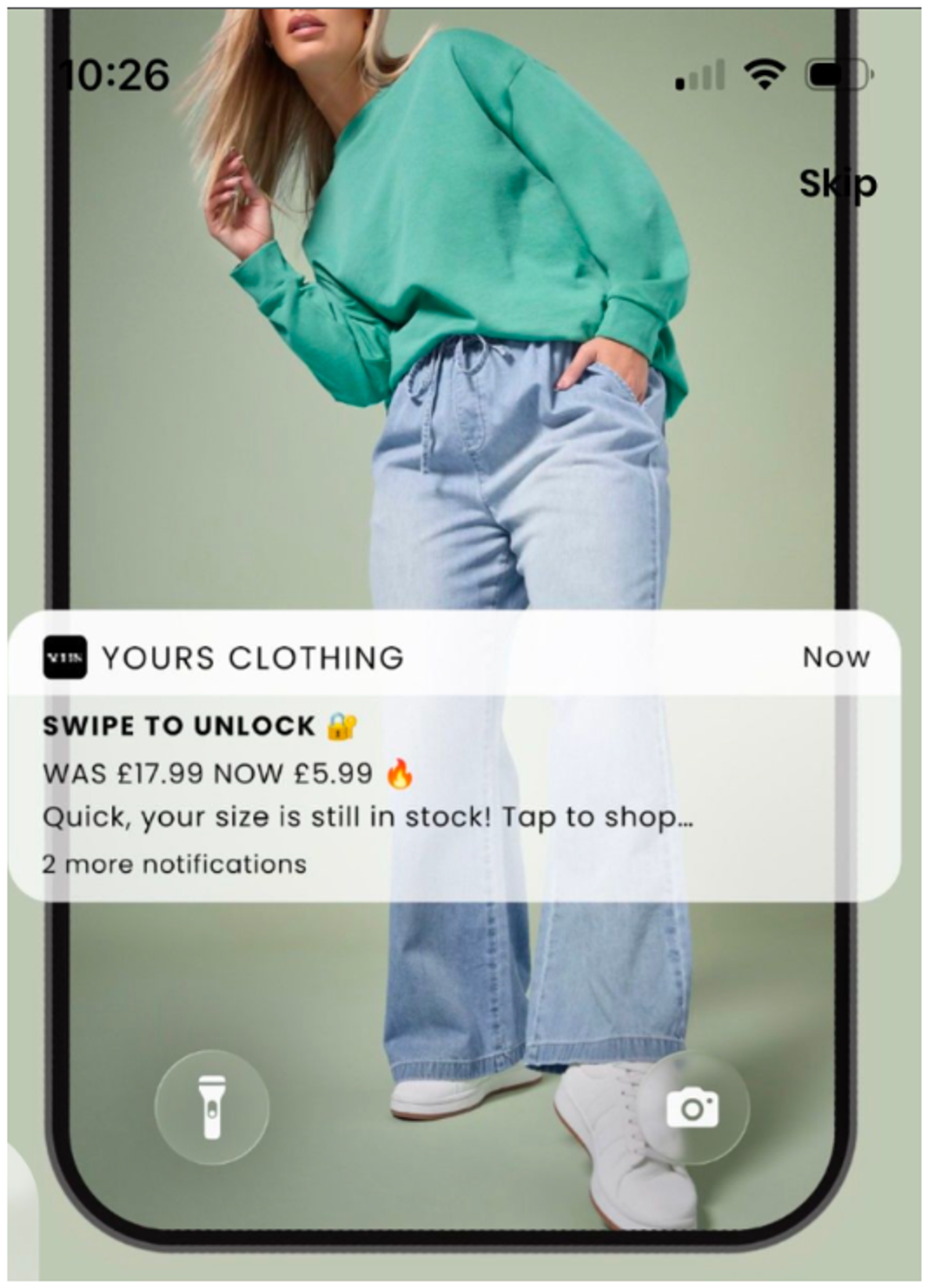
Here’s an example of a price drop push notification from apparel brand Yours Clothing, which uses bold font and emojis and personalizes the message to the recipient’s size.
Source: Yours Clothing
The technical advantage to these messages is deep linking. With deep links, you can route a customer from the notification to the exact product or page inside your app, not to a browser window they have to navigate through. Announce a price drop, link straight to the product, and the path to check-out gets dramatically shorter. Plus, once someone is in your app, they tend to stay and browse.
2. Nudges based on shopping behavior
You can trigger a push notification for every behavioral event your app tracks, like:
- Viewed a product: Browsing behavior powers abandonment flows, price-drop triggers, and up-sell nudges, like, “Still thinking about the Luna boots? 👀 They're 20% off for the next 24 hours.”
- Added to cart but didn't buy: Cart activity drives abandoned cart pushes and can help you time an up-sell while intent is high. You can pair the push with an in-app message targeted to the same segment, like, "The Harper hoodie in your cart misses you! 🛒 Check-out takes 30 seconds."
- Added to a wishlist: A wishlist event is one of the strongest purchase signals available. Use it for price-drop pushes and wishlist reminder flows that say, “That item you saved is back in stock,” or “Wishlist alert: The Celeste dress dropped from $59 to $39. You saw it first!”
- Searched your app or site: Search activity tells you what a customer wants in their own words. If someone searched for something you don't carry yet, or misspelled something you do, a follow-up push can rescue a session that would otherwise end in frustration, like, “Looking for the Nova set? 🔍 It's back, with new colors!”
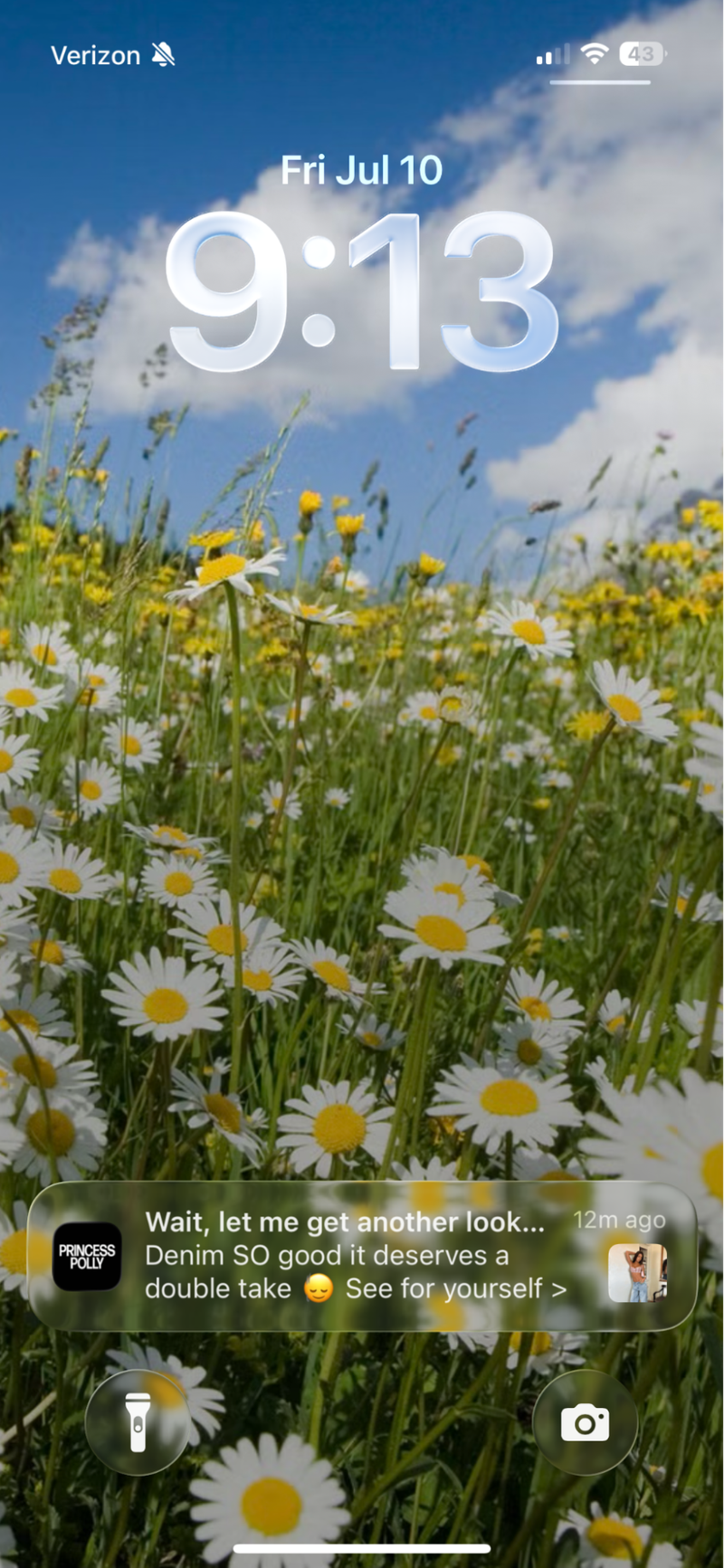
Here’s an example of an abandonment push notification from fashion brand Princess Polly, which encourages the recipient to do a “double take” at the denim they were eyeing earlier.
Source: Princess Polly
3. Welcome messages
For customers who are new to your app, a simple welcome push (“Welcome to the app, here's what's new”) starts the relationship off on the right foot. It also teaches them what kind of value your notifications will deliver, which is important for setting expectations.
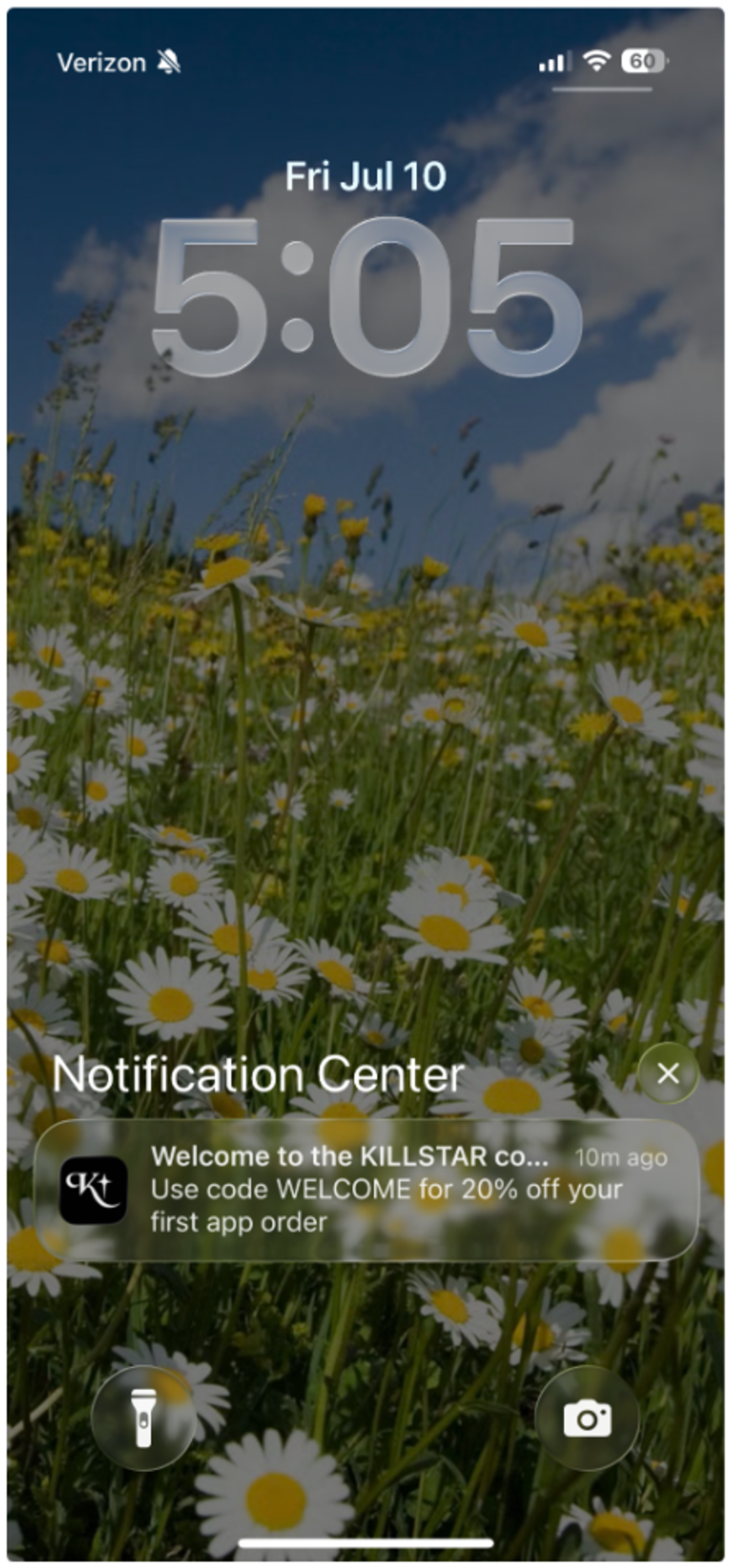
Here’s a great example from Killstar that keeps the message short and sweet, encouraging the recipient to use a discount code to get 20% off their first in-app order.
Source: Killstar
4. Loyalty and birthday updates
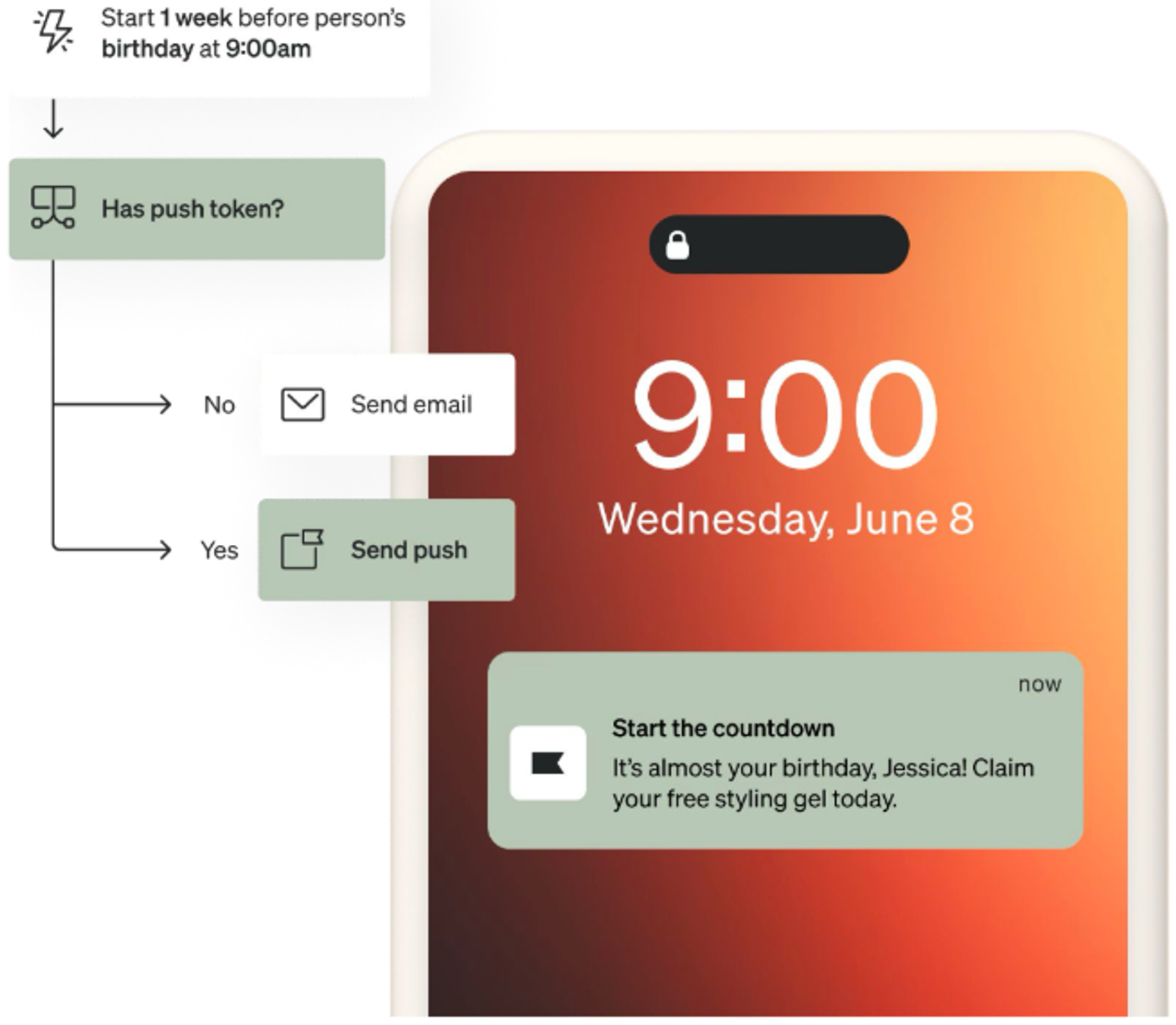
Your long-tenured, more engaged app users are a great audience for loyalty messaging like points balances, earned rewards, and birthday perks. If your loyalty program runs on a separate platform from your CRM, a loyalty integration can pull that data into your customer profiles so you can send push notifications.
5. Location-based messages
If your brand has physical locations, geofencing can target app users who’ve shared their location based on where they are or where they shop. A geofence identifies the boundary around a specific location, after which you can track when a person enters or exits that boundary and automatically send a push notification.
Here are two location-based push notification strategies I recommend:
- Trigger flows on entry and exit. Send a welcome offer or in-store deal the moment a customer walks in. If they left without purchasing, follow up a few hours later to convert them online.
- Build location segments. Segment profiles by geofence entry to know who visited which stores, then use those segments for location-specific campaigns. People who entered your New York City store in the last 90 days, for example, get a campaign featuring local events and promotions.
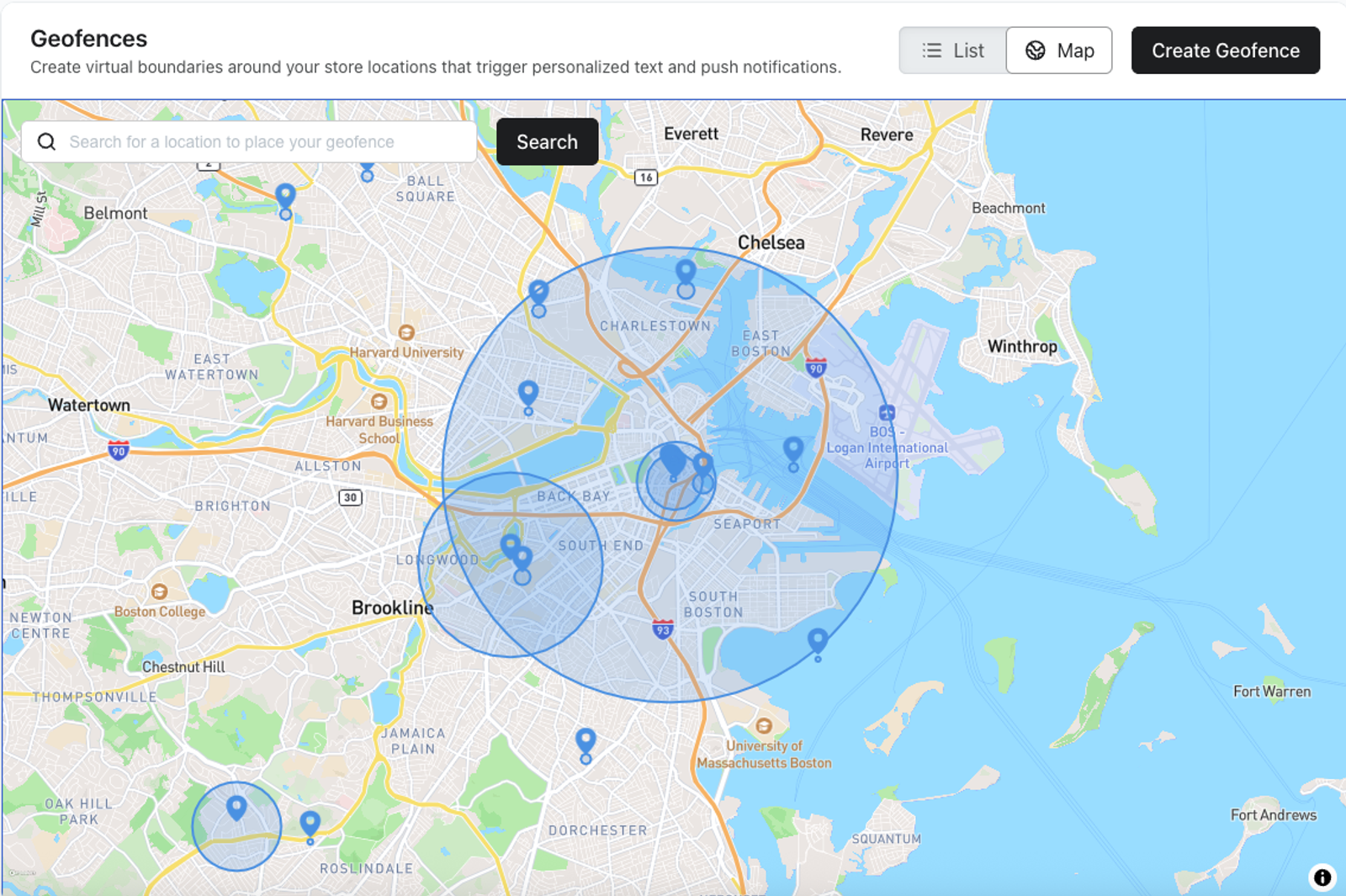
Source: Klaviyo Help Center
6. Win-back promotions
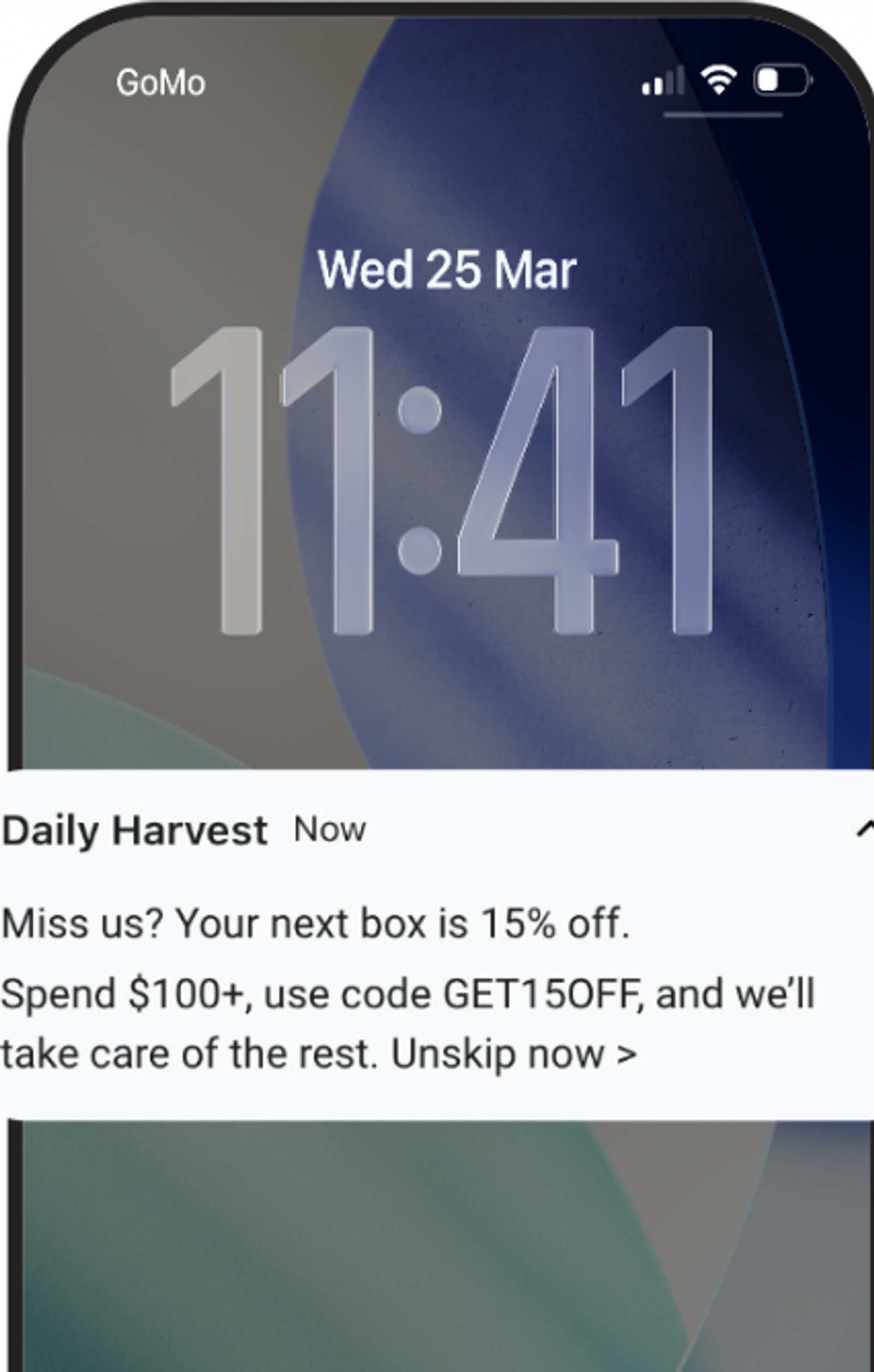
Push is a low-risk way to re-engage the customers who’ve ghosted you. This is the use case I recommend most often. Emailing unengaged subscribers risks spam complaints and deliverability damage, and text and WhatsApp messages cost money and can feel intrusive to someone who's already drifting away.
But if a customer hasn't engaged or purchased in 60–90 days, a push notification is a free test. If they engage, you've won them back at no cost. If they don't, you have a clear signal that it's time to say goodbye. Either outcome makes your program healthier.
In this example, Daily Harvest sends a push notification with a win-back reward: 15% off the recipient’s next box when they spend $100.
Source: Daily Harvest
When to send push notifications: timing, frequency, and channel order
Push notification timing comes down to 3 decisions: the time of day, how often you send, and where push sits in your channel sequence. Here’s what to keep in mind:
Optimize send time by recipient and intent
For scheduled campaigns, deliver at each recipient's local time. You can take this further with personalized send time, which delivers each campaign when someone is most likely to open and tap based on their own engagement history.
For triggered flows, the behavior sets the timing: a back-in-stock or cart abandonment push fires the moment it's relevant. This is part of why behavior-triggered flows see more engagement than scheduled campaigns at every stage of the funnel, according to Klaviyo's 2026 Omnichannel Benchmark Report.
Either way, give each push a clear objective, like a launch, a sale, or a behavioral trigger, rather than filling a slot on the calendar.
Start conservatively with frequency
For your new subscribers, start with one or two pushes a week. Sending too many notifications early on tends to drive the most opt-outs, before users have the chance to build a habit with your brand.
With engagement-based segments, you can message your most active subscribers more often and send less to anyone who hasn't opened in 60–90 days. You can also cap profiles at one push per configurable window even if multiple campaigns fire at once with Smart Sending.
Sequence your channels by cost and customer engagement
When a message could go out on push, text messaging, WhatsApp, or email, you have some options for deciding which channel goes first:
- Think about cost. Push has no per-send cost. After sending a push notification, you can escalate to a paid messaging channel like text or WhatsApp, then finally email the customers who haven’t engaged yet.
- Think about channel preference. Use AI-powered channel affinity to identify which channel each customer is most likely to engage on next, and let your campaign or flow start there instead.
With the cost approach, you’re protecting your budget. With the affinity approach, you’re protecting engagement. Either way, you’re protecting your customers, so they get the right message at the right time.
I recommend you start with push where you can, because it’s included in your Klaviyo plan. You can send it to as many people as you want. If they don’t interact, send a text or WhatsApp message, depending on where your customer is and what they use. You can reuse similar messaging, but you're saving on the cost because you already tried push.
Still nothing? Send an email. That ranking increases the ROI on your spend.
How to measure and test your push notification strategy
Push metrics need a different lens than email. Because a notification shows its full message on the lock screen, a customer can read it, never tap, and still convert on your site an hour later.
So track opens, clicks, and deliverability, but also track influence. Look at mobile purchases shortly after a send. Then, put your energy into testing. With only two lines to work with, small copy changes can have a big impact. A/B test push messages within flows and let the results guide your strategy.
Here are some ideas for A/B testing to increase push notification opens:
Personalized vs. generic
Test whether dynamic content like a name, a saved product, or a nearby store actually increases taps over a one-size-fits-all message. For example:
- A: "Back in stock: the Mara jacket you saved."
- B: "New arrivals just dropped!"
Curiosity vs. urgency
Test hooks in your messaging. Find out which ones your audience responds to before using similar hooks in text messages, WhatsApp, or emails. For example:
- A: "Something special is waiting for you. 👀"
- B: "4 hours left: 20% off everything."
Rich vs. plain
Test whether emojis, images or GIFs, and sounds help, or if they just add noise for your audience. For example:
- A: “🚨 Restock alert: the Daisy dress is back 🖤 Your size won't last long.” Test with a photo of the dress and a notification sound, all in isolation.
- B: “Restock alert: the Daisy dress is back. Your size won't last long.” Send text only without a sound.
Anchor your analysis on positive engagement trends. Are opens and clicks holding steady as your audience grows? Are opt-outs staying flat as you adjust frequency? If engagement dips, treat it as an early warning system and pull back before customers opt out.
With Klaviyo, push notifications pull in customers
Your push subscribers gave you prime real estate: their phone lock screen. Send them messages that are timely, personal, and worth their attention, and they'll keep that line open.
Klaviyo mobile app marketing runs alongside your email, text message, and WhatsApp marketing in the same B2C CRM, with unlimited messages included in any Klaviyo plan. That means you can:
- Send behavior-triggered pushes from the flows you already use. Add push to your abandoned cart, back-in-stock, price-drop, and win-back flows, and A/B test push messages to improve performance over time.
- Route every message to each customer's preferred channel. Channel affinity predicts where your customers are most likely to engage next, so your cross-channel sequencing starts on the best channel automatically.
- Send customers exactly where you want them to go. Deep links route customers straight to a product page or cart inside your app, and smart sending windows keep push notifications, text messages, and emails from stacking up on the same customer in the same hour.
- Greet shoppers when they arrive. Pair push with in-app messages that target the same users.
Put your app to work with Klaviyo mobile app marketing.

Related content