Where RCS Strengthens Klaviyo Flows
Generated by Klaviyo AI
RCS adds rich media, carousels, buttons, GIFs, read receipts, and verified business profiles to text messaging in Klaviyo. The primer explains when RCS can outperform SMS, key launch considerations, and eight flow use cases ranging from welcome messages to product-specific calls to action.
- Best-fit messages: RCS is most useful for visual, trust-sensitive, and in-thread shopping experiences rather than simple transactional texts.
- Automatic fallback: Klaviyo falls back to SMS or MMS when a device or carrier does not support RCS.
- Launch requirements: Brands should balance carousel copy, place links in buttons, write fallback messages, and test media on real iOS and Android devices.
- High-intent flows: Welcome, abandonment, back-in-stock, post-purchase, and win-back flows can use rich cards to reduce friction and showcase relevant products.
- Personalized shopping: Quiz responses, multiple product cards, and separate product CTAs can create more relevant paths from message to purchase.
RCS has been live in Klaviyo text message marketing since early 2026, and it's a big upgrade to mobile marketing. Yet, most direct-to-consumer (DTC) brands aren’t making the most of it.
As co-founder of Retention Harbor, a retention agency specializing in Klaviyo email and SMS for DTC ecommerce, we've been building RCS carousels directly into client flows. Here, I guide you through where they're working, when RCS outperforms plain SMS, and what to know before you launch your first one.
What is RCS?
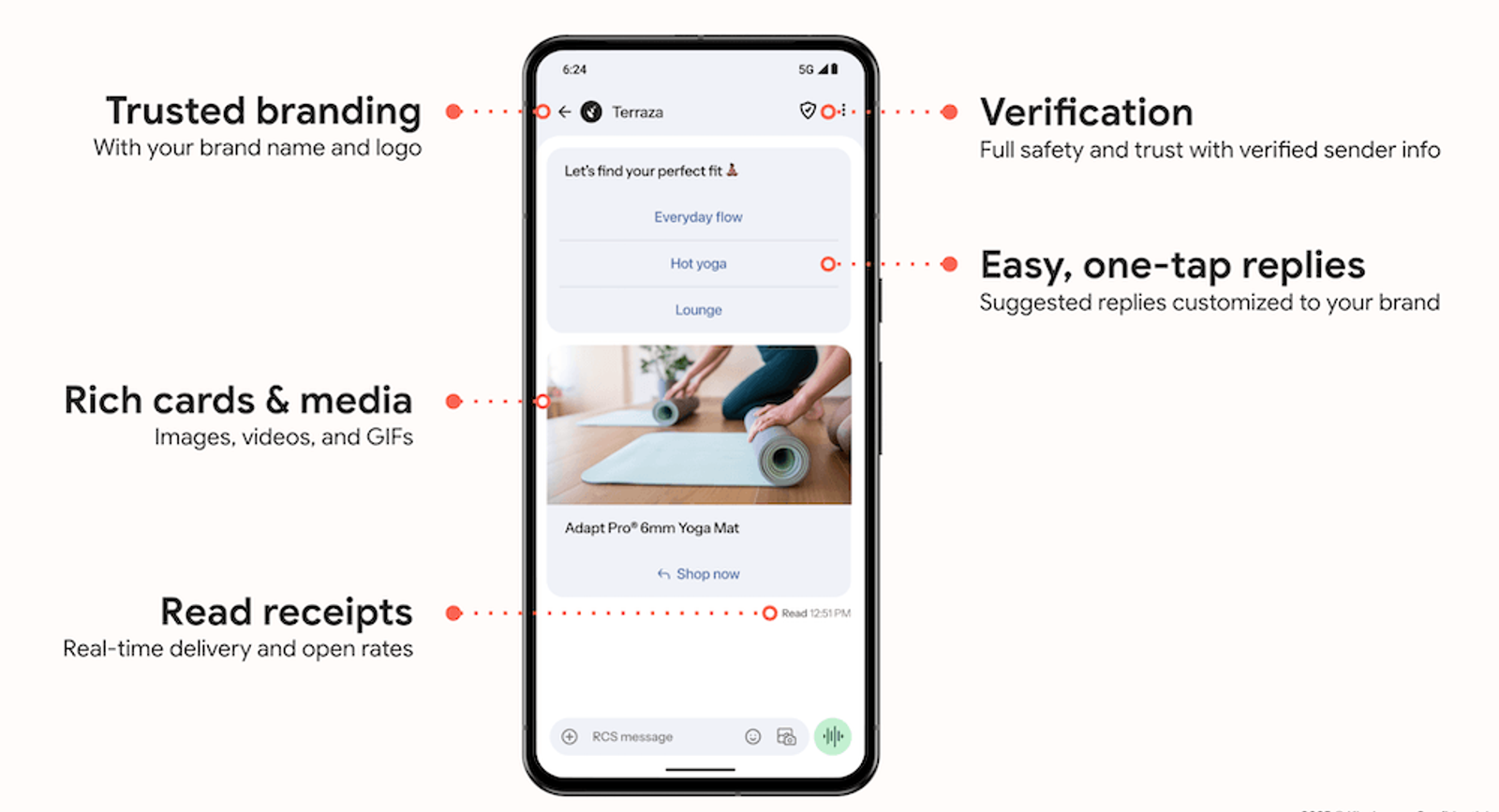
RCS is the newer, richer standard for text messaging, replacing plain SMS right inside a phone's default messaging app. A standard text message is limited to characters and the image may be low-quality.
RCS supports rich media natively:
- Swipeable carousels
- Buttons
- GIFs
- Read receipts
These are all inside the same thread a subscriber already uses to text friends and family. There’s no separate app required.
In Klaviyo, RCS lives inside the text message marketing product alongside SMS, so a subscriber's whole texting experience shows up in one flow and one report. Messages send from a verified business profile with your logo and brand name attached, so subscribers see who's actually messaging them instead of an unfamiliar number.
If a device or carrier doesn't support RCS, Klaviyo automatically falls back to SMS or MMS, so the message still lands, just in a plainer form.
When to use RCS instead of SMS
RCS isn't a wholesale replacement for SMS, but it is the right tool for specific jobs. RCS tends to win decisively when:
- The message is visual (e.g., products, collections, drops)
- Trust carries the conversion (e.g., VIP, win-back)
- You want the shopper to act in the thread instead of routing out to a browser
But RCS can be overkill for a transactional text. An order confirmation doesn't need a carousel. Text-only RCS generally bills at SMS rates, while rich content costs more credits, so put the spend where the visual actually moves something.
6 things you need to know before launching RCS
There are few things marketers should consider from the build side before launching RCS in Klaviyo:
1. iOS renders carousels differently than Android
Apple's iOS 18 update added RCS support, but it doesn't follow Google's layout rules. iOS sizes each card's image based on how much text that card carries, so to keep a carousel's images uniform on iOS, you need to keep card titles and descriptions roughly the same length across every card. Uneven copy means uneven images.
2. Put links in buttons, not in the text
Plain-text URLs aren't clickable inside RCS rich cards. Every link has to live on a button, or the tap does nothing.
3. Mind the fallback to SMS
When a device can't receive RCS, Klaviyo sends SMS or MMS instead. That means every rich message needs a fallback that still reads as a normal text message. Build the carousel, but write the SMS version too.
4. Watch the unsubscribe tradeoff
Richer messages pull more attention, and in our early data, they've also pulled higher opt-outs than plain SMS. But don’t let this prevent you from trying RCS altogether. Try to see it as a reason to spend on RCS where the payoff justifies it, rather than everywhere.
Importantly, text message opt-outs apply across both SMS and RCS. That means if someone opts out of RCS, you can't fall back to sending them SMS messages.
5. Take time for technical considerations
Getting media to render consistently across devices takes some trial and error. Image specs that look fine on Android can get cropped hard on iOS if they're off, even slightly.
And if you're considering a GIF or video card instead of static images, know the tradeoffs going in: on at least one carrier's end, a GIF currently renders as a static image instead of animating, and an MP4 requires the recipient to tap play rather than autoplaying.
Test on real devices before you build a whole flow around either format.
6. Intent matters
Start where intent is already high. Audit your existing text messaging, find what's already working, and test RCS there first. Abandoned cart, browse abandonment, and post-purchase flows are the cleanest places to prove it out, because intent is high and the lift is easy to read against your SMS control.
The 8 most effective use cases for RCS messaging
1. Welcome flow: your catalog in one swipe
When a new subscriber hands over their number, they're the most engaged they'll ever be. A plain-text welcome wastes that high point on a line of copy and a coupon code.
A carousel can do more. A single RCS welcome message can introduce your top few products or hero collections as swipeable cards, each with its own image and "Shop now" button. And it all arrives from a verified business profile with your logo right in the thread.
Instead of "Welcome, here's 10% off," a brand-new subscriber gets a branded, shoppable mini tour of what you're actually known for, on day one, in one message. It's also where new product launches naturally live for your newest audience: feature what's new as the first card.
The welcome series is high-volume and controlled, which makes it the ideal first place to see what the rich format does to first-purchase rate.
2. Browse and cart abandonment flows: show them what they almost bought
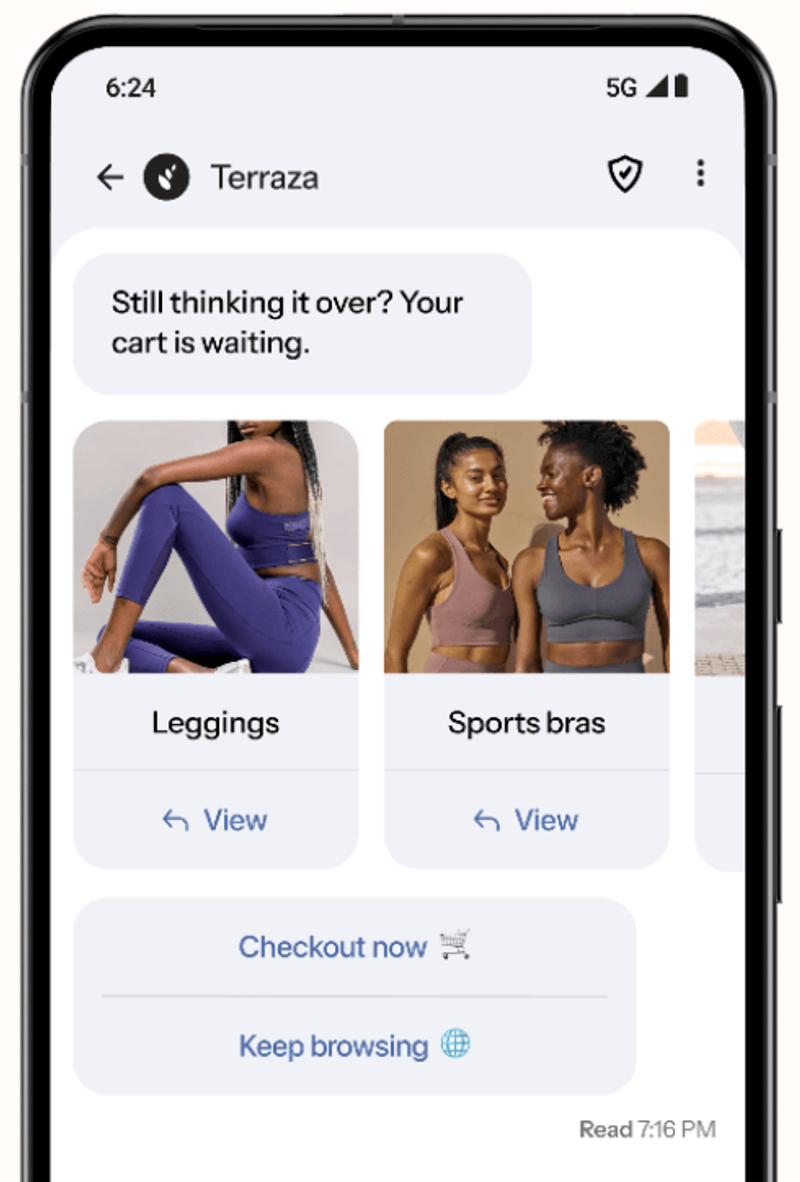
Someone views a product and leaves, or adds something to their cart and leaves. In both cases, a plain "Still thinking it over?" text message isn’t good enough, because it can't show the shopper the thing that they almost bought.
A carousel can. The build is the same for either trigger: lead with the product they were looking at, then fill the rest dynamically with either a "You may also like" recommendation feed or a similar collection.
The difference between what you put in these two flows comes down to intent and tone.
- Browse abandonment is a softer signal, so the carousel's job is rekindling interest: the product they looked at, plus more to discover.
- Cart abandonment signals higher intent. This shopper is close to the line, so messaging should lean toward closing: the product they added, reinforced with bestsellers, and a nudge to check out.
Both flows are among the highest-revenue automations a brand runs. Because intent is already high and the audiences are small, they're a smart place to spend the slightly higher unsubscribe cost on purpose.
3. Back-in-stock alerts: don't get second-guessed
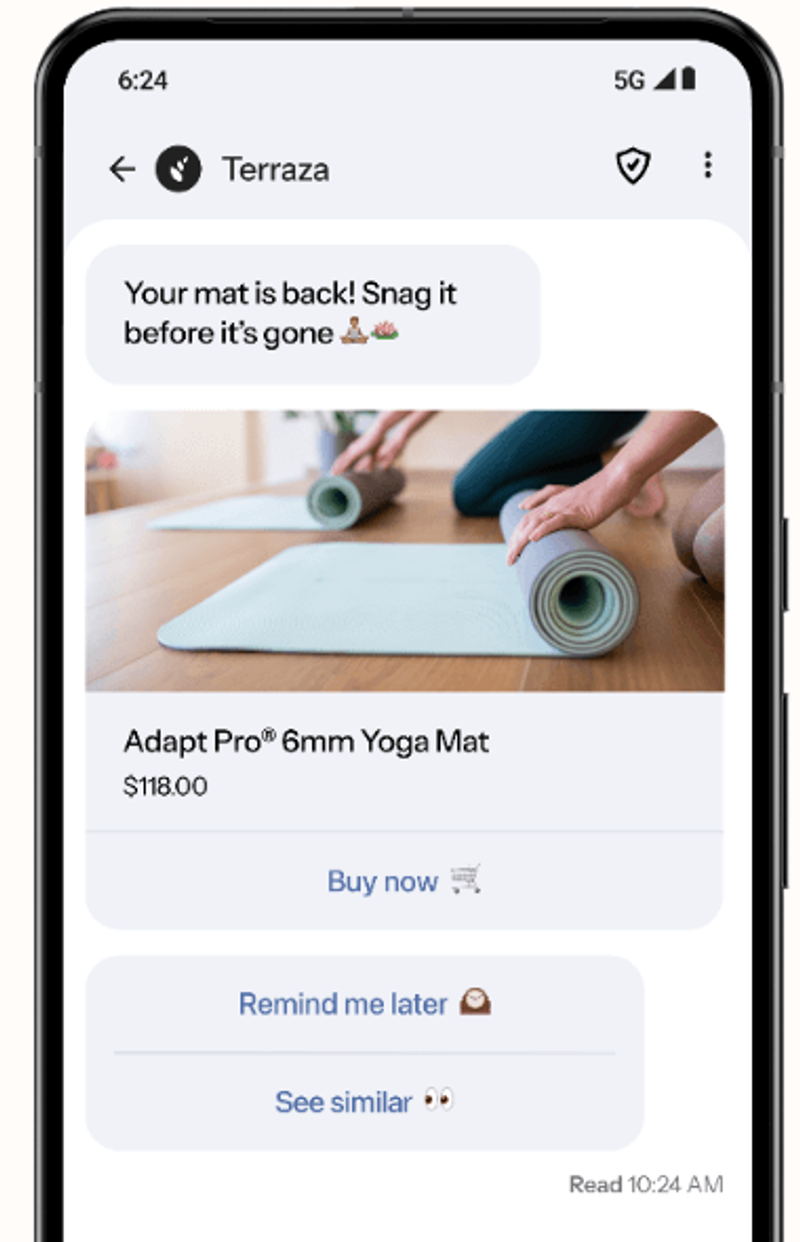
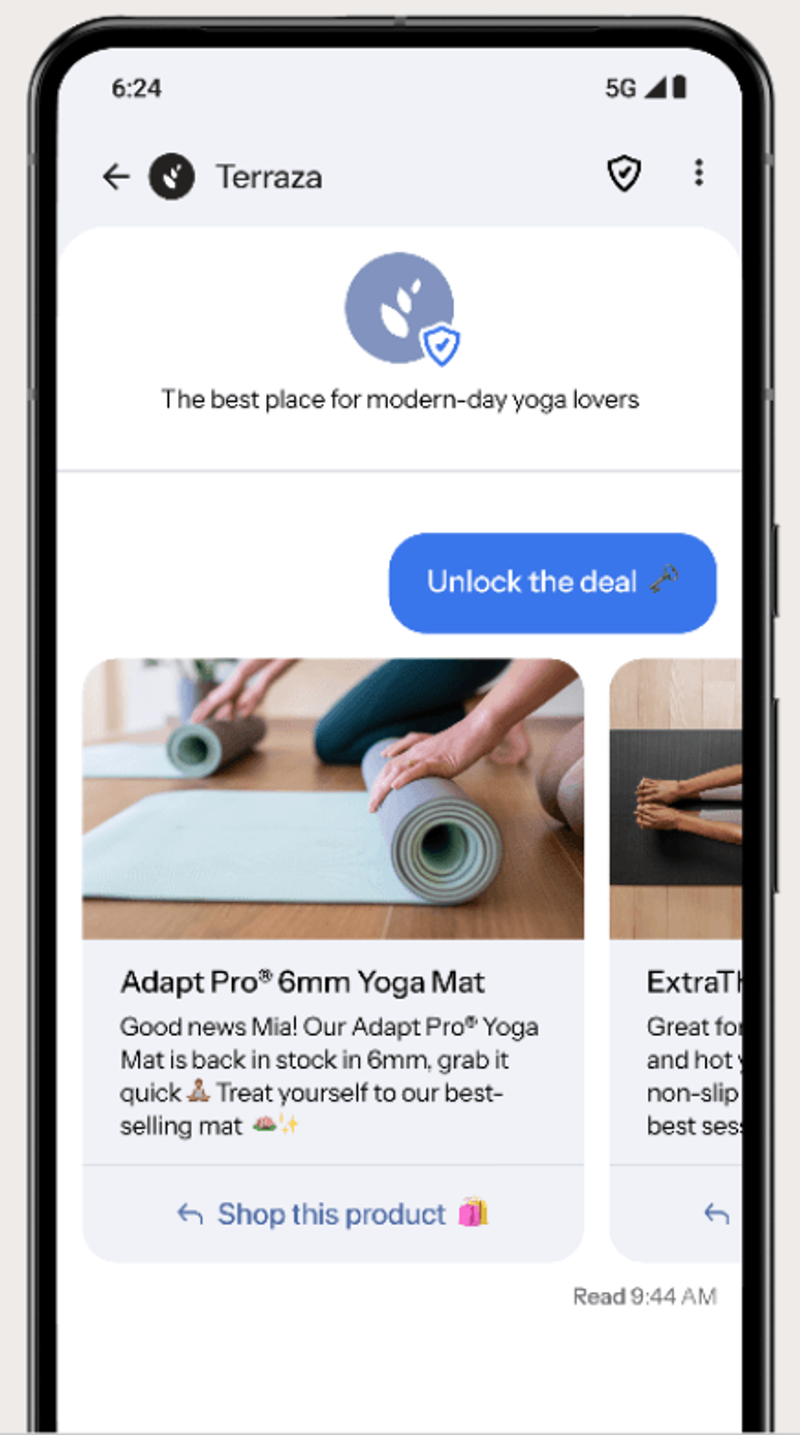
With back-in-stock messaging, someone raised their hand for this exact product and asked you to tell them when it returned. Your only job here is removing friction between the alert and the buy, and RCS removes it two ways.
First, the verified business profile: the message arrives with your name and logo on it. There's none of the "Wait, is this real?" hesitation that kills urgency on an unknown number, which matters most on exactly this kind of time-sensitive alert.
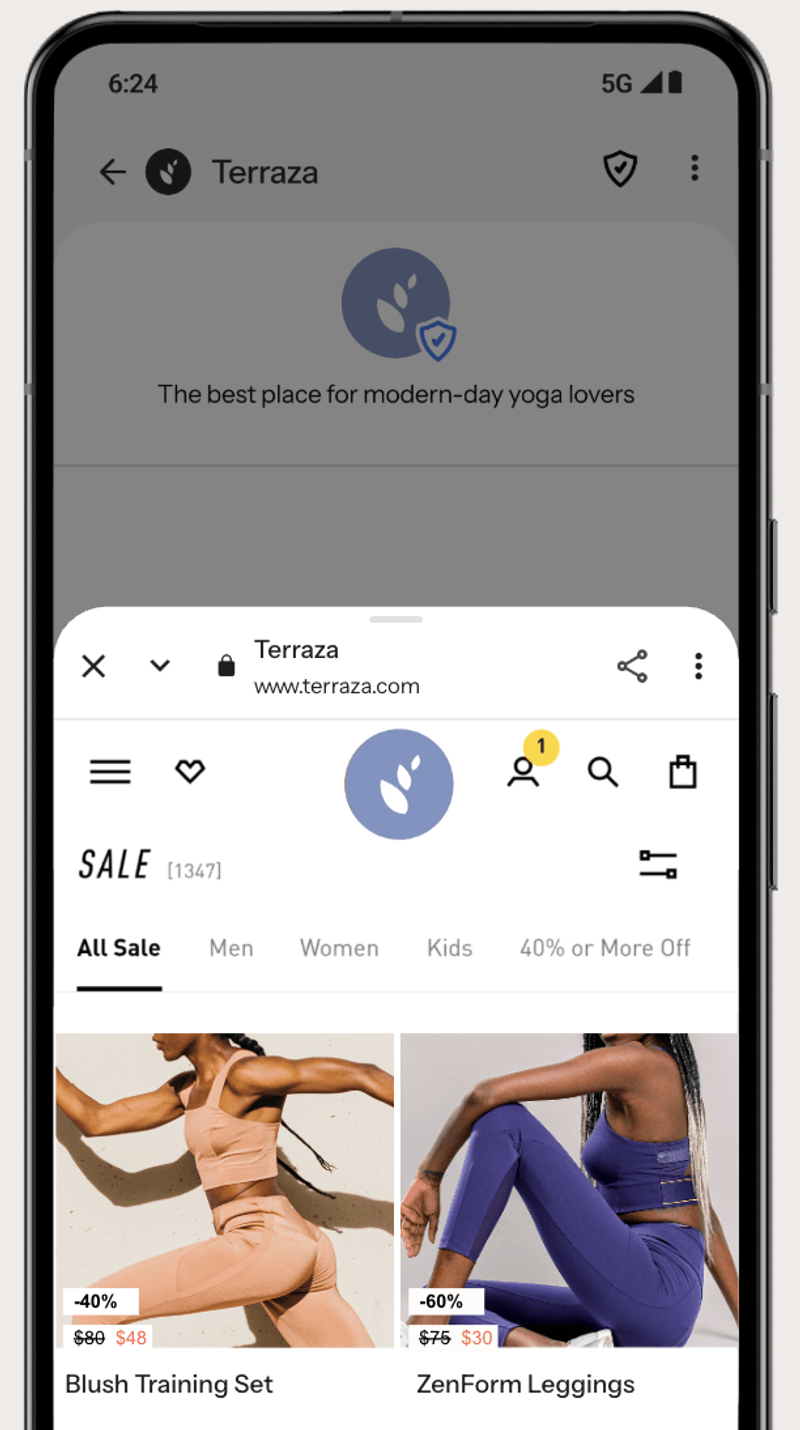
Second, the visual: a rich card shows the restocked item with a "Shop now" button right there, so the customer acts on the message instead of tapping out to hunt for it again. When the demand already exists, every step you remove converts, and a verified, visual restock alert removes most reservations.
4. Post-purchase up- and cross-sell flows: turn a thank you text into a shop now moment
The window right after a purchase also signals high intent. Someone who just bought decided to trust you with their money, and most post-purchase text messages burn that goodwill on a flat "Thanks for your order.”
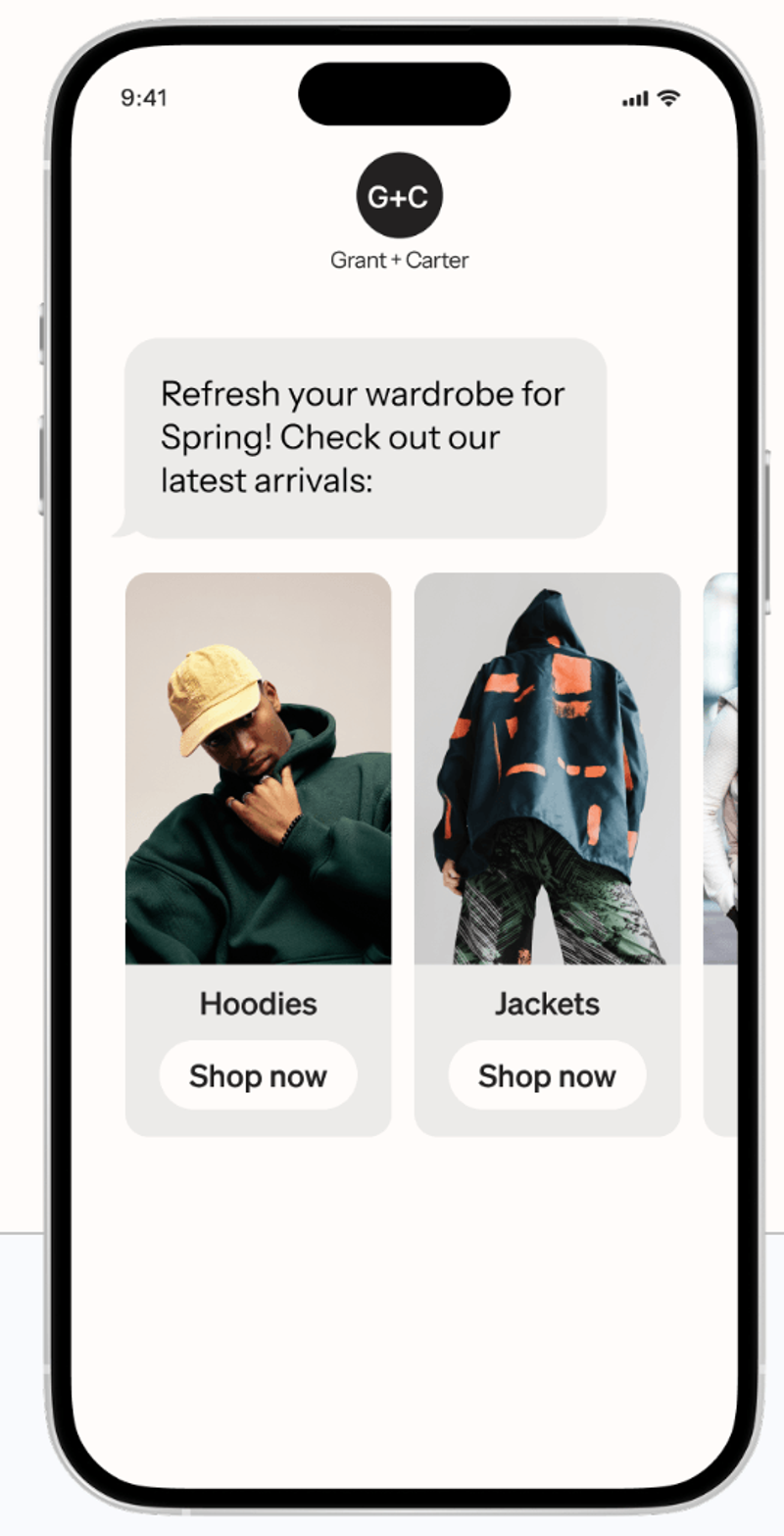
A carousel turns the thank-you into a merchandised cross-sell: a recommendation feed of products the customer is likely to want next, each card with its own "Shop now" button. It's the in-thread version of "Customers also bought," delivered at the one moment someone’s most likely to be receptive to it.
5. Win-back flows: show lapsed customers what they've missed
A customer who hasn't bought in months has drifted. The reason a plain "We miss you" text message fails is that it gives them no reason to look. It's all sentiment, no substance.
What actually pulls a lapsed customer back is news: the stuff that's changed since they last paid attention. This is a job for a carousel because there's real ground to cover.
A win-back flow can serve a feed of your newest arrivals or bestsellers since someone left, each card with a shoppable "Here's what's new." Instead of an empty guilt trip, a dormant customer gets a quick, visual catch-up on what they've been missing.
The verified business profile earns back attention, too: people are more likely to open a message that arrives with your name and logo on it than one from an unknown number, which matters most for someone who's already tuned you out.
Win-backs are a lower-frequency, higher-stakes send, which makes it a sound place to spend on the richer format.
6. Quiz-driven personalized carousels: turn one question into a shoppable carousel
This is the most advanced play on this list, and the one most brands won't think to build, because it connects two different systems. If your sign-up pop-up collects zero-party data beyond contact information, you can do this.
Let’s say you're asking, "What are you shopping for?" The answer tells you exactly what this person wants before they spend a cent. RCS lets you act on that information immediately.
Instead of dropping every new subscriber into the same generic welcome flow, route them by their form response into a flow whose carousel is built from that exact collection. Someone who taps "couches," for example, gets a first message that's a swipeable carousel of different couches. One question on the pop-up becomes a fully personalized, shoppable sequence in the thread.
This requires a bit more set-up than the others: the pop-up question has to feed a profile property, and the flow has to branch on that property into collection-specific carousels. But what makes it work is that the personalization is grounded in something the customer told you, not something you inferred from their behavior. The carousel reads as relevant instead of creepy, and relevance is what earns the tap.
7. Media cards: showcase multiple products at once
Email has always been able to introduce a whole new collection in one send. SMS never could, because a single text message can't showcase a range of products, and even MMS was never going to carry the same weight as a well-designed email campaign.
Jemma Sears, digital marketing manager at Kulani Kinis, points out that "SMS was only ever supplementary to our email campaigns for new collection launches. RCS changes that.”
"RCS now allows us to showcase various products through rich media, helping us to increase product discoverability and also allowing us to provide the customer with a more complete introduction to our new product ranges," Sears explains.
RCS allows us to showcase various products through rich media, helping us to increase product discoverability and allowing us to provide the customer with a more complete introduction to our new product ranges.
RCS also closes the creative gap between channels by letting Kulani Kinis "match the creative we showcase on every other channel," Sears says. That way, a launch looks and feels consistent everywhere a customer sees it, resulting in what Sears calls "a more impactful launch and true omnichannel strategy."
The lift shows up in the numbers. On a recent US collection launch, SMS/MMS drove $1,218.30 in revenue across 3 recipients, while RCS drove $9,868.41 across 49 recipients.
"While SMS had the higher RPR, RCS had significantly higher cut-through," Sears notes. Zoomed out to the last 6 months, RCS has outperformed the SMS fallback with a 60% higher conversion rate and 64% higher revenue per recipient.
8. Separate product CTAs: shorten the path to purchase
"Attention spans are getting smaller and smaller," says Sears, "and a simple inconvenience in a customer journey can be what stops a potential conversion in its tracks."
Linking a product to a general collection page or the homepage means the customer doesn't land where they expected, and that's often enough to lose the sale. That mismatch "creates friction between them and the purchase," Sears says, and with plain SMS, sending everyone to one generic link "was almost the only option" for marketing multiple products.
RCS removes that constraint. With separate, product-specific CTAs, brands get "a logical and linear path to purchase for the customer, reducing friction," Sears says. Critically, she adds, "with the use of multiple cards and CTAs, you're no longer reducing product discoverability."

Related content