4 BFCM lessons hiding in this year's Memorial Day text message campaigns
Generated by Klaviyo AI
A client strategy director at ebusiness pros teamed up with three Klaviyo Community Champions to review Memorial Day text message campaigns from four brands — Rooftop Cinema Club, Kulani Kinis, Technoblade, and a Kulin client — as a stress test ahead of BFCM 2026. Each team ran a different experiment (an A/B copy test, a mistake-and-recovery send, an RCS channel switch, and a WhatsApp/SMS market split), and the piece pulls a specific, non-obvious takeaway from each before tying them together around one idea: the send that performs best is the one aimed at wherever the offer's real constraint sits.
- Lead with a hook, not the discount: Rooftop Cinema Club's A/B test found that a curiosity-driven opener beat a straight-to-the-discount message by a 30.94% lift in click rate, and its final-day, deadline-driven send generated roughly 4x the orders and revenue of the initial launch send.
- A fast, human recovery can outperform the original: After Technoblade's launch text went out with a broken link, a playful correction sent 16 minutes later beat the original on every metric (252 orders vs. 191, and a 15.97% vs. 11.68% click rate), though unsubscribes on the correction were more than 3x higher.
- Switching to RCS can separate two problems classic SMS can't tell apart: Kulani Kinis found that RCS read receipts kept showing steady reach (open rate holding near 9%) even as click rate fell by more than half across their sequence, revealing that the decline was fatigue rather than shrinking audience — a distinction plain SMS reporting couldn't have surfaced.
As the client strategy director at ebusiness pros, an email and SMS marketing agency for DTC and CPG brands, I developed a hypothesis this spring while my team started building Black Friday Cyber Monday (BFCM) plans: text message marketing as we know it may look different by the time we get to November.
I teamed up with a few fellow Klaviyo Community Champions to see what the holidays leading up to BFCM, particularly Memorial Day, could tell us ahead of time. I looked at send-level data outside of BFCM because that's when teams take risks they'd never try during peak season.
Ahead of BFCM 2026, I asked 3 other teams to open up their Memorial Day text message marketing results, and pulled one from my own roster too. Here’s what they sent, what they learned, and what they're changing before Q4.
What made these tests worth running
None of us treated Memorial Day as a standalone promo. We ran it as a rehearsal, which is why the details matter more than the top-line numbers.
For Rooftop Cinema Club, an experiential entertainment company reimagining the moviegoing experience through open-air cinemas across major cities in the US and UK, that meant building the deadline into the offer itself, not just the copy.
The 15% discount only worked on films screening during the Memorial Day weekend window, so, as Kara Monroe, head of digital marketing, put it, that meant "the deadline send was the biggest lever, not the launch."
For Kulani Kinis, an Australian swimwear brand known for their bold prints and seasonal collections, visibility mattered more than clicks. Jemma Sears, digital marketing manager, said RCS read receipts helped her team "better understand if we were achieving a decent cut-through on the channel," something an SMS-only send never showed her.
For Marika Tselonis, director of retention at Kulin, a performance marketing agency for DTC brands specializing in paid and retention, the test was about picking the right channel for each market: WhatsApp for UK and German subscribers and SMS for US subscribers, launched at the same time so she could compare them directly.
1. Build your last-chance send like it's the main event
Monroe ran Rooftop Cinema Club's Memorial Day program as a live rehearsal for BFCM: an A/B copy test, a full-list launch, and a last-chance send on the final day of the sale.
The copy test
Rooftop Cinema Club tested two SMS approaches at a 30% test size across 8 city subscriber lists, sent on Friday, May 22 at 2 p.m.:
- Variation A opened with a curiosity hook: "Stop scrolling: here are your Memorial Day Weekend plans," before revealing the 15% code.
- Variation B skipped the hook and led straight with the offer: "15% off with code MEMORIAL15," plus the hard expiration date.
Variation A won with a 95.3% win probability and a 30.94% lift in click rate over Variation B in the test window (4.07% vs. 3.11%). Lifetime click rates on the same two sends later settled at 4.87% and 4.50%, which is worth flagging on its own: the number your A/B tool shows you at decision time isn't always the number you'll report at the end of the month. Decide which one you're being held to before someone asks.
That result cuts against a pretty common instinct in SMS marketing. Because a text message is so short, the thinking goes: the discount should be the first thing in it. Lead with the number, then get out. Variation B did exactly that, and it lost to a send that spent its first line on a reason to keep reading.
The offer mechanics
The code only worked on films screening during the Memorial Day weekend, Friday–Monday. Subscribers couldn't buy early or late and still get the discount. That constraint is what gave the last-chance send its pull.
The results
After the test, Rooftop Cinema Club sent the winning copy to the rest of their list that same Friday at 8 p.m. Combined with the test cells, the launch delivered 47,864 texts, 44 orders, and $2,438.06 in revenue.
Then came the last-chance send on the final day of the sale at 6 p.m., in the hours before the code expired. Sent to the same 43,553 subscribers as the launch, it pulled a 6.42% click rate, 140 orders, and $8,214.12 in revenue. That’s about 4x the launch send's orders and revenue, at the same $59 average order value (AOV).
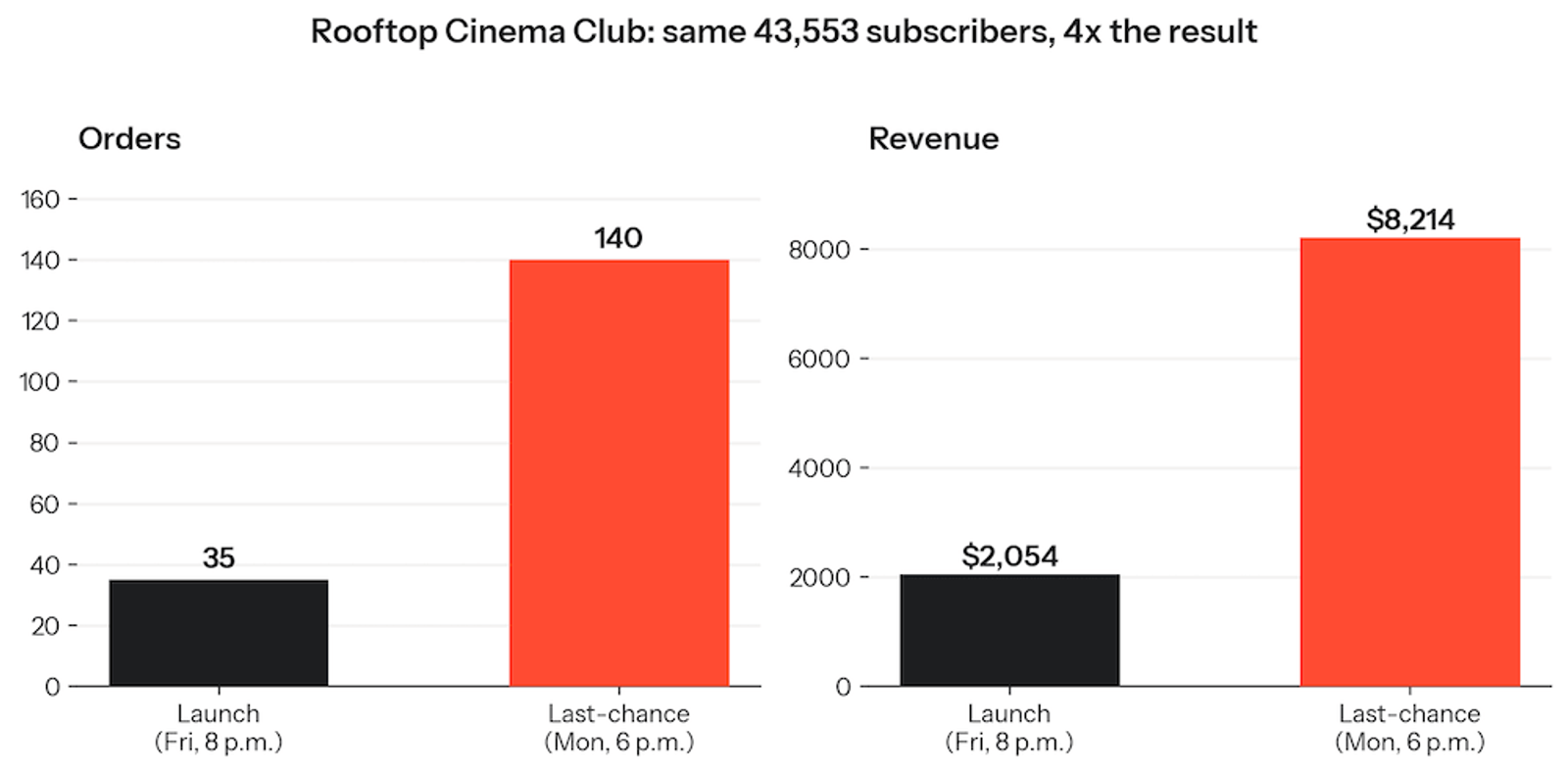
Note that Rooftop Cinema Club sells tickets at fixed prices, so basket size doesn't move the way it would for a brand selling a mix of low- and high-ticket items. With AOV effectively locked by the product itself, a 4x jump in revenue could only have come from one place: more people buying, not bigger baskets. 105 more people bought tickets because Monday at 6 p.m. was the last chance to.
Across the full program, that one send drove roughly 77% of the $10,652.18 in total revenue, more than 3x what the entire launch campaign earned on its own.
The takeaway for BFCM
If your offer has a real, structural deadline, plan the send around that deadline as a primary revenue driver, not as the thing you write the night before because you should probably send something.
2. Turn a mistake into the moment people remember
At ebusiness pros, one of my favorite Memorial Day sends wasn't supposed to happen at all. It started as a mistake.
The anniversary promotion
We ran an anniversary promotion for Technoblade, a company that sells merchandise inspired by their late founder's love of gaming to a devoted community that spots generic copy instantly. The promo, The Art of War: Technoblade Edition, was a limited-edition book-and-merch collection timed to the anniversary, with preorders closing a few weeks later. No discount, just an exclusive, limited run. 6 SMS sends carried it.
But, the first send included the wrong link. We sent out messaging with the correct link just minutes later.
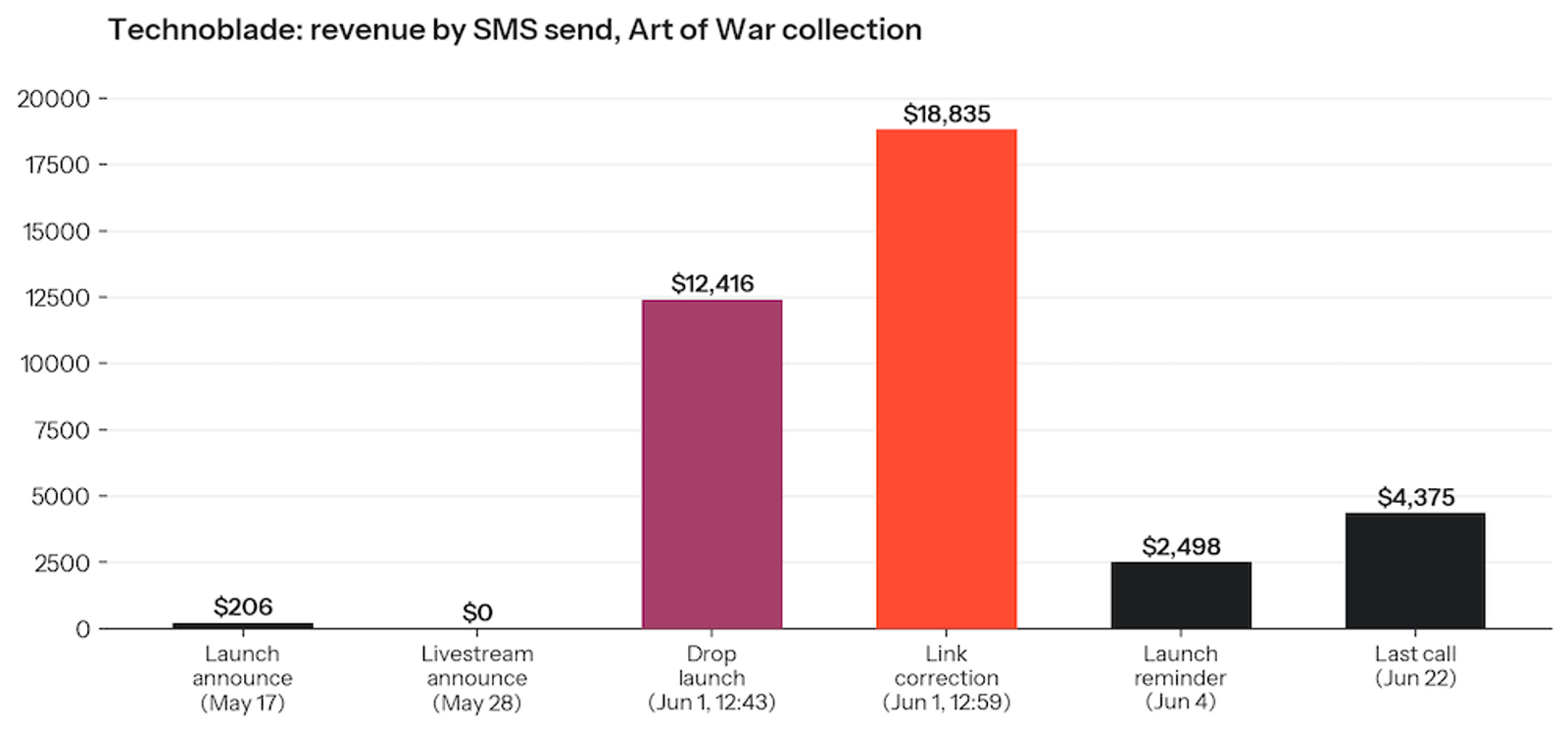
Two things stand out before the mistake. The first two sends, a launch and livestream announcement, made just $205.50 combined on 23,620 deliveries, which looks like a failure on a revenue dashboard. But they hit click rates of 11.97% and 7.30%, the highest of the sequence, because there was nothing to buy yet and every click was pure intent.
That taught us to judge teasers on click rate and list warming, not revenue.
Then came the mistake: the launch text message went out on the brand's anniversary morning with the wrong link.
The crisis and the recovery
Something will go sideways during your promotion, so the question isn't how to avoid it. It's what your recovery looks like when it does.
We sent a follow-up 16 minutes later owning the mistake outright: "YEESH. Human error. You want this link, nerds," followed by the correct link. We crafted it to be playful and human, not a canned apology.
The results
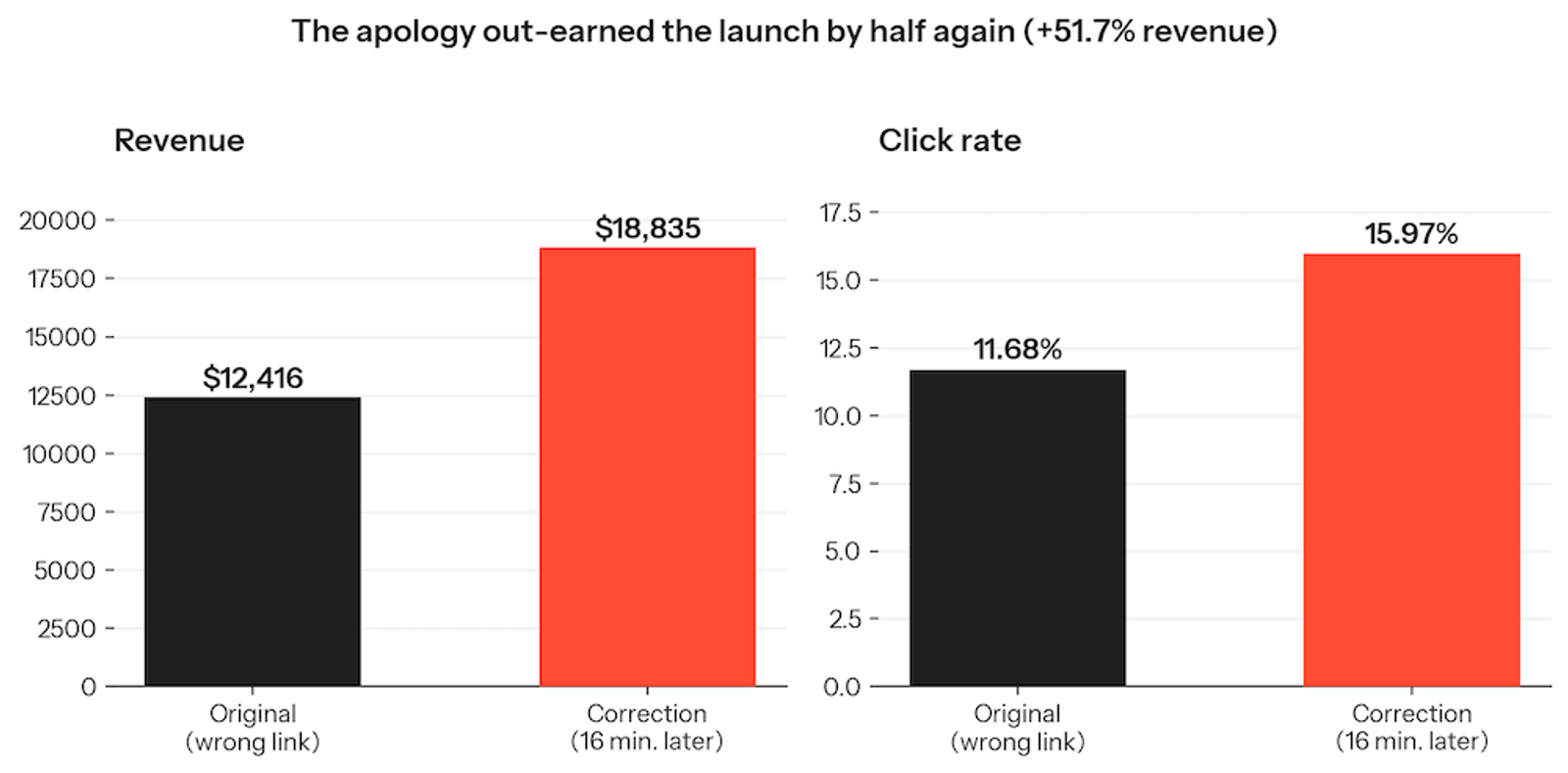
The correction beat the original on every metric: 252 orders vs. 191, $18,834.80 vs. $12,415.76, and a 15.97% click rate vs. 11.68%, on nearly identical deliveries. The community talked about it on Reddit for days. A recovery handled well is one of the few moments your audience sees through your brand to the people behind it.
Of course, it wasn't free. Unsubscribes on the correction hit 0.37%, over 3x the original's 0.11%. A fast, human correction can beat the thing it's correcting, but it still costs something to send.
Two things made the turnaround possible: a brand voice documented well enough to improvise under pressure, and someone who can approve copy in minutes, not through a ticket queue. A slow approval path means a slow recovery.
SMS generated $38,328.88 for the drop, about 22% of the collection's total attributed revenue. Roughly 70% came from returning customers and 30% came from first-time buyers, which tracks for a discount-free, preorder-only drop. SMS revenue was up 168% YoY, and revenue per recipient still climbed 3.6% even as the list roughly doubled.
A recovery handled well is one of the few moments your audience sees through your brand to the people behind it.
The takeaway for BFCM
When you handle it with personality, a flawed send can outperform a flawless one, as long as the fix goes out fast and sounds like your brand instead of a legal team.
3. Use RCS to see which segments are actually paying attention
For Kulani Kinis, Sears tested a channel switch, moving from classic SMS to RCS for the swimwear brand's Memorial Day sale sequence.
The sequence
Kulani Kinis sent 4 messages:
- A 24-hour sale teaser
- A sale-live announcement that excluded anyone who'd already redeemed the code
- A halfway-point reminder
- A 24-hours-left send to their regular segments
The offer was the same across all 4 sends: 20% off sitewide, no code required.
The results
Total revenue hit $43,061, up from a 3-message sequence in 2025 that drove click rates between 2.23% and 6.66%. The two reminder sends alone, the ones most likely to get cut from a calendar for looking redundant, carried about 41% of the sale's revenue between them.
That's important if you sell anything people have to think about before they buy: a customer isn't deciding whether to spend the money. She’s deciding between colors and whether her size from last summer still fits.
Unsubscribes ticked up slightly (0.61%, 994 unsubscribes) vs. 2025 (0.54%, 950 unsubscribes), which Sears' team reads as typical for a heavy sale period.
The read that classic SMS couldn’t provide
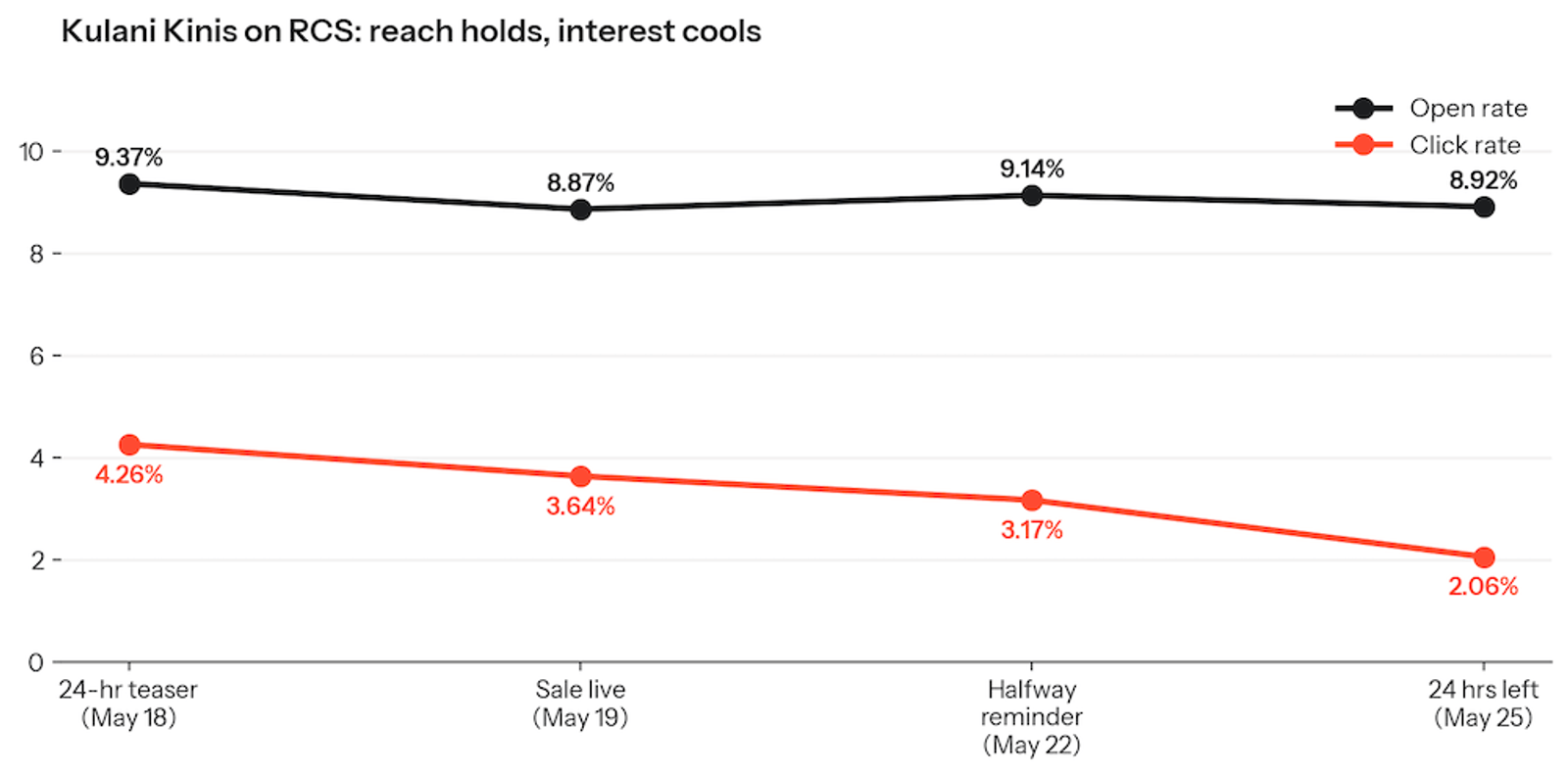
Look at the two lines. Open rate barely moves across the sequence, staying in a tight band around 9%. Click rate falls steadily, from 4.26% down to 2.06%, cut by more than half. On classic SMS, that decline is the only thing Sears would have seen, and it would read like a channel wearing out.
RCS told her which story was actually true: reach held, interest declined. The same share of her audience opened every message. Clicks fell due to messaging fatigue. Those are two different problems with two different fixes, and SMS reporting alone wouldn’t be able to diagnose the right one.
Since they use image cards in RCS, they were able to add fresh creative to keep the campaign interesting and showcase different products as opposed to plain text SMS.
Sears did flag real friction in adopting RCS as a channel: drafts disappearing mid-build with no warning, and no way to send herself a test message on RCS because her team doesn't have a US test number to send from. None of that stopped the test, but it cost time she had in May that she won't have in November.
RCS also carries roughly a month of approval lead time before you can send anything at all, so whichever channel you're evaluating, the decision needs to happen well ahead of the promotion it's meant to power.
"I will definitely be leaning into RCS over plain SMS for 2026 BFCM," Sears says. She’s expecting RCS to maintain higher cut-through and engagement rates due to more varied content and the ease of showing top-selling products. Her team is considering adding a second RCS message during the BFCM sale if the timeline allows it.
I will definitely be leaning into RCS over plain SMS for BFCM 2026.
The takeaway for BFCM
If you're already running a reminder-heavy sequence, RCS open data is worth the switch on its own. It tells you whether a falling click rate means people stopped seeing your messages or stopped caring, and those explanations need completely different responses.
4. Let the market decide your channel
Tselonis didn't run WhatsApp and SMS head-to-head in the same market. WhatsApp went to Germany and UK subscribers, SMS went to US subscribers, matched to where each channel already performs best. Four sends, spring-summer 2026: an outdoor collection launch, a Memorial Day event, a sitewide sale, and a last-chance send.
The market split
Across 4 sends timed to a spring–summer sale window—an outdoor collection launch, a Memorial Day event launch, a sitewide sale launch promoted only through owned channels, and a last-chance send—click rates varied by market and channel. WhatsApp adoption is high in Germany and UK, SMS is the default in the US. Rather than force one channel everywhere, Tselonis leaned into that.
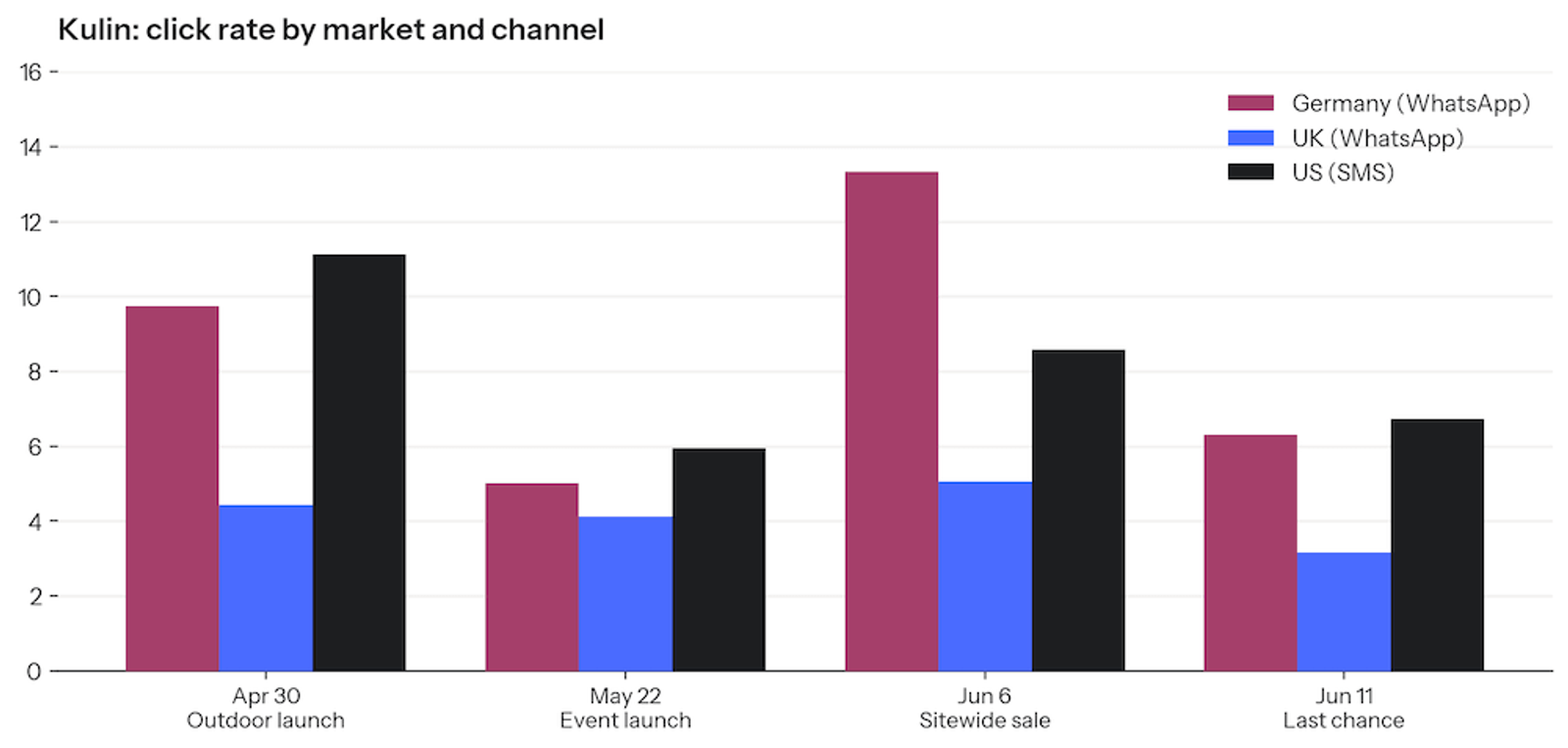
Germany's WhatsApp clicks ranged from 5% to 13.33%, the UK's WhatsApp clicks from 3.17% to 5.06%, and US SMS clicks from 5.94% to 11.11%.
One honest caveat: this isn't a controlled test of WhatsApp against SMS. Channel and market moved together, so we can't say WhatsApp beat SMS, or vice versa. What we can say: each market held up well on the channel it was given. On sample size, Tselonis' US SMS sends went to roughly 100 recipients each, so at that scale a single additional click moves the percentage by a full point. Read these as direction, not precise measurement, especially against Rooftop Cinema Club's or Kulani Kinis' much larger audiences.
The results
Since the Spring 2025 launch, the brand’s WhatsApp list has grown to 943 subscribers across the UK and Germany, compared to 159 for SMS in the US, on the same start date. Unsubscribe rates held at 0% across every WhatsApp send in this window.
Tselonis credits the faster list growth to market fit rather than effort: "WhatsApp is where UK and European audiences actually want to hear from brands," she says.
WhatsApp is where UK and European audiences actually want to hear from brands.
The promotional arc mattered as much as the channel choice. Tselonis’ client sold the same collection twice: first at full price on April 30, when the newness of the collection was the draw, then at a discount on June 6 through an owned-channel-only sale, promoted solely by email and mobile messaging.
That's two complementary offers aimed at two different buyers of the same inventory: the segment that buys because something is new and wants it first, and the segment that likes the product fine but was never going to pay full price. Running them separately monetizes the same inventory twice instead of handing a discount to people who would have bought anyway.
Kulin was an early adopter of Klaviyo WhatsApp, running it through BFCM 2025. The early-access campaign hit click rates above 21% in both the UK and Germany, about 4x Tselonis' normal rates, and repeating it is her top priority for BFCM 2026.
This year, Tselonis’ plan involves a full sequence across all 3 markets, a dedicated early-access moment for WhatsApp, and a bigger push to grow the WhatsApp list before peak season. "It's worth asking whether you're using a channel because it's right, or just because it's familiar," she says.
The takeaway for BFCM
If a meaningful part of your list sits outside the US, don't assume SMS is the default. Check where that audience already spends its time messaging, and test against it early enough to have real numbers before November.
Read Tselonis’ deep dive on WhatsApp vs. SMS
The pattern across experiments: find where your offer's constraint is actually real
Put the 3 promotions with a discount and a deadline side by side and something beyond the obvious emerges.
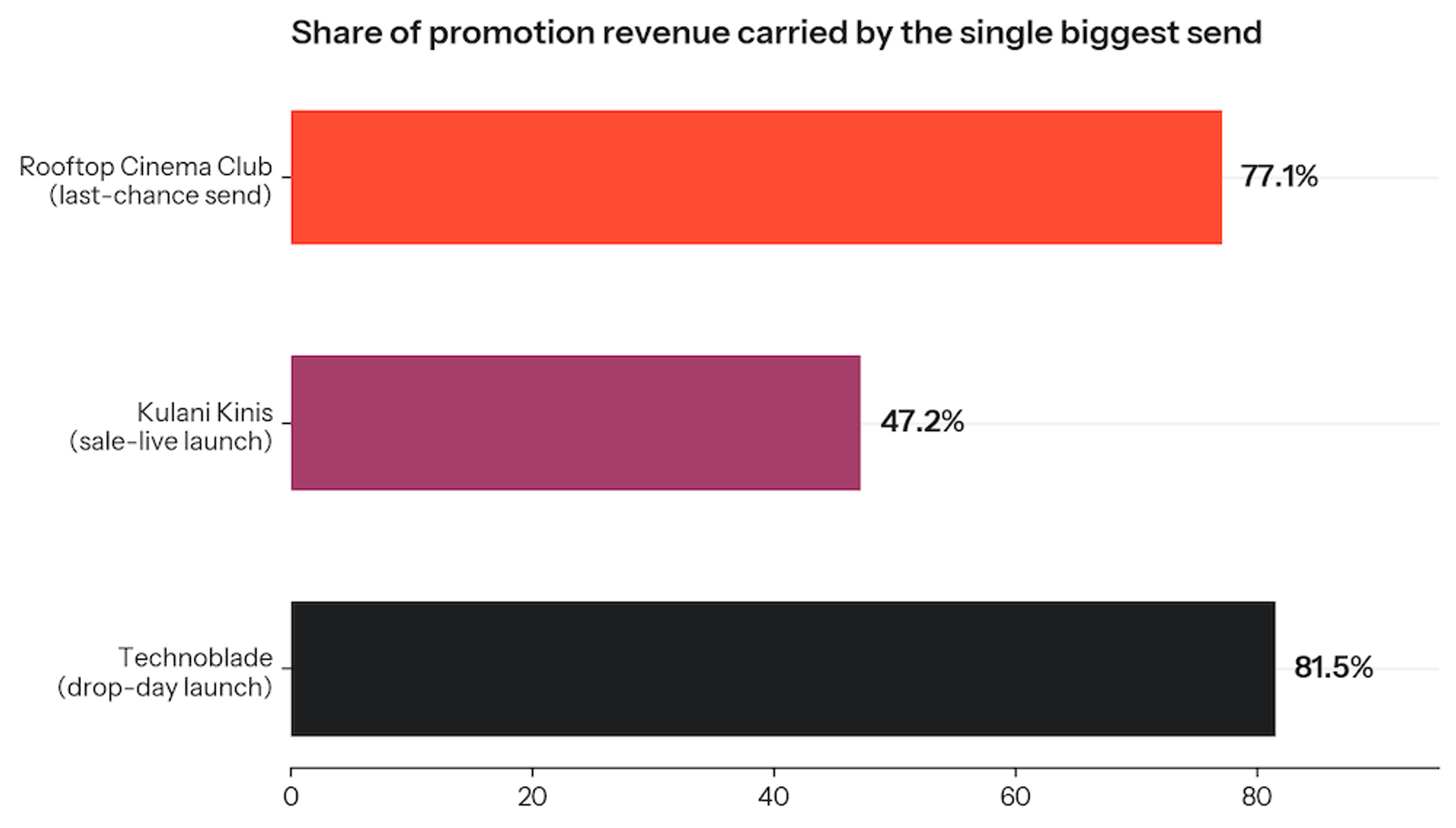
- Rooftop Cinema Club's last-chance send carried 77.1% of their promo revenue.
- Kulani Kinis' sale-live launch carried 47.2%, with its deadline send trailing at 23.3%.
- Technoblade's drop-day launch carried 81.5%.
The results
The tidy explanation would be that discounts build urgency toward a deadline while scarcity peaks at the drop, but that story survives only two-thirds of our examples. Kulani Kinis ran a discount with an end date too, same as Rooftop Cinema Club, and their deadline send came in third, not first.
So, it isn't discount vs. scarcity. It's where the constraint in the offer is actually real.
Rooftop Cinema Club's discount only worked on films screening that specific weekend. You couldn't buy early, and you couldn't buy late. The constraint sat at the closing end of the offer, so every hour that passed removed something from the customer, and the final-day message harvested days of accumulated pressure.
Technoblade's constraint sat at the opposite end. The collection dropped on a date the community actually cared about, and the whole promotion was built to converge on that morning. The constraint was real at the open, so the peak was the open, and everything after it was a declining tail.
Kulani Kinis' constraint was a calendar range on a sitewide discount. Nothing structural stopped anyone from buying on Tuesday instead of Sunday, so the launch novelty carried it and the reminders did steady work. There was never a single moment where something was taken away.
The takeaway for BFCM
Before you decide on a channel or a send count, ask where your offer's constraint is actually persuasive, and make sure your best message is pointed at it. If your deadline is just a date you picked, and nothing about the offer changes when it passes, your list can tell. No send schedule can fix that.
When you put the results of all these tests side by side, one truth holds across every one: the channel mattered less than what each team was willing to test on it, and the send that carried each promotion followed the offer's real constraint, not the channel it ran on.
None of us waited for BFCM to find out. You still have back-to-school season, Labor Day, and Halloween before peak season starts. Use them to test the send, channel, or recovery plan you're unsure about, so whatever you learn this summer doesn't cost you in November.
Related content