Use Halloween to sharpen BFCM
Generated by Klaviyo AI
The article explains how to use Halloween email and SMS campaigns to collect customer data, test discount strategies, and refine messaging ahead of Black Friday Cyber Monday. It highlights six examples that show how social proof, segmentation, urgency, and SMS bundles can improve Q4 performance and personalization.
- Leverage social proof: Feature reviews instead of or alongside discounts in Halloween campaigns to build trust and set up stronger product promotion for BFCM.
- Collect actionable data: Design Halloween interactions, like playful CTA choices, to gather zero- and first-party data that informs more targeted segments later in Q4.
- Refine brand and urgency: Use Halloween to test bolder creative, countdown timers, and urgency tactics that reveal which subscribers respond to storytelling versus time-limited offers.
- Test discount strategies: Experiment with targeted offers and tiers, such as BOGO-style promotions, to identify effective discount levels and audiences before BFCM.
- Reward SMS subscribers: Offer Halloween-themed early access bundles via SMS to capitalize on high-intent subscribers and accelerate planned purchases.
If your brand sells makeup, clothing, or food and beverages, your Halloween marketing strategy may be a given. But there’s plenty of spend to go around if you don’t fit neatly into these categories.
Even more important, Halloween is a great testing ground for the most lucrative shopping event of the year: Black Friday Cyber Monday (BFCM). And now, the shift towards autonomous marketing means a small team can have a more successful and less stressful October.
Here are 6 Halloween marketing campaign ideas with real examples from brands.
Align your marketing campaigns with relevant holidays and year-round celebrations.
Get your marketing campaign calendar1. Collect Halloween reviews to build social proof for BFCM
According to Klaviyo’s 2025 Future of Consumer Marketing Report, reviews and feedback are more influential to a first purchase than competitive pricing and discounts.
So, before you start discounting for your Halloween campaign, consider leaning more heavily on product reviews instead. This strategy, of course, depends on whether you already have good social proof for the product you intend to push during BFCM.
Collect reviews year-round with automated request flows, which incentivize customers to review products they recently purchased and can even encourage reviews that contain specific details. That way, you always have a library of holiday-relevant reviews to pull from for your Halloween campaigns.
When you’re ready to deploy those reviews as part of any campaign, that’s easiest when they live in the same CRM that houses your customer data. That way, your social proof can line up with any one customer’s browsing or purchase history.
If your products aren’t an obvious Halloween buy, use the holiday to offer a discount in exchange for a review on a product you plan to feature during BFCM. Your BFCM self will thank you later.
Halloween marketing example: Happy Wax uses reviews to highlight product benefits
Happy Wax, a brand that sells wax warmers and candles, uses their Halloween marketing to feature social proof from a few satisfied customers. The first review in the series is specifically Halloween-themed, which means the brand made the effort to collect social proof that fits a purpose.
To collect this kind of social proof, you can add custom questions to your review requests. A question like, "How did this product help you celebrate Halloween?" when a customer bought from a Halloween discount can help your customers get specific with their review.
Subject line: Get Spooky with BLOOD MOON 🌝
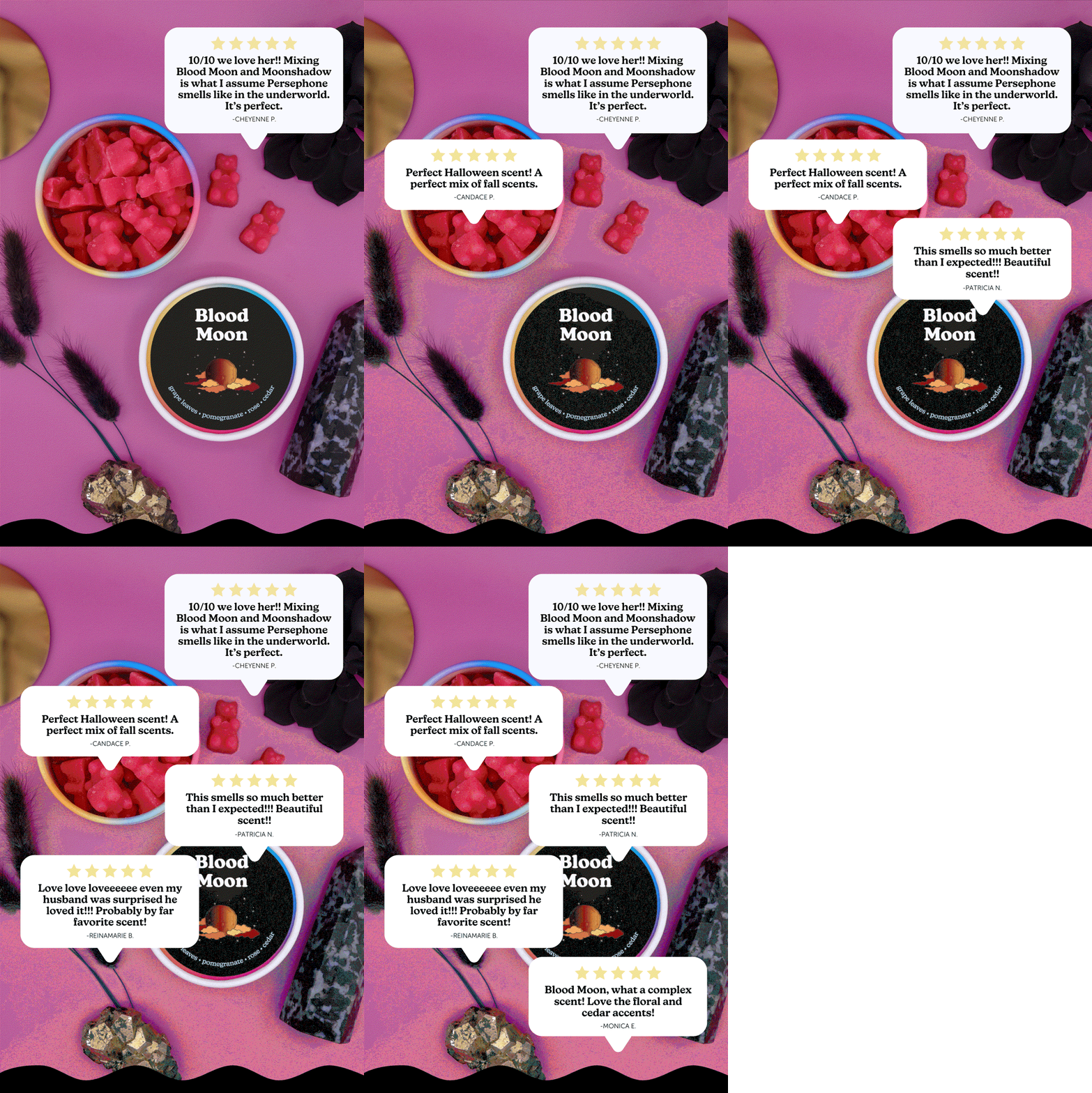
Image source: Milled
2. Answer Halloween shopper questions with an AI customer agent
Halloween traffic brings a wave of questions: what will ship on time for the party, what size to order, and what costume elements pair with what.
Left unanswered, those questions can turn into abandoned carts. But when you answer some of these simple questions at scale, you can turn them into holiday revenue more quickly.
For example, a customer might text about a recent order days before Halloween to ask whether the product will ship in time for their party. An AI customer agent can pull from your brand’s shipping policy and customer data to personalize an answer, no matter what time they reach out.
Halloween marketing example: Naked Wardrobe answers customer questions with an AI agent
Shapewear and streetwear brand Naked Wardrobe wanted to create a concierge experience for their website. The brand was using AI for customer service on their site, but it could only recognize and quickly resolve a few pre-set queries. It also had limited contextual information on customers.
Now, Naked Wardrobe is using an AI customer agent that can answer questions like a skilled salesperson. Trained on their website and documentation, it can handle post-purchase service queries about order status and returns, as well as pre-purchase product recommendation requests.
In this Halloween marketing example, Naked Wardrobe’s AI agent recommends an outfit for a potential customer looking for warm and witchy Halloween costume options.
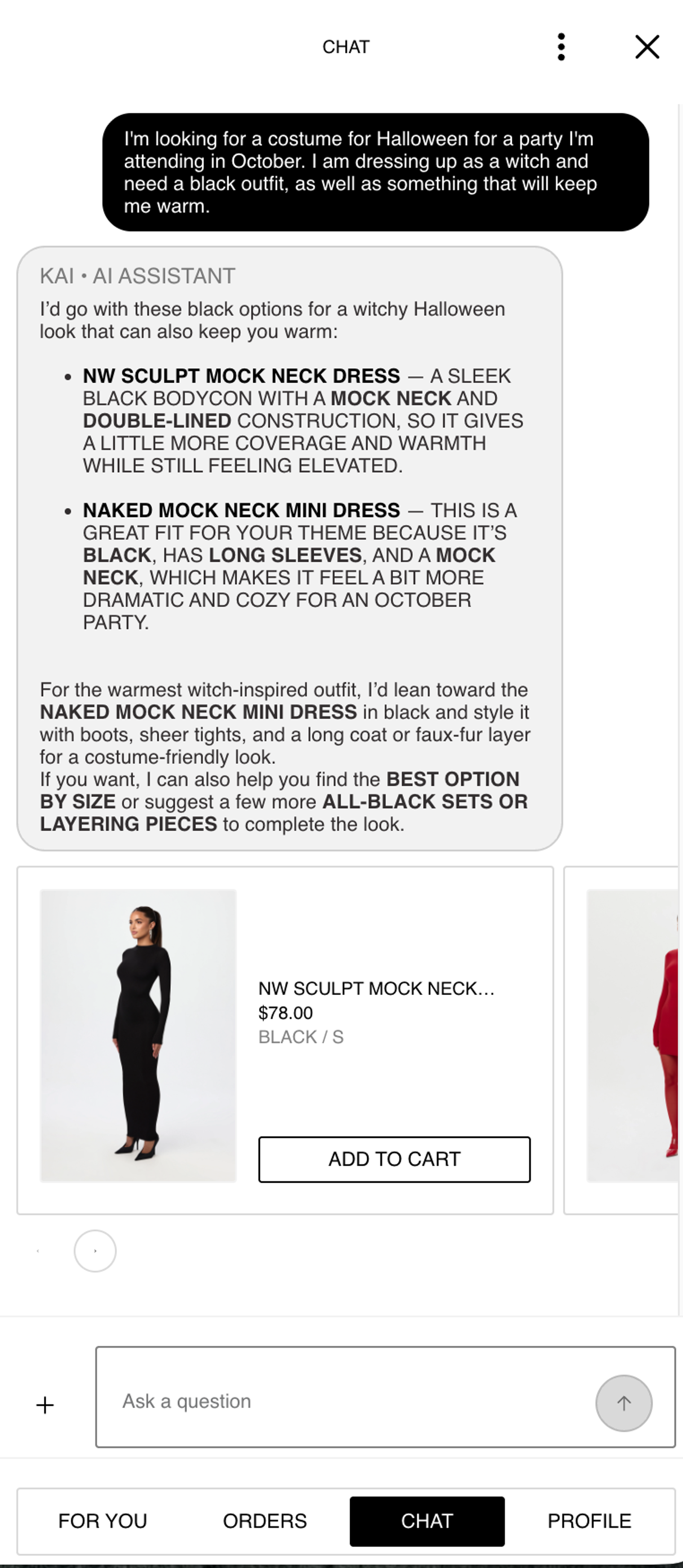
Image source: Naked Wardrobe
When people click on one over the other, they might see a creepy image. Or a funny one. Or a cute one. It’s a Halloween Choose Your Own Adventure that ends in delight—and, most importantly, a vibe check on the brand’s audience.
3. Draft Halloween campaigns faster with an AI marketing agent
If you don't want to compete on price with heavy discounting, increasing your top-of-mind brand awareness may be your best bet ahead of BFCM.
That could mean testing bolder versions of your brand voice. Halloween is a great holiday for this, since it’s cheeky to begin with. With an AI marketing agent, you can describe the tone you want in a prompt, and it drafts the content, builds the customer segments, and determines send times across channels.
Here are some example prompts to start with:
- Test a bolder voice. “Write a Halloween email for subscribers who have browsed our skincare category but not purchased in the last 60 days. Position our bestselling serum as a potion. Be dry and a little witchy, no forced puns. Lead with the product benefit and one clear CTA, then draft a text message follow-up for anyone who opens but doesn't click.”
- Build from a product image. “Here's a photo of our top-selling product, a candle that smells like a wood cabin. Create a Halloween email based on this photo for customers who haven’t bought from us since last October. The header copy should emphasize the magical nature of this candle as customers prep for the most enchanted day of the year.”
- Try some humor. “Write a Halloween 'lick or treat' campaign for our dog treats. Keep it kooky and short. Give repeat purchasers early access to the Halloween bundle as a thank-you, and give lapsed customers a limited-time discount with more urgency to come back before it sells out. I need an email and text message with follow ups for each segment.”
According to Klaviyo's 2026 Match Day Ready Report, 66% of B2C teams missed at least one cultural moment in the past year because they couldn't move fast enough. During Halloween, testing new ways to decrease campaign execution time can help get you ready for BFCM.
Halloween marketing example: Surreal leans into the chaos
Cereal brand Surreal built this Halloween marketing email around a deadpan 10-step survival guide for a demon apocalypse. The humor is dry, the logic is absurd, and the product mention is buried naturally into the bit ("demons hate cereal").
Subject line: All hell breaks loose 🎃🦇
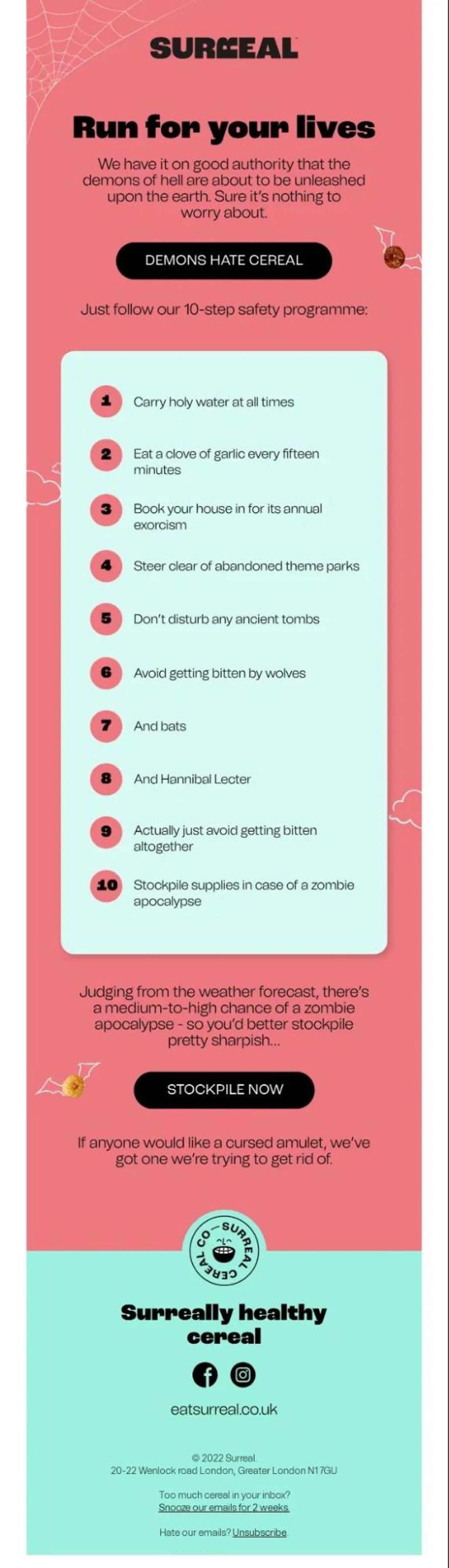
Image source: Really Good Emails
4. Test your BFCM discount strategy during Halloween
If you know discounts are going to be the primary focus of your BFCM email campaigns, use Halloween to test your discount pricing strategy.
A thoughtful discount strategy can move your brand away from sweeping, more expensive discounts and toward a more targeted approach. During Halloween, test discount tiers on different segments of your audience, based on browsing behavior, previous purchases, and stated interests.
The trick is knowing which customers belong in which tier. RFM analysis groups customers by recency, frequency, and monetary value, so you can see who your VIPs are, who's ghosting you, and who buys often but spends little.
Rather than one blanket offer, you might send your loyal, high-value customers early access without a discount because you know they don’t need one to buy. That way, you can save your most tempting discount for at-risk customers you want to bring back, and test a mid-tier offer on frequent buyers.
Predictive analytics takes this a step further with per-customer forecasts for lifetime value (LTV), churn risk, and next order date.
Let’s say a customer's predicted next order date lands within the Halloween window. They’re due for a restock on their favorite product, regardless of any sale. Send them a nudge without a discount rather than your BOGO offer, and save that incentive for someone flagged as a churn risk.
Halloween marketing example: Woolino runs a BOGO sale with a dash of urgency
In this Halloween marketing example, baby sleepwear brand Woolino uses the holiday as an opportunity to offer a compelling incentive: buy one, get one 30% off sitewide. The message leads with the offer in bold typography and closes with an urgent deadline ("ends today") to drive same-day conversions. A top nav gives subscribers a direct path to shop by product type.
This offer is perfect for frequent, price-conscious customers. A BOGO rewards buying more without training your highest-value customers to wait around for a discount they don't need.
Subject line: Boo! BOGO 30% off everything!!!

Image source: Milled
5. Send Halloween early-access bundles through preferred channels
If browsing behavior shows someone haunting the same product pages again and again, build a product bundle around that intent.
You can use AI product recommendations to create a set based on each subscriber's purchase or browsing history. A bundled offer for products they're already considering, available before anyone else can get it, could be the final nudge they need to make the purchase.
And rather than assuming email is the way to go, you can use AI channel affinity to reach each subscriber where they're most likely to engage next. Channel affinity analyzes each subscriber's past interactions across email, text messaging, push, and WhatsApp, then ranks each customer’s top channels in order of preference.
Here's what that might look like for a Halloween bundle of glow-in-the-dark costume accessories:
- Open with an early-access alert sent via each VIP's top channel, like, "Early access starts now: the Glow Bundle is available for you before anyone else can get it.”
- Follow up a day later with anyone who didn't open, switching to their second-most preferred channel: "Still deciding on a costume? Your early access closes soon."
- The next day, send a message to subscribers who've been browsing the bundle pages without buying. For anyone whose preferred channel is WhatsApp, send a product carousel of each item in the bundle so they can scroll through to see what they’d get.
Halloween marketing example: The Dog Bakery unlocks early access to a product bundle
The Dog Bakery sells dog treats and celebration cakes. In this Halloween marketing example, they use MMS to give their text messaging subscribers early access to a holiday bundle. The kooky, on-brand image and short copy get straight to the point, giving the subscriber everything they need to take advantage of the early access.
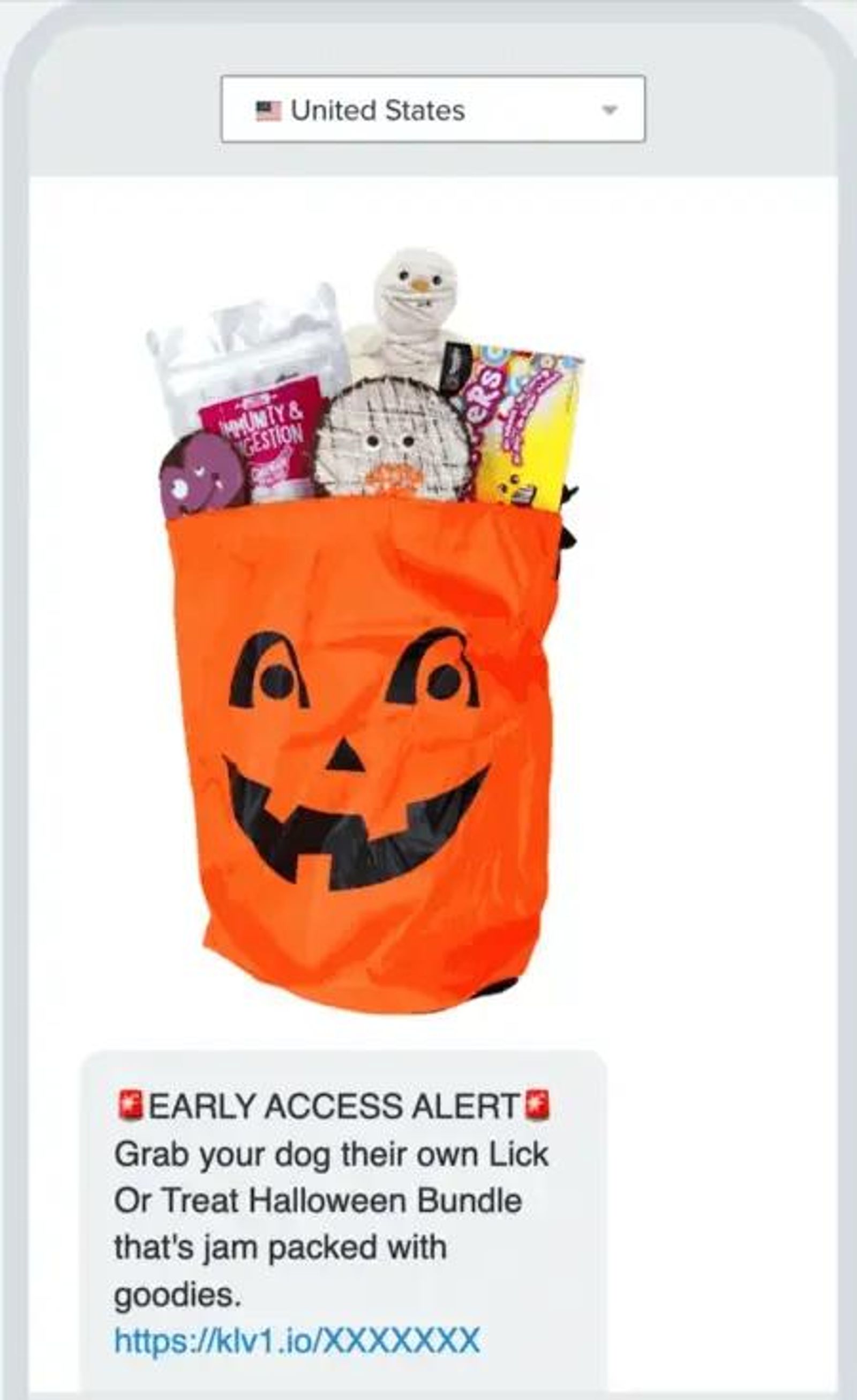
Image source: Klaviyo Showcase
6. Dress your brand up for Halloween with an AI photo editor
Halloween is a natural moment to show your products in a new context. With AI, you can style existing products with Halloween accessories or drop them against a moody autumn background.
Use an AI image editor to update your product images with a prompt. You can give direction like:
- “Add a tiara, swap in a darker background, and change the product color to blue.”
- “Drop the product onto a candlelit table with scattered autumn leaves and a few cobwebs in the corners.”
- “Turn the plain studio backdrop into a foggy graveyard at dusk, keeping the product sharp and in focus.”
- “Add a curly orange wig and glasses to go along with our white tee, then place it against a school background.”
- “Add seasonal props like mini pumpkins, black candles, and dried botanicals around our box of tea.”
Halloween marketing example: POPFLEX turns a costume guide into a list-building moment
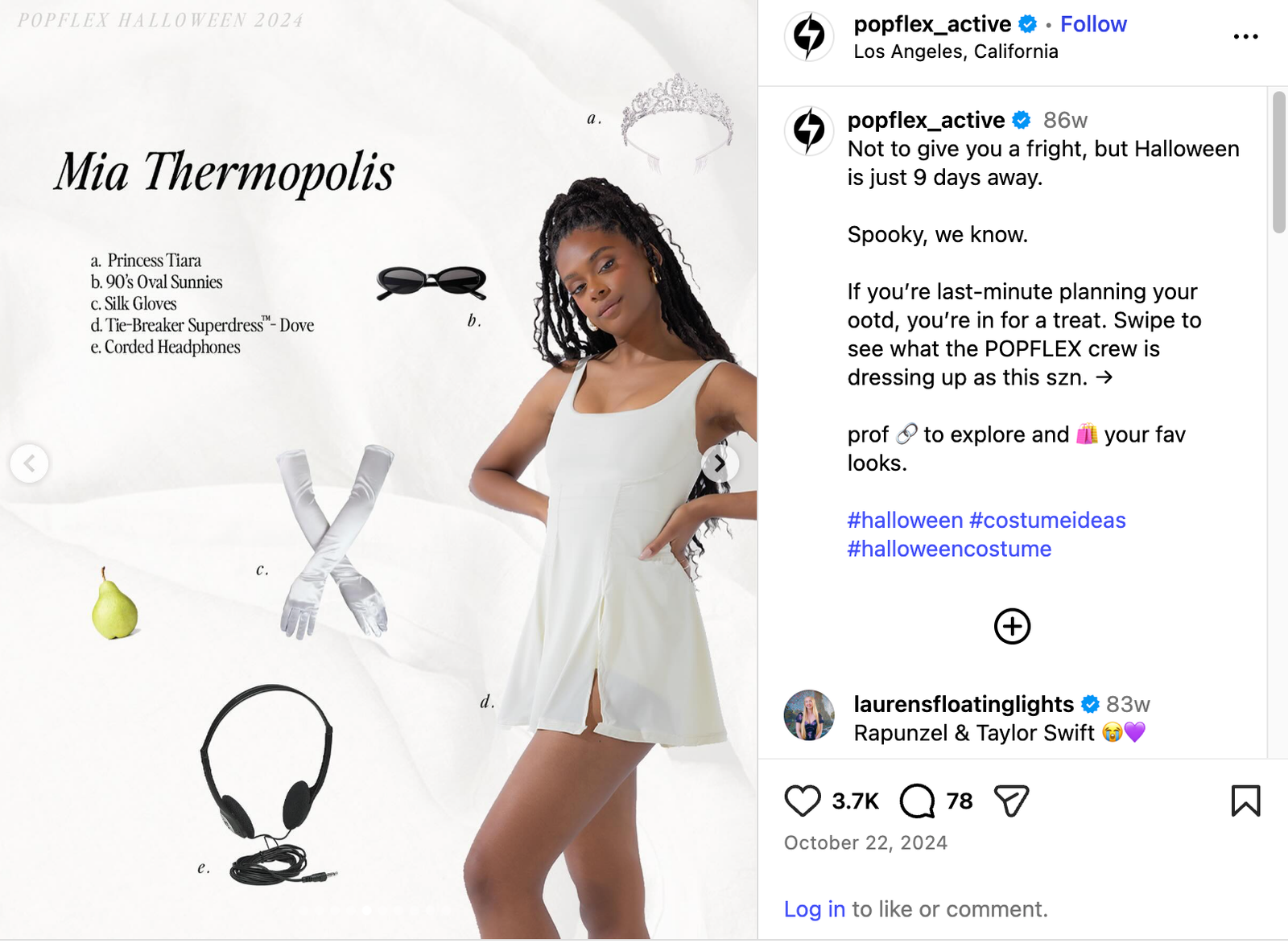
In this Halloween marketing example, activewear brand POPFLEX builds a Halloween costume guide from their own products, styling existing pieces into a recognizable pop culture look.
The costume refers to Mia Thermopolis from 2001 film The Princess Diaries, assembled almost entirely from the existing catalog: the tie-breaker superdress in dove, silk gloves, oval sunglasses, and corded headphones, topped with a tiara. POPFLEX successfully reframes a dress that normally sells as everyday activewear as a costume.
The post also gives shoppers a reason to engage rather than just admire. A costume guide invites comments ("which one’s your favorite?") and shares.
Source: POPFLEX Instagram
Gather customer data during Halloween with Klaviyo
Halloween probably won't be your biggest revenue day of the year. But what you learn in October shapes how you show up for the rest of the year.
The brands that drive revenue during BFCM don’t start planning in November. They spend the months before it building more detailed customer profiles and using AI to draft and test messaging.
Klaviyo can help you build your Halloween marketing strategy with:
- Composer: Describe your Halloween campaign in plain language and guide Klaviyo’s built-in AI marketing agent to draft the copy, build the creative, define the segments, and coordinate timing across channels, all ready for your review before anything goes live.
- Customer Agent: Give shoppers 24/7 help finding the right costume, gift, or product with Klaviyo’s AI customer agent that answers questions and recommends products across web chat, text message, email, and WhatsApp.
- Reviews: Collect social proof year-round with automated review requests, then showcase customer photos, videos, and ratings in your Halloween sends to build trust ahead of BFCM.
- Social: Capture intent where it happens by compliantly collecting opt-ins directly from social interactions like Instagram DMs, comments, and tags.
- Marketing Analytics: Use RFM analysis and predictive analytics to spot your VIPs, at-risk customers, and likely next purchasers, so you can test discount tiers on the right segments.
- Omnichannel marketing: Run coordinated seasonal campaigns across email, text messaging, push, and WhatsApp, with AI-powered channel affinity reaching each customer where they engage.
Grow sales and engagement all year long with Klaviyo.
Sign up
Related content