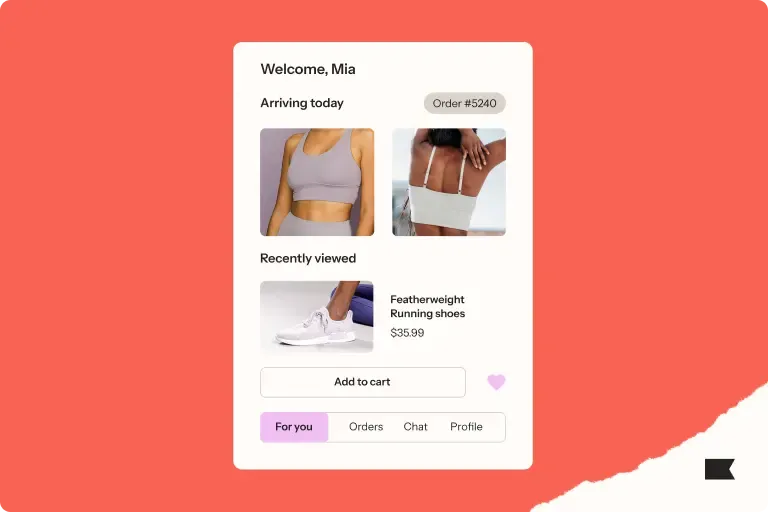
Turn Customer Data Into Personalization
Generated by Klaviyo AI
Effective personalization depends on making existing customer data usable, not simply collecting more of it. A four-layer framework—data, segmentation, intelligence, and decision-making—helps brands identify meaningful signals and activate them in relevant messages.
- Ask useful questions: Only collect information that can lead to a specific, different message later.
- Make data usable: Convert valuable event details into profile properties that can support filtering, segmentation, and future messaging.
- Separate key functions: Segmentation determines who receives a message, while personalization determines what that message contains.
- Activate decisions: Use conditional flow splits to turn customer preferences into distinct content and product paths.
A lot of brands think they have a messaging problem. In reality, they have a data problem.
As head of email and retention at FABO, a holistic ecommerce growth partner for lifestyle and apparel brands, I've seen the same pattern play out across dozens of ecommerce clients: they collect plenty of customer data, but that data never makes it into an actual email or text. It sits in a pop-up submission, an event payload, or a spreadsheet that nobody opens again.
So the send goes out anyway, generic as ever, and everyone wonders why personalization "doesn't work" for their brand.
The answer is that most brands never build the foundation to use the data they collect properly.
“Hi {{ first_name }}” isn't personalization
Here's a pattern you've probably seen: a pop-up asks a single question, something like "What are you shopping for?" It's a micro-commitment ask, and it works, in the sense that submission rates look great. Brands love that number.
But look at what happens after someone answers. The flow and campaign messaging doesn't change. The answer just sits there, unused, while everyone gets the same send they would have gotten anyway.
The solution isn't necessarily to ask more questions. It’s to ask better ones. Before you write a single pop-up field, ask yourself what you actually want to know about this person in order to talk to them well.
If you can't connect the answer to a specific, different message you'll send later, don't ask the question.
The data for personalization is there. You just can’t use it.
Even when brands do ask the right questions in their sign-up forms, a lot of times, that information doesn’t go any further. For most brands, it’s yet another example of the fact that the data necessary for good personalization usually already exists somewhere in Klaviyo. It's just stuck.
Every form response, every purchase, every browse, and every click generates an event, and that event carries a payload full of useful detail. The problem is that a lot of that detail lives and dies inside the event itself. It never becomes something you can filter on, segment by, or reference later.
Let’s say you sell watches, and someone just bought a high-end model. That's a signal worth remembering and acting on, not just logging. If you can capture what they bought and when, you can plan for what happens next: a check-in message timed to when they're likely ready for their next purchase, referencing the piece they already own.
One way to do this is to build a webhook that writes what someone purchased into a custom property on their profile. Now that detail is available to you long after the original event scrolled out of their activity feed, and you can reference it in a retargeting flow months later (e.g., "This pairs well with what you picked up in May").
All this requires is making your existing data usable.
Read how I made ad attribution easy in the Klaviyo Community.
A practical 4-layer framework for marketing personalization
Once you accept that personalization is a data problem, you need a system for solving it, not another one-off flow. Here's a framework that breaks the work into 4 layers:
1. Data: what's already available to you
Start with what Klaviyo already knows. Ask yourself what data points you actually want to use for personalization, and be specific. For example:
- Gender
- Loyalty tier
- Product preference (e.g., prefers gold jewelry over silver)
- Where someone is in the customer journey
There's no universal list here. Make your own that makes sense for your brand and your products.
2. Segmentation: who gets what
Segmentation is who you send to. Personalization is what you send them. Keep those two ideas separate, because conflating them is where a lot of set-ups go wrong.
Take a sunglasses brand with a wide range of frame shapes. Instead of leaving a face-shape guide sitting on the website, hoping someone finds it before they buy, ask a question directly in your welcome series. Now you can recommend frames that actually fit, before that first purchase ever happens.
“Reaching the right person at the right time is a science,” says Aaron Schwartz, co-CEO of Orita, a company that makes customer segmentation purpose-built for Klaviyo. “Pair that with the art of the right message (think personalization), and the results add up fast.”
“But knowing who someone is and what she likes only gets you halfway,” cautions Schwartz. “You also need to know if now is the time to reach her."
Reaching the right person at the right time is a science. Pair that with personalization and the results add up fast.
3. Intelligence: where the data comes from
This layer is about sourcing, and it can happen entirely inside Klaviyo. If you don't have a data point directly, you can often infer it. Someone who's only purchased square-shaped frames has told you something about their face shape without ever answering a survey.
Klaviyo’s predictive analytics can fill in other gaps, too, flagging who's likely to churn or who's likely to buy again soon, along with personalizing messaging according to gender and customer lifetime value (CLV). And, it works with channel affinity to reach your subscribers on the right platform.
4. Decision: data activation
The decision layer is where you make the call on what's actually usable, not just theoretically interesting.
Here’s a real example: A lifestyle brand asks new subscribers in their welcome pop-up to pick their primary interest: Sweatwear, Activewear, or Accessories.
Most brands collect this choice, apply a custom property to the profile, and then send the exact same generic welcome series to everyone anyway. The data is there, but the decision to act on it is missing.
Activating that data means building conditional splits directly inside the Welcome flow.
- Sweatwear: subscribers branch down a path featuring cozy hoodies, loungewear sets, and relaxed styling.
- Activewear: subscribers branch into highlighting performance fabrics, gym sets, and mobility.
- Accessories: subscribers see bags, headwear, and lower-AOV items optimized for a quick first purchase.
That’s a serious missed opportunity. When the data point simply isn't there yet, it can't drive a decision today.
Before you build anything, ask two questions:
- Is this data actually valuable to us?
- Are we going to use it?
Where AI helps, and where it adds noise
AI tools, including Klaviyo’s MCP Server powering an integration with an AI platform like Claude, are useful for this work. Instead of reinventing your data structure every time you onboard a new client or launch a new segment, you can point AI at what's already available and ask it to surface interesting patterns.
That's where Klaviyo AI earns its keep: pattern recognition across purchase history, product recommendations based on what similar customers bought next, and personalized send time based on when someone actually engages.
And Klaviyo Personalization (formerly Marketing Analytics) uses AI decisioning and Klaviyo’s real-time customer data to determine the right product, channel, and moment for each customer, helping brands boost retention and grow revenue.
Where AI falls apart is wherever there’s messy, unstructured data. AI can't fix a foundation that doesn't exist, and it can't rescue a segmentation strategy that's trying to do too much at once. Asking AI to segment simultaneously by country, loyalty status, and gender sounds efficient. In practice, it multiplies your workload into more variations than you can realistically write for.
Quality over quantity applies here more than anywhere else. Pick the data points that matter most for your brand, get those right, and build from there.
If you’re just getting started, try this prompt with Klaviyo Composer: “Do an analysis of my subscribers and give me 5 ideas for how I can work with personalization.” It may surprise you what data you actually have available to start your personalization journey.
Personalization is a systems problem you solve with better data. Get the foundation right, and every layer that comes after—segmentation, intelligence, decision-making—gets easier and more effective.

Related content