Match welcome flows to visitor intent
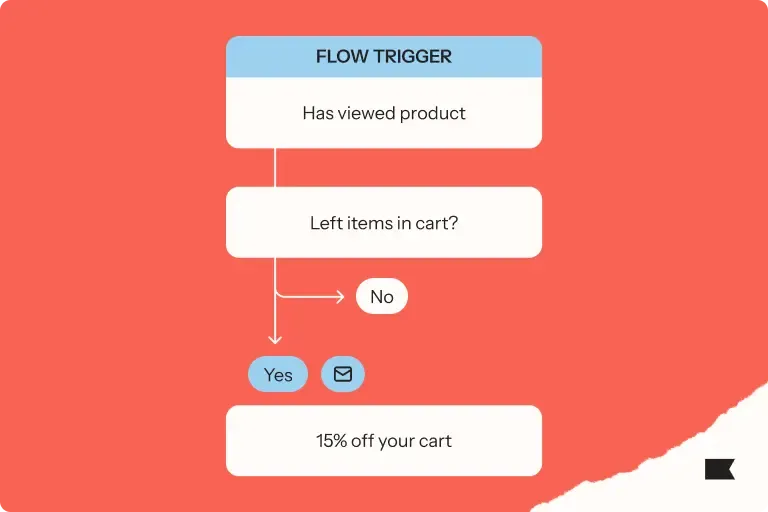
Generated by Klaviyo AI
A single welcome flow overlooks major differences in visitors’ readiness, motivations, and objections. Segmenting converters, journey starters, and bounced visitors allows each group to receive a flow designed for its stage in the customer journey.
- Converters: Reduce purchase friction and use a post-purchase welcome flow for education, cross-selling, loyalty, and referrals.
- Journey starters: Use a story-driven flow and targeted messages that address objections beyond price.
- Bounced visitors: Capture contact details with an exit-intent offer, then use incentive-based and abandonment flows to encourage a return.
As the strategy director at Underground Ecom, an Elite Klaviyo partner agency for full-service email and lifecycle marketing, I've audited more than 300 Klaviyo accounts. Almost all of them made the same mistake: one welcome flow, built for one imaginary customer, sent to everyone who signs up.
That approach is costing you more than you think.
The problem with a one-size-fits-all welcome flow
Walk through the typical welcome flow and you'll see the same pattern everywhere: someone signs up for marketing through a pop-up form that promises a discount code. The welcome flow delivers the code on the channel the new subscriber signed up for, then pivots into brand story, product highlights, a founder note, and maybe a few recommendations.
It's not a bad flow, but it’s built on a flawed assumption: that every new subscriber is equally informed, equally ready to buy, and equally motivated by the same 10% off. They're not.
That one flow is also usually trying to do two jobs at once. It's transactional (here's your discount, as promised) and it's a brand-building pitch (let me convince you to fall in love with us) at the same time. Trying to accomplish both goals means accomplishing neither well.
As a result, your flow is never operating at its full potential, because it was never built for one specific person. It was built for everyone. And that means it was really built for no one.
When I realized this was happening with the brands I work with, I started with a simpler question: Who is this email actually for?
The 3 visitor types your welcome flow should be built around
Once I stopped assuming every new subscriber behaves the same way, 3 distinct groups started showing up in the data, and they show up for every brand.
1. Converters: ready to buy the moment they land
Converters land on your site already having made the decision to buy. They click a product, check out, and they're gone, often within minutes.
There are several scenarios that could have landed them on your site:
- They clicked through a Facebook ad.
- They researched on Reddit.
- They read a number of reviews.
- Your product is a low-ticket item and this is a pure impulse buy.
The mistake: Still handing these shoppers a discount. If someone's already at check-out, you're giving away margin unnecessarily. Worse, you're often throwing pop-ups and redirects in their path that only slow down a sale that was already happening.
What you should do for this group: Get out of the way. Minimize friction, let them check out, and save your real marketing energy for after the purchase. That's where product education, cross-sell flows, loyalty or VIP programs, and referral programs turn a first-time buyer into a repeat one.
The welcome flow converters need: a post-purchase welcome flow. After someone just bought for the first time is where a note from the founder, a personal touch, product care tips, or an early up-sell belong, since these people already chose you.
2. Journey starters: the ones who need a reason to come back
Journey starters need at least two visits before they convert. Think of them as your middle-of-funnel shoppers: they land once, spend time on your product pages and copy, then bounce, usually to compare you against 2–3 competitors in the same category. If you win that comparison, they come back and convert. If you don't win, they don't come back.
The mistake: Assuming what’s holding them back is always price. Sometimes it is, but just as often, it's a missing product feature, a shipping cost that surprised them, or an item that was out of stock in their size. When you treat every hesitation like a discount problem, you might miss the actual objection.
The welcome flow journey starters need: A story-driven welcome flow that skips the discount entirely and instead does what a great sales associate would do if someone walked into your store: introduces the brand, builds a case for why it matters, and earns the sale. Think of it as your CRM concierge.
Note too that in this scenario, it makes sense to use a time-delay or scroll-based pop-up that responds to the way journey starters are actually engaging with your site. Consider where visitors spend the most time on your site, or tie the trigger to your average session length (often somewhere between 40 seconds and a minute), and show the sign-up form just before that window closes.
What else you should do for this group: Build other flows that respond to specific needs, like back-in-stock alerts, product education content, price drop alerts, or a short survey asking what's holding someone back. Each one of these solves a different objection instead of assuming there's only one.
3. Bounced visitors: your biggest, most overlooked opportunity
This is the largest group by far, typically 50–60% of your entire traffic.
- Some land by mistake.
- Some click an ad they didn't mean to.
- Some just aren't ready yet.
Whatever the reason, they leave without buying.
It may sound counterintuitive, but this is often the most valuable group you have, not just because it’s the biggest but because it's the easiest to convince. Converters and journey starters are small, hard-won segments. Bounced visitors are a wide net, so a good offer, a well-timed reminder, or just consistent visibility can turn a meaningful share of them into customers.
The mistake: Letting them go without capturing anything, then paying to win them back through paid ads or SEO instead of owning the relationship through email and text messaging.
The welcome flow bounced visitors need: An incentive-based welcome flow triggered when they fill out an exit-intent pop-up form. Deliver the discount immediately to keep them on-site.
What else you should do for this group: Build other flows that keep them coming back, like browse abandonment, site abandonment, and cart abandonment. Once you have their contact information, staying in front of them is cheaper.
Build 3 welcome flows, not one
Each of these welcome flows has a different job built for the person actually receiving it. When I've walked brands through this shift, the pattern has been consistent: a meaningfully more effective welcome experience, better conversion from that first pop-up all the way through to a second purchase, and a lifecycle program that's finally working as hard as it should.
Your welcome flow may be underperforming not because you're missing a clever subject line or a better discount, but rather because it's trying to speak to 3 different people with one message.
Split it, and watch what happens.

Related content