Tatcha’s AI Personalization Framework
Generated by Klaviyo AI
Tatcha’s two-person lifecycle team uses a four-rung personalization ladder to progress from segmentation to predictive analytics and, eventually, real-time AI-generated messaging. Its approach emphasizes small tests, measurable results, customer trust, and continued human oversight.
- Four-step ladder: Teams can advance from audience segmentation and behavioral triggers to predictive analytics and fully personalized real-time messaging.
- Predictive win-backs: Tatcha replaced a fixed six-month trigger with each customer’s predicted next purchase date, producing steadier revenue and fewer discounts.
- Trust through testing: The team tests AI in limited, measurable applications before expanding its use.
- Human oversight: AI helps the small team monitor flows and identify problems, but human judgment remains central to its marketing.
Shannon Jörgenfelt drives 30–40% of Japanese skincare brand Tatcha's direct-to-consumer revenue with a team of two. Her rule for AI in marketing personalization is to “test small, earn trust, then expand.”
She runs a business-critical chunk of Tatcha's revenue with her lifecycle marketing strategies. Last year, Tatcha grew New Year promo revenue 20% with email and text message marketing, and that's before factoring in the AI trust framework she's built since.
In our first episode of Klaviyo Originals, Jörgenfelt shares her team’s approach to marketing personalization, her philosophy on where AI is and isn’t helpful right now, and her advice for brands looking to grow revenue while keeping customers’ trust.
Climbing the 4 rungs of AI-driven personalization
When considering marketing personalization, Jörgenfelt returns to the concept of omotenashi, the Japanese approach to hospitality that shapes how Tatcha treats its customers, where you anticipate a guest's needs before they have to ask.
"Is the information we're sending you actually helping you?" she said. "Or did we just get a little piece of information about you and get really excited and want to hit you right away?"
With just two people, Jörgenfelt explained, her team has to be deliberate about each decision. "It forces us to adapt and try new things as new technologies come out, in order to meet customers at this level of personalization that they've come to expect."
She compares marketing personalization to climbing a ladder. Personalization happens one rung at a time, and skipping rungs or climbing too fast is how most teams stall out. She recommends going further than adding a first name to a subject line, and climbing the 4 steps of the personalization ladder, gathering data along the way.
1. Segment your audience so you can send more targeted messages
It starts with segmentation, building a list around what a message is actually about, rather than sending the same campaign to everyone.
"Are we making sure we're hitting the people who are most engaged? Are we sending people the product or message that’s right for them?” she said.
In practice, that means a loyalist who shops religiously gets more about new products and brand news, while a new customer gets Tatcha's founder story and bestsellers first, since they don't have that context yet.
That same logic extends to protecting the channel itself. Tatcha built a direct mail segment for high-lifetime-value customers who've gone quiet on email, typically those who haven't opened in 3 to 6 months, stretching to a year around major launches. Rather than keep emailing people who've disengaged, the team reaches them through a different channel entirely. A recent cleanser reformulation launch sent to that segment brought in a 19x return on ad spend.
2. Personalize content with real-time triggers based on behavior
Next on the marketing personalization ladder is reacting to what a customer just did, on the site or in an email, instead of sending messages on a fixed schedule.
"Are you reacting in real time to what somebody is doing?" she said. "Are you sending them the message that's right for whatever they just did on your site or within your email?"
Using AI, you can adjust your marketing to people’s individual preferences:
- Use channel affinity to reach them where they respond better, whether that’s email or text message.
- Personalize send times based on what time recipients typically open their inbox.
3. Use predictive analytics to anticipate needs
From there, Jörgenfelt said, "that's when you can start to play in the more advanced AI space” using behavioral data and predictive analytics to anticipate what someone needs, rather than just reacting to what they already did.
With predictive analytics, you can estimate a customer’s predicted next date of order, average time between orders, potential churn risk, average order value, and predicted customer lifetime value. Then, you can use that data to inform your marketing and send more useful content based on predicted spending patterns.
4. Create fully personalized, AI-generated messaging in real time
The top rung of the ladder is fully customized messaging, produced and delivered in real time for each person, the area AI marketing agents are built for.
Tatcha isn't there yet. "That's the future for us," she said. "But there are baby steps you can take to get there."
The point of laying it out this way, Jörgenfelt said, is knowing which rung you're actually standing on, rather than feeling behind for not doing "full AI personalization" just yet.
How machine learning personalization replaced Tatcha's 6-month win-back rule
The clearest example of that third rung shows up in Tatcha's win-back strategy. A common strategy for ecommerce brands is to send anyone who hasn't purchased in the past 6 months a discount code. Jörgenfelt noticed that the timeline and the content of the email itself wasn’t working for Tatcha’s subscribers.
"We have some people who shop Black Friday every single year, and they have for a decade," she said. "And then we have people who buy our lip mask every single month. If you're contacting both of those people 6 months since their last purchase, it's the wrong time for both of them."
So her team swapped the calendar trigger for predicted date of next purchase, an AI model that estimates when each individual customer is likely to buy again, and built the win-back flow around that instead.
"It doesn't matter if your expected date of next purchase is one month from now or a year from now," she said. "If you miss that date, that's when we're gonna reach out to you."
The result is steadier revenue instead of the big, lumpy spikes that come from blasting a discount to an entire list at once, plus fewer promo codes going out in general.
That flow covers customers with a specific date to work toward. Other emails have to hold attention without one.
Brand building outside the shopping cycle
Some of Tatcha's most engaging emails aren't built around a sale. They're built to keep the relationship going between purchases.
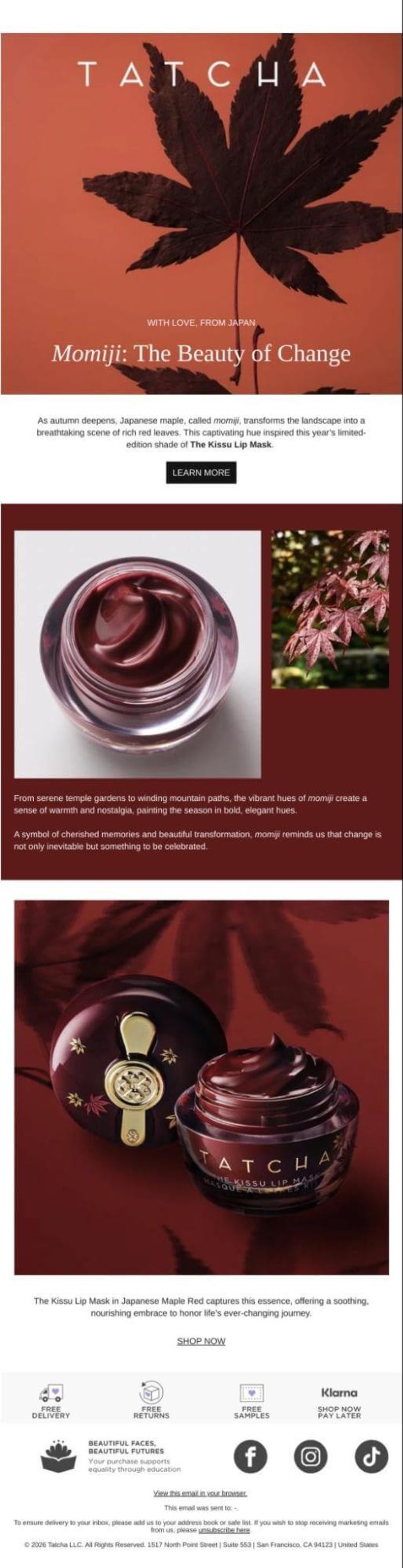
When Tatcha launched its limited-edition Momiji lip mask shade, the origin story went out to the full list as part of the product launch campaign, giving everyone a reason to care about the release.
Subject line: The story of this year’s limited-edition lip mask shade 🍁
So how does Tatcha continue to engage those "once a year" shoppers until it's time to buy? They skip the standard "we miss you" message in favor of something with more substance, like a milestone from Tatcha's partnership with Room to Read, a nonprofit that funds girls' education, or an educational piece about skincare best practices that anyone can benefit from, even if they don't have a Tatcha product on hand.
"Do we have something interesting to say about who we are?" she said, describing how she thinks about maintaining engagement.
Subject line: We’re thankful for you 🫶🏼

The trust test Tatcha uses for AI
Jörgenfelt built a rule for her team when deciding to use any new AI tool. "It is completely about trust, and the key is to test small, develop that trust, and then start to grow from there," she said.
That rule is also why she draws a hard line around a specific use of AI. Predictive analytics earned its place fast, because it was easy to test in one corner of the business and measure against a clear result. By contrast, one place she won't experiment yet is generating images of people. In skincare, she's not convinced it’s the best use of AI.
"We're not ready to dabble in fully generated AI emails or AI-generated image generation," she said. "In skincare it's so sensitive. We don't want to show you a fake person. We want to show you real skin."
Instead, her team is testing AI-generated text message copy, by running it directly alongside the standard version and watching the results before deciding whether to build a strategy around it.
Sitting AI out entirely isn't really an option, either. "This is the future, this is the direction we're going," she said. "So to a certain point, we have to keep up or be left behind, and nobody wants to be left behind."
The team has already grown to trust AI analytics tools. With only two people covering all the flows Tatcha runs, AI tools like Composer and Claude now help her spot "a canary in the coal mine" before a flow stops working, in place of manually sifting through "a million flows, a million open rates, a million click rates."
"AI has become kind of that extra person on the team," she said. But she was clear it doesn’t replace the human gut check. "I feel like we're never going to get to a place where you can market without a human marketer, because marketing is so human."
Test your way up the personalization ladder
Jörgenfelt's advice for other marketers is to find the rung that matches where the team actually is and go from there, rather than going all in on AI immediately or avoiding it entirely.
"Everybody needs to start playing with personalization in whatever way feels comfortable to you, whether that's being really intentional and strategic with your segmentation manually, all the way through to starting to test generative AI," she said.
Whichever rung a team starts on, the work doesn't stop once a flow goes live. "You have to make sure that you're constantly checking in. You can't just let things run and never revisit them, because that's how you end up in a trap of things becoming stale."
For a small team running a third of a brand's direct-to-consumer revenue, that habit of testing, one flow at a time, is the whole strategy.

Related content