New Year’s campaigns built on customer data
Generated by Klaviyo AI
These eight ideas show how B2C brands can personalize New Year’s marketing across email, text, social, and customer service. Tactics include year-in-review messages, resolution quizzes, giveaways, audience segmentation, reviews, bundles, VIP offers, and AI-assisted support.
- Personalized engagement: Use customer data to tailor recaps, recommendations, quizzes, and offers without exposing sensitive purchase details.
- Owned audience growth: Social giveaways can collect email and text message opt-ins while reducing reliance on paid reach.
- Relevant offers: Segmentation, next best offer, and channel affinity can match party products, bundles, and VIP promotions to each customer.
- Credible small wins: Detailed customer reviews can demonstrate realistic product benefits and provide useful context for shoppers and AI tools.
The week between Christmas and New Year's Day is a mood. Routines fall apart, nobody is quite sure what day it is, and your customers are taking a moment to reflect.
It may also be when customers are cleaning out their inboxes and wanting to snag some last-chance sales before the season ends. According to Klaviyo’s 2026 state of the holiday buyer research, 1 in 5 global consumers shop for New Year’s Day gifts for the deals and discounts.
In late December and early January, keep it personal and give people a reason to engage and buy. Your brand can do this with a personalized recap, a useful recommendation, or a fast answer to a post-holiday question.
For inspiration, check out these 8 New Year's marketing ideas for 2027, each paired with a real example from a B2C brand.
1. Send a personalized year-in-review email
Year-in-review content is a December tradition, and your brand can join in. Use customer data to build a round-up campaign around what each shopper browsed, bought, or reviewed this year. As a P.S., offer personalized product recommendations that complement their browsing and buying behavior.
Note that ecommerce year-in-review content comes with some risks. Whereas a music recap from Spotify feels fun because people like to share their listening history, purchase and browsing history can feel more private.
You know your customers best, but here are a few ways to keep your year-in-review personal without overstepping anyone’s boundaries:
- Celebrate milestones over products. Recap a customer’s move between loyalty tiers, points earned, reviews, or how many years they’ve shopped with you. Leave out itemized lists of what they bought or browsed.
- Leave out gifts and sensitive product categories. Exclude orders marked as gifts or shipped to another address. Skip categories like health or intimates altogether.
- Lead with your brand story. Feature your own milestones and frame the customer as part of that story, like, “You were one of 5,000 people who helped us sell out our winter collection.”
If your team is stretched thin after BFCM and Christmas, try vibe marketing your year-in-review messages with an AI marketing agent. If your AI agent is built into the same CRM that houses your customer data, it can personalize year-in-review messages for each customer.
Here’s an example prompt: “Build a year-in-review email for customers who ordered at least twice in 2026. Open with [top brand milestones], then show each person’s loyalty tier, points earned, and how long they’ve been a customer. Leave out anyone with an open return. End with 3 personalized product recommendations for 2027, based on recently browsed product categories.”
New Year’s marketing example: Little Sleepies turns their year-in-review into a 2026 wishlist
In this New Year’s marketing example, family pajama brand Little Sleepies gives subscribers a reason to feel invested in their year, then asks for feedback. A timeline of milestones reads like a thank-you note to the customers who made it happen.
Near the end, a wishlist section asks customers which prints and styles they'd like to see next. When customer responses like these are stored in unified customer profiles, they can help brands personalize their 2027 campaigns and flows. For example, a customer who asks for more holiday prints might get an alert when they drop.
Subject line: 🎉 2025, Can You Believe We Did That?! 👀

2. Build a quiz around New Year’s resolutions
People love setting goals at the start of the year, and your brand can think of these goals as customer data points. A fitness brand might focus on healthier routines, for example, while a kitchen brand might help people cook more at home.
When you’ve chosen goals that make sense for your brand, invite people to flesh out their resolutions with a quiz. Quizzes point customers to the products they need while collecting data for your CRM.
You can also run your New Year’s quiz as a conversation. With an AI customer agent that asks shoppers a series of questions, you might even generate revenue with relevant product suggestions. 68% of global consumers are willing to share some personal information with AI assistants to help them shop, according to Klaviyo's 2026 state of the holiday buyer research.
New Year’s marketing example: New West KnifeWorks helps shoppers find their 2026 kitchen companion
Cooking at home is a common resolution, and kitchen knife brand New West KnifeWorks leans into it with a quiz in this New Year’s marketing example.
At the bottom of the email, the brand invites shoppers to take a quiz to find the right knife for their needs. A quiz like this could ask how someone cooks, what they cook most, and what's already in their knife block, then recommend the knife that fits. Each answer becomes customer profile data the brand can use to personalize future messages.
Subject line: Start the year sharp with 10% off

3. Run a New Year’s giveaway to grow your email and text message lists
By late December, people have scrolled past a flood of promotions. Social algorithms add another hurdle, in that your followers don't see all your posts. You can only reach them reliably once you have their email address or phone number.
A New Year's social giveaway can move some of that earned attention onto owned channels, so you can rely less on paid ads next year.
Let’s say a candle brand posts a New Year’s giveaway on Instagram and asks people to comment or DM “FRESH” to win a year of candles. With social marketing in their CRM, the brand can send an automated DM asking for their email address or phone number to finish entering the contest. That information is then stored in a customer profile, and a direct relationship with the customer can begin.
As an important bonus, anyone who engages with the giveaway and then buys can seed a lookalike audience, so next year’s paid budget reaches people who are most likely to actually become customers.
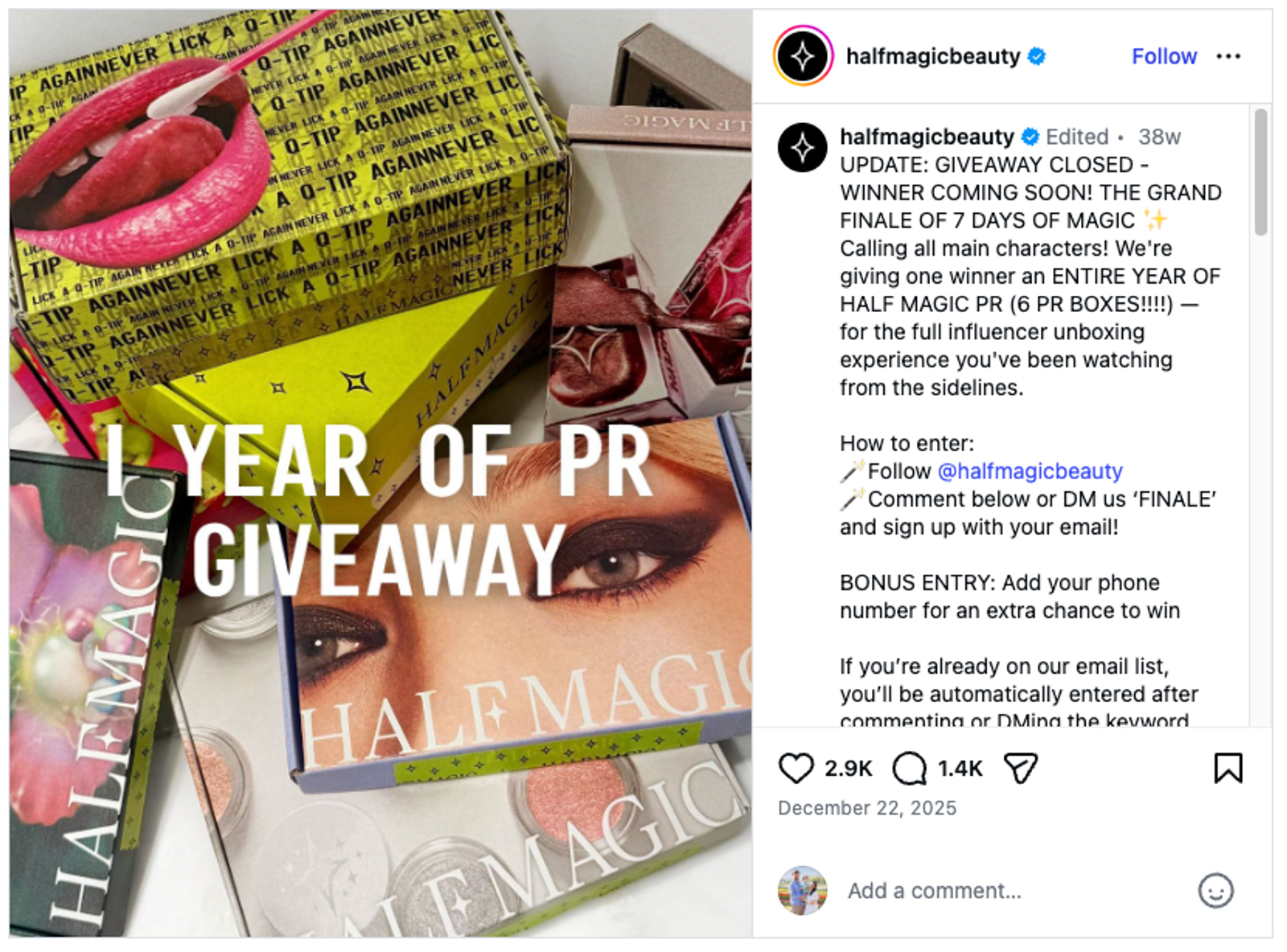
Marketing example: Half Magic gives away a year of PR boxes
Beauty brand Half Magic closed out 2025 with an Instagram giveaway built to grow two lists at once. Shoppers signed up with their email address to enter, and adding a phone number earned a bonus entry. The prize, a year’s worth of PR boxes, kept the winner engaged with the brand all year.
The mechanics of the giveaway made things easy for existing subscribers, who were entered automatically. That meant they didn’t have to sign up twice, but they could still give away their phone number for an extra chance to win.
Collecting email and text message opt-ins together means Half Magic can reach new entrants on both channels from day one through cross-channel automations. In fact, after consolidating their email and text message marketing in one platform, the brand grew revenue from automations 110% and repeat purchasers 5x YoY.
4. Promote party essentials to the right audience segments
New Year's Eve is a chance to throw a party that sets the tone for the year ahead. If you sell festive clothing, food and drinks, or party gear, position your products as must-haves for the night, for hosts and guests.
A host stocking up for 20 people and a guest looking for a hostess gift will act on different messages, and you can use customer data to tell them apart. Customer browsing, purchase, and review behavior are clues that can point you toward segmenting your audience, so you’re sending relevant messages.
An AI marketing agent built into your CRM can easily find especially complex segments that use a lot of customer data points, so you can message shoppers with specificity about your offer. Describe the audience to your AI agent in plain language, and it can build segments like these from your customer data:
- Hosts in the making: Customers who bought serveware or party supplies for the past two New Year’s Eves and have browsed similar products since December 1.
- Gift givers who skipped themselves: People who bought gifts during BFCM or Christmas but haven’t bought anything for themselves, sent to their own address.
- Last-minute guests: Subscribers who browsed party outfits or accessories in the last 7 days, haven’t purchased, and usually buy within 3 days of a holiday.
- Lapsed party regulars: Customers who bought for New Year’s Eve last year and haven’t ordered since.
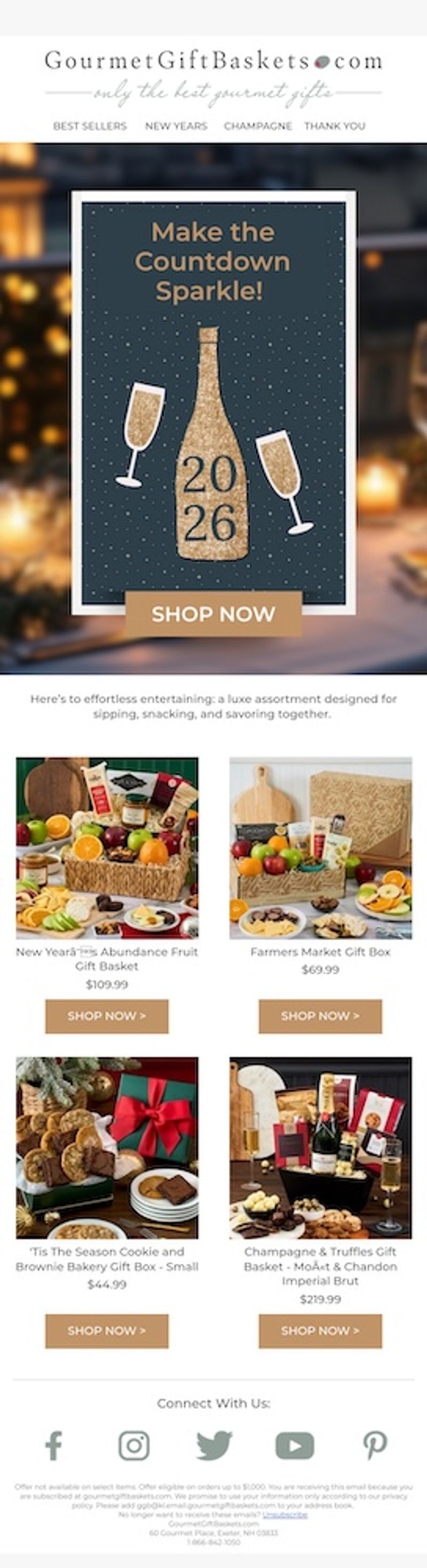
New Year’s marketing example: GourmetGiftBaskets.com uses RFM segmentation to segment their holiday audience
Gift baskets brand GourmetGiftBaskets.com uses recency, frequency, and monetary value (RFM) segmentation to send seasonal campaigns. RFM analysis groups customers by how recently they bought, how often they buy, and how much they spend.
With RFM segmentation and cohort analysis, GourmetGiftBaskets.com can send text message campaigns to the customers most likely to convert, and skip the ones most likely to be annoyed. In June 2025, their first full month using RFM segmentation, campaign performance across email and text message jumped substantially. Revenue per recipient jumped 42% MoM for email and 88% MoM for text message.
This New Year’s marketing example reaches GourmetGiftBaskets.com customers with something for every kind of celebration. The product grid covers a wide range of price points, from a $44.99 cookie and brownie box to a $219.99 champagne and truffles basket.
The brand could take this a step further by matching products to each RFM group. A high-spending customer could see the champagne basket first, while a one-time holiday buyer sees the lower-priced boxes.
Subject line: Ring in the New Year With Champagne 🥂
5. Use customer reviews to show small, realistic New Year’s wins
At the beginning of the year, people are eager to try new habits and products, but resolution fatigue sets in fast. Only 39% of Americans who made a 2026 resolution said they were very likely to keep it all year, according to YouGov.
Given this data, you might want to opt for messaging about small changes rather than featuring total reinventions. Shoppers might be more interested to hear about how your products improved other customers’ lives in incremental ways.
Customer reviews can help describe these small benefits in a more credible way than you would be able to alone. And keep in mind that, more and more, people are comparing products and reading customer reviews with LLMs. According to Klaviyo’s 2026 State of the Holiday Buyer Report, nearly 1 in 4 consumers plan to use AI to summarize reviews or research products.
That means your customer reviews need to be readable by AI crawlers as well as people. AI models pull from reviews, product pages, and FAQs to answer shopper questions, and they get more context from specific details than from star ratings and non-descriptive reviews.
First, to collect more detailed reviews, time review requests based on product usage. This will make sure your customers have had enough time to get the benefits from a product before leaving a review. You can also ask specific questions in your review request, like, “How did this help you achieve your New Year’s goals?” You may want to incentivize photo and video reviews, too.
More broadly, you can optimize your online presence for agentic shopping by allowing AI crawlers to access your product pages, adding detailed FAQs to each page, and writing your product descriptions with as many use case examples as possible.
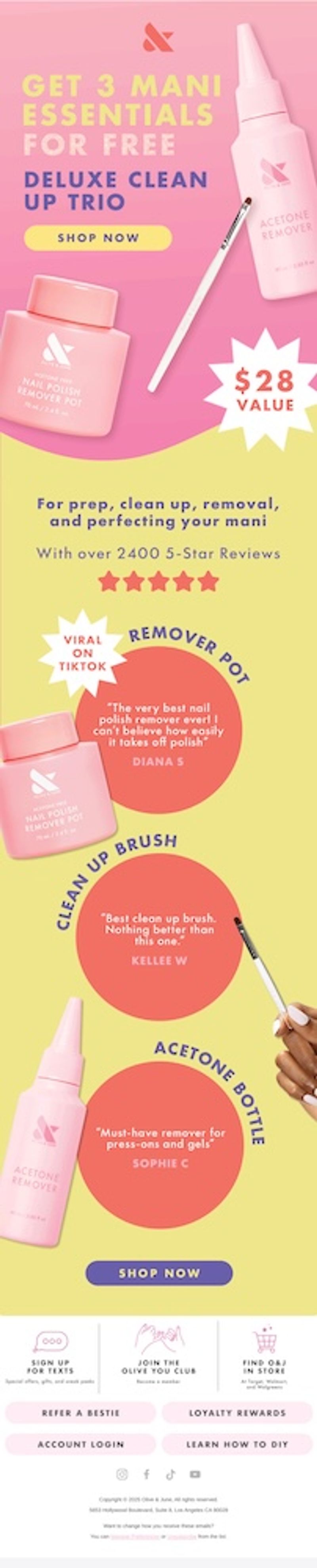
Marketing example: Olive & June sells a fresh mani routine with reviews
In this New Year’s marketing example, nail care brand Olive & June offers a free manicure essentials kit in this email, where reviewers describe each product.
When your CRM houses both your reviews and customer browsing and purchasing data, emails like this become easier to automate. A message like this could offer recommendations based on customer behavior, then automatically pull in a great customer review for each product.
Subject line: Start 2026 with fresh nails for free
6. Bundle New Year’s essentials into one easy offer
After weeks of holiday shopping, a lot of customers don't want to make more decisions. A New Year's bundle keeps it simple and can raise your average order value (AOV).
You can use next best offer to decide which bundle a customer should see. Next best offer is a predictive strategy that uses customer data and AI to determine the most relevant product to show an individual at any given moment. It analyzes each person's unique purchase and browsing history to surface the one thing they're most likely to want next.
For example, a customer who bought a cleanser and moisturizer in December is a natural fit for a “fresh start” bundle with a serum and SPF sunscreen to complete their skin routine. You can also add a free gift, like a travel-size item, so the offer feels generous while protecting your margins.
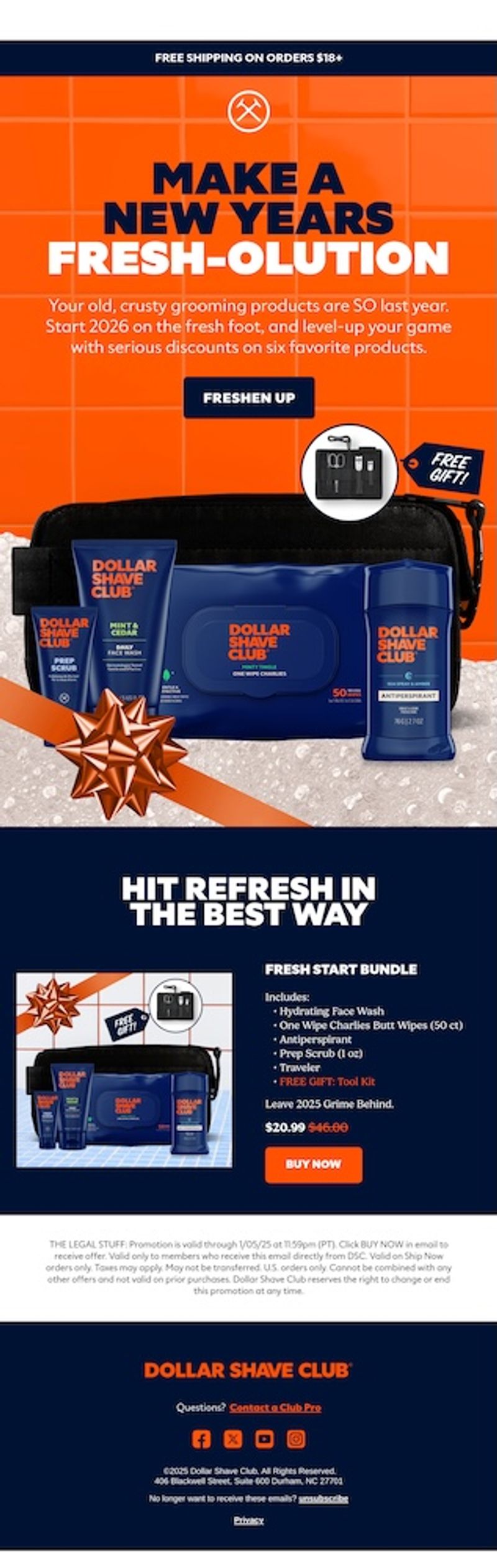
New Year’s marketing example: Dollar Shave Club makes a "fresh-olution" easy to keep
In this New Year’s marketing example, grooming brand Dollar Shave Club packages a full routine into one bundle, including face wash, wipes, antiperspirant, prep scrub, and a travel bag, plus a free toolkit.
You could build a more personal version of this offer with next best offer data. Someone who reorders face wash and prep scrub every few months could see an offer for a bundle built around the antiperspirant and wipes they haven’t tried yet, while a lapsed customer could see a discounted offer for the full kit to restart their routine.
Subject line: Going Fast: 50% Off Our New Year Bundle 🪩
7. Make your VIPs feel special on their preferred channels
Start the new year by thanking your most loyal customers with something the rest of your list doesn't get, like early access to a limited-edition product or a special discount. Text messages can work especially well for VIP customers because they're personal and immediate.
Use channel affinity, which predicts each customer’s most engaged channel, to reach each VIP customer on the channel where they’re most likely to engage. If someone is on your email list but consistently engages over text messaging, for example, send your VIP offer by text first.
New Year’s marketing example: Ministry of Supply shares their founder’s favorite pieces
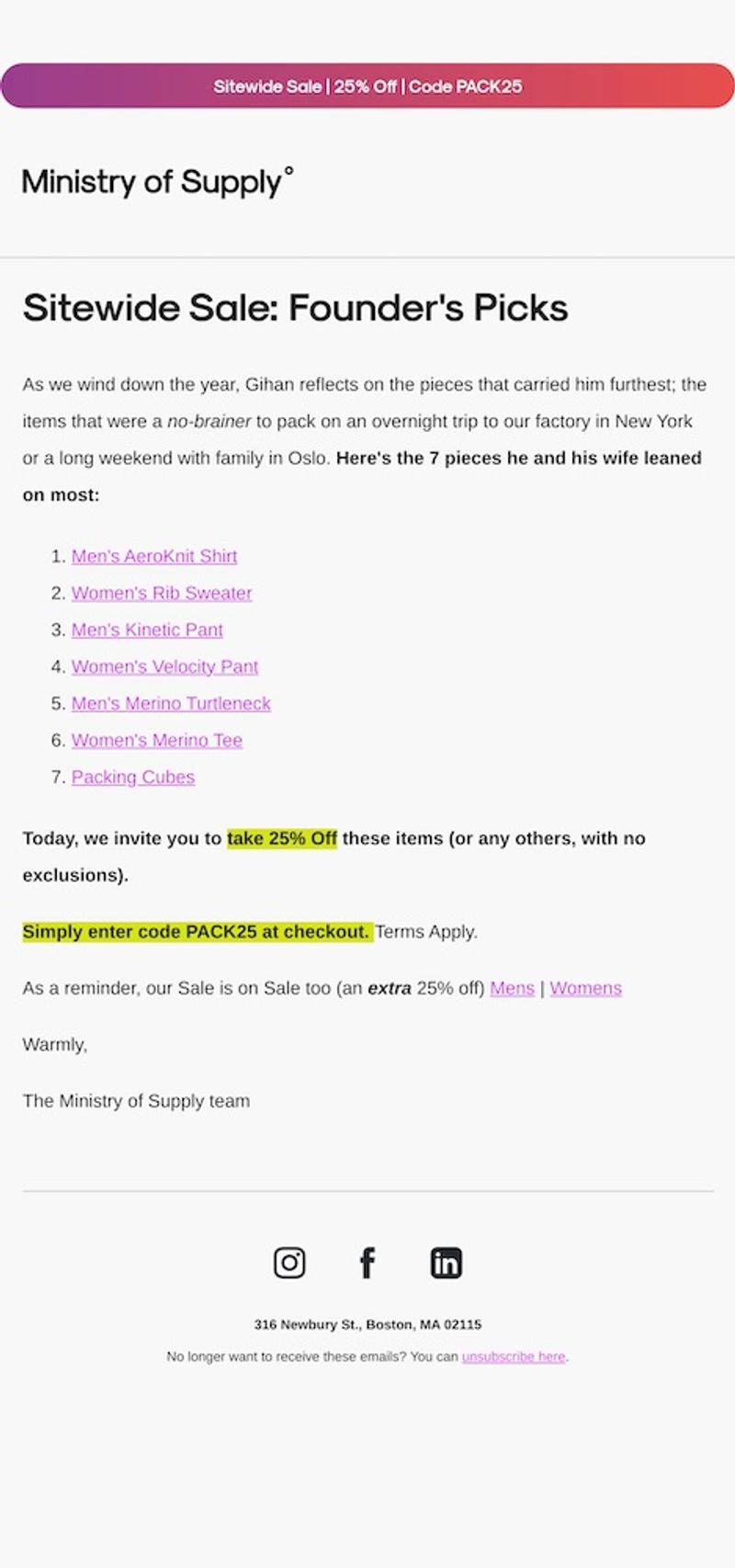
In this New Year’s marketing example, performance apparel brand Ministry of Supply sends a year-end sale that reads like a note from a friend. Founder Gihan shares 7 pieces he and his wife packed most often this year, for trips to the brand’s New York factory and to see family in Oslo.
This email is perfect for loyal customers who already know the brand and might want to know what the founder likes. A brand could send the founder’s note only to customers in their champions RFM group, swap in picks from product categories each VIP has bought from before, or open the sale to VIPs a day before the rest of the list.
And if a VIP who normally engages over email doesn’t click, follow up with a shoppable link via RCS or WhatsApp. Both channels support rich product images and carousels, so shoppers can browse the founder’s picks and buy straight from their phones.
8. Answer post-holiday questions around the clock with an AI customer agent
The first weeks of January bring a wave of support requests. Narvar data from the 2025 holiday season found that return volume increased 11% YoY, faster than order volume.
Customers want to exchange gifts, redeem gift cards, and figure out which size to swap into. Also, "where is my order" (WISMO) and return questions often spike over the holidays.
Each of those conversations is also a buying signal. Someone exchanging a sweater for a different size is telling you exactly what fits. Someone with a new gift card is ready to shop. A fast, helpful answer keeps that customer happy, and a well-timed recommendation can turn a return into an exchange or a new order.
We recommend setting up autonomous service before the holiday rush, so you can answer questions about returns, recommend products, and keep customers loyal. When a question needs a person, an AI customer agent can hand it to your team with the full conversation and customer context.
For example, let’s say that on January 3, a shopper has a $50 gift card and a sweater that doesn’t fit. An AI customer agent can confirm the sweater is within the return window, start the exchange, and recommend a few items that use up the gift card balance.
If the shopper mentions the sweater also arrived damaged, the AI customer agent can hand the conversation to your team with the full chat and order history attached, to speed up time to resolution.
New Year’s marketing example: Folk Clothing answers questions 24/7 with an AI customer agent
Fashion brand Folk Clothing used to handle support from a shared email inbox, where it was hard to tell which questions an agent had already picked up. Now, their AI customer agent answers shoppers first across web chat and email.
Over 90 days, their AI customer agent resolved 53% of their support conversations, and the team cut average ticket resolution time by 75%.
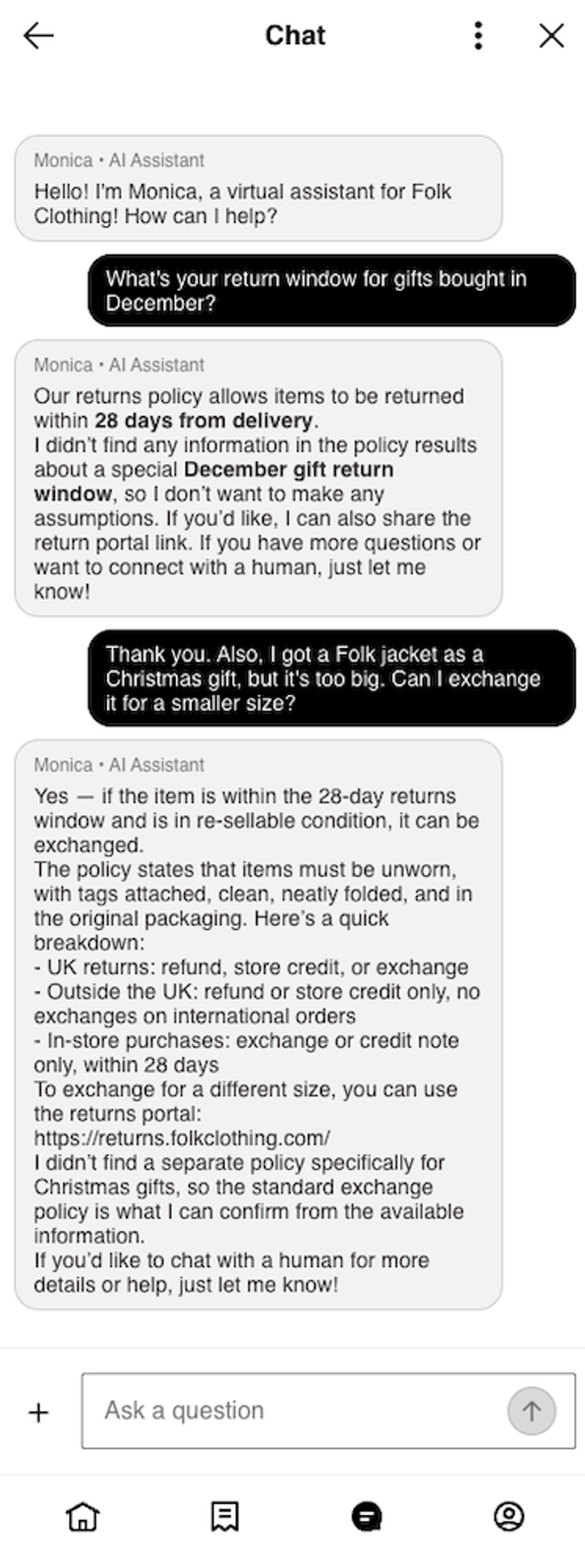
In this New Year’s marketing example, when a shopper asks Folk’s AI customer agent about returning a December gift and exchanging a jacket that's too big, it shares the 28-day return window, the condition items need to be in, and the returns portal link. It also says plainly when it can't find a gift-specific policy and offers to connect the shopper to a person.
Folk Clothing
Plan your New Year’s marketing campaigns with Klaviyo
New Year's shoppers are slowing down, sorting out their gifts, and deciding which brands have a place in their year ahead. Klaviyo, the autonomous B2C CRM for ambitious consumer brands, can help you plan and personalize your New Year's campaigns.
Put these New Year's marketing ideas into action with:
- Composer: Try vibe marketing by describing the New Year's campaign you want in plain language. Composer can build the segments, draft the copy, choose the channel and timing, and stage everything for your review.
- Customer Agent: Deliver autonomous support for gift returns, shopping assistance, exchanges, and order questions, 24/7. Save service interactions in customer profiles for future personalization.
- Customer Hub: Give shoppers one place on your site to track orders, start returns, check their loyalty balance, and find New Year's offers made for them.
- Social: Turn giveaway entries from Instagram comments and DMs into email and text message subscribers you can reach all year.
Power better customer relationships all year long with Klaviyo.
Sign up

Related content