Turn Klaviyo Data Into Answers
Generated by Klaviyo AI
Four Klaviyo updates help teams query customer data, connect social activity to revenue, analyze purchasing by product category, and tailor customer service by market. The post explains how Klaviyo AI supports each use case and suggests a practical first step.
- Plain-language queries: Composer writes and runs SQL against Klaviyo data while showing how it interpreted the question.
- Social revenue: Social Performance connects engagement and content data with orders to show which posts drive sales.
- Category-level RFM: Teams can run up to four RFM models with category-specific conversion metrics and thresholds.
- Market-specific service: K:AI Customer Agent adapts policies, skills, recommendations, pricing, currency, and language to each shopper's market.
Marketing teams tend to keep a running list of questions that go unanswered. How many customers bought for the first time last quarter and haven't ordered since? Which Instagram posts led to sales? Who’s overdue for a nudge in a category they used to buy from? What should a shopper in France see when they ask about returns?
Much of the data you need to answer these questions already lives in Klaviyo. Rather than requesting information from a data analyst or manually building segments, here are 4 new ways to work through that list using Klaviyo AI.
1. Ask Composer anything about your data with Klaviyo SQL
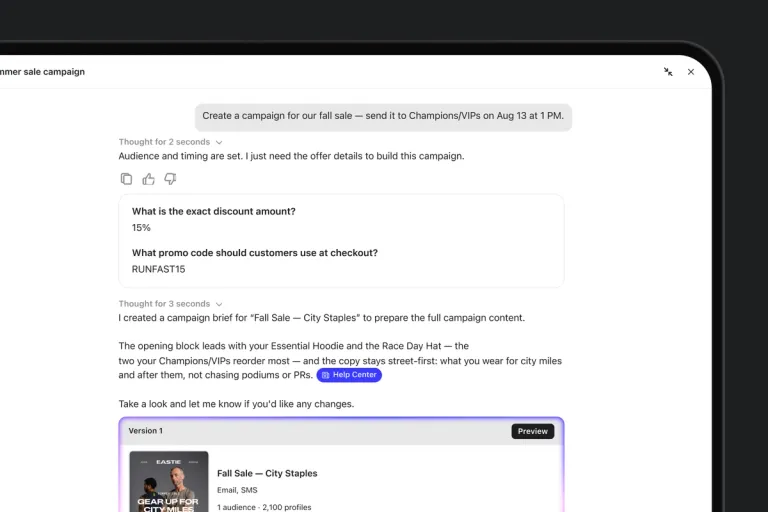
Klaviyo Data Platform now supports Structured Query Language (SQL), the standard language for asking questions of data. Composer, Klaviyo’s built-in AI marketing agent, writes the SQL for you.
Let’s say you want to know how much of last quarter's discounted revenue went to customers who had already paid full price twice. Ask Composer in plain language, and it writes the query and runs it against your data. A brand with $4.82 million in discounted revenue might find that $1.49 million, about a third, went to those customers.
Composer also shows its work. Its thinking stream shows how it interpreted your question, including how it defined discounted revenue. In this example, that means gross sales on orders where an offer was applied, minus refunds and cancellations. If that definition doesn't match how your team measures it, you can catch the gap before you act on the number.
Klaviyo’s MCP server, meanwhile, connects AI assistants like Claude to your Klaviyo data. Ask Claude the same question and you get the same number, because the same SQL runs underneath. SQL support comes with the connection, so there’s nothing to turn on.
It works beyond retail, too. A restaurant group could ask what share of last quarter's first-time delivery guests came in for a meal, and at which locations. The answer might show that almost a third did at one location, compared with closer to a fifth at the others.
2. Use Klaviyo Social Performance to see which posts drive sales
Let’s say someone comments on your Instagram post or DMs you for a discount code. Until now, you could see that it happened, but not whether it led to a sale.
Klaviyo Social Performance is now live for Klaviyo Social customers. It shows the revenue your social presence drives, because your order data and social data live in the same place.
You can break engagement down by likes, comments, and shares for any date range. You can also see your top-performing content, including user-generated content, with who made it, how it performed, and whether you have consent to reuse it. Drop the top pieces into your next campaign right from the editor.
Then, when a report spikes or dips, zoom into that date and ask Composer to explain the trend. It shows you what's behind it, so you don’t have to comb through individual posts.
3. Run up to 4 RFM models, one for each product category
Recency, frequency, monetary (RFM) analysis sorts your customers into groups, like Needs attention or “At risk,” based on how recently they bought, how often they buy, and how much they spend.
Until now, those groups came from a single model that looked at all of a customer's orders together. In Klaviyo, you can now run up to 4 models at once, each built for one product category, like apparel or footwear. Each model has its own conversion metric, which decides which orders count toward it, and its own thresholds for what recent, frequent, and high-spending look like in that category.
That matters because people don't buy every category the same way. Take a customer who buys apparel often but hasn't replaced her running shoes in over a year. Each model reads her purchase history for its own category, so she's “Needs attention” in your apparel model and “At risk” in your footwear model. A single blended model would have averaged those signals together and missed the gap in footwear. Now you can send her a campaign about new running shoes based on her footwear group, without her apparel purchases hiding it.
4. Tailor customer service answers to each market
Brands that sell in several markets deal with different policies, products, pricing, and languages. K:AI Customer Agent, Klaviyo's built-in AI agent for customer service, now adapts to each shopper's market through multi-geo for Shopify Markets. It connects directly to the markets you've already set up in Shopify.
Start with the content Customer Agent answers from. When you add a piece of content to its knowledge base, such as a return policy, you choose which Shopify market it applies to.
Skills work the same way. A skill is a set of instructions that tells Customer Agent how to handle a specific task, like a return. If you handle returns differently in the US and the EU, create one return skill for each and assign them to their markets. Customer Agent then follows the right process for each shopper.
The pre-built product recommendation skill follows the shopper's market, too. It searches that market's catalog, so shoppers only see products available where they are, with the right pricing and currency.
For skills you build yourself, add the “Get Profile” tool. It lets a skill look up a shopper's profile and check their country, so one skill can handle the same request differently depending on where the shopper is.
Ask the same returns question from the US and from France, and each shopper gets the policy for their market. If a shopper switches to French, Customer Agent replies in French and maintains the context of where they're shopping.
Where to start with each update
You don't need to roll out all 4 updates at once. Each one has a quick first step:
- Ask Composer the question you'd normally send to an analyst. Open its thinking stream to check how it read your question.
- Open Social Performance and find your top-performing post. Then check whether you have consent to reuse it.
- Add a second RFM model for your largest product category. Then send a campaign to the customers who are “At risk” in it.
- Set up one Customer Agent skill by market. Returns is a good place to start.

Related content