Fewer Sends, Higher Revenue
Generated by Klaviyo AI
Criquet Shirts used testing and AI-powered segmentation to target customers more precisely, reducing send volume by about 40% while increasing revenue 30% in the first 3 months. AI also helps its small team build segments and first drafts faster, while human judgment guides creative work and customer relationships.
- Test before pitching: Bucket tests gave leadership evidence that fewer, more targeted messages could outperform broader sending.
- Individual-level targeting: Klaviyo’s Orita integration scores customers using thousands of data points, including patterns that can identify seasonal shoppers.
- Measured business impact: The segmented approach cut send volume by about 40% and lifted revenue 30% in the first 3 months.
- AI saves time: Claude helps the small team build location-based segments and generate first drafts from existing briefs and product descriptions.
In 2010, two lifelong friends started apparel company Criquet Shirts in Austin, Texas, to pursue, in their words, “the perfect shirt and all things anti-ordinary.”
So, it’s no surprise they hired former NFL mascot Zach Scheimer to lead retention marketing. Until recently, he ran the program alone before adding a junior team member.
Scheimer’s approach to AI runs counter to the advice most marketers are hearing. Many company leaders are urging marketing teams to use AI to produce more emails, text messages, and content.
But Scheimer uses AI to send fewer, more carefully targeted messages. His goal is a deeper relationship with each customer, and, in his experience, sending less, deliberately, can outperform sending more.
Data on AI and trust gestures toward Scheimer’s instinct. According to Klaviyo's 2026 AI Consumer Trends Report, 32% of consumers say AI-generated marketing content makes them trust brands less. 61% are neutral, and only 7% say it increases trust.
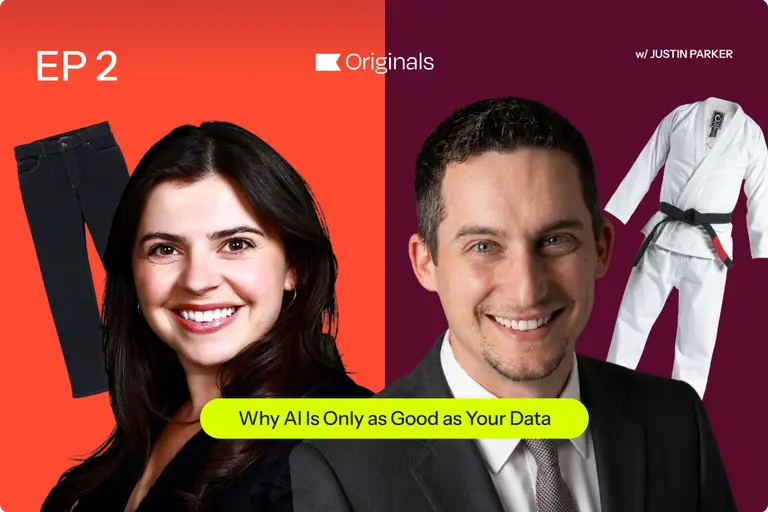
In our latest episode of Klaviyo Originals, Scheimer explains how he made the case for sending less during his career, how he uses AI segmentation to target audiences more precisely, where AI saves time, and which parts of the job remain human.
How Scheimer used bucket tests to make the case for sending less
Sending less can be a hard sell, especially to leaders who equate more sends with more revenue. Early in his career, Scheimer learned that a proposal to leadership goes further with evidence.
Before his time at Criquet Shirts, Scheimer’s team was building a plain-text version of each email for BlackBerry users, with text variations for as many as 15 emails. Scheimer saw the work as wasted time, but he had no proof. So, he put a UTM parameter on each link in each text version. After a month, not one sale was directly attributable to those emails.
"If you have a hypothesis you can test without breaking anything else,” Scheimer advises, “test it first, then go to leadership."
Scheimer carried the learning experience to Criquet Shirts. Midway through last year, engagement was slowing and email deliverability was dropping. Before proposing a new strategy, he ran a bucket (A/B) test across email and text messages, grouping subscribers by engagement to see who was responding on a seasonal basis.
"There are some customers who might not have clicked or opened an email in the last 180 days, but because of the seasonality, they’re still likely to buy," Scheimer explains. "So we knew with this bucket approach, we were missing people that were in a queue, wanting to hear from us."
Early results from Scheimer’s bucket tests showed leadership that targeted messages could work, which opened the door to explore how AI could help him scale his segmented approach.
How AI segmentation cut send volume 40% and lifted revenue 30%
Before AI, Scheimer built and managed 15 segments based on his own knowledge of customers. He could message each of the 15 segments based on engagement within the last 180 days, but that approach missed seasonal shoppers, like customers who buy polos only in spring and summer.
To reach seasonal shoppers, Criquet Shirts uses Klaviyo’s integration with Orita, a machine learning segmentation tool, to score each customer individually using thousands of data points. “It allows us to really scale that process and planning that we had done on the bucketed level, by being able to do it on the individual level,” Scheimer says.
With this approach, the brand’s send volume dropped by about 40%, and revenue rose 30% in the first 3 months.
“It was this massive change,” Scheimer points out. “I think starting with the bucketed approach and seeing small results from that helped leadership be like, ‘This is a working strategy. We can take this further.’ That's been huge for us.”
The real value of AI: “You can save time for teams that don't have time”
Scheimer defines AI narrowly. "Not everything is AI," he says. "AI, to me at least, is more agentic.” For him, that means "using Claude to help automate processes," especially ones that used to take him hours.
Last Father's Day, Scheimer put AI workflows to the test. To generate in-store revenue, he wanted to send a hyper-targeted email with a specific goal: to make sure last-minute shoppers could buy Criquet Shirts products in stores if they couldn't order online in time.
So, Scheimer used Claude to quickly set up segments of subscribers within 15 miles of the 215 retail locations that carry their products. The task took 30 minutes as he learned how to prompt Claude, but, for a later collegiate product launch, a similar segment took 10–15 minutes to build.
"That's where I see the real value in AI: you can save time for these teams that don't have time,” Scheimer explains. “That's their most precious resource as a team."
“AI gets you to step one”: Criquet Shirts’ AI writing philosophy
Two copywriters have left Criquet Shirts during Scheimer's time there, partly because a business of their size doesn't consistently have enough work for one. So, Scheimer’s team started training a copywriting skill in Claude.
“We've used Google Docs for 6 years for all of our email and text message briefs,” Scheimer explains. “We can now feed that into Claude. Claude also has access to Shopify, where all of our product descriptions are, and can pull from those.”
“So, instead of me spending 10–20 minutes pulling from last time we wrote a similar email, I can have Claude spit out a first draft, and I can make edits,” Scheimer adds.
Shoppers are split on AI-written messages. Globally, 57% of consumers assume most brand messages are AI-generated, according to Klaviyo's 2026 State of the Holiday Buyer Report. Just under half say AI-written messages bother them, while 55% don't mind as long as the message is helpful and relevant.
Scheimer is clear about where the role of AI ends. "I don't think AI is great at creative, whether it's imagery or writing,” he says. “I think it gets you to step one and takes away some of the writer's block phase, where it gives you a first draft and then you can actually write from there."
How gift buyers changed Criquet Shirts’ email send frequency
For Scheimer, the whole point of sending less with AI is to deepen the brand relationship with each customer. That means taking customer feedback seriously throughout the entire lifecycle.
For example, when one shopper said they wanted all of the campaigns and none of “the flow messages,” specifically abandoned cart reminders, Scheimer checked the customer’s profile. Sure enough, he could see they weren't engaging with flows, so he added a suppression to each flow for that one person.
It was something he didn't expect to repeat for any other customer, but he took the request as a starting point for further investigation. Scheimer determined he could isolate shoppers who were just buying gifts and didn’t need to be contacted as often.
“So there are some customers who genuinely just want to be getting our campaigns,” Scheimer points out. “Those are the ones I always want to be sending to. There are other customers, and especially recently we've learned this, that are really gifters. So, we added a question to our post-purchase survey: ‘Is any item in this order a gift?’”
The brand found that 20% of customers answered yes for most of the year, but that number reached 45% around Father's Day. Many of those buyers are shopping for someone else and don't need to hear from Criquet Shirts 3 days a week, so the team started saving those sends for gifting seasons.
Why sending less protects the text message relationship
No matter how much AI is involved in generating a message, a person is still on the receiving end. That's especially true for text messages. "You're texting someone on their phone. It’s an incredibly personal channel," he says. "So you have to be really respectful, especially on that channel."
Still, revenue is always at the forefront of Scheimer’s mind. "I think the biggest white whale in the industry is: What is the cost of an unsubscribe?" he points out. "I would rather not over-send, in order to not have too many unsubscribes."
For Scheimer, AI earns its place when it gives a small team the time and precision to send fewer, more targeted and helpful messages. Deciding who hears from a brand, and when, still comes down to knowing the customer.

Related content