The AI shopping agent era: 3 strategic marketing shifts for ecommerce brands
Generated by Klaviyo AI
Shane Mulcahy, senior digital strategist on Klaviyo's Professional Services team, argues that as more consumers turn to AI assistants for product research and recommendations, brands need to rethink how they compete. He lays out three strategic shifts — building AI-first customer experiences, scaling 1:1 personalization with AI, and using AI to create marketing content and reports — and points to specific brand results as evidence each pays off.
- Deploy an AI customer agent: Rather than a scripted chatbot, an AI customer agent trained on a brand's catalog and support content can personalize answers and recommend products; Naked Wardrobe's agent autonomously resolved 86% of customer queries and 94% of product recommendation requests over 90 days.
- Scale personalization with predictive tools: Tactics like personalized send time, channel affinity, predictive analytics (e.g., next order date, next best product), and audience optimization let brands tailor timing, channel, and targeting per customer; Marc Fisher Footwear's channel-affinity strategy contributed to 46% YoY SMS revenue growth across its portfolio in H2 2025, and Harney & Sons' Customer Hub drove over $120,000 in revenue in a single quarter with 12% higher average order value from Customer Hub users.
- Use AI to build campaigns and reports faster: Tools like Klaviyo Composer draft campaign audiences, copy, and timing from plain-language prompts, while an MCP server connects AI tools like ChatGPT and Claude directly to Klaviyo data for plain-language performance insights — though the author notes Composer has an edge for enterprise teams since it keeps data governance in-house.
Lately, almost every marketing strategy conversation I have comes back to the same question: How should my brand’s strategy change as customers shop more and more with AI?
It’s a fair question. Accenture's 2026 Talk to My AI Agent Report found that 71% of consumers expect generative AI to influence at least half of their spending decisions over the next 12 months.
And according to Klaviyo's 2026 AI Consumer Trends Report, 60% of consumers interact with AI at least weekly, and 39% have purchased a product from an AI recommendation.
I see it in my own habits, too. Research that used to happen on search engines and social media is now happening in conversations with AI assistants like ChatGPT, Claude, and Gemini.
Rather than browsing, people are asking AI assistants for product recommendations and expecting instant, tailored answers. And if they’re getting that level of relevance from AI before they reach your site, they may be expecting your brand’s shopping experience to be just as personalized.
After nearly a decade in CRM and lifecycle marketing, I recommend 3 strategic shifts to help you compete in the AI shopping era.
Shift 1: Build AI agent-first customer experiences
When a customer lands on your site and they’re used to getting personalized product recommendations from AI, a static FAQ page can feel like a step backward.
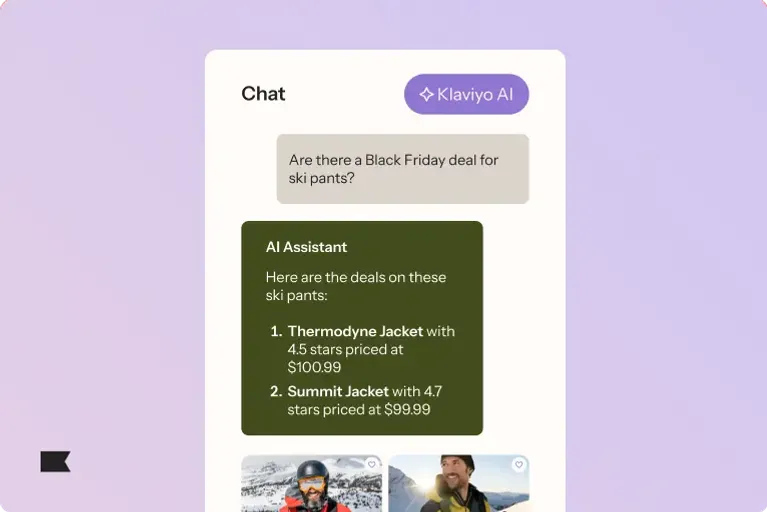
My recommendation is to use an AI customer agent to meet new shopper expectations. Unlike a generic chatbot working from scripted answers, an AI customer agent is embedded within your CRM’s customer data infrastructure and trained on your product catalog and support content. That means it can personalize answers with relevant details, recommend the right products to the right shoppers, and surface the right offer in the moment.
K:AI Customer Agent, for example, generates answers based on each customer’s browsing behavior, purchase history, and stated preferences. Customers can also start a conversation on your website and continue it on another channel, such as email, text messaging, or WhatsApp.
The data flows both ways, too. Whenever customers ask product questions or provide details like their favorite color or fabric, the AI agent can feed that information back into their customer profile and use it later to personalize future interactions.
Now that apparel brand Naked Wardrobe has added an AI customer agent to their website, shoppers can type queries like, "I’m looking for a dress for a party," and the AI agent can recommend pieces from the catalog, the same way ChatGPT might.
Over 90 days, the brand’s AI agent autonomously resolved 86% of customer queries and 94% of product recommendation requests.
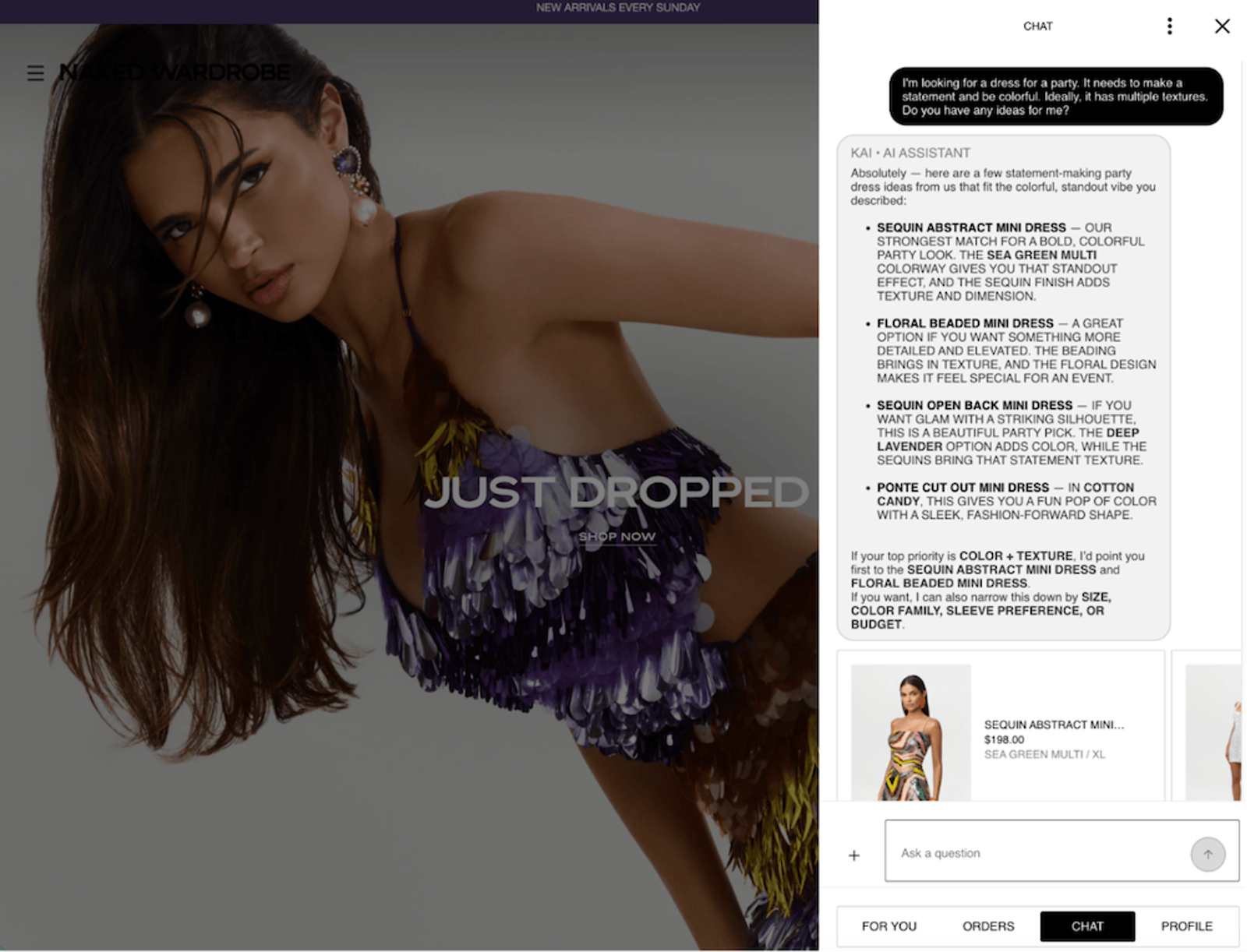
Source: Naked Wardrobe
The impact of an AI customer agent shows up the most during peak periods. One brand told me they hire around 20 extra support staff every Black Friday Cyber Monday to field sizing, product, and routine post-purchase questions. An AI customer agent could absorb most of that volume.
Shift 2: Use AI to scale 1:1 personalization
According to Klaviyo’s 2025 Future of Consumer Marketing Report, 74% of consumers expect personalized experiences from brands. When I work with enterprise brands in particular, two personalization goals come up again and again: increasing retention and improving first-to-second purchase rates.
Delivering that at scale takes unified customer data, real-time orchestration across channels, and predictive analytics. Here’s what that looks like in practice:
Personalize send time for each subscriber
Rather than sending a campaign to everyone at 8 a.m., personalized send time uses AI to deliver campaign messages when each subscriber is most likely to engage.
You can also set a sending window, say 8 a.m. to 10 p.m., so no one gets a 3 a.m. email. Personalized send time works with email, text messages, WhatsApp, and push, with a control group built in so you can see the actual uplift.
Meet customers where they prefer to engage
Channel affinity is an AI-powered prediction of which channel is most likely to drive engagement for each customer, based on their historical and real-time behavior. It’s most effective with automated flows, where you can use a conditional split to send, for example, the SMS-first customer a text, then follow up by email if they don’t act.
If someone prefers email, they get the email first and might buy before you ever spend an SMS credit. This is important because blanket texting everyone can drive your ROI down and use up credits you didn’t need to.
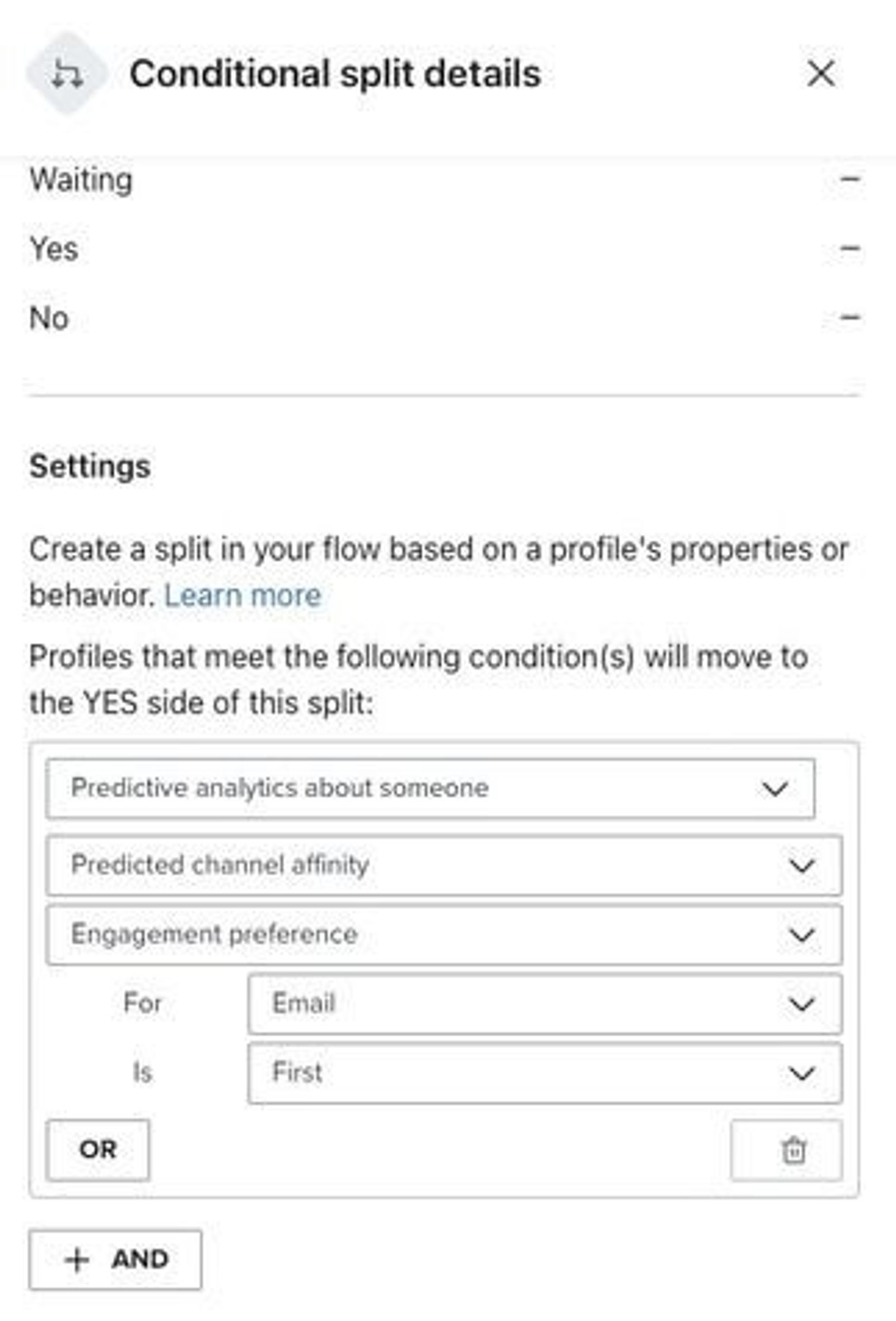
Meta title: channel-affinity-back-in-stock-flow
Shoe brand Marc Fisher Footwear is a good example. Running 6 brands on Klaviyo, they used AI-powered channel affinity to send one message on the channel where each subscriber is most likely to engage, cutting duplicate sends across email and SMS. This strategy is part of a program that delivered 46% YoY growth in SMS revenue across their portfolio in H2 2025.
Predict when and what customers will order next
Predictive analytics can help you act on behavior before it happens.
For example, a standard repurchase flow assumes a fixed cycle, like 90 days. A predictive metric like expected date of next order, on the other hand, reflects how often each customer actually buys, then assigns a personalized reorder date so you can send a reminder at the right moment.
Next best product works at the product level instead. It spots that customers who buy product A tend to buy product B about 3 weeks later, for example, then adds that recommendation as a product block in your emails and texts.
Let AI optimize your audience before you send
If your brand has been around for a while, you probably have quite a few subscribers who don’t even remember signing up. They’re still on your list and receiving messages, but they likely have no intention of making a purchase. Even worse, their disengagement may be damaging your overall sender reputation.
Before a campaign goes out, audience optimization removes profiles it predicts are unlikely to engage and likely to unsubscribe or churn. Think of it as a lookalike model pointed inward, at your own database, protecting your deliverability.
I've worked with brands whose whole challenge was acquisition. They couldn't grow consent fast enough, so slowing unsubscribes on the other end mattered enormously, and they saw a measurable lift.
Give repeat customers a VIP experience
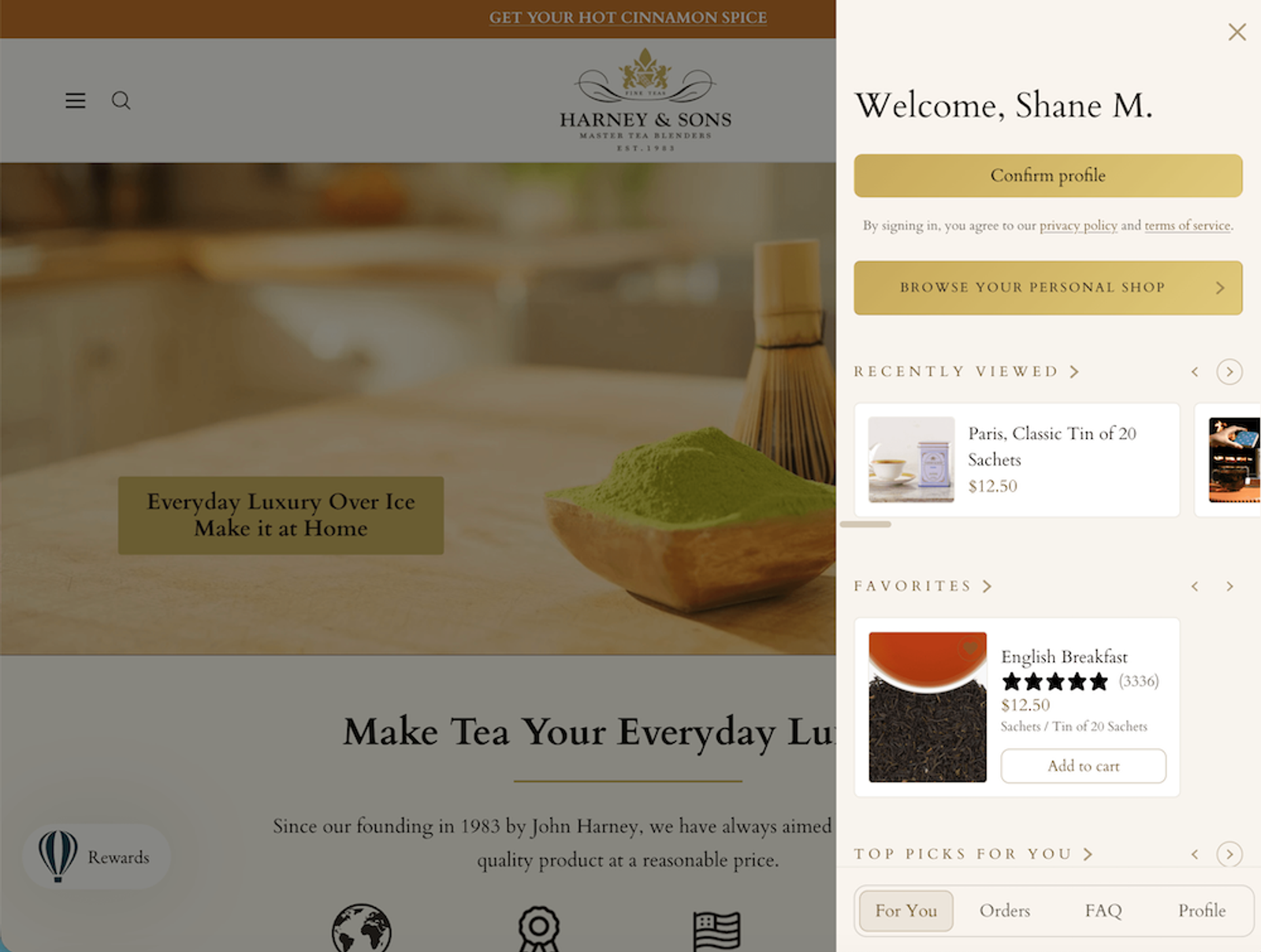
This level of personalization should continue on your site. Klaviyo Customer Hub can recognize shoppers via tracking tokens, whether they’re logged in or not.
The account page then becomes a true shopping experience: customers track orders, manage subscriptions, see loyalty points, find unused discounts, revisit favorites, and get tailored recommendations, all from the same profile.
In a single quarter, Customer Hub drove more than $120,000 in revenue for fine tea brand Harney & Sons, and 12% higher average order value from Customer Hub users than from shoppers overall.
Source: Harney & Sons
Shift 3: Create marketing content and reports with AI
This last shift is operational. Today, marketing teams are expected to run more channels, segment more deeply, test constantly, and personalize more, all without adding headcount. The teams keeping pace are building AI into how the work gets done. Here’s how:
Use AI to build campaigns
Klaviyo Composer plans and builds campaigns from a plain-language prompt. It drafts the audience, copy, and timing, and it learns your brand voice so the output sounds like you.
Marketers I work with use it two ways. First, to audit flows and ask questions like, "Where are customers dropping off in this post-purchase flow?" Second, to generate a first draft of campaign copy that can be refined.
To build segments, marketers describe who they want to reach—for example, “customers who engaged with SMS or push in the last 60 days and bought [product] in the past year.” Composer instantly builds the audience, so you don’t have to manually assemble it.
The same intelligence can flag your best cohorts for smarter spend, like showing a smaller discount to champions who are likely to buy anyway and a larger one to at-risk customers. That's useful for timely moments like a product drop or a tie-in to a cultural moment.
Chat with an MCP server to build conversational reports
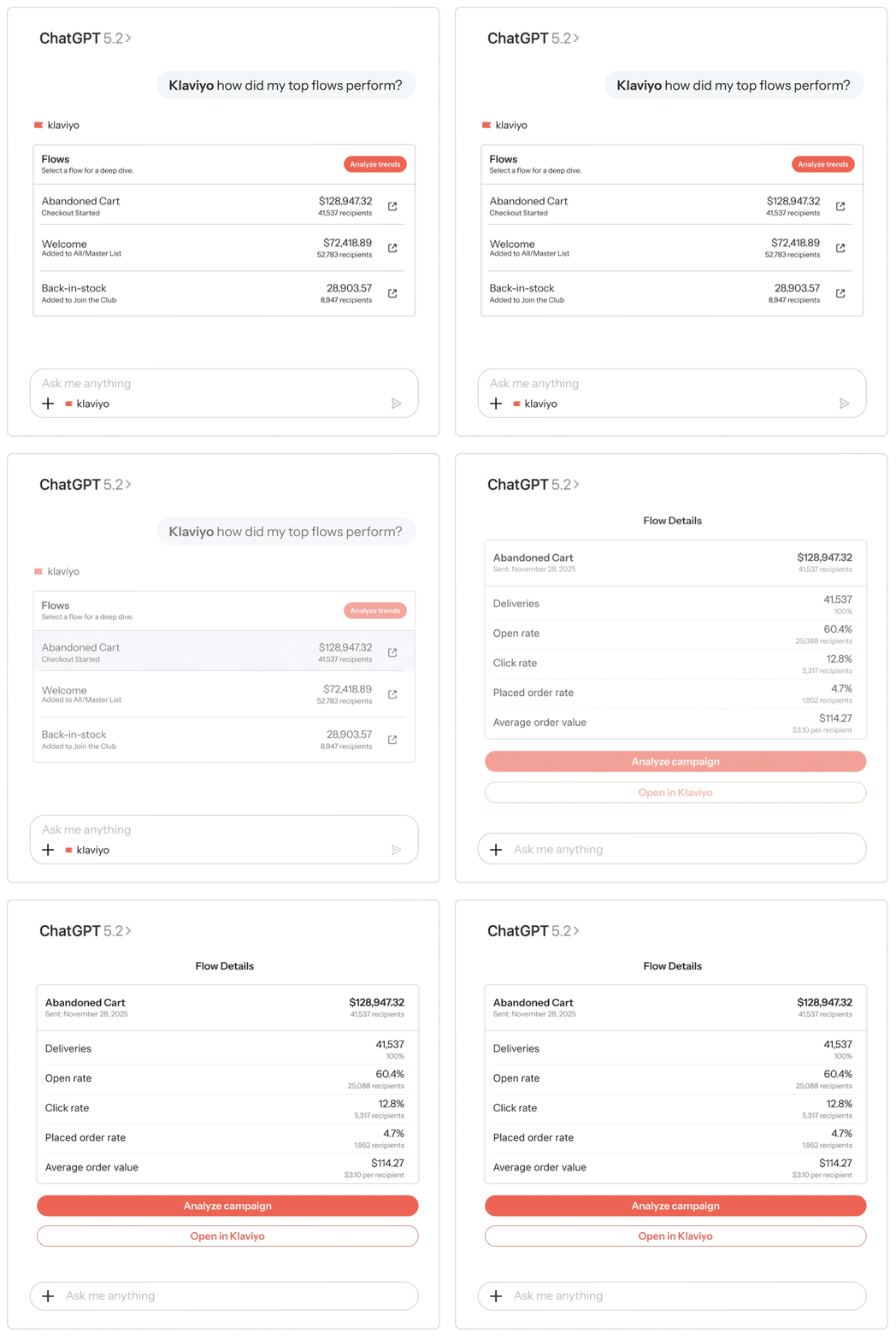
Teams also need less distance between a question and an answer. Klaviyo's Model Context Protocol (MCP) server connects approved AI tools like ChatGPT and Claude directly to your Klaviyo data, so you can ask for performance insights in plain language instead of exporting reports or clicking through dashboards.
I’ll note though that Composer has an edge here for many enterprise teams, since it’s built in, carries more context, and keeps data governance inside Klaviyo.
How to measure whether your AI investments are working
The advantage of using AI that’s built into your CRM is that the results are easy to see. A few metrics can tell you whether these shifts are paying off:
- Resolution and deflection rates: Track the share of conversations your AI customer agent resolves without human intervention. Keep an eye on how ticket volume drops during peak periods.
- Order, click, and open rates: Use built-in control groups to compare against a standard send and read the actual uplift.
- Split-test results: For channel affinity, run one flow path with affinity and one without, then compare placed-order and click rates side by side.
If these numbers move in the right direction, the shifts are working. If one dips, treat it as an early signal and adjust.
Shift into your AI marketing strategy with Klaviyo
AI product discovery only strengthens the case for better customer relationships. As more buying decisions start inside AI conversations, the brands that adapt earliest will exceed new customer expectations as they change.
Klaviyo B2C CRM brings your customer data, marketing, service, analytics, and AI onto one platform, so you can:
- Answer questions and recommend products in real time. K:AI Customer Agent resolves questions and suggests products across web chat, email, text messages, and WhatsApp.
- Personalize every send. Personalized send time, channel affinity, predictive analytics, and other AI personalization features empower you to tailor timing, channel, and content for each customer.
- Build campaigns by describing them. Klaviyo Composer plans and drafts campaigns from a brief, with human review at every step.
Exceed new customer expectations with Klaviyo.

Related content