Why disconnected AI pilots won't fix the customer experience
Generated by Klaviyo AI
Forrester's Shar VanBoskirk draws a direct line between the early years of email marketing and today's rush into AI, arguing that most brands are about to repeat the same mistake: expecting a new tool to fix a broken data and customer strategy. She offers a framework (customer-led, insights-driven, fast, and connected) for avoiding that trap.
- AI scales what you already have, good or bad: Without clean data and a real customer strategy, AI just makes existing problems bigger and faster.
- Fragmented tools are driving "random acts of AI.": The average marketing team runs 25 tools against 23 data sources, making results hard to attribute or invest behind.
- Being customer-led means creating value: The strongest AI use cases start with what helps the customer.
- Speed shouldn't come at the customer's expense: Automating a process only helps if it doesn't push friction and wait time onto the person on the other end.
- Tech consolidation is already paying off for the teams who have tried it: Marketers expect real efficiency and adoption gains along with cost savings.
Is AI overpromising or are marketers screwing it up by not addressing underlying issues?
In the 90s, email disrupted traditional direct marketing. It promised to help people scale, be more productive, automate, and personalize. And marketers expected this new tool to fix their program performance.
But “marketers underestimated the challenge of data hygiene,” shared guest speaker Shar VanBoskirk, VP and Principal Analyst at Forrester in her talk at K:BOS. “It took them years to unwind some of the reputation challenges that came about because they didn’t have their data house in order.”
Marketers put more weight in production, while putting aside the customer, their needs, and the value of their relationship with the business. It’s “shiny new tool” syndrome, and it’s happening again with AI. VanBoskirk explained that a look back at email gives us a preview of the impact of AI. And while having a clean underlying data infrastructure was important then, the stakes are higher now.
In her session, Shar walked through her perspective on AI transformation, and why random or tacked-on AI implementations aren’t going to be successful for consumer brands.
More AI, less trust
“Marketers screwed email up by treating it as a tool that would fix bad programs instead of fixing the underlying data and customer strategy first. AI is on track to repeat that exact mistake, just faster and more expensively,” Shar said. “Better AI tools won’t solve the problem. Good marketers need to be customer-led, insights-driven, fast, and connected.”
According to Forrester’s 2026 Global Government, Society, and Trust Survey, more than 50% of US online adults have used generative AI to find answers, but only 18% agree that they trust the information it provides. Poor AI implementations are eroding trust.
At the same time, decision makers are ramping up their AI use.
VanBoskirk shared Forrester research showing 79% of AI decision-makers expect generative and agentic AI to significantly reshape how their business interacts with customers within two years. 44% expect a positive ROI within 12 months, and 37% are already tying AI directly to company performance.
“We are in an environment with high usage, high expectations, and low trust,” VanBoskirk summarized. “This disconnection, lack of trust, concern around metrics, inflated expectations shows up in ‘random acts of AI.’”
Random acts of AI stem from disconnected data and systems
These random acts of AI, VanBoskirk explained, are probably a familiar concept to most teams today. “They show up as AI pilots that don’t connect to each other across the organization. Or AI pilots that don’t connect to each other within marketing. It’s projects that focus on automating existing workflows, stuff you already know how to do, just doing it faster. You’re trying a volume of things without having privacy, security, or customer experience guidelines in place.”
VanBoskirk identified that the reason that these AI pilots and disconnected activities are happening is largely due to the fact that “data and processes for most organizations are complicated.” According to Forrester’s Q3 2026 CRM Consolidation Survey of global marketing and CX technology decision makers:
- 53% agree that their organization’s customer data is difficult to act on
- 51% agree that campaigns require an enormous amount of human involvement for tasks that should be automatic
- 50% agree that their organization lacks the internal resources to build their own AI agents
The same survey found that the average organization has 25 different marketing tools, 23 different data sources, and 16 people trying to wrangle it all together.
Without a single source of customer data, each AI pilot or initiative is outputting different results, and marketers can’t attribute the results accurately, so they don’t know where to increase investments and can’t use AI in more sophisticated ways.
“AI scales what you give it, and it’s a means, not a strategy. Focusing on how AI can improve productivity can keep you from seeing the destinations like growth, better customer relationships, or entering a new market,” said VanBoskirk.
With connected data, you can tap into less obvious AI use cases
These more advanced AI use cases, or as VanBoskirk calls them, the less obvious AI use cases, rely on integrated data from all areas of the customer experience.
While AI is more obvious for tasks like content generation, image or subject line optimization, and segment creation, it's less obvious for:
- Customer discovery: not "build me a segment," but "find me a customer who'll take a specific action, in a specific window, for a specific goal"
- Deliverability and reputation management: predicting delivery problems and correcting them before they tank sender reputation
- Regulatory compliance: an automated QA layer checking messages against legal, brand, and privacy guardrails
- Data onboarding: structuring incoming data automatically so teams without a data science function can use it right away
- Inbox optimization: helping a message compete for attention inside an inbox that's also being curated by AI
AI best practices are email best practices
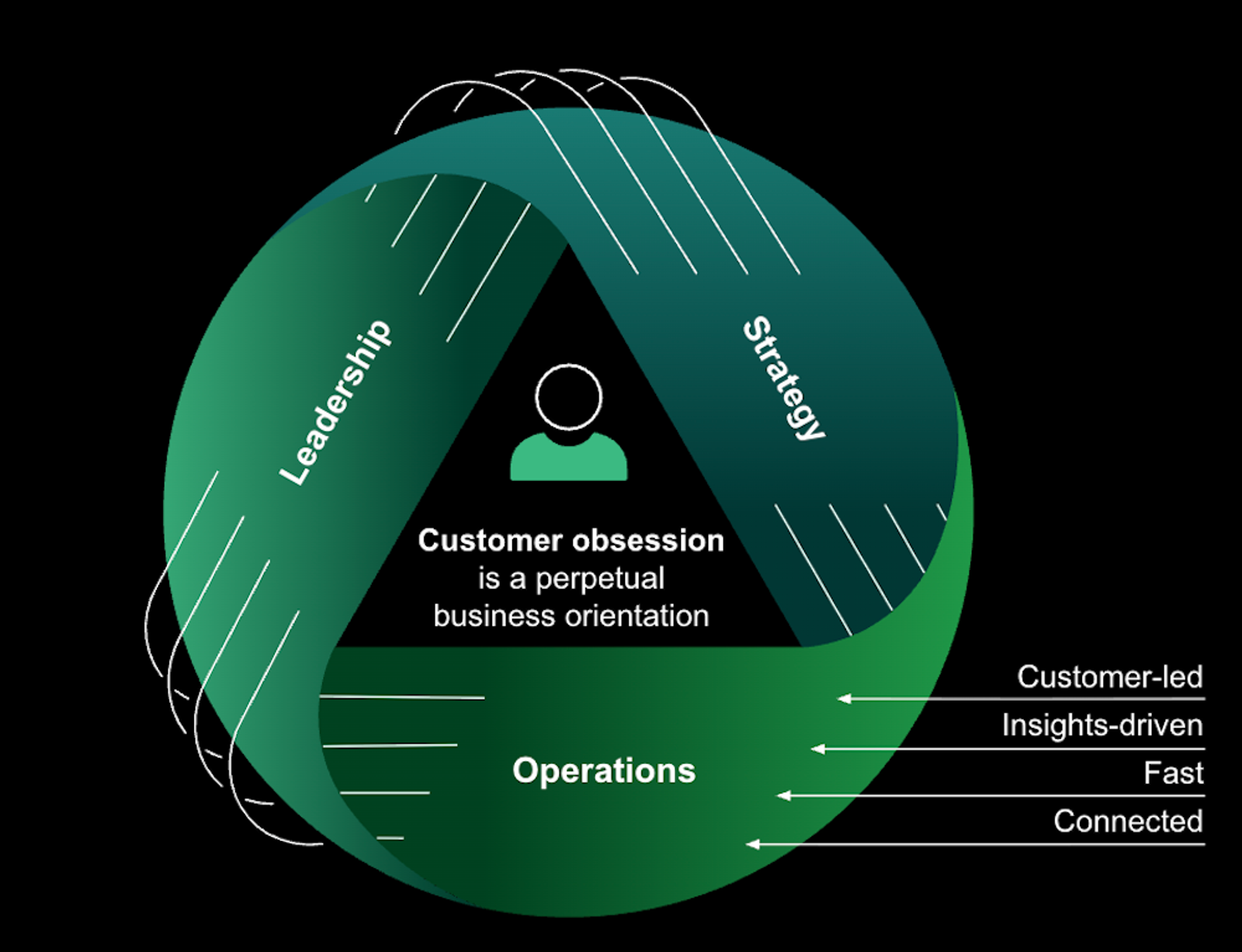
VanBoskirk shared a framework that the Forrester team calls customer obsession, which applies to email best practices and AI best practices alike.
“Being customer-obsessed means putting your customer at the center of everything your business does. Organizationally, this means the 3 biggest levers that you pull to make your business go, your leadership, your strategy, and your operations, all originate with the customer,” she said. “Companies that are customer-obsessed, the ones that start every meeting, every strategy with the customer, they tend to demonstrate 4 hallmarks. They’re customer-led, insights-driven, fast, and connected.”
Be customer-led
Rather than thinking of customer-led as “how should we send differently?” VanBoskirk explained that it means thinking about how you can add value for your customers.
She gave two examples of customer-led strategy:
- AI-facilitated user interview platform Hey Marvin scales qualitative research, making it possible to bring design thinking into every customer interaction instead of treating it as a periodic exercise.
- German video streaming service RTL used AI to find subscribers who'd stopped engaging, then sent fully personalized messages built from each person's viewing history. Instead of generic "we know you like reality TV" messages, they sent specific nudges like a reminder that a favorite character's storyline was airing that night. Viewership with this audience rose 21%.
Knowing your customers deeply is now possible with AI. AI can detect signals and preferences, like which channel each customer is most likely to engage on, so you can connect with every subscriber how they want to communicate, and tailor every message more effectively.
Let insights drive better decisions
For VanBoskirk, insights-driven means supporting better decisions, not just creating more dashboards. She shared the example of Tombras, an independent ad agency that customized its martech stack into a data operating system with a unique interface for every client, using that data to build real-time campaigns for each one.
Better decisions also mean building trust deliberately, not assuming it. VanBoskirk cited Forrester research showing 53% of online consumers are worried about the effect AI and deepfakes will have on their long-term quality of life, a reminder that the data foundation behind your decisions needs to be built with the drivers of trust in mind.
Move fast
AI has changed consumer expectations for their experiences with brands. They want faster responses now. Klaviyo’s 2025 Future of Consumer Marketing Report found that after reaching out, 81% of consumers expect a customer service response within 24 hours, and 38% expect a response within 4 hours.
VanBoskirk referenced an infamous LinkedIn post where a user shared that an AI-supported customer service chat took 24 minutes. “Just because you offloaded your process, took fewer people, or automated more, doesn’t mean to push the friction or time onto your customer,” shared VanBoskirk.
She gave the example of Cooltra, an on-demand scooter rental company out of Spain. They used AI to identify customers who were running low on credits and sent offers based on their behavior and how they’d ridden scooters in the past, making it so that customers wouldn’t have to top up right when they’re trying to start a rental. It saved their marketing team 10 hours a week and boosted their revenue by 12%.
Stay connected with customers
Instead of just sending more emails, staying connected means providing a coherent customer experience.
To illustrate this idea, VanBoskirk pointed to GovX, a digital commerce site that provides supplies and gear to military and first responders at a discount. They had created over 50 intricate journeys for email marketing and wanted to figure out which journey was the best for a given customer. Using AI, they reduced these to 14 programmatic adaptive templates that pull in content based on where a user falls within the lifecycle, personalized based on characteristics, interests, and previous behavior.
Transforming the customer experience with AI starts with data and technology
The study Forrester conducted on behalf of Klaviyo, the Q3 2026 CRM Consolidation Survey, showed that marketers expect tech upgrades to help them improve their customer experience.
In the next 12 months, marketing and customer experience decision-makers say they’ll upgrade:
- Their CRM (55%)
- Their digital dashboard and analytics solutions (51%)
- Their customer data platform/data management (39%)
- Onsite or web personalization (39%)
- Their email service provider (38%)
“This might mean consolidation,” said VanBoskirk. “In the same sample, we found that a lot of folks were expecting good value to come from consolidating their existing marketing toolkit.”
42% of respondents said they expect to see process efficiency from consolidating their marketing tech stack, and they generally expect to see 13% improvement. 40% expect to see AI adoption for marketing use cases across the organization with 12% improvement. And 36% expect faster campaign execution speed, with 12% improvement. “This is all to create an easier, more efficient way to view your customer,” VanBoskirk said.
She then shared a quote from a VP of a consumer goods company: “A single customer view across sales, loyalty, and marketing would help us make smarter decisions faster.”
Put AI CX strategy into practice
VanBoskirk closed out her session with recommendations to keep in mind that encapsulate the concepts she covered:
- Start with your data. Get your data foundation right and get a handle on identity resolution, data hygiene, and what you’re feeding to your AI. Make sure it’s consistent across the company.
- Consolidate to cut costs. Eliminate waste. Audit your technology and see where you have multiple tools doing the same thing.
- Start with measurable AI use cases. Pilots are useful if you have a good understanding of the value not just to the business, but also to the customer.

Related content