Winning visibility in AI-assisted shopping
Generated by Klaviyo AI
Most shoppers using AI don't click through search results anymore. They ask for a shortlist and pick from it, and 75% choose whatever comes first. Growth Memo's Kevin Indig breaks down the 5 moments where brands can still earn visibility and preference when an AI is doing the comparison shopping.
- Discovery is collapsing into shortlists: Most AI-assisted shoppers never click a result. They read the shortlist and stop.
- Trust can break the ranking pattern: A recognized brand gets picked almost regardless of where it lands on an AI shortlist.
- Winning happens across 5 reinforcing moments: The shortlist, the site visit, the unboxing, the post-purchase relationship, and brand recall all feed into each other.
- Branded search is the strongest signal: Getting people to search for your brand by name is one of the most powerful ways to win AI visibility.
- Triggered flows outperform campaigns by a wide margin: Behavior-based emails are a small share of sends but drive a disproportionate share of revenue.
Brands worry about autonomous agentic shopping burying them beneath 10 more optimized brands in the AI results page. And there’s a valid reason for this fear. Marketer and writer Deana Burke created a fake deodorant brand and got ChatGPT to recommend it within 3 weeks.
Research from Kevin Indig, author of The Growth Memo, backs up that fear. When AI hands someone a shortlist, 75% of people pick the first item on it. Only 10% ever consider anything ranked third or lower. There's almost no room left to compete once an agent has made its pick.
“The closer we get to the money, to the actual purchase, the more we want to stay in control,” said Indig in his talk at K:BOS 2026. “There are the utility-driven parts of shopping: the researching, discovery, discounts, returns. But then there’s the emotional side, like taste, subjective decisions, and making memories.”
“I’d argue that shopping is part of your product. The experience begins even before people actually buy your product.”
He went on to ask, “If that’s true, what does that mean for ecommerce? For brands?” Indig dug into the research, and posits that the way people shop is changing, but the emotional core has remained intact. Even still, if you’re not adjusting to AI-assisted shopping, you’ll risk getting overshadowed by a brand that’s investing in AI shopping visibility best practices for retailers.
The modern consumer’s discovery process: by the numbers
Indig’s team at The Growth Memo invested “a lot of time and money into conducting research to see how normal people use AI.” Here’s what he found, based on two observational studies of over 100 people from 2026.
To start, they gave people expensive items to buy. 64% of consumers using AI mode didn’t click anything. “They ask for comparisons for products, or for short lists, they get the answer, and they’re all set. 23% of people will actually open a new tab and go directly to the brand,” Indig said. “Clicks and conversions are no longer related.”
The team found that when people got a short list of products, almost 75% of people picked the first item on the list.
There are two factors that can break the ranking pattern: how AI frames a product as the top match, and whether the brand itself is one people already recognize. When a product is positioned as the best option, or comes from a brand people trust, they'll pick it almost regardless of where it lands on the list.
There's also a strong link between a brand's "shared voice" (how often it shows up in AI answers relative to competitors) and which product people actually bought. Appearing in the AI answer doesn't decide the purchase, but it's a strong predictor of it. Only 3% of people, fewer than the percent of people who read terms and conditions, actually verify AI answers on the web. Whatever people say about trusting AI in the abstract, in the moment of shopping, they rarely check its work.
Fast facts about AI-mediated discovery
While agentic shopping isn’t the fully autonomous experience many thought it would be by now, it’s also not what shopping used to be. Here’s what The Growth Memo research shows happening among consumers:
- Discovery is collapsing. Most users don’t click the AI search results. They look to AI to build them a short list to review.
- Position wins on any single list. Within one shortlist, the first result dominates, unless the brand already has trust or recognition working in its favor.
- Verification is rare. Only 3% of people check an AI's answer against anything else, compared with the 9% who read terms and conditions.
- Showing up repeatedly compounds over time. A brand that keeps showing up across AI answers, even without ever topping the list, builds the familiarity that predicts purchases.
Today, appearing in the AI result is as good as getting a click, in Indig’s opinion. So, how can brands improve their AI visibility? He has a 5-step system.
5 moments where brands can win in agentic shopping
Indig laid out 5 ways brands can turn these findings into better AI visibility
1. Win the short list
“I asked AI for a recommendation for workout shirts. I mentioned that I like the brand Virus, which AI translates into three criteria: athletic fit, technical fabric, and restrained design. Then it recommends Ten Thousand as the closest match. The brand I know is now a brief for recommending another brand,” Indig explained. “Then, I see the product images, prices, ratings, and sellers. AI interprets my taste, explains the match, and suggests a product.”
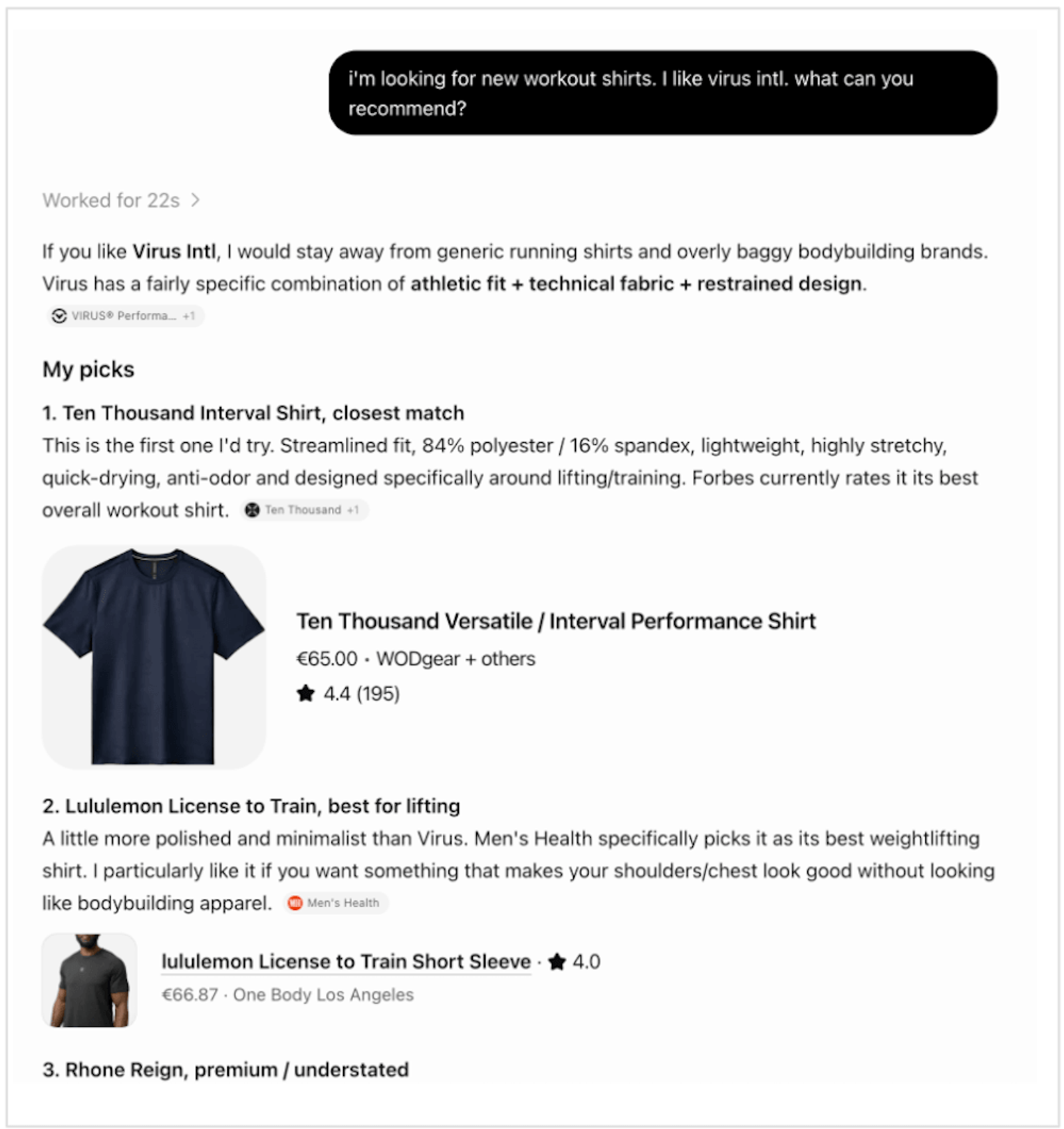
"Agentic shopping experiences are extremely visual and extremely limited in space," Indig said. He pointed to two emerging protocols, Google's UCP and OpenAI's ACP, that let AI agents read a brand's product data and let customers check out directly inside the chat. Shopify has found that products bought through protocol-enabled checkout convert at twice the standard rate, making this the single highest-leverage move on this list.
Reviews, optimized product and category page content, and FAQs still matter too, since they're what these protocols and AI agents pull from to answer shopper questions. "Think about your product and category pages like service reps in a store that help answer questions," Indig said.
2. Win the visit
“People might be qualified that are coming from AI to your store, but they’re not yet confident,” Indig said. “To instill confidence, lean on things like calculators and quizzes. They have much higher conversion rates because they guide shoppers through the experience and help them match with the right product.”
Indig used the example of Lawless Beauty, which has a quiz to find the right shade of makeup. He cited that it has an 80% completion rate, 36% conversion rate, and 34% higher average order value (AOV).
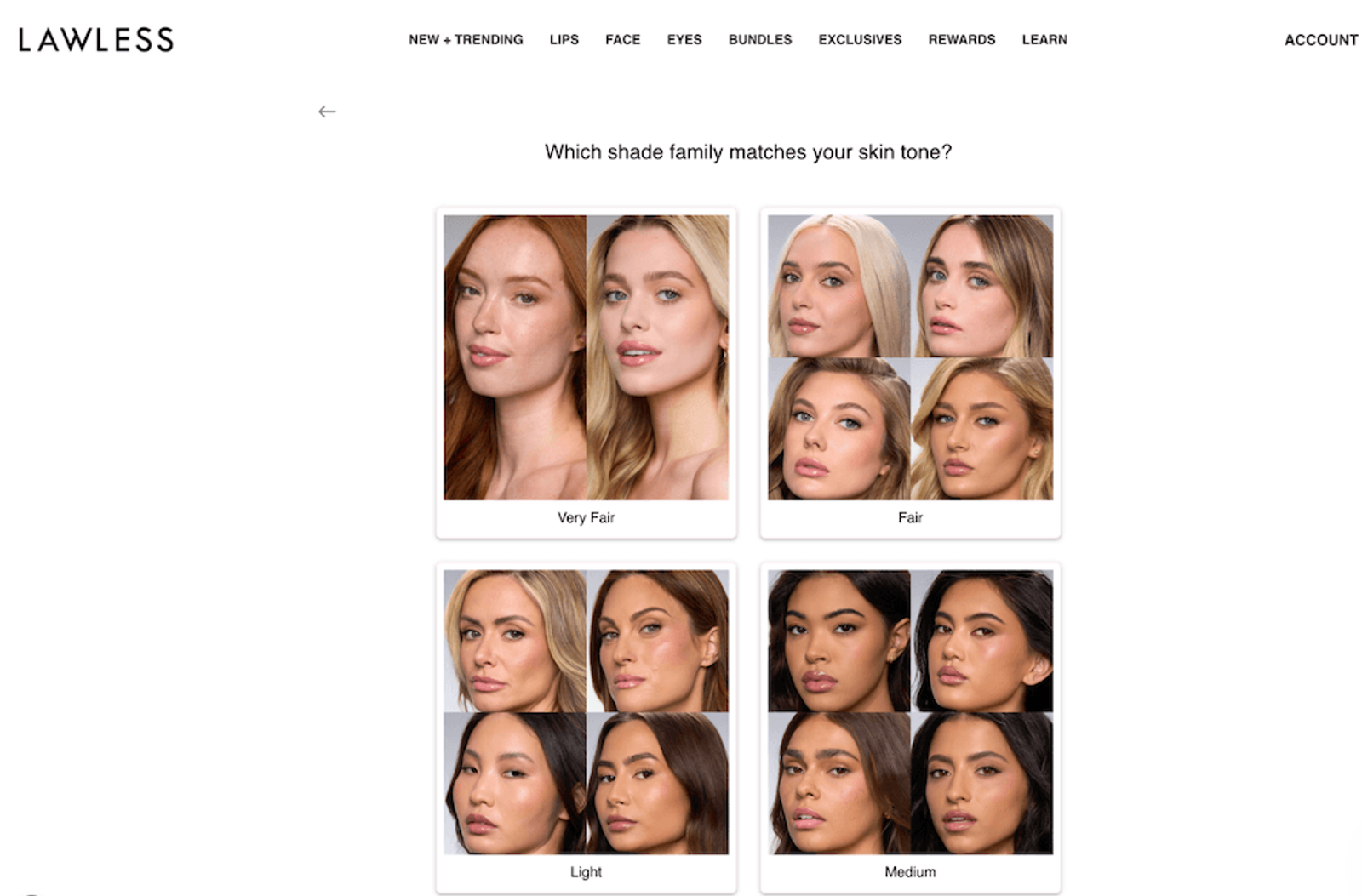
“Quizzes help you match your problem with the ideal product,” Indig shared. “They’re a great way to learn more about customers to drive emails, and powerful ways to capitalize on first party data.”
Along with quizzes and calculators to help visitors find the right product, AI customer service agents are becoming more important to answer questions in real time. “A quiz is a predetermined experience,” Indig said. “But agents can react to what people actually need and the questions they have in the moment.”
He went on to ask attendees what percent of questions in-store service personnel can generally answer. Someone guessed one out of 10. In reality, it’s about 71% for first-call resolution, according to SQM. And AI customer service agents can resolve 65% of questions without a human needing to be involved, with some brands seeing up to 86% of customer queries resolved with AI.
He gave the example of Nanuk, a manufacturer of custom cases for highly sensitive equipment. Their agent can answer about 84% of customer questions. “You can take those questions and interactions and enrich your product pages, and inform your marketing over time,” Indig said.
3. Win the box
“The box is the first real interaction with your product. It’s the packaging that your product arrives in,” Indig said. He told a story about going to Cannes Lions this year, where he came across two security guards handcuffed to a suitcase. Inside was a $10,000 limited-edition Gucci Xbox. Only 100 were ever made, and they sold out in days. It ended up generating buzz at the festival, getting people to take pictures, post about it, and became a viral moment.
All of these experiences, he argued, end up in reviews and show up in the AI search results for your brand. “People go to YouTube, they go to Reddit, they post about it, they talk about it, and all of that finds its way back into the AI answers. Unboxing is a massive promotion for your brand.”
Indig gave a few tips for winning the box:
- Incentivize creators to do unboxing videos and create user-generated content (UGC)
- Design for the reveal, and think about the experience that people have when they open the box
- Ask for reviews a week or two after a customer receives their product, or when they may find value in it
- Reinforce people talking about your product and leaving positive reviews
4. Win the relationship
Repeat customers make up roughly 20% of a brand's buyers but drive nearly half of total revenue. Starbucks is the extreme case: more than 60% of its revenue comes from repeat customers, backed by 75 million rewards members.
Quaker Marine, a much smaller nautical apparel brand, tested something simpler: a short, no-discount check-in note a couple of weeks after purchase. It drove a 16% lift in repeat purchases, even without promotion.
Indig explained that getting a customer to make another purchase relies on signals after the first purchase, and the window starts as soon as they make the first purchase.
Here’s what that journey might look like:
- A customer makes a purchase.
- They receive their product and begin to use it.
- They reach out to support for help.
- They get a timely response, have a positive experience with customer service, and get a reward.
- They receive a relevant marketing message.
- They make another purchase.
If there’s a poor experience in between, you lose the relationship. “There are opportunities to improve the customer experience that go a long way,” Indig said. “Maybe your order confirmation or shipping confirmation includes a video or a note. Maybe you kept them excited about the box coming to the doorstep. Maybe you help them learn more about your product or your brand. These are important touch points in the customer relationship.”
Triggered messages, or flows, that are based on customer behaviors, like order confirmation or shipping confirmations, make up only 5.3% of email sends but account for 41% of email revenue, according to Klaviyo’s 2026 Email Marketing Benchmarks. They also drive 18x more revenue compared to campaigns. “These signals are incredibly powerful. You want to capitalize on them,” Indig explained.
5. Win the name
“Winning the name means driving brand recall or people searching for you directly,” Indig shared. “Branded prompts, like ‘the best Ridge minimalist wallet for me,’ means that if you’re Ridge, AI just needs to match you with the best product. Branded prompts and searches are the best way to win AI. Period.”
To improve AI search visibility for your brand, Indig explained that brands should:
- Get repeat exposure. This could be creator videos, ads, word of mouth, or any marketing activity that gets people to talk about your brand and remember you. “If they know your brand, there’s a much higher chance they’ll seek it out directly,” Indig said.
- Align your brand profiles. Make sure you have the same category descriptors and product facts across your site and all of your third-party profiles.
- Publish your own comparison content. Indig calls this “owning the versus.” Make your brand the reference point and explain what makes you different.
- Measure and monitor recall. Ask new customers how they found out about you, and measure whether people remember you.
Get your brand to show up in the short list
While it looks like a linear journey to go from invisible to an AI-assisted shopper to showing up in their short list, it’s actually a system, where one step reinforces the next.
“Being the top of the short list reinforces the visit, which reinforces the box, which reinforces the relationship and people searching for your brand name, which drives positive signals to AI,” Indig explained.
And while people might not remember what prompt they typed in that led them to a product, they’ll remember the emotions they feel when wearing their favorite coat or putting on a new pair of shoes.

Related content