Five data-driven Christmas marketing strategies
Generated by Klaviyo AI
The article outlines five ecommerce Christmas strategies built around owned marketing channels and customer data. It covers consistent festive branding, personalised gift guides, alternatives to blanket discounts, brand partnerships, and automated price drop alerts.
- Consistent festive branding: A shared seasonal look and consistent messaging across websites, emails, ads, and other channels help shoppers recognise the brand.
- Personalised gift guides: Gift guides organised by recipient or budget can use quiz answers, browsing activity, and purchase history to tailor recommendations.
- Alternatives to discounts: Free delivery bundles, gift wrapping, early access, and loyalty perks offer alternatives to blanket discounts, while targeted offers address shoppers who need an incentive.
- Complementary brand partnerships: Co-branded gift sets and joint giveaways let brands reach each other’s audiences through relevant Christmas offers.
- Automated price alerts: Price drop flows notify opted-in shoppers when products they viewed, added to their cart, or saved go on sale.
You don’t need a Mad Men-sized advertising budget to have a bumper holiday season. For a growing online shop, the campaigns that bring in sales run on channels and customer data you own, from your email list and text message subscribers to your data on purchase history, browsing activity, and web pop-up form answers you already have in your B2C CRM.
You’ve got a few weeks, a fixed budget, and plenty of brands chasing the same shoppers. Retail figures suggest online is a good place to focus. In December 2025, online sales values in Great Britain rose 11.1% YoY, even as overall retail volumes slipped 0.3% October–December compared to the summer quarter. In other words, Britain’s shoppers bought a touch less overall but spent noticeably more online.
These 5 Christmas marketing ideas fit around the dates already in your marketing campaign calendar, from Black Friday to your last order dates.
1. A festive refresh for all your marketing channels
Shoppers notice when ads, emails, and websites look like they’re coming from different brands, and that mismatch may make them hesitate before buying. An inconsistent brand can feel less trustworthy: the No. 1 consumer frustration when shopping across channels is inconsistent pricing and promos, according to Klaviyo’s 2025 Future of Consumer Marketing Report.
At Christmas ,that consistency includes the season itself. If your online shop doesn’t look or feel like Christmas, someone who interacts with your festive marketing communications and lands on a website that hasn’t changed much since summer may check whether they’re in the right place. It’s like walking into a shopping centre in December and finding no Christmas tree.
That pause may especially cost you with first-time shoppers, who don’t have past orders with you to reassure them. Repeat customers already know your brand and may not notice or care about the mismatch.
Christmas email templates are a great starting point for developing consistent, festive branding for your Christmas communications. From there, an AI marketing agent can draft the copy and design for a Christmas-themed cross-channel campaign, and an AI photo editor can remix your existing product shots with holiday themes, both based on your brand guidelines, product catalogue, and customer data.
Whichever tools you end up using, choose one palette, holiday backdrops for your product photos, and copy that sounds festive and still sounds like you, so shoppers recognise the look as yours.
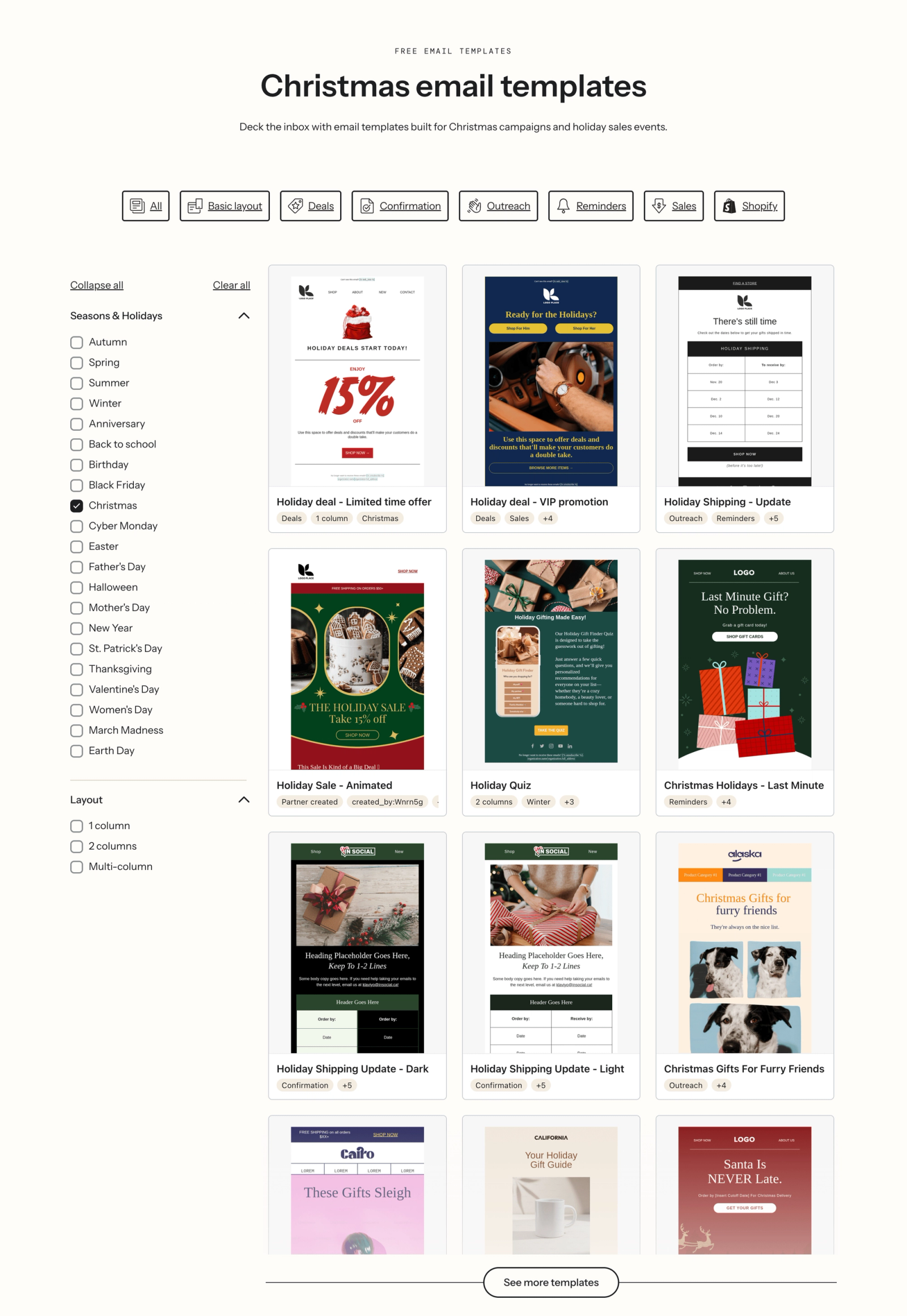
Then, use this holiday branding across your website and in your sign-up forms, self-serve customer hub, emails, WhatsApp and text messages, mobile push notifications, and ads. That way, a shopper who clicks a festive email or ad lands on a page that matches it, and a shopper who signs up for marketing on your website receives consistent messaging, too.
A note on sign-up forms: You don’t necessarily have to offer a discount to give shoppers a reason to sign up for marketing. Instead, consider offering a gift guide (more on this next) in exchange for an email address or phone number. AI can help you figure out the form placement and timing that drive more submissions.
And if you’re collecting phone numbers, make sure you add clear consent wording next to the field. Text message marketing requires explicit consent under the Privacy and Electronic Communications Regulations (PECR).
2. Gift guides organised by recipient or budget
Two-thirds of shoppers (67%) already have a gift idea before they start searching, according to Klaviyo’s 2026 State of the Holiday Buyer Report. A gift guide helps those people find exactly what they’re looking for fast, and gives the rest a shortlist to start from.
The same holiday shopping trends also show that many shoppers like to get in early, with 36% saying they love early access to sales. Consider launching your gift guide in November and sharing it with your subscribers first to reach those early shoppers. If you’re running behind, there’s still time to catch the early- to mid-December shoppers.
There isn’t a one-size-fits-all approach to crafting gift guides, but broadly speaking, shoppers tend to think about gifts either by person or by budget. A guide organised by recipient groups gifts under headings like “For the host,” “For the person who has everything,” or “For the new parent”. A guide organised by price groups gifts under headings like “Stocking fillers under £20,” “Plants under £50,” or “Smart watches under £100.”
Hypothetically, with a £20 Secret Santa limit and a colleague someone’s not familiar with, narrowing down gifts by price is an easy way to find something about right without overthinking gift-giving.
From there, you can get more out of your Christmas gift guides by personalising them and putting them in front of the right shoppers:
- Quiz responses that feed your marketing: Launch an on-site gift-finding quiz that first asks whether the gift is for the shopper or someone else, then narrows the options by recipient, taste, and budget. In a B2C CRM like Klaviyo, those answers land in each customer’s profile so you can later build segments from them, such as everyone shopping for gifts under £50.
- Automated gift guides: A completed gift-finder quiz can trigger an automated flow that sends gift ideas matching the shopper’s answers.
- AI customer service conversations that feed your marketing: Instead of or in addition to a quiz, an AI customer agent on your website can ask shoppers about their preferences in a chat. Based on their responses, the AI agent can recommend relevant products from your catalogue in-conversation, while also feeding those preferences back into the customer’s profile for future personalised marketing efforts.
- 1:1 personalised gift guides: Add AI-powered personalised product recommendations like next best product to your gift guide messages. That way, returning customers see gifts based on their unique browsing and buying history, not just messaging developed for an entire segment.
- Cross-channel communication: Send the full gift guide via email, then send short text messages, WhatsApp messages, or push notifications that link back to the guide.
In this Christmas marketing example, The Body Shop puts their gift guide front and centre. The hero shot of a strawberry gift set promises “feel-good, body-loving gifts, right this way” above a “Discover our gift guide” button. Further down, the email splits the guide into routes shoppers can tap straight into, from “Bath & Body Gifts” to “Stocking fillers,” and closes with “Ranges loved by you.”

Balique, a beauty brand, uses a Typeform quiz to ask about hair type, texture, condition, and care habits. Each completed quiz adds those answers to the shopper’s profile and triggers an email flow with matching product recommendations and expert tips.
Beyond the initial flow, Balique continues to use the quiz data to personalise marketing automations and drive conversions. Their email flows convert at 6.3% on average, 4x their sector’s benchmark. Swap the hair questions for questions about recipient, taste, and budget, and the same set-up could work as a Christmas gift finder.
3. Christmas shopping incentives that don’t involve a discount
You might win Christmas orders with a sitewide discount, but you’d be giving away margin on sales you might have made anyway. And, if your Black Friday discount runs deep, some shoppers may learn to hold out for your next sale.
Consider these alternatives instead of a blanket Christmas discount:
Targeted discounts for price-sensitive shoppers
If you offer a Christmas discount, save it for shoppers who need one to buy. Recency, frequency, and monetary value (RFM) analysis groups customers by how recently they last ordered, how often they buy, and how much they spend. And where RFM looks back at past orders, predictive analytics looks ahead. It uses AI to estimate how much each customer is likely to spend with you over time, known as customer lifetime value (CLV), and how likely they are to stop buying.
Customers with a high predicted lifetime value may buy without a discount, so early access could be enough. At-risk customers who haven’t ordered in a while may need a win-back offer before Christmas. Send each group a segmented campaign with the incentive that fits.
Product bundles with free shipping
Instead of a discount, price a product bundle just above your free delivery threshold instead of cutting prices, so it qualifies for free delivery without a big jump in price. With a £50 threshold, for example, pair a £36 candle with a £16 wick trimmer and matches set, for a £52 bundle. An order that might have been £36 becomes £52, and free delivery does the job of a price cut.
Your abandoned cart flow can nudge the same way. If a shopper leaves the £36 candle in their basket, encourage them to “Spend £14 more for free delivery.”
Before you promote your bundles, keep in mind that the Competition and Markets Authority (CMA) bans drip pricing, where compulsory charges appear after the headline price. Under the CMA’s unfair practices guidance, the price in your email, WhatsApp, text marketing message, ad, or any other similar communication has to include VAT and any mandatory fees. If delivery isn’t free below your threshold, clearly state what it costs.
Free gift wrapping options
Free gift wrap is another perk that can cost you less than a discount. If paper, ribbon, and a tag cost £1.50 a set, that’s well under the £5.20 you’d give away with 10% off a £52 bundle. Just remember to factor in the time it takes to wrap each order.
Early access to holiday sales
Early access can win people over, too. 36% of consumers say they love early access to sales, according to Klaviyo’s 2026 State of the Holiday Buyer report, and it’s a perk you can tease directly through your email, text messages, and WhatsApp.
Bonus loyalty perks
Bonus loyalty points reward the next customer order without necessarily cutting today’s price. Run rewards through an ecommerce loyalty integration, but check the multiplier first. If shoppers earn one point per £1 and 100 points unlock a £5 reward, double points costs as much as a 10% discount, as long as the shopper eventually comes back to redeem.
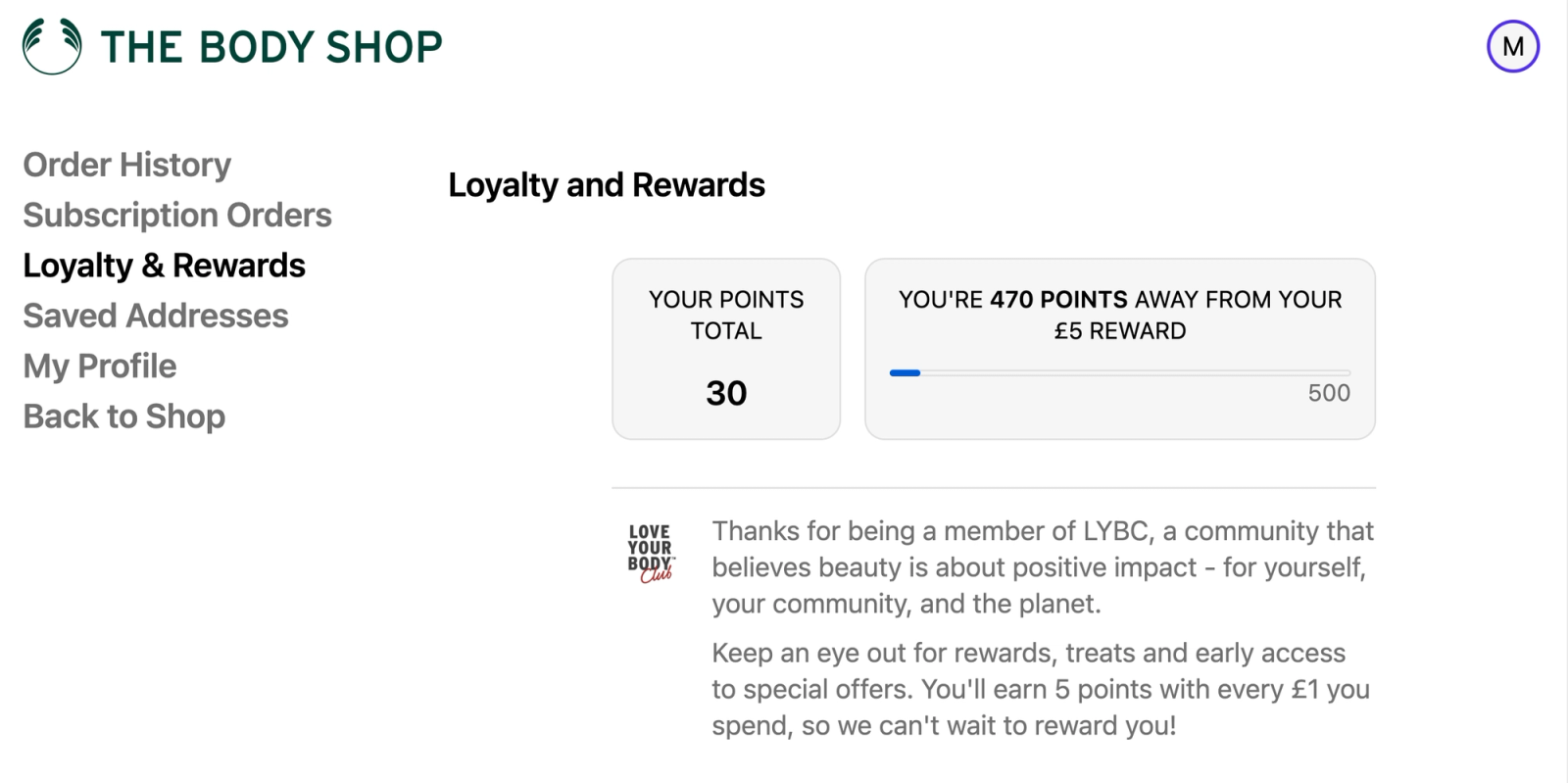
And remember, points only bring shoppers back if they’re top of mind. In The Body Shop’s self-service customer portal, a Love Your Body Club member sees a 30-point total next to a progress bar showing they’re 470 points from a £5 reward.
At 5 points per £1, that’s £94 of spending. On double points, a £52 gift bundle would earn 520 points and unlock the reward in one order. Show the balance in your marketing communications too, and remind members to redeem before Christmas.
4. Brand collabs and joint giveaways
No brand is too big or too small for a partnership. Reaching new shoppers in December can mean paying more for ads, with so many brands competing for attention. A collab borrows an audience instead. Two brands team up on a co-branded gift set or a joint giveaway, and each reaches the other’s audience, or at least the slice most likely to love what the other brand sells.
Some pairings are obvious, like a candle maker with a ceramics studio, or a speciality coffee roaster with a mug maker. Others take a little more imagination. Good partners might share your values, sell to people who look a lot like your customers, or simply make sense at Christmas.
British fashion designer Paul Smith works with other brands on jointly created products for customers with similar tastes. In the run-up to Christmas 2025, Smith joined a blindfold guessing trend. His social media team handed him pieces from the brand’s Christmas gift shop, and he had to guess what each one was.
Watch the full reel on Instagram
“This one is quite easy because we’ve done a collaboration with an Italian company called Alessi for opening all those Christmas wines,” Smith says in the video.” After the Alessi wine opener comes a rugby polo shirt (“beautifully heavy for this winter weather,” Smith says), a stripe book, orange socks, and a knitted scarf. Paul Smith doesn’t sell wine openers, and Alessi doesn’t make polo shirts. Both products still ended up in the same Christmas gift shop in 2025.
What you make together is up to you and your partner. A gift set, a Christmas giveaway, or a limited gift bundle can all work, as long as your customers and theirs hear about it.
Paul Smith could also use a post like this to collect email and SMS sign-ups and grow their owned marketing lists around Christmas time. The caption might invite followers to comment with a keyword, such as “GIFTS”, or send it in a DM to get the brand’s gift guide. An automated Instagram DM would then send over the guide and ask shoppers to opt in to updates. That way, the conversation that starts on social media can carry on in the inbox right through December.
5. Price drop flows for saved items
Some wishlists live on sticky notes, in a notes app, in a letter to Santa, or in someone’s head. Others live on your website as favourited items. Those saved items are telltale signs of what a shopper wants.
Why haven’t they bought yet? Some shoppers may be biding their time until the price drops. In Klaviyo’s Holiday Shopping Trends 2026 report, 38% of consumers say they plan to use AI to compare prices or find deals, and 20% plan to use it to track price drops. Shoppers like these weigh up whether BFCM, the weeks after it, or the Christmas sales will bring the lowest price.
Price drop flows catch the moment a price falls for one of your products. When an item someone recently viewed or added to their cart goes on sale, the price change triggers a flow that sends the new price via the marketing channels they’ve signed up for. The offer feels personal because the shopper picked the product.
With a self-service ecommerce customer portal built into a B2C CRM, when a shopper favourites or wishlists an item, that gets logged on their unified profile. You can also narrow your price drop flow so it only alerts shoppers who’ve saved the discounted item. Or use that data to build a segment of everyone who saved items from one collection, then send them a Christmas campaign when it goes on sale.
Fashion brand Folk Clothing gives shoppers a self-service panel that slides out over their website. In the “Favourites” section, a saved light pink T-shirt displays a sale price of £55, down from £75, with an “Add to cart” button below it. Under “Top picks for you,” the panel suggests a shirt and a pair of trousers, both also marked down.
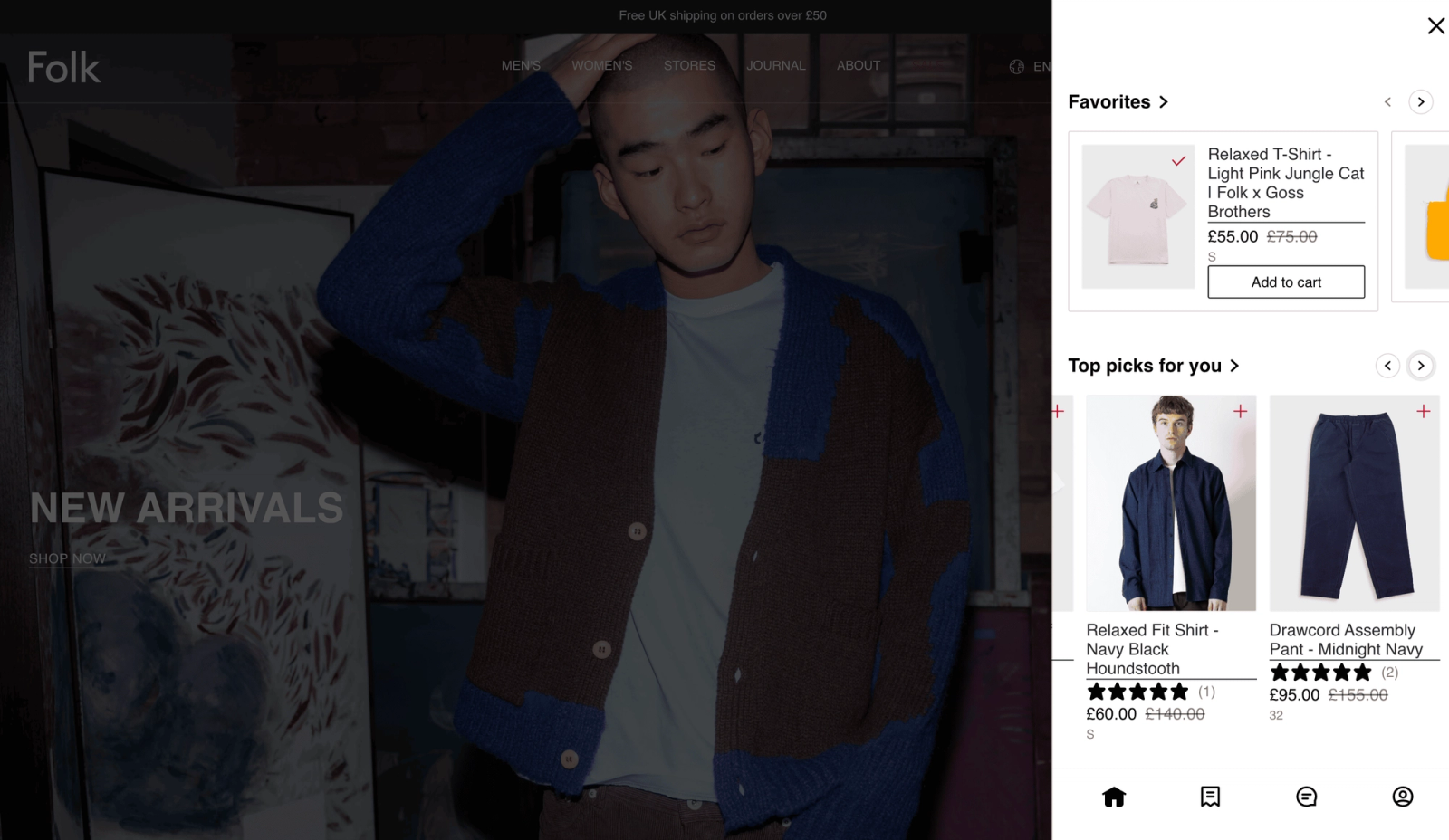
Now picture the same client panel in December. “Favourites” might show which saved items have been marked down for Christmas. “Top picks” could be pulled from gift guides. And if a saved item drops in price, your price drop flow can alert the shopper, too.
H2: You’ve got the data. Now use it for Christmas.
You’re unlikely to run out of Christmas marketing ideas for your online shop if you use your own customer data. Each idea here builds on what your customers browsed, saved, bought last December, or told you in a gift-finder quiz, because Christmas may look different for each of your customers.
Klaviyo, the autonomous B2C CRM, makes that possible by combining your customer data, marketing automation, customer service, and agentic AI all in one platform. Klaviyo AI can take some of the guesswork out of your Christmas timing and copy.
To brainstorm, start with Klaviyo’s AI prompt library. Load these ready-to-use prompts into Composer, Klaviyo’s AI marketing agent, and Composer drafts an on-brand campaign or flow complete with copy, visuals, and audience and timing recommendations. Composer can also audit your past performance to uncover where you might be missing opportunities to improve. No Christmas campaign or flow goes live to customers without your review.

Related content