More people are turning to AI for shopping to guide their next purchase, just as they would with Google and TikTok.
As a B2C brand, you can likely assume that some of your customers are discovering your products through LLMs like ChatGPT and Gemini. In fact, 39% of consumers have purchased a product recommended by AI in the past 6 months, according to Klaviyo’s 2026 AI Consumer Trends Report.
The research, which grouped 8,000 consumer respondents into 4 personas based on their AI usage and trust, found that 85% of AI Enthusiasts (26% of total respondents) have used AI while shopping over that same timeframe.
What’s especially interesting is that AI for shopping is happening across channels that brands own and those they don’t. On the one hand, consumers use LLMs like ChatGPT, Google Gemini, and Perplexity to research, compare, and click through to purchase. On the other hand, brands are integrating AI throughout the customer experience.
Today, B2C brands are using AI for shopping to:
- Scale 1:1 personalization across marketing and service.
- Guide shoppers toward purchase with AI assistants.
- Serve customers more quickly with AI-driven support.
Here’s what AI for shopping looks like in practice, and how real-life B2C brands are embracing it to increase sales and deepen customer loyalty.
What is AI for shopping?
AI for shopping is the process through which consumers use LLMs and other AI agents to discover, compare, and buy products.
The AI shopping experience has some distinct qualities compared to traditional search:
- Shopping is conversational and contextual. Rather than searching for a product and hopping through websites to conduct research, consumers are having conversations with AI agents like they would with a personal shopper. They’re getting recommendations that align with previous searches and answering follow-up questions from the AI to find exactly what they need.
- Consumers use more descriptive, emotional language with LLMs. According to our AI Consumer Trends Report, 30% of AI searches contain 8+ words, and 78% of consumers include emotional or personal context at least some of the time. For example, someone might search, “I’m looking for accessories for my office that feel warm and inviting. My office is too cold, and I’d rather my space feel cozy so I like sitting down to work.”
- Product discovery, comparison, and purchasing can happen in one place. With brand-side AI customer agents and shopping assistants, consumers can find new products, compare options, and even check out in one interaction, rather than searching across websites and marketplaces. This may soon be true of LLMs as well.
What do consumers want from AI shopping experiences?
AI can accomplish more for product discovery and comparison in fewer steps. But when customers use AI for shopping, they want more than just speed.
Consumers look to AI shopping experiences for:
- Personalization: 55% of all consumers have had at least one “aha” moment when AI impressed them with accuracy or personalization, according to the research behind our AI Consumer Trends Report. AI can offer more in-depth, contextual personalization in a way that traditional search and social media algorithms can’t.
- Simplification: Consumers’ most common “aha” moment happened when AI clearly explained a complex concept in simple terms, according to our research. LLMs and brand-side AI agents can give shoppers valuable context about new or expensive purchases by consolidating a lot of information to a single, quick response.
- Efficiency: 62% of consumers would prefer that AI remember their preferences over re-explaining them to a human customer agent, according to the research behind Klaviyo’s 2025 Online Shopping Report. To save customers time and effort, brands can train AI customer agents to reference customer data and, when necessary, hand off conversations to humans with complete context preserved.
How do consumers use AI to shop?
43% of consumers have used AI when shopping for non-essential products in the past 6 months, according to our AI consumer trends research. Most often, they use AI to search for products in electronics or technology, travel or hotels, and health or beauty.
Our research also found that 70% of consumers have used AI multiple times to find the best product or deal, and 69% have used it multiple times for general product recommendations.
But even as many shoppers experiment with AI, not everyone is ready to hand off the entire buying process to it. 85% of consumers have at least some trust in AI to provide accurate and personalized shopping recommendations, but only 27% completely trust AI to do so.
In 2025, 65% of consumers expected 2026 to be the year AI assistants become a normal part of online shopping, according to the research behind Klaviyo’s 2025 AI Shopping Index.
Where do AI shopping experiences break down?
Despite increased AI use on the consumer side, brands still face a learning curve. The results you see from AI depend on many factors: the quality of your data, how it’s integrated across your tech stack, and the guardrails around it.
Consumers know inadequate AI when they see it. And when they see it in their shopping experience, that translates to missed revenue for your brand.
Here are consumers’ biggest red flags when using AI for shopping:
- Delayed answers: According to our AI shopping index research, 75% of consumers have abandoned a purchase because they couldn't get instant answers. Structuring your product catalog for LLM discoverability and training your AI customer agents to answer FAQs are the new requirements for converting customers.
- Inadequate personalization: After receiving poorly personalized content, 21% of consumers become less likely to open messages from a brand, according to our AI consumer trends research. This underscores the importance of AI product recommendations that pull from real-time customer data, so your messages reflect real context on the customer’s end.
- Detached support: Less than half of consumers (43%) say AI has improved customer service quality, and 42% of people feel neutral about it, according to our AI consumer trends research. The No. 1 consumer concern about AI in brand experiences is customer service interactions that make them feel like they’re talking to a robot. Train your AI agents on customer and product data so support doesn’t feel generic.
- Misinformation: 27% of consumers are most uncomfortable with AI when it shares inaccurate, misleading, or low-quality responses, according to our AI consumer trends research. Inaccurate answers about your products can damage your brand’s reputation, whether the misinformation comes from an LLM or a brand-side AI customer agent.
What does the consumer AI shopping experience look like?
The consumer AI shopping experience varies across LLMs and brand websites. But given the recent launch of two open standards for agentic check-out—Agentic Commerce Protocol and Universal Commerce Protocol—there may be more cohesion in the near future.
Let’s look at a few examples of the AI shopping experience today:
Perplexity
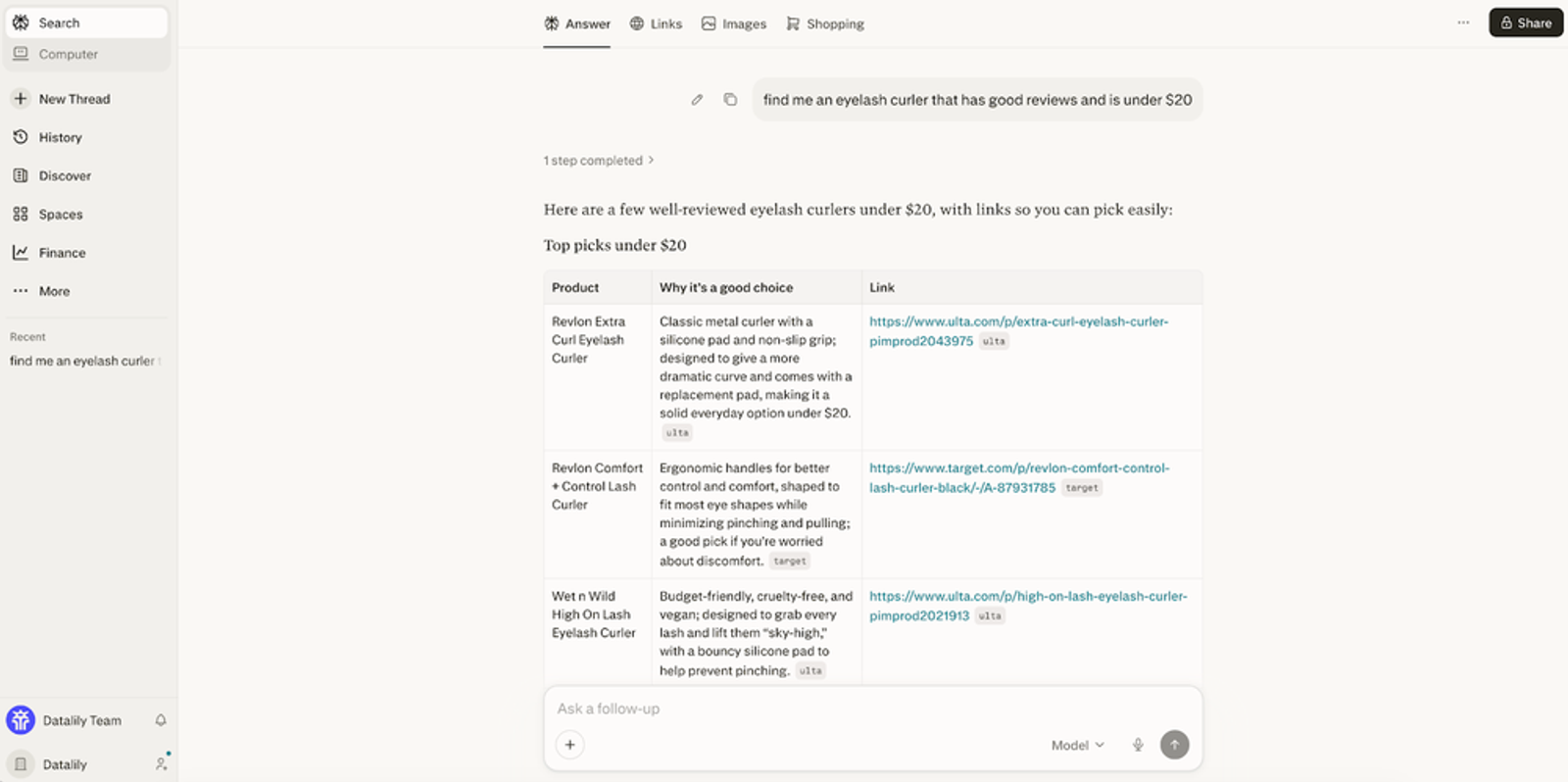
Here’s an example of a consumer using Perplexity AI to shop for an eyelash curler.
The user searches, “find me an eyelash curler that has good reviews and is under $20.” In the Answer tab, Perplexity finds a few options, creates a comparison table, and links out to where the consumer can make a purchase.
In the Shopping tab, Perplexity displays more in-depth product cards for top picks. These product cards include star ratings, summaries of customer reviews, and multiple links for where to buy the item. Each product card also cites specific review sources, which often include the brand’s website, Reddit threads, TikTok posts, and third-party review sites.
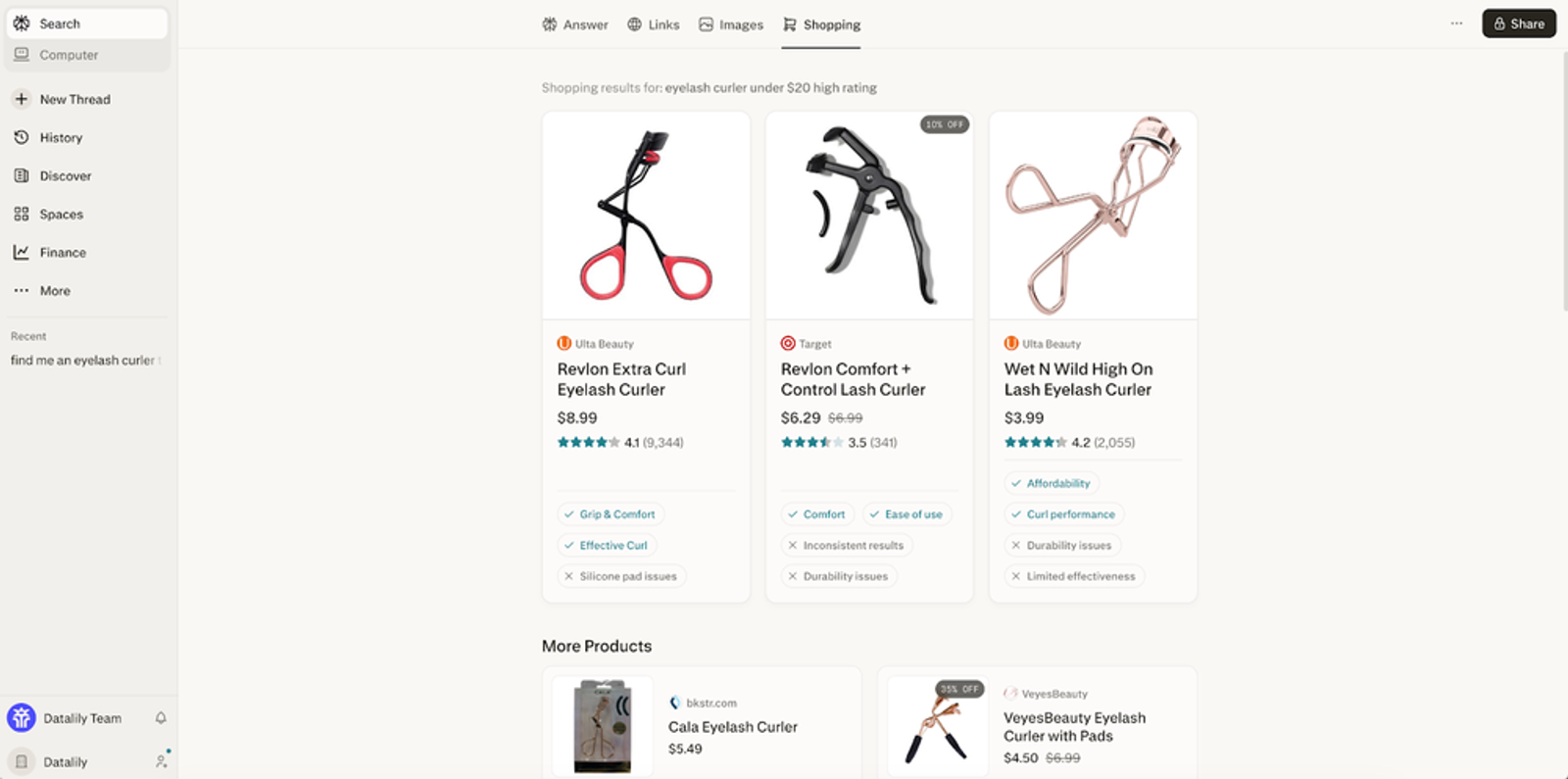
In 2025, Perplexity partnered with PayPal and Venmo to launch Instant Buy, an agentic check-out option for US users.
In this Google AI Search example, the shopper asks about a pair of Reeboks that are stylish and good for running and weightlifting. Google provides a comparison table, then asks a follow-up question to help narrow down available options.
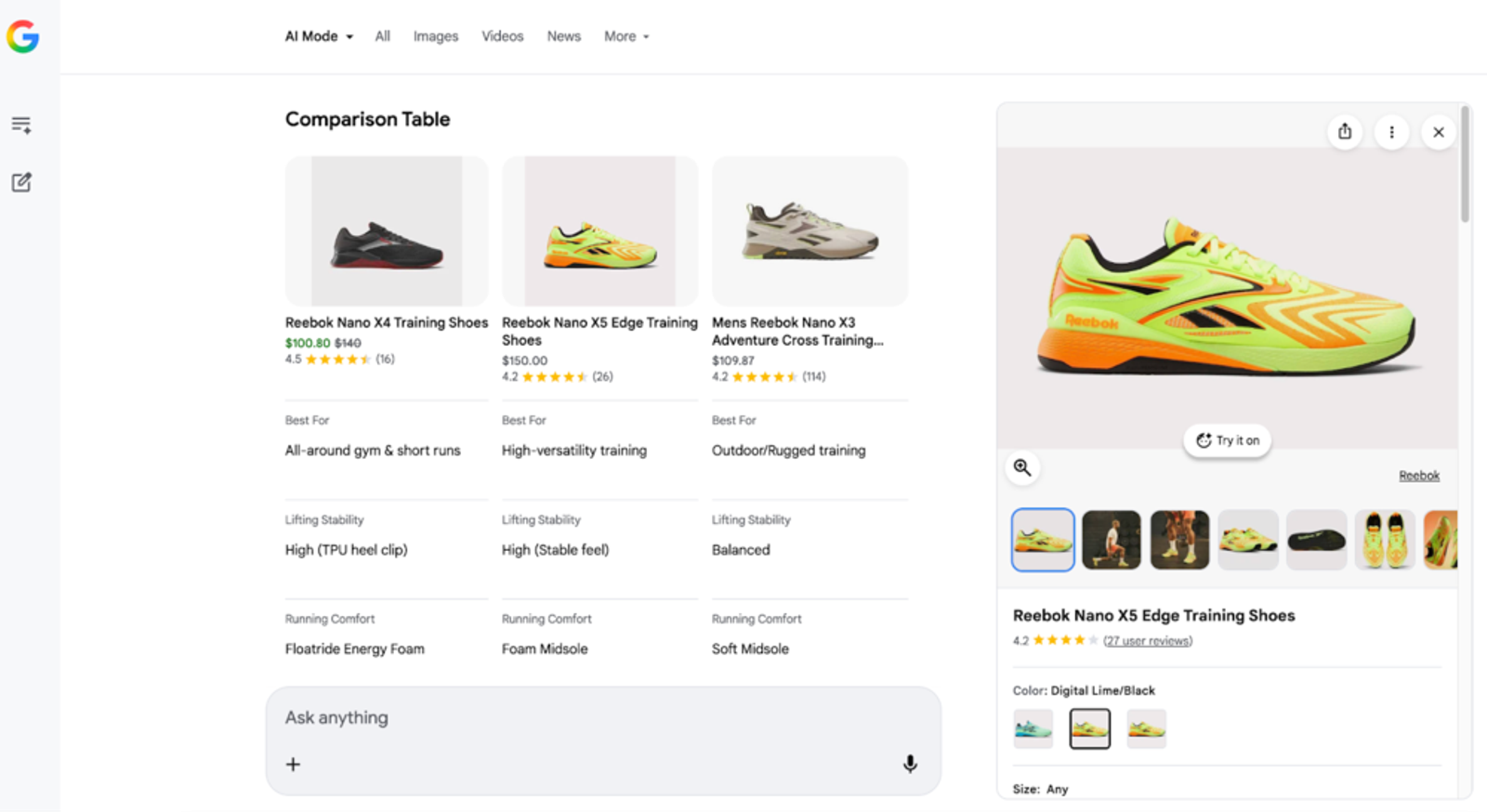
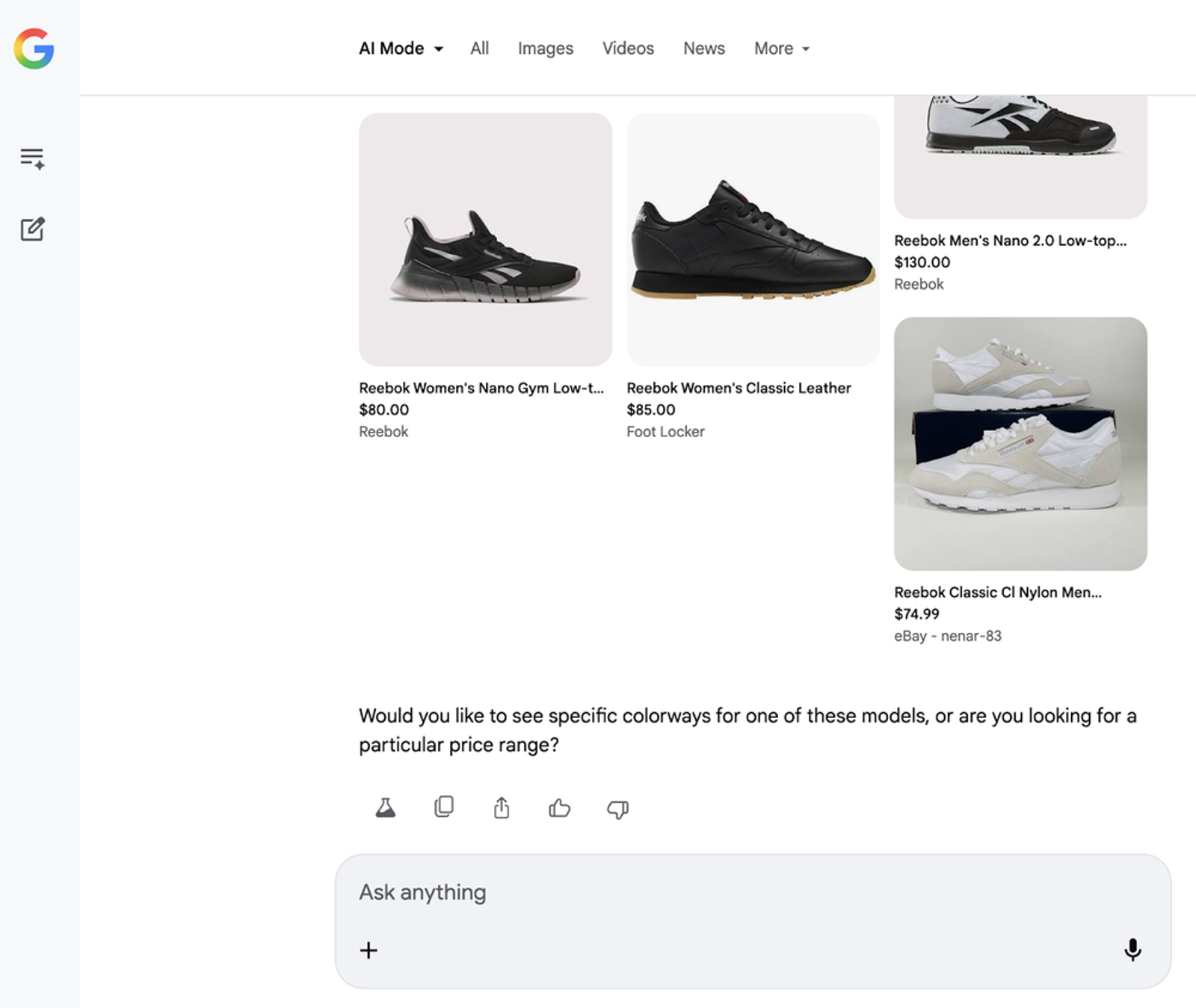
In 2025, Google launched agentic check-out in Google AI Search and Gemini with select retailers, so that consumers can find and eventually purchase what they’re looking for from the same interface.
Brand-side AI customer agents
Brand-side AI customer agents are AI agents customers can interact with on a brand website. While many brands primarily use AI agents for customer service, they can also assist shoppers during the research phase the same way LLMs do.
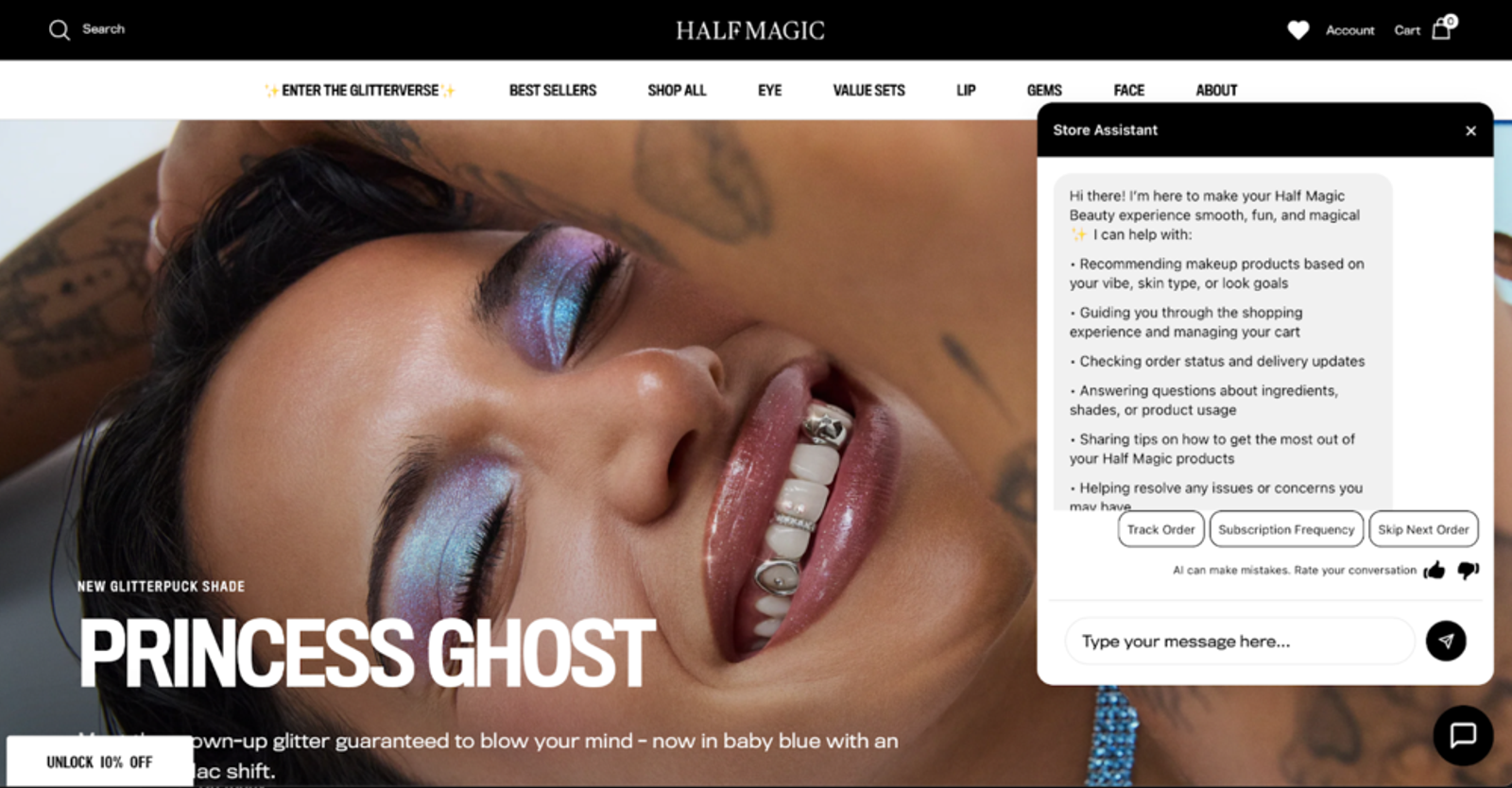
Here’s an example of an AI assistant from beauty brand Half Magic. The conversational chat experience invites consumers to ask for product recommendations, check order statuses, share product usage tips, and more.
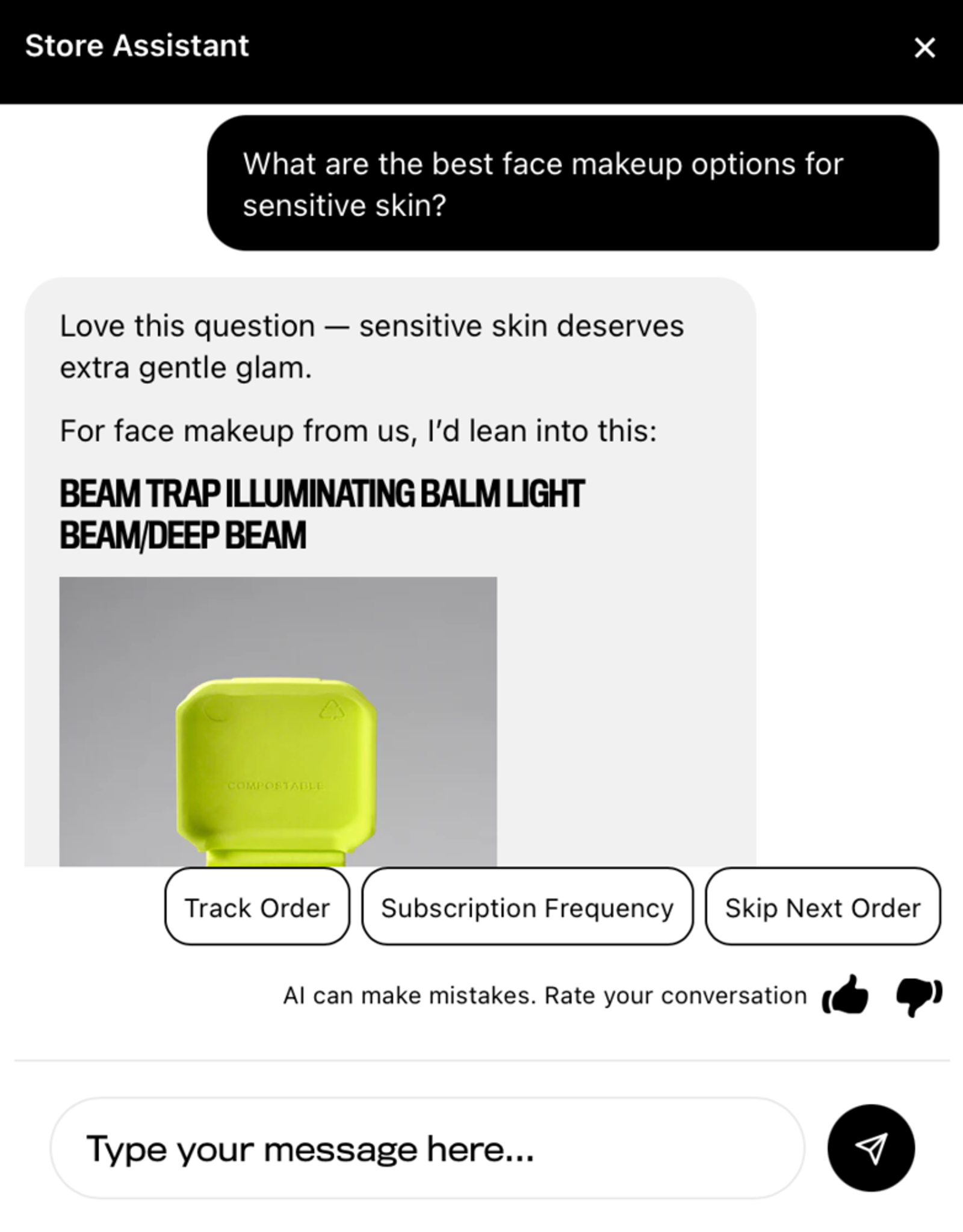
In this exchange, the shopper prompts the assistant to find face makeup options that work well for sensitive skin. The assistant follows up in a fun, friendly tone with an initial recommendation that links to a product listing.
4 examples of how brands are using AI shopping to drive revenue
B2C marketers’ top technology stack priority for 2026 is to expand their AI adoption, according to Klaviyo’s 2026 future of consumer marketing research. If that’s you, here’s a little inspiration from 4 real-life brands that are already delighting customers with AI shopping experiences:
1. Happy Wax’s AI customer agent is a product research shortcut
Ahead of the hectic 2025 holiday season, home fragrance brand Happy Wax launched an AI customer agent on their website. Drawing from customer and product data, the personalized AI assistant works 24/7 to resolve issues, answer questions, and recommend products.
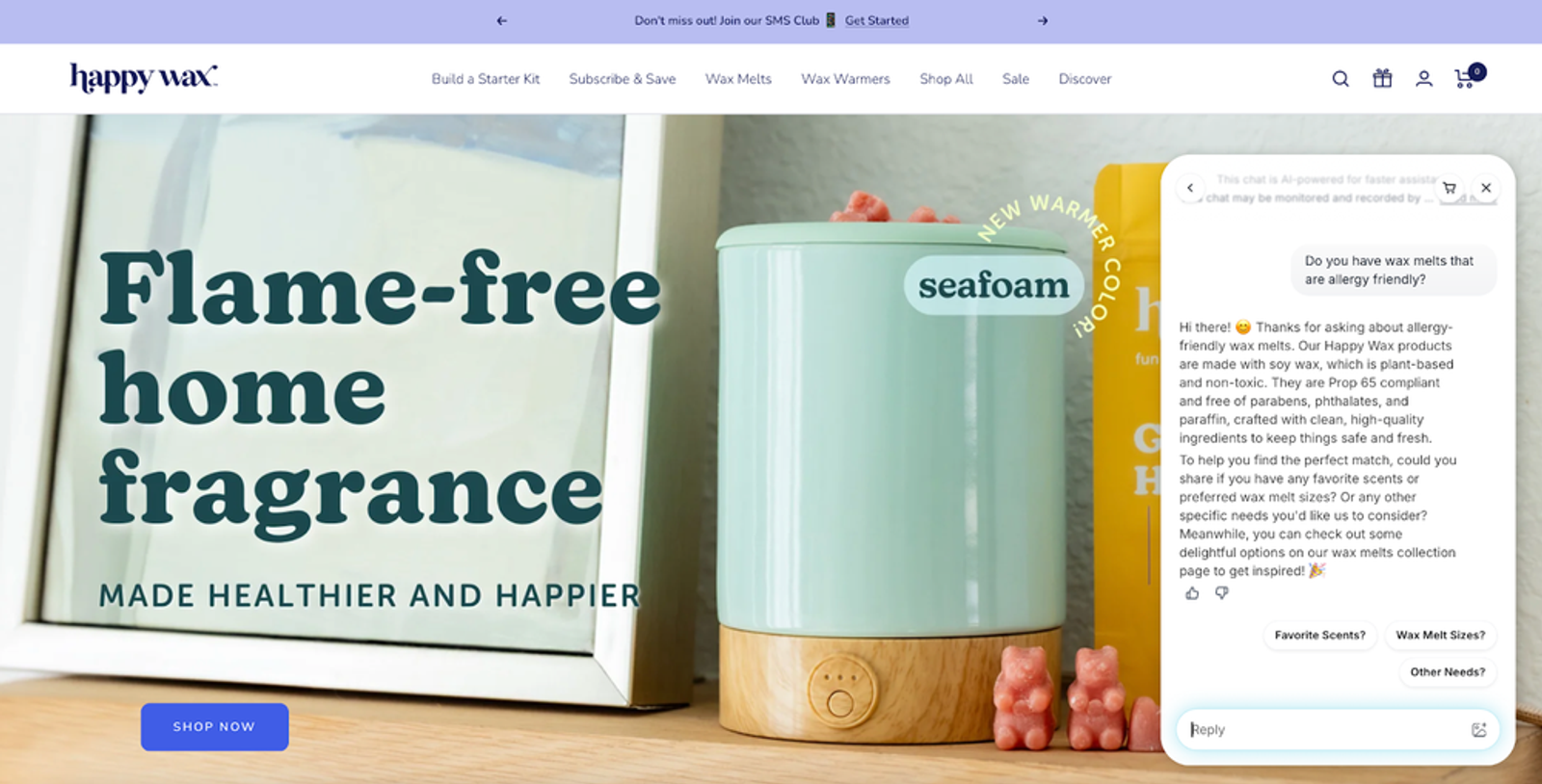
Over a 90-day period, over 50% of conversations handled by the AI agent were fully resolved without any service team involvement. “Customers get instant answers, and our team gains bandwidth for high-touch moments,” says Rachel Fagan, VP of marketing at Happy Wax.
2. Harney & Sons’ AI customer agent resolves product recommendation queries
Family-owned tea brand Harney & Sons uses an AI customer agent alongside a self-serve customer portal and a shared helpdesk where human and AI agents can handle customer requests across channels.
The AI customer agent works 24/7 to answer support and recommendation queries autonomously. If the conversation needs a human, the AI agent passes it on to the human customer service team’s helpdesk with full context. But in 60 days, the AI agent resolved 77% of product recommendation queries on its own.
3. Folk Clothing’s AI customer agent takes over simple support
For years, the team at London-based fashion brand Folk Clothing struggled with customer service logistics that relied on a basic email inbox and a phone line that was easily overwhelmed. So, the brand implemented an AI customer agent that could provide instant answers to common customer questions, without any input from the team.
In 90 days, Folk Clothing’s AI customer agent resolved 53% of support conversations. “It’s already made a noticeable difference to my workload,” says Hayley Scott, ecommerce coordinator at Folk Clothing. “I was relieved to see that even our most loyal clients, who are used to high-touch service, haven’t noticed a drop in quality.”
4. Svenfish shows customers what they need before they know they need it
Fresh seafood brand Svenfish uses AI behind the scenes: to support a high-volume, highly-targeted campaign strategy. They used to send discounts to their whole list, but now, they only offer them to disengaged customers who haven’t bought for 3+ months.
Svenfish also uses predictive analytics to reward high-value customers whose forecasted customer lifetime value is greater than $200. This has not only helped them shrink their win-back segment and improve margins. It’s sparked real shopping and purchases from their audience, too: Svenfish made 82% of their YTD Klaviyo revenue using one or more AI features.
How Klaviyo positions your brand to succeed with AI for shopping
AI shopping isn’t the future. It’s already here. If you haven’t already, now is the time to plan for how you’ll embed AI across your customers’ shopping experience.
Klaviyo is the autonomous B2C CRM that unifies your customer data, marketing, service, analytics, and agentic AI in one platform. Consider how Klaviyo can help you take advantage of AI shopping opportunities at each phase of the customer journey:
- Discovery: Optimize your content for LLM visibility with well-structured product catalogs and a robust customer review strategy. Launch campaigns faster with an AI marketing agent like Klaviyo Composer, and drive better engagement with more precise targeting and fresh content.
- Nurture: Use AI to develop more 1:1 customer relationships. With Klaviyo, you can send messages at each shopper’s preferred time, on their preferred channels. Create voice and tone guardrails for all AI-generated content, so every interaction feels on-brand and human.
- Conversion: Use an AI shopping assistant like K:AI Customer Agent to answer pre-purchase questions, share personalized recommendations, and find relevant offers.
- Retention: Grow customer loyalty with retention messaging rooted in when customers buy, what they’re interested in, and their lifetime value. Use Klaviyo’s predictive analytics to identify at-risk customers before they churn and trigger personalized win-back flows.
- Analytics: Use the Klaviyo app for ChatGPT or connector with Claude to gain access to your analytics through simple text prompts. Lean on your AI assistants to capture zero-party data that can enrich customer profiles and improve future personalization.
Klaviyo helps brands scale with AI while maintaining customer trust. Sign up