The Universal Commerce Protocol (UCP) is an open source standard developed by Google that supports agentic commerce.
As the infrastructure behind AI product discovery and purchase, the UCP establishes a shared language between AI models, brands, and payment providers. It standardizes how stores, apps, and platforms exchange information about products, prices, payments, etc.
With the UCP, merchants, payment providers, and AI agents can connect to one another without building custom integrations every time.
The UCP is compatible with other emerging standards in agentic commerce, including:
- Agent Payments Protocol (AP2): AP2 handles secure payment authorization between AI agents and payment systems.
- Agent2Agent (A2A): A2A allows different AI agents to communicate with each other, exchange information, and coordinate actions across platforms.
- Model Context Protocol (MCP): MCP gives AI models structured access to external tools and data sources.
Google co-developed the UCP with partners such as Shopify, Etsy, and others, with more than 20 additional endorsements from American Express, Mastercard, Visa, Stripe, and more.
How does the UCP work?
The first iteration of the UCP was built to support both product discovery and check-out within Google Search and Gemini.
Retailers can integrate with the UCP by connecting their product feed, check-out logic, and payment provider through a set of standard API endpoints. When a purchase happens on a Google AI surface, the order flows through those endpoints, and the retailer pushes order updates back to Google.
Here's what the customer experience will look like with the UCP:
- The shopper enters a natural language query into Google Search AI Mode or Gemini. For example, "Find me a travel skincare kit under $60 that ships in two days."
- Google’s AI agent queries UCP-enabled merchants. The AI agent pulls live product data, such as inventory, pricing, shipping timelines, then customizes its rankings based on the shopper’s previous searches.
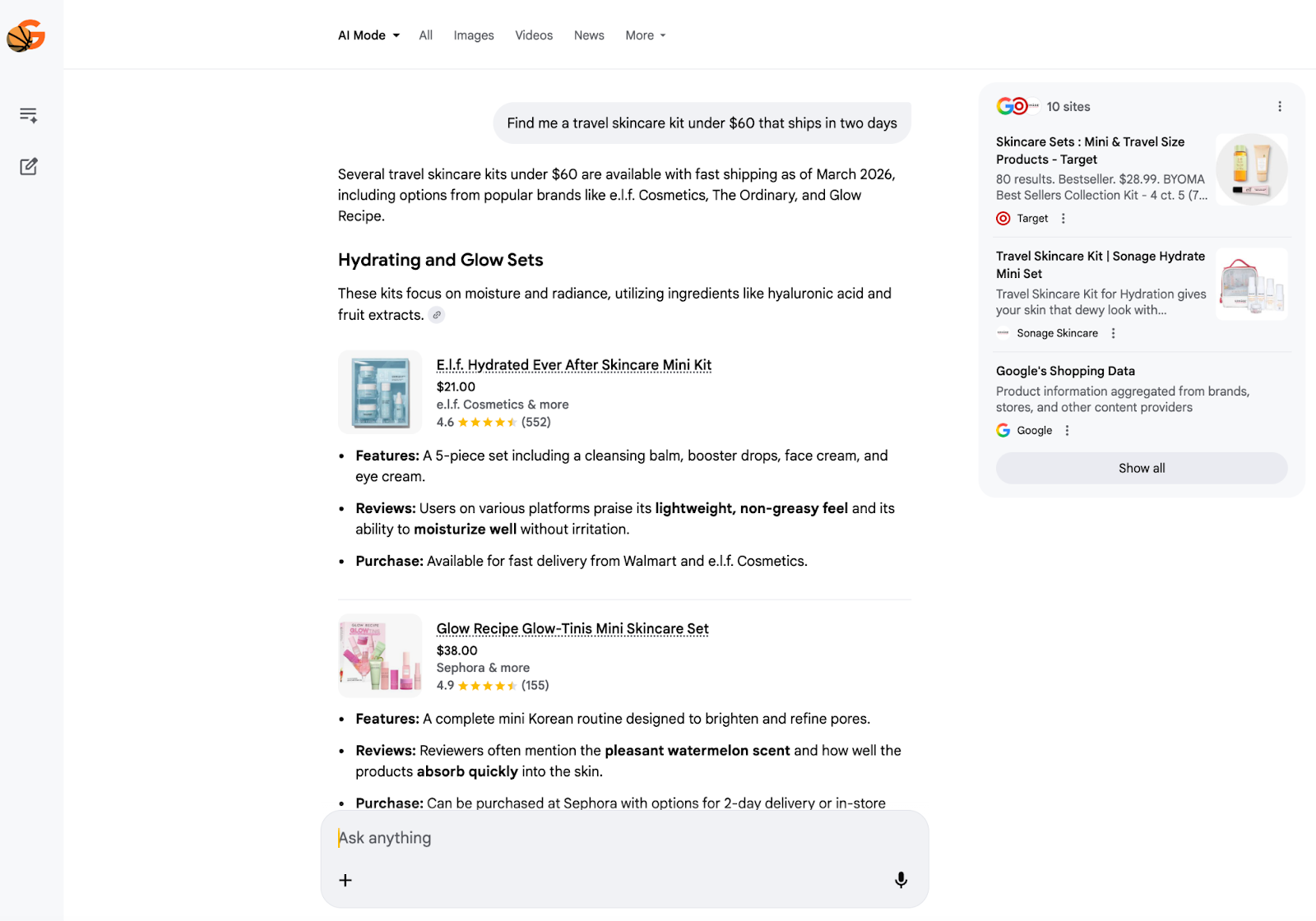
- The shopper selects a product. For US merchants that have opted in to the UCP, a “Buy” button appears directly on the product listing inside Google's interface. For those without UCP enabled, Google directs the shopper to check out with the merchant or with a marketplace provider.
- If the shopper is buying direct from Google, a pre-filled check-out screen opens. Payment and shipping details that are saved in Google Wallet are pulled in automatically. The shopper reviews and confirms.
What are the benefits of the UCP for retailers?
For retailers, the UCP expands reach and simplifies payment integration. Here are the main advantages:
- Your brand stays in control. The UCP standardizes how AI agents interact with your existing commerce infrastructure through a single integration. Even when the transaction happens on a Google interface, merchants remain the seller of record. Your product descriptions, pricing, fulfillment rules, and customer data remain yours.
- Your brand gains new reach without new infrastructure. Once you implement the UCP, your products become discoverable and accessible across any AI interface that supports it. Rather than rebuilding your check-out experience for every new platform, you can connect once and open up access to many.
- Payments are secure and provider-agnostic. The UCP works with retailers’ existing payment providers rather than forcing a switch. Every transaction includes cryptographic proof of user consent, giving merchants the confidence to accept orders automatically.
- Shoppers enjoy faster check-out. For shoppers, the UCP eventually means fewer steps between finding a product and buying it. If their payment and delivery information is already in Google Wallet, they’ll be able to complete a purchase in a few clicks without leaving the conversation.
How does the UCP differ from the Agentic Commerce Protocol (ACP)?
The Agentic Commerce Protocol (ACP) is another open source standard that was co-developed by OpenAI and Stripe.
The ACP was originally intended to let shoppers complete transactions directly inside ChatGPT. However, in early 2026, OpenAI shifted its focus to enable purchases via third-party apps that plug into ChatGPT instead. As a result, the ACP's position in the agentic commerce space is narrower than what it first set out to be.
It’s worth noting that Amazon has not opted in to either standard. In fact, Amazon has blocked AI from scraping its listings and is instead developing its own agentic commerce protocols through its Rufus AI assistant.
For brands operating across multiple channels or exclusively on Amazon, this essentially makes Amazon a separate consideration rather than part of a unified agentic commerce strategy.
What do marketers need to know about the UCP?
Klaviyo’s 2026 AI Consumer Trends Report found that 39% of consumers have bought an AI-recommended product in the past 6 months. Another 27% have learned about a new product from an AI recommendation that they went on to research further.
Here’s what marketers should understand about this shift:
Descriptive product data is key for agentic discoverability
When a shopper uses AI to search for “a carry-on suitcase under $150 with a built-in charger that fits in overhead storage and arrives before Friday,” they don’t necessarily see your product page. What they see is whatever the AI surfaces, and what it surfaces depends on how detailed and descriptive your product information is.
Klaviyo's AI Consumer Trends Report found that 30% of people use 8+ words when searching with AI. 78% of people say they include emotional or personal context at least some of the time when using AI. Shoppers are describing exactly what they want, and your product descriptions need to fulfill their requests.
Google has introduced new Merchant Center attributes for conversational commerce, including answers to common product questions, compatible accessories, and substitutes. These are the signals AI crawlers use to decide whether your product fits the query.
Agentic commerce is complicating attribution
Both UCP and Shopify enable merchants to identify and track orders that came through AI agents. The UCP's API contracts cover the full purchase flow, so you can see transactions coming from the UCP versus your own channels.
For Shopify merchants, orders from agentic storefronts appear in the Shopify admin with channel attribution, showing where each order came from.
However, as more transactions are completed off-site, last-click attribution loses visibility into a growing percentage of transactions. Performance measurement means pulling together order data, multi-touch attribution, and webhook-delivered order events from protocol-mediated check-outs.
Brands still maintain customer experiences beyond the sale
The UCP standardizes how AI agents and merchant platforms communicate, but it doesn't build the relationship that brings a customer back.
Transactions still run through your own check-out logic, and you still own your customer data. And even though your post-purchase marketing flows work in the same way, they become that much more important.
A shopper who bought your products through an AI chat may never have visited your site or engaged with your brand directly. Post-purchase emails and text messages can introduce your brand and turn a one-time, AI-assisted buyer into a repeat customer who buys from you directly.
How to prepare your brand for UCP-enabled shopping
The UCP is currently live for eligible US retailers. Most of what brands need to do to prepare is already within reach. Here’s what you should focus on:
1. Understand your UCP access options
Shopify merchants can connect to the UCP through agentic storefronts directly in Shopify. For brands on other platforms, Shopify's new agentic plan means a full Shopify store is no longer required for UCP access.
Any brand can now list products in the Shopify catalog and sell across AI channels through Shopify's infrastructure, regardless of where their primary website sits.
2. Audit your product catalog
Accurate product details, specific and extensive descriptions, and real-time pricing and availability all improve how and how often AI algorithms recommend your products.
To prepare your catalog for AI recommendations:
- Make sure key attributes like material, size, color, and compatibility are consistent across your catalog.
- Write product titles and descriptions in plain language that reflect how shoppers actually search. For example, "TREK-7 Performance Shell Jacket" is hard for AI to match to a detailed shopper query. "Light, waterproof hiking jacket with a non-technical design, suitable for trails and everyday wear" is much easier.
- Add schema.org markup to your product pages as JSON-LD to make it easy for AI crawlers to read key product information such as names, descriptions, images, prices, and availability.
- Don't just describe what a product is. Describe the moment it's for. Shoppers are telling AI about the dinner party, the difficult dad, the occasion that needs to feel just right. Product copy that speaks to those situations gives AI the hooks it needs to surface your products for those queries.
3. Enrich your Merchant Center data
Google Merchant Center is a free tool that makes it easy for merchants to upload and manage product data so it appears across Google Search, Maps, YouTube, and AI shopping surfaces like AI Mode and Gemini. If you’re not already using it, set up your account so you can optimize your brand for AI search.
If you already have a Merchant Center feed, the next step is enriching it with Google's new conversational commerce attributes, including answers to common product questions, compatible accessories, and substitutes.
AI Mode and Gemini use these signals to match your products to specific shopper queries, and they reach beyond what a standard product feed typically includes.
4. Scale up owned channels with LLM queries
AI shopping search queries can guide new marketing materials like emails and text messages. You can track LLM-referred traffic using tools like Google Analytics or dedicated AI visibility platforms, then use those insights to create fresh messaging using an AI marketing agent.
As shopper queries change with different seasons or trends, AI marketing agents make it easy for you to move quickly to launch marketing campaigns and flows that reflect what your audience is looking for. For example, if you’re running a kids’ clothing brand and you notice a spike in searches related to summer camp in early April, you can build out a flow with summer camp essentials.
The UCP is changing where consumers make purchase decisions, but what happens before and after those moments is still yours to shape.
Klaviyo B2C CRM is the autonomous CRM that unifies customer data, marketing, and service, analytics, and agentic AI. Sign up today to make sure the UCP moment is the beginning of a relationship, not just a transaction.