Consumers are inviting AI into their daily routines. They use LLMs to shop, plan vacations, and answer questions.
But despite how mainstream AI use has become, consumers aren’t sure how much they trust it.
According to Klaviyo’s 2026 AI Consumer Trends Report, only 13% of consumers completely trust AI. 36% somewhat trust it, and 30% are neutral.
These comfort levels shift depending on how consumers are using AI. The research behind the report found that 85% of consumers express at least some trust in AI for providing accurate and personalized shopping recommendations, and 39% have purchased an AI-recommended product in the last 6 months.
When everyone trusts AI differently, how can brands deliver the best experience to every customer?
The 87% of consumers who don’t completely trust AI are still winnable. The brands that segment by AI persona will convert more, retain longer, and lose less trust when the experience isn’t ideal.
How are consumers using AI today?
AI use is widespread, even as consumers are still deciding how they want it to fit into their lives.
60% of global consumers interact with AI at least weekly, according to our AI Consumer Trends Report—and 22% use it daily for a variety of tasks, according to the research behind the report. The most common personal use cases for AI include doing research (28%) and answering questions (22%).
“Research” can include a lot of things, but Klaviyo data suggests that consumers are beginning to use AI for shopping: many have used AI multiple times to find the best product or deal (70%), compare products or brands (69%), and get general product recommendations (69%).
By product category, consumers use AI for:
- Shopping for electronics or technology: 68%
- Researching travel or hotels: 48%
- Finding health or beauty products: 47%
- Shopping for apparel, footwear, or accessories: 44%
Do consumers trust AI? It depends
Trust in AI exists on a spectrum. Just as each person trusts information on social media differently, everyone trusts AI differently, too.
Consumers who are more exposed to AI are more comfortable with it. According to our AI Consumer Trends Report, 38% of daily AI users completely trust AI to provide accurate and personalized shopping experiences vs. 27% of consumers overall.
Demographics play a role, too. Gen Z is 256% more likely than boomers to interact with AI daily, and they’re the generation most likely to somewhat trust AI. Men are 60% more likely than women to trust AI completely.
AI trust also fluctuates depending on how consumers interact with it while shopping. Even though a strong majority of consumers (85%) have at least somewhat trust AI to provide accurate and personalized shopping recommendations, only 54% trust AI to provide good support via conversational agents.
A one-size-fits-all approach to AI shopping and service, then, won’t cut it. Similar to how you would segment customers based on other online behaviors, it’s important to segment your AI shopping strategy based on AI usage and trust.
Klaviyo’s 2026 AI consumer research uncovered 4 new consumer personas, how each of them is using (or not using) AI, and what it means for modern B2C brands:
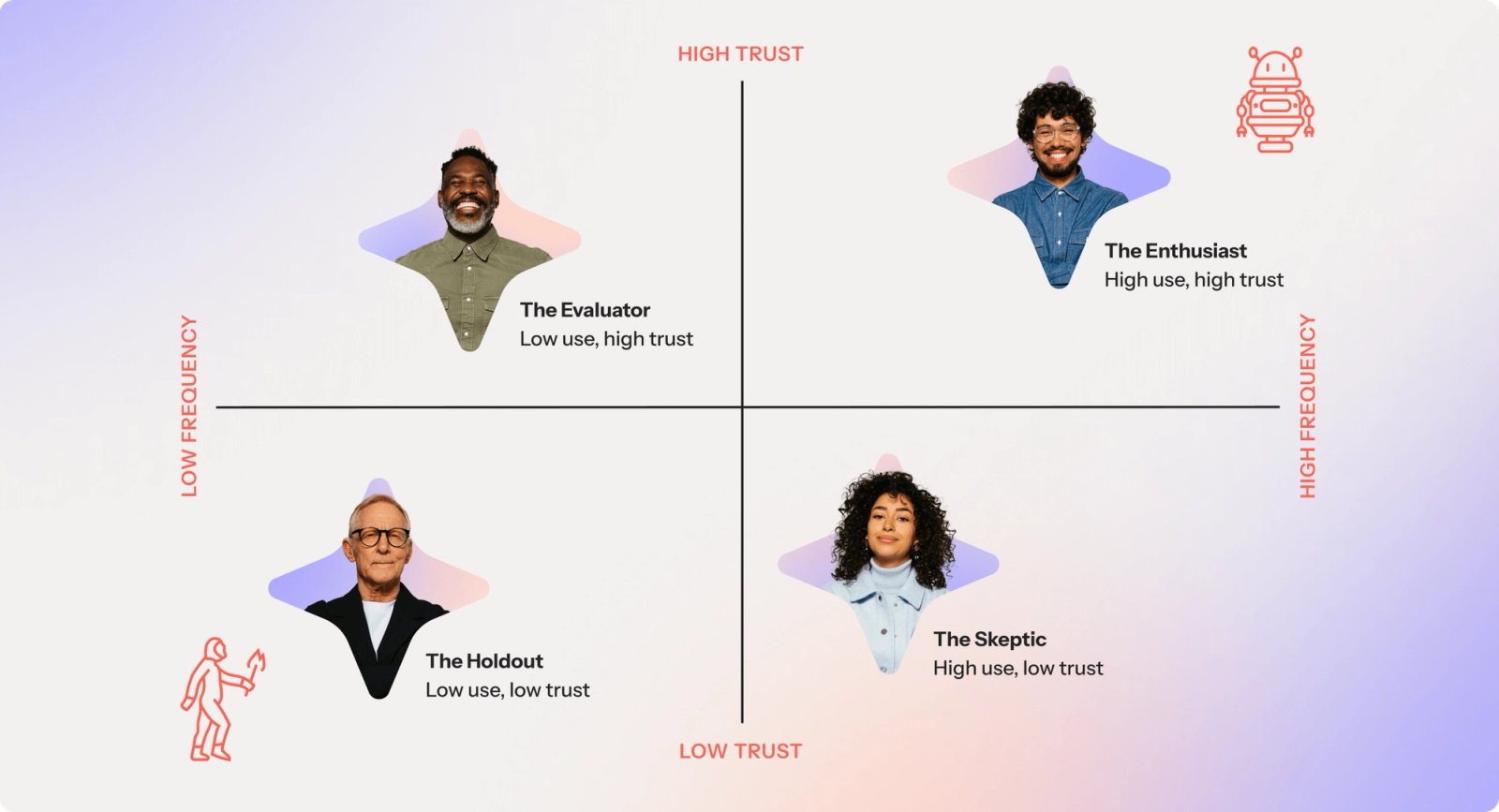
The AI Enthusiast: high trust, high frequency
AI Enthusiasts treat AI as a decision partner. 85% have used AI while shopping in the last 6 months, and 81% say AI has improved the quality of their personalized product recommendations.
Enthusiasts are also highly aware of AI use by brands themselves: 38% say they encounter AI slop from brands multiple times per week, compared to 17% of consumers overall.
While Enthusiasts value AI, many don’t respect brands that use AI to replace human work. 39% would trust a brand less for using AI-generated content, and 42% are neutral.
The AI Evaluator: high trust, low frequency
AI Evaluators don’t rely on AI for everything, but they believe in its potential. 54% have used AI multiple times to compare products, and 45% have used it to read or summarize reviews.
Evaluators feel mostly neutral about brands using AI-generated content (74%), but 26% of them feel uncomfortable when interacting with AI that sounds overly human or pretends to know them. The AI Skeptic: low trust, high frequency
AI Skeptics use AI at least monthly, but they don’t trust it, nor do they trust brands that use it. Less than 20% of AI Skeptics believe AI has improved their brand experiences across a variety of use cases, from personalized promotions to customer service.
36% of Skeptics, meanwhile, trust a brand less for sharing AI-generated marketing content, although all personas tend to overestimate how much brands rely on AI for content creation.
The AI Holdout: low trust, low frequency
AI Holdouts don’t buy into the AI hype, and they don’t reward brands for using it. 96% of AI Holdouts don’t use AI when shopping, and most completely distrust AI to deliver quality customer service (70%). 58% say they trust brands less for using AI-generated content.
AI Holdouts’ biggest concerns are accuracy and invasiveness. They’re uncomfortable with receiving inaccurate, misleading, or low-quality responses (27%), AI that feels too personal and intrusive (22%), and AI that tries to pressure their decisions (20%).
How AI impacts brand trust—and what you can do about it
AI is transforming how your customers experience your brand. Whether that transformation is positive or negative highly depends on how you’re using it.
When AI delivers real value, brand trust gets a boost
When AI delivers truly helpful information or saves time, brands benefit just as much as consumers.
According to our AI Consumer Trends Report, 55% of consumers have had at least one “aha” moment where an AI tool impressed them. These happen most when AI clearly explains complex concepts, finds information they can’t find easily on their own, and shares relevant recommendations.
For instance, Klaviyo’s 2025 AI Shopping Index found that 40% of consumers say AI assistants improve brand trust. This jumps to 55% among millennials, and 56% among Gen Z.
What you can do:
- Build segments and flows with predictive analytics. If you can offer customers what they need before they need it, you’re meeting a higher set of expectations in the era of AI shopping. For example, target customers whose predicted next order date is coming up soon with a perfectly timed replenishment flow.
- Deliver personalized customer service with an AI agent. When your AI customer agent is embedded in your CRM, it can draw on customer data, your product catalog, and other brand guidelines to deliver personalized service, 24/7. You’re much more likely to gain trust in your AI service experience if it’s tailored to each customer.
Low quality output has long-term consequences
“AI slop” is a buzzword for a reason. Many consumers won’t tolerate brands shipping AI-generated content that’s inaccurate or vague.
According to our research, nearly 1 in 5 consumers see low-quality or generic AI content from brands on a weekly basis. While 61% of consumers are neutral toward brands using AI-generated content in marketing, 32% say it makes them trust brands less.
And while brands may alienate audiences with AI-generated Instagram ads, misguided AI usage in 1:1 interactions can be just as damaging. Our research shows that when consumers get poorly personalized messages from a brand, they’re more likely to stop opening future messages and lose trust in the brand’s ability to use their data responsibly.
What you can do:
- Edit real photos with AI rather than generating them. You can still see productivity gains and keep content fresh with AI editing. Update or enhance your existing images for seasonal campaigns, different segments, or new product launches with an AI photo editor.
- Don’t cut out human review. Make sure a real person reviews campaign creative and messages to avoid an AI-driven brand crisis. Use an AI marketing agent with full human-in-the-loop controls to maintain quality.
- Let humans handle complex service requests. Create seamless handoffs between AI and human agents to keep customers from becoming frustrated. Use a shared, AI-powered helpdesk where both human and AI agents have access to full customer data and conversation context.
Your brand voice and tone matters more than ever
According to a 2026 Gartner survey, 50% of US consumers would prefer to give their business to brands that don’t use generative AI in customer-facing messages, ads, or content.
The two most common ways consumers distinguish AI from human interactions are when responses come through too fast (50%) and sound too formal or robotic (49%), according to our AI Consumer Trends Report.
Maintaining a distinct, genuine brand voice across channels can differentiate your brand in a sea of AI slop and makes consumers more comfortable.
What you can do:
- Train your AI marketing agent on your brand. When your agentic AI is trained on your customer data, product catalog, and brand guidelines, it’s much more likely to sound like you always have. Further refine your outputs through few-shot prompting and fine-tuning, so your final messages reflect your vision and brand identity.
- Train your AI customer agent on your brand. You want all your customer service agents to know what they’re talking about, and that includes your AI agents. To deliver great customer service with AI, your agent needs to sound like you.
How Klaviyo helps brands build trust in AI
Your customer base isn’t a monolith. Brands that take the time to understand how their audiences like (and don’t like) to use AI have a much better chance of serving them well with it.
Consumer trust in AI will continue to evolve. In the meantime, you need a tech stack that can help you keep up with myriad preferences.
Klaviyo B2C CRM makes it easier to connect with customers with AI, with:
- Composer autonomously builds, refines, and optimizes marketing campaigns you just need to approve.
- K:AI Customer Agent delivers personalized, real-time support, recommends relevant products, and hands off issues to a human when necessary.
- Klaviyo Reviews helps customers leave reviews faster with AI-generated headlines, while helping brands understand review sentiment more quickly.
With Klaviyo, you get built-in agentic AI that uses your real-time customer profiles to launch marketing campaigns and resolve customer requests—on one platform, with humans in the loop.