Segmentation that actually drives revenue
Generated by Klaviyo AI
The article explains why engagement metrics like opens and clicks rarely translate into revenue and outlines a behavior-based segmentation framework. It covers purchase-driven exclusions, RFM analysis, zero-party data, dynamic content, Klaviyo AI, and smart exclusions to create more relevant, higher-converting campaigns.
- Move beyond engagement: Relying on open and click windows alone is unreliable and often fails to produce revenue growth or protect deliverability.
- Anchor in purchase behavior: Exclude recent purchasers and separate subscribers from non-subscribers so messages reflect where customers are in their buying journey.
- Use RFM intelligently: Apply recency, frequency, and monetary analysis to tailor messaging, with special focus on “Needs attention” customers to unlock incremental revenue.
- Activate zero-party data: Collect subscriber preferences through forms and quizzes only when they will meaningfully change recommendations, education, or segmentation.
- Scale with AI and exclusions: Leverage Klaviyo’s Segments AI and predictive analytics to operationalize this framework, while using strong exclusions to protect deliverability and relevance.
Most ecommerce brands I talk to still rely on engaged segments built on opens and clicks.
Those segments look good on a dashboard, but they rarely translate to revenue. I see it with small lists and big lists, including brands with millions of subscribers. The set-up is usually the same: 30-, 60-, or 90-day click and open windows, plus a “send to everyone” approach that ignores how people actually buy.
Two things are happening at once, here:
- Open rate data is unreliable, especially with Apple Mail Privacy Protection. Sending based on opens can hurt your deliverability when you think people are opening, but they’re not.
- Generic personalization limits performance. If the message isn’t tailored to a customer’s context, you’re leaving money on the table.
The takeaway is simple: sending alone doesn’t equal growth. Smart segmentation creates campaigns that convert and build long-term customer value.
At Zettler Digital, my team and I use the framework below for segmentation that actually drives sales.
Start with segments based on purchase behavior
If I’m auditing a program, the first questions I ask are also the simplest:
Are you excluding recent purchasers?
At whatever threshold makes sense for the business, exclude customers who just bought. For some brands, that’s 7 days. For others, it’s 30 days.
You can get more nuanced (for example, excluding customers with an unfulfilled order), but the principle holds: most marketing content doesn’t belong in front of someone who has not even received their last order yet.
This one change fixes a problem I see constantly: brands promoting a product to people who already purchased it last week, or who actively subscribe to it.
Are you separating subscribers from non-subscribers?
If someone already subscribes to a product, they don’t need the pitch again. They need order and shipping updates, and then different messaging that fits their relationship with the brand.
Use RFM analysis to change the message, not just the audience
Purchase behavior gets you the foundation. Recency, frequency, and monetary (RFM) analysis helps you decide how to talk to each group of people.
A one-time purchaser and a 10-time purchaser shouldn’t receive the same message. And a “Champion” customer shouldn’t be treated like someone who’s in the “Needs attention” bucket.
If you want a segment that reliably creates incremental revenue, look at customers who fall into “Needs attention.” These are people who’ve bought before, but not recently. A few questions to ask, here:
- Why did they stop buying?
- What did they miss since the last purchase?
- What would make it worth coming back?
That’s where better targeting and better offers can move the needle.
Collect zero-party data, but only if you’ll use it
Zero-party data is one of the lowest-effort ways to make segmentation more effective, especially early in a relationship with a subscriber.
A pop-up form can do more than collect an email address or phone number. It can collect context that helps you personalize the welcome experience, like:
- Fitness goals: lose weight vs. build lean muscle
- Dietary restrictions: gluten-free vs. lactose-intolerant
- Shopping intent: for themselves vs. a gift
This is also where quizzes can be valuable. If a subscriber takes a quiz and shares preferences, you can use that information to recommend products, tailor education, and segment future campaigns.
One note of caution: don’t collect data just to collect it. If the answer won’t change what you send, skip it. And don’t create 30 separate campaigns because you have 30 data points. That level of personalization isn’t effective.
Use dynamic content and show/hide logic to personalize without creating more campaigns
One of the most underused tactics I see is dynamic content inside a single message.
With just one campaign, you can personalize key sections based on what you already know about each customer. For example:
- Rewards members see their points; non-members see a prompt to join.
- Lapsed customers see a reactivation offer; recent purchasers do not.
- Product subscribers see different product education than non-subscribers.
This is one way you scale personalization without multiplying production work. But it’s not the only way.
“Using Klaviyo’s show/hide logic across both profile and event properties is another powerful way to scale personalization,” says Anna Sophie Fokdal Christensen, head of email and retention at FABO, a holistic growth partner for ecommerce brands working in the lifestyle and apparel industry.
“If you already know your subscribers’ preferences from your data touchpoints, there’s no reason not to activate them consistently across campaigns and flows,” she adds.
Using Klaviyo’s show/hide logic across both profile and event properties is another powerful way to scale personalization.
Use Klaviyo AI to operationalize your segmentation framework
One thing I see often is brands agreeing with this framework in theory, but struggling to execute consistently.
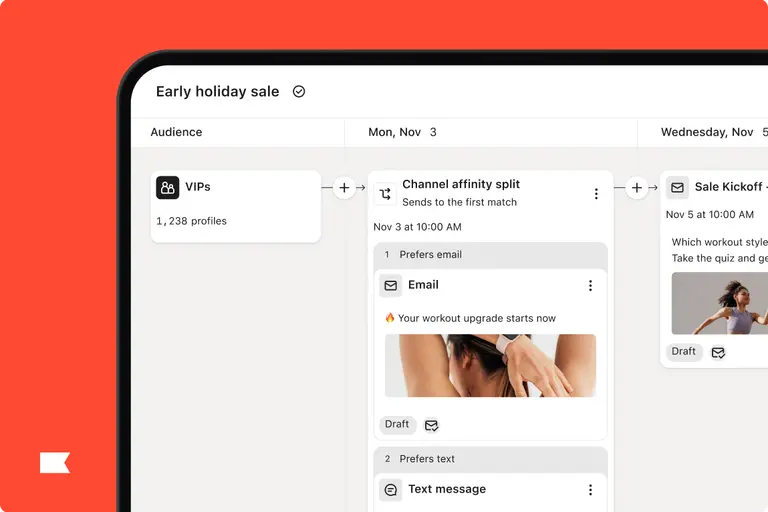
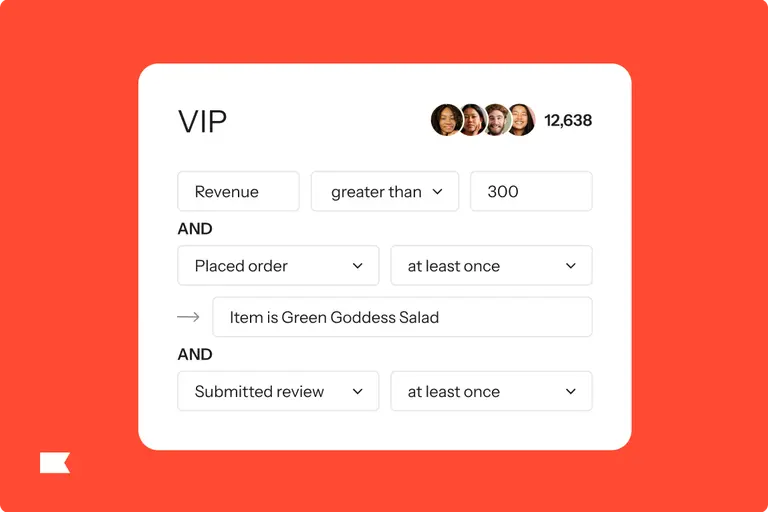
Klaviyo’s Segments AI helps close that gap by empowering teams to describe the audience they want to reach in plain language, and let Klaviyo handle the logic.
That makes it easier to:
- Test new segment ideas without starting from zero.
- Update targeting as customers move between lifecycle stages.
- Spend less time maintaining segments and more time improving messaging.
Klaviyo’s predictive analytics fits cleanly into this framework because you can use it directly in segment building.
For example, you can target customers with a predicted lifetime value above a threshold, or you can use predictive signals to refine who receives a message and when.
Remember: predictive analytics aren’t a replacement for purchase behavior, RFM, or zero-party data. Think of it as an extra layer that can help you prioritize and fine-tune.
Don’t forget about exclusions
Even when a brand sends to a wide audience (like a 180-day click window), I rarely see strong exclusions in place.
At a minimum, consider excluding:
- Recent soft bounces
- Subscribers who’ve received a high volume of messages without engaging
- Customers who just bought the product you’re promoting
These exclusions protect deliverability, reduce wasted sends, and improve relevance.
You don’t need a massive overhaul to get better results. Start with the tactics above and see how much progress you can make.
Engagement data can be a useful input, but it’s not a growth strategy. The brands that win are the ones that segment around customer behavior and deliver messages that match the moment.

Related content