Scale email revenue beyond 12%
Generated by Klaviyo AI
The article explains why many D2C brands plateau around 10–12% email-attributed revenue and outlines a practical system to move toward ~30%. It details how optimized pop-ups, structured welcome and abandonment flows, guardrails, and consistent campaigns work together inside Klaviyo to increase list growth, conversion, and flow-driven revenue.
- Fix underperforming pop-ups: Brands should treat desktop and mobile separately, use two-step forms, collect one smart zero-party data point, test timing and offers, and highlight maximum savings to lift pop-up conversion from 1–3% toward 5%+ and drive more qualified subscribers.
- Build a real welcome series: A five-email welcome framework focused on offer delivery, brand intro, best-sellers, social proof, and a reminder—paired with exclusions, purchaser exits, light segmentation, and iteration—can raise revenue per recipient from around $0.50 to as high as $8.
- Run layered abandonment flows: Operating both cart and check-out abandonment flows with laddered incentives, social proof, and strict exits can recover up to ~30% of abandoned orders and convert high-intent shoppers more efficiently.
- Aim for the 15/15/30 mix: Installing core and “espresso shot” flows, optimizing step-level performance, enforcing global filters, and sending regular campaigns can shift flow revenue from 5–8% to 15–20%, supporting a total email-attributed revenue target of about 30%.
- Leverage Klaviyo’s strengths: Native A/B testing, clear analytics, and reduced reliance on bolt-on apps in Klaviyo make it easier to see what works, iterate quickly, and coordinate lifecycle marketing without overwhelming subscribers.
Be honest: what was your email-attributed revenue in Klaviyo in 2024? Was it closer to 10% or 30%?If you’re missing a few key building blocks, you’re likely to hover around that 10%. Most brands plateau because they haven’t set up pop-ups, welcome series, abandoned cart flows, and basic filtering. (Or maybe they have, but they haven’t properly tested them.)
Fix the pop-up (by audience and device), build a real welcome series, run both cart and check-out abandonment flows, add social proof and sensible discounts, and watch your filters, and you’re on the right track to boosting your email-attributed revenue to ~30%—roughly half from flows, half from campaigns.
As operations manager at One 10 Media and someone who lives inside Klaviyo, this is my team’s focus all year long: getting brands with lower email revenue to the next level.
When a new brand comes to us, the very first thing we check is the pop-up. 9 times out of 10, that’s where the bottleneck starts. From there, we move into the welcome flow, abandonment flows, and the filters that prevent customers from getting clobbered with too many messages at once.
Below is the exact playbook we use to move accounts from “fine” to “finally working.”
Pop-ups: where list growth (and everything else) begins
“Pop-ups are where and how your people enter your database,” says Omar Lovert, CEO and founder of Polaris Growth, a Klaviyo Elite agency based in The Netherlands. “They’re also the biggest lever you can pull to boost the results of your new subscriber flow.”
Pop-ups are the biggest lever you can pull to boost the results of your new subscriber flow.
I’m always amazed how many brands think a 1–3% pop-up conversion rate is “great.” It isn’t. Aim for 5%+. Yes, that’s achievable.
Here’s what usually fixes it:
- Test desktop and mobile separately. This is my biggest pet peeve because it’s both easy and overlooked. We’ve seen totally different winners by device, especially when audiences skew older on desktop and younger on mobile. Treat them as different canvases, because they are.
- Use a two-step pop-up. Collect email consent on step one and SMS consent on step two, and keep inputs minimal. The more fields, the more friction, and conversion is often lower. While using a single-step form sets you up to miss key information (like an SMS opt-in), and 3 steps ask for too much information, two steps is the sweet spot.
- Collect one smart, zero-party data point. If you sell skincare, asking “oily, combo, or dry?” in the pop-up is incredibly valuable. That single answer informs relevant recommendations from day one.
- Run an SMS-specific pop-up to email-only subscribers. Before Black Friday Cyber Monday (BFCM), an SMS-only pop-up promising early access works incredibly well. If it’s not Q4, tie it to a product drop or launch.
- Fix timing with tests, not guesses. Don’t present a pop-up in a shopper’s face for products that require explanation. I’m a fan of page-scroll triggers that display forms after someone has consumed a meaningful portion of the page. Different products need different timing. Test to find the right timing for your audience.
George Kapernaros, CEO and founder of YOCTO, an agency that works primarily with health and wellness subscription brands, recommends leading with your highest available offer in the pop-up headline.“Most brands make the mistake of promoting a small entry discount, like 5% off,” Kapernaros says. “This hides the real value your site already offers. If your store has volume discounts, bundles, or a ‘subscribe and save’ program, your pop-up should reflect the maximum savings potential.”
If your store has volume discounts, bundles, or a ‘subscribe and save’ program, your pop-up should reflect the maximum savings potential.
Let’s say one of your bundles or a subscription plan can save a shopper 45% off. “If you make the headline of your pop-up ‘Save up to 45% off,’ it instantly reframes the visitor’s perception of value,” Kapernaros explains.
“It anchors them on your best possible deal, even if they ultimately redeem a smaller one,” he adds. “This simple shift can increase sign-up rates and lift first-order AOV, since shoppers enter the funnel expecting to spend more to unlock the higher discount tier.”
Why I love doing this in Klaviyo: A/B testing behavior and timing is native, the analytics are clean, and winners are obvious on a single screen. It honestly makes me want to test even more.
Once we implement these practices, we tend to see exciting developments. Here are a few from brands we’ve worked with recently:
- In just two weeks, one brand’s pop-up collected 700+ new subscribers, generating over $3,500 in revenue.
Submission rates average 19.4% on mobile and 7.0% on desktop.This brand is currently A/B testing 10% off vs. a mystery discount offer.- Submission rates average 19.4% on mobile and 7.0% on desktop.
- This brand is currently A/B testing 10% off vs. a mystery discount offer.
- Another brand’s pop-up generated $12,000 within a few days of being live.
- A third brand saw their pop-up bring in 2,000+ new subscribers in just over a month.
The pop-up helped generate $14,300 in revenue, making the welcome flow the highest-earning and best-converting flow in the account.The welcome flow accounted for 36.7% of total flow revenue.- The pop-up helped generate $14,300 in revenue, making the welcome flow the highest-earning and best-converting flow in the account.
- The welcome flow accounted for 36.7% of total flow revenue.
Which brings us to our next tactic…
The welcome series most brands think they have
I can’t tell you how often I see a welcome series that consists of one or two chaotic emails. Meanwhile, my team and I have taken welcome revenue from $0.50 per recipient up to $8 simply by getting the basics right.
For a brand we work with that sells auto parts, we recently saw some impressive results:
- The welcome flow generated $15,000 in less than a week.
- The first email in the welcome series saw click rates of 10.9% and a placed order rate of 15.5%.
My welcome series roadmap: a 5-email framework with one-day delays
- The offer delivery: clear discount delivery and redemption path
- Brand introduction: what you stand for and why you exist
- Best-sellers: making it easy to buy what most people love
- Social proof: UGC, ratings, and reviews, especially vital for skincare/haircare
- Reminder of the offer: a clean, friction-free second chance
“Remember,” urges Kapernaros, “at this stage, your subscribers aren’t looking for a relationship. They’re looking for reasons to buy. The goal of your welcome flow should be to close the sale: to reinforce the value of your products, highlight differentiation, and make redemption of the incentive frictionless. After they’ve purchased is a good time for nurturing, storytelling, and community-building.”
“The first flow’s job is simple,” Kapernaros adds: “Convert interest into action.”
The first flow’s job is simple: convert interest into action.
4 operational welcome series rules that matter
- Exclude welcome recipients from campaigns while they’re in this journey. Don’t approach them from two directions.
- Exit purchasers from the flow. If someone converts, get them out of the flow. No one needs 3 more “use your discount” nudges after they already did.
- Implement lightweight segmentation based on the pop-up. Use the same email framework with different product blocks based on that one smart question (e.g., oily vs. dry skin recommendations).
- Iterate. If speed matters, start with 3 emails, watch where people fall off, add the next step, and keep testing. Once you’ve figured out what works, plan a 5-email sequence.
Abandoned cart and abandoned check-out: run both, layer thoughtfully
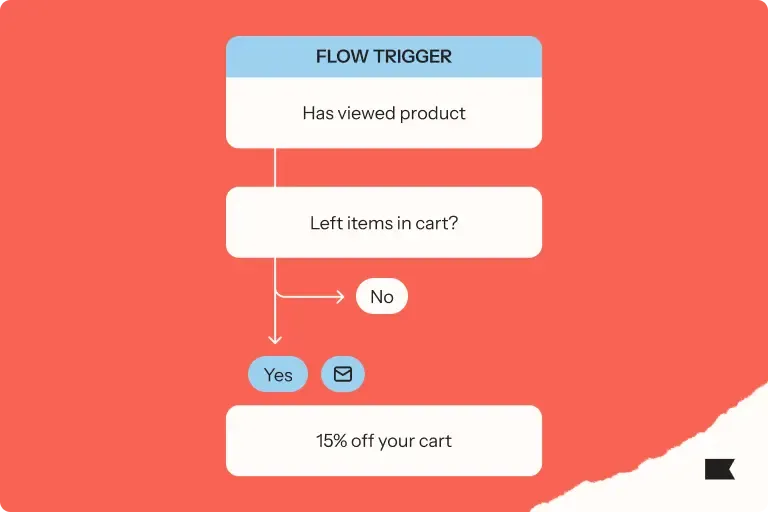
This is another place where brands leave money on the table. Many run cart or check-out abandonment flows, but not both. You need both. Those are different customer states.
One tactic that moves the needle: a laddered incentive,if your margin allows. Here’s what it might look like:
- Email 1: friendly reminder (soft nudge, no discount)
- Email 2: discount
- Email 3: slightly stronger incentive if they make it this far
We often see the second email drive the bulk of conversions once you’ve introduced a discount. “Remember,” says Lovert, “when motivation is high, people take action.”
Here are a few tips to keep in mind for abandonment series:
- Include social proof inside these emails. If you have great reviews, use them where hesitation lives.
- Use filters and exits. Again, when someone buys, get them out of the flow immediately.
I’ve pushed abandoned cart recovery as high as ~30% for the right products and audiences with this structure.
“Don’t forget about testing,” says Stefan Milicevic, strategy director at Underground Ecom. “If emails 2, 3, and beyond aren’t converting, test different timing, angles, offers, or even removing certain emails from your sequences. The goal is to find what works best for your audience.”
Don’t forget about testing. The goal is to find what works best for your audience.
Flow revenue goals: the 15/15/30 rule
My north star is simple: ~30% email-attributed revenue, with half from flows and half from campaigns.
How do we get there?
4 steps to get to ~30% email-attributed revenue
- Install the missing “obvious” flows. Welcome, browse abandonment, abandoned cart, abandoned check-out, and a clean post-purchase. Many accounts are missing one or more.
- Add “espresso shot” flows. These are for engaged non-buyers who’ve completed welcome and stuck around, but still haven’t converted. It’s a short, high-intent sequence with a specific, time-boxed offer (think 3 emails over ~5 days). It’s essentially an advanced, custom mini-journey that often unlocks that first purchase.
- Optimize inside the flows. Don’t just “have a welcome flow.” Look at step-level performance. If email one is doing all the work but not converting, diagnose the next step in the path and adjust.
- Institute guardrails. Global filters prevent overlap so shoppers aren’t getting a campaign blast while they’re mid-flow.
- Send campaigns. Make sure you’re sending them at a cadence that works for your brand. This is typically at least once a week, but can be as little as twice per month if your list is smaller than 5,000 people.
“Guardrails in particular are so incredibly important,” says Milicevic. “Many brands out there simply cast the widest possible net with a communication onslaught through flows, campaigns, push notifications, and text message marketing. True omnichannel marketing means finding people where they are (and want to be), not overloading them, hoping they’ll pick up one of your messages.”
True omnichannel marketing means finding people where they are (and want to be).
Your tech stack matters
I’ve worked in other platforms besides Klaviyo. Reporting can get confusing—numbers don’t match across screens, or testing takes too many clicks.
Because Klaviyo is a CRM built for B2C companies, it gives you everything you need to conduct the symphony of marketing, logistics, and customer support.
Here are just a few of my favorite things about Klaviyo:
- A/B testing is painless. From pop-up behavior and timing to email variants, it’s easy to set up and call a winner.
- Analytics and dashboards are clear. I can see views, conversions, and winners on one screen, then compare month over month and year over year without spelunking through 10 reports.
- There’s less context switching. I don’t need bolt-on apps to do core list-growth and lifecycle work.
The short version: with Klaviyo, better visibility leads to better decisions, which leads to faster iteration.
Where the soft metrics usually land
Every brand is different, but when teams implement the playbook above and actually test, these are the kinds of changes I’m comfortable pointing to:
- Pop-ups: Improve conversion from 1–3% to 5%+.
- Welcome series: Improve RPR from $0.50 to up to $8.
- Abandoned cart/check-out: Achieve up to 30% recovery.
- Flow revenue: Improve revenue share from 5–8% to 15–20% of total revenue, which is how we reach that ~30% email-attributed revenue benchmark (flows + campaigns).
If you’re stuck at 12%, you’re not broken. You’re probably missing a handful of simple, compounding pieces.
Get the pop-up right, give new subscribers a real welcome, rescue hesitation with thoughtful abandonment flows, and keep your journeys clean with filters. Do that, and the math starts to move in your favor.
Work with One 10 Media.
Reach out
Related content