4th of July marketing playbook
Generated by Klaviyo AI
This article outlines nine 4th of July marketing strategies for ecommerce and consumer brands, from personalization to post-holiday follow-ups. It explains how to use customer data, creative visuals, channel strategy, urgency, and AI tools to drive seasonal engagement and revenue.
- Data-driven personalization: Use customer purchase and browsing data to build targeted segments and recommend relevant 4th of July and summer products across email and SMS.
- Seasonal creative and context: Incorporate patriotic visuals, summer settings, and holiday-specific collections while tying campaigns to broader seasonal needs like skincare or outdoor activities.
- Channel and timing strategy: Differentiate how you use email and text, personalize send times, and extend campaigns beyond July 4th to capture pre- and post-holiday demand.
- Inventory and urgency tactics: Align promotions with inventory goals, use limited-time offers and clear deadlines, and highlight discounts to move seasonal or soon-to-date products.
- Loyalty and AI-powered support: Reward VIP customers with exclusive offers and leverage AI agents for campaign creation, channel selection, and real-time customer assistance during sales.
Black Friday Cyber Monday (BFCM) may drive the most revenue for your brand, but you don’t have to wait until then to reap the benefits of holiday-centric marketing.
July 4th is a prime revenue opportunity for brands that sell consumer-packaged goods (CPG), home and garden goods, sporting goods, and even apparel.
According to research from the National Retail Federation (NRF), the top reasons consumers celebrate the 4th of July are:
- It’s fun to do with family and friends.
- It’s important to celebrate the US.
- They like the food and/or fireworks.
- It’s a fun summer holiday.
- It’s a favorite holiday.
You can use these motivations to inform your holiday messaging, centering your campaigns around the fun, patriotic pastimes Americans enjoy. To get ahead on July 4th promotions, start preparing your brand’s email marketing and text message marketing strategy in May or sooner.
Need some inspiration? Check out these 4th of July campaign ideas, each backed by real-world examples from brands with stellar Independence Day marketing.
1. Use customer data to personalize your holiday marketing
When you understand your customers’ preferences, buying patterns, and demographics, you can better reach them with targeted holiday marketing that resonates. For example, if you identify customers who’ve purchased products with SPF, you can recommend a suncare-specific product bundle for the 4th.
Use the customer data in your B2C CRM to:
- Create a segment of people who’ve previously purchased products in the summer.
- Create a segment of customers who’ve bought the kind of products you’ll be promoting over the 4th of July.
- Design location-specific marketing campaigns based on summer weather or local events.
4th of July marketing example: More Labs’ holiday hangover solution
Subject line: Combat your 4th of July hangover! 🍻🍷🍹
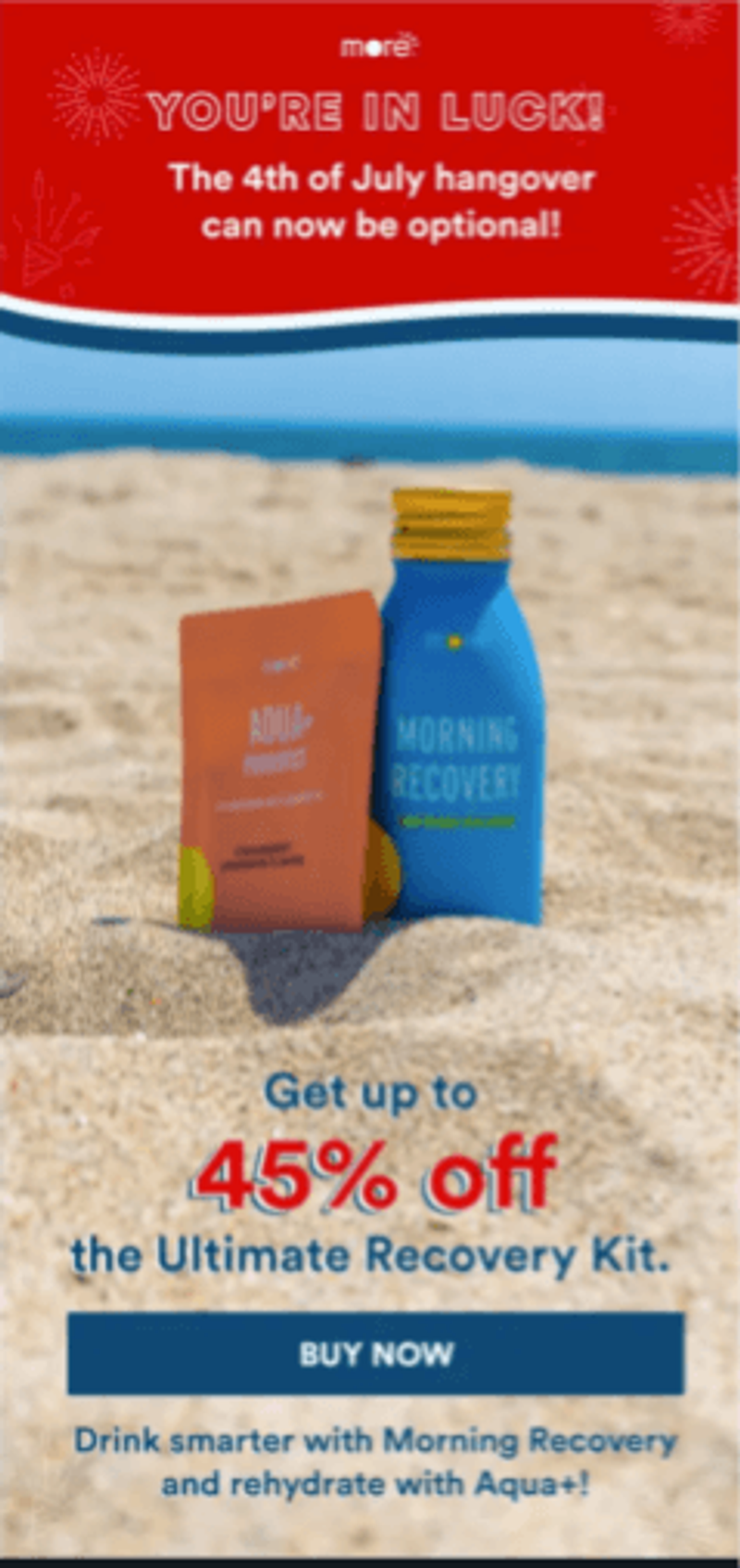
Supplement brand More Labs demonstrates a clear understanding of context and positioning in this 4th of July marketing example. For those who partied too hard at their cookout, the brand offers a discount on a hangover cure. They position their products for the season, putting their supplements in the context of beach days and summer parties with their recommended products nestled in the sand.
4th of July marketing idea: Use holidays, when consumers are already in a shopping mood, to convert window shoppers into customers. Create segments of people who’ve browsed or added to carts within the past few months, but haven’t made a purchase. Then, send personalized product recommendations based on the products that piqued their interest.
2. Lean into holiday visuals
Holidays are a great opportunity to jazz up your marketing with a fun theme. You can use holiday-centric messaging, visuals, and products to appeal to people who enjoy celebrating Independence Day.
Put your products in context by adding seasonal backgrounds, decorations, and colors, like:
- American flags
- Fireworks
- Red, white, and blue elements
- BBQ items, like hot dogs and picnic tables
4th of July marketing example: Little Sleepies’ fireworks-themed email
Subject line: Best Dressed at the BBQ 🏆

Children’s sleepwear brand Little Sleepies uses their 4th of July marketing campaign to show off their patriotic collection in action at a fireworks show, with the “Forever Favorites” section below showcasing bestselling products year-round.
Plus, Little Sleepies gives busy parents the information they need to plan ahead. By clearly breaking down the 3 shipping options with specific cutoff dates, they help families feel more confident knowing everything will arrive in time for their plans for the 4th.
4th of July marketing idea: Use an AI photo editor to update your product images for the 4th. Swap out the background for one with patriotic colors or a summery location, or add on-theme elements like fireworks and stars like Little Sleepies did.
3. Lean into the strengths of each channel
Different communication channels serve different purposes in the customer journey. For instance, text message marketing creates an intimate, immediate connection with your most engaged audiences, while email works better for longer storytelling and product showcases.
Around the 4th of July, text messages can work great for time-sensitive promotions or follow-ups after sending emails to remind customers when the sale is ending. Use concise and high-value language for text messages and more visual and comprehensive content for email. And make sure you maintain a consistent brand experience across all touchpoints.
4th of July marketing example: ThreeMain’s concise text message approach
SMS character count: 209
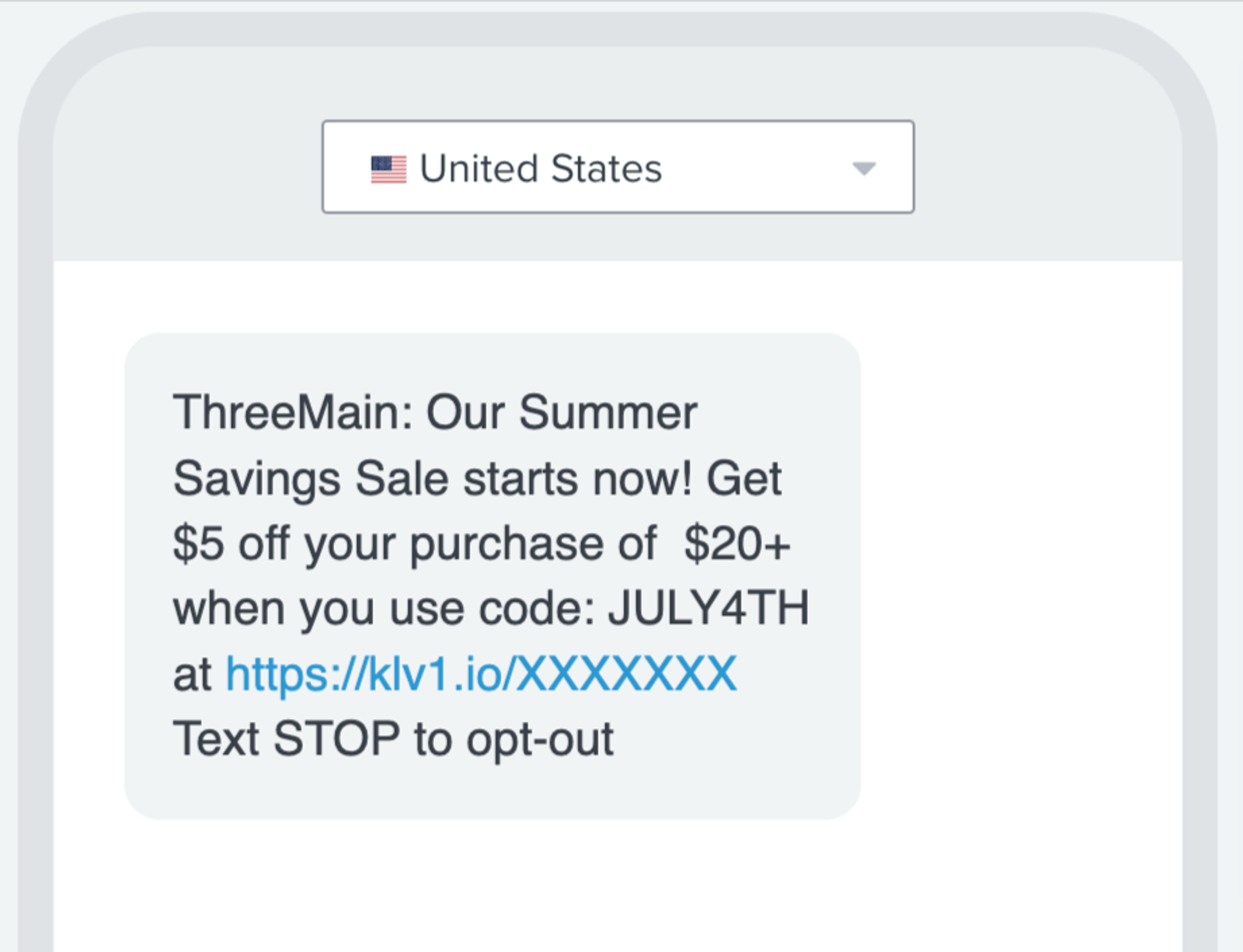
Consumers are selective about which brands they let into their text messages. ThreeMain, a brand that sells non-toxic, planet-friendly cleaning products, puts that principle into action in this 4th of July marketing example ahead of Independence Day.
This text doesn’t waste any time, making a subscriber more likely to feel that the brand respects their attention and loyalty. With just one sentence, the brand gets right to the benefits for the subscriber:
- The amount of money they’ll save
- The amount they need to spend
- The code they need to use
- The link they need to shop
4th of July marketing idea: Reach customers on the channels where they’re most likely to engage first, especially if you have an omnichannel campaign that spans multiple channels. Use AI-powered channel affinity to send your first promotional message to their No. 1 most preferred channel, then follow up on their second-most engaged channel if they don’t interact.
4. Align inventory management with seasonal promotions
Holidays provide the perfect opportunity to move seasonal inventory before it becomes less relevant. Your July 4th marketing can serve a dual purpose: celebrating the holiday while strategically reducing overstocked seasonal items.
By identifying which products need attention in your inventory cycles, you can create win-win promotions. Your business can optimize stock levels while customers get access to timely discounts on products they’ll love for the summer season.
4th of July marketing example: NOGU’s seasonal inventory strategy
SMS character count: 240
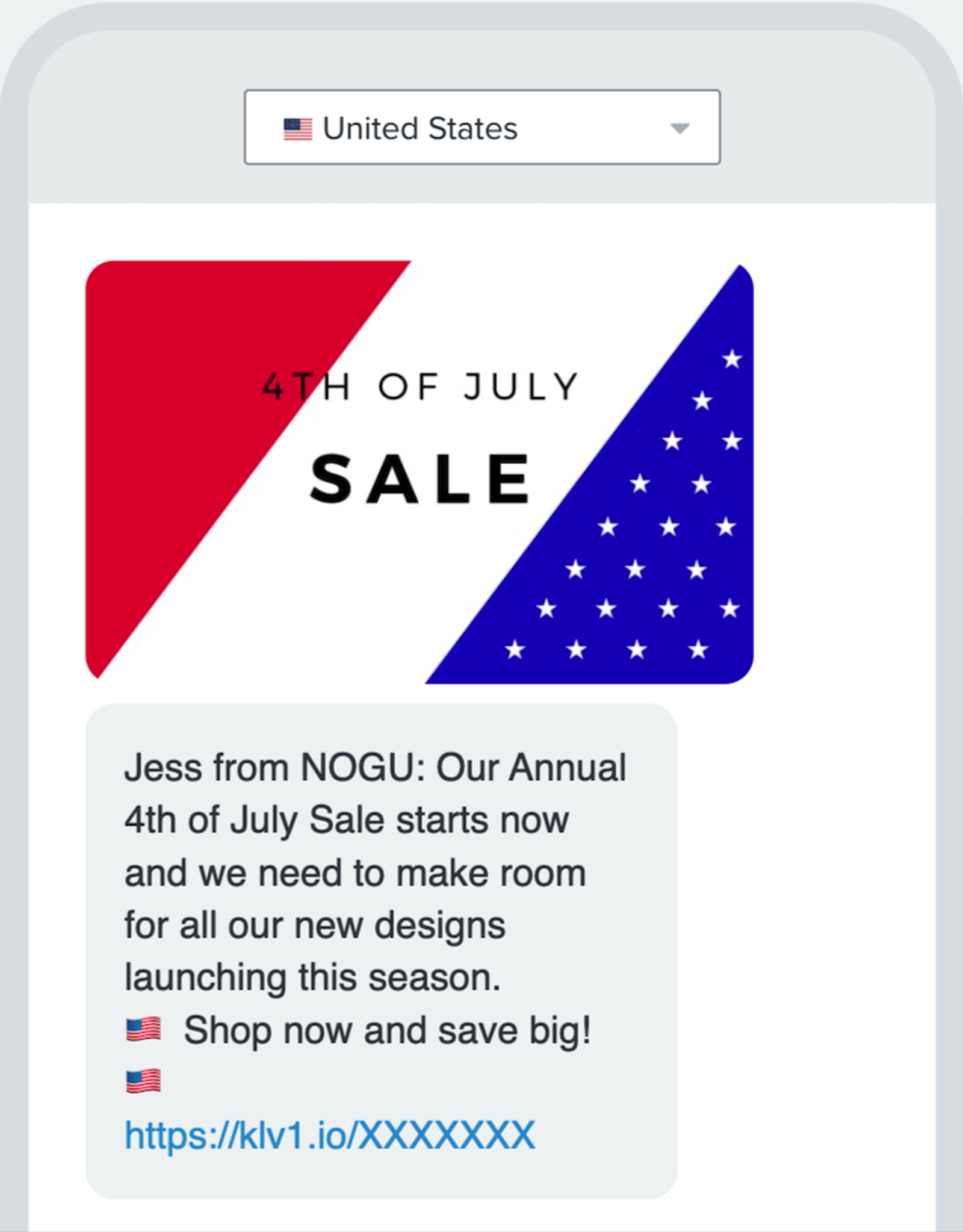
Early July means summer is in full swing in all 50 US states, making it a prime time for ecommerce brands to focus on seasonal designs. In this 4th of July marketing example, NOGU, a Canadian jewelry brand, takes advantage of the timing of the US holiday to promote a big sale.
While the brand admits in the text that they’re looking to move along a set of inventory that may go out of style, their subscribers will likely be excited to get first access to these big discounts.
4th of July marketing idea: If you’re clearing out inventory, let shoppers chat with an AI customer agent to answer questions while they’re browsing. An autonomous service agent has access to your inventory, product details, reviews, and more, so they can answer questions like “Is this still available?” or “Does this run large?”—particularly helpful for low-stock inventory or final sale items.
5. Think beyond just the holiday
When planning for an upcoming holiday like July 4th, consider the holiday’s context in addition to the holiday itself.
What’s happening weather-wise this time of year? What might that have to do with your products and how they can deliver value to your subscribers? And how can you tie it all together in an email, text message, or ad?
4th of July marketing example: Beekman 1802’s summer skincare connection
Subject line: On Sale Faves: Summer Skin Must-Haves 😍 🇺🇸
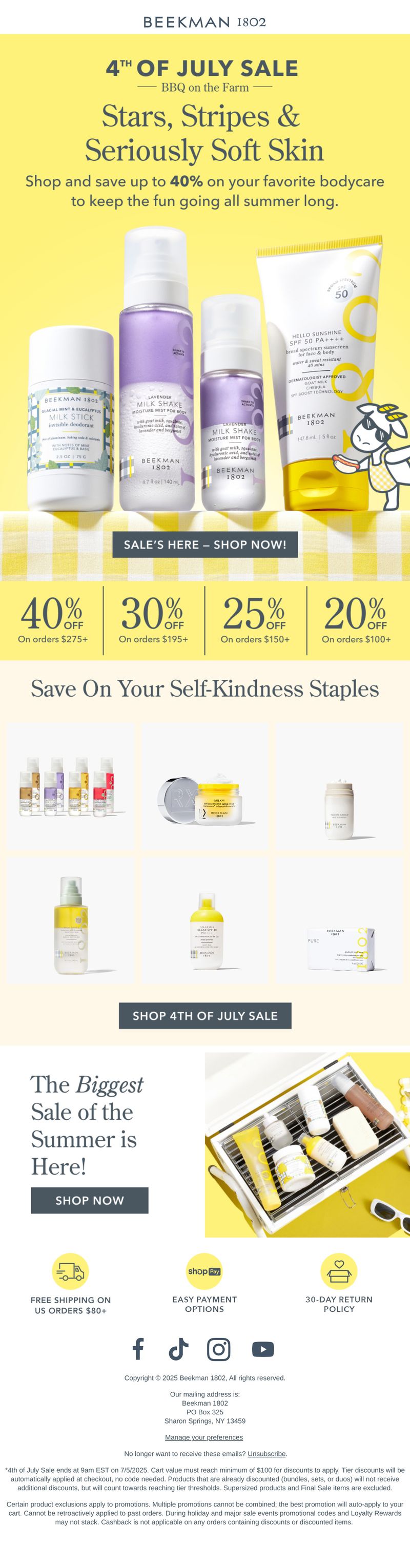
People who take their skincare routines seriously and live in places with more than one season tend to adjust their routines to the weather. Nearly everybody uses more skincare products in summer—namely, sunscreen and hydrating formulas to combat sun exposure.
In this 4th of July marketing example, Beekman 1802, a skin health brand, connects the holiday to the broader summer season, using the tagline “Stars, Stripes, and Seriously Soft Skin” to promote their products as essential for keeping skin healthy during outdoor celebrations.
4th of July marketing idea: Launch a summer collection, or a dedicated Independence Day collection, and promote it across different channels like email, text messages, push notifications, and digital ads. Then, track which marketing touchpoints are influencing sales using omnichannel linear multi-touch attribution.
After the holiday is over, you can analyze which marketing efforts contributed to the most sales, then use this data to inform future holiday marketing strategies.
6. Align your brand values with the spirit of the 4th of July
The 4th of July celebrates American independence and values, which creates a natural opportunity to highlight aspects of your brand story that resonate with these themes.
Identify which elements of your story will align most strongly with different customer segments. Building these connections thoughtfully can help your messaging feel authentic rather than opportunistic.
4th of July marketing example: Tecovas’ classic Americana positioning
Subject line: Two NEW stars in town

In this 4th of July marketing example, leather goods brand Tecovas spotlights their limited-edition boot styles, with simple product descriptions and clear calls to action (CTAs) for each. The email’s straightforward structure makes it easy to scan, and each boot gets its own moment in the spotlight.
The boots themselves embody classic Americana aesthetics that naturally connect with the holiday, making them appealing to customers who value quality craftsmanship and Western heritage—all without relying on overt red, white, and blue graphics.
4th of July marketing idea: Use an AI marketing agent to generate a 4th of July marketing campaign that brings in your brand voice and messaging, and incorporates industry and holiday trends. An autonomous marketing agent can suggest sign-up forms, emails, text messages, WhatsApp messages, and push notifications, as well as target audiences, helping you launch creative ideas faster.
7. Build urgency through limited-time offers
Creating a sense of urgency is one of the most powerful motivators in marketing.
When you apply them strategically to your 4th of July campaigns, time-limited offers can drive immediate action from customers who might otherwise postpone their purchase decision. The key is making the deadline feel both real and significant.
4th of July marketing example: Quikflip’s deadline-driven approach
Subject line: ⏰ Don’t miss out on our July 4th Sale!
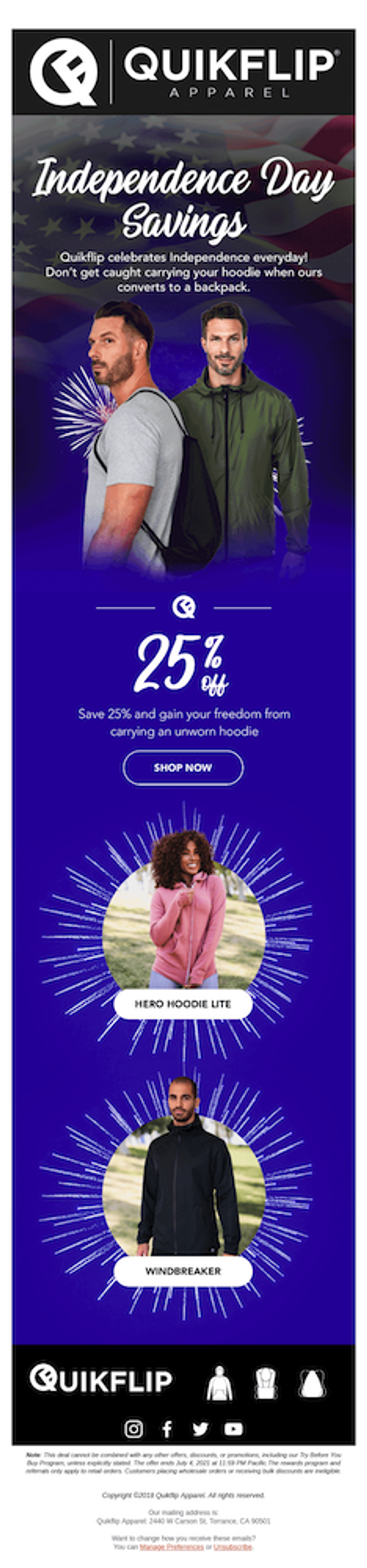
Quikflip, an outerwear brand that sells hoodies and jackets that convert into backpacks, makes a bold move in this 4th of July marketing example: they offer subscribers a 25% off discount, but establish a sense of urgency by using an alarm clock in their subject line and noting in the fine print that the sale ends on July 4th at midnight.
The email also features firework-like graphics and copy that connects the brand’s products to the concept of independence: “Quikflip celebrates independence every day! Don’t get caught carrying your hoodie when ours converts to a backpack.”
4th of July marketing idea: Make the most of your urgency-driven campaigns by using AI to personalize send times, getting your messages to each customer when they’re most likely to engage. Use personalized send times for initial messages around your flash sales or time-sensitive offers, but when the final hours are approaching, use regular sends so no one misses a deadline.
8. Reward loyal customers with exclusive VIP offers
Creating special offers exclusively for your loyal customers not only drives revenue, but also strengthens emotional connections with your brand. These customers already know, like, and trust you. Showing them extra appreciation during holidays can transform them into brand advocates.
Segmenting your audience based on purchase history and engagement lets you deliver these personalized VIP experiences. Even small perks like early access or free shipping can make loyal customers feel genuinely appreciated and part of a special community.
4th of July marketing example: Wildling’s VIP recognition strategy
Subject line: 10% Off + Free Shipping! Code: FIREWORKS
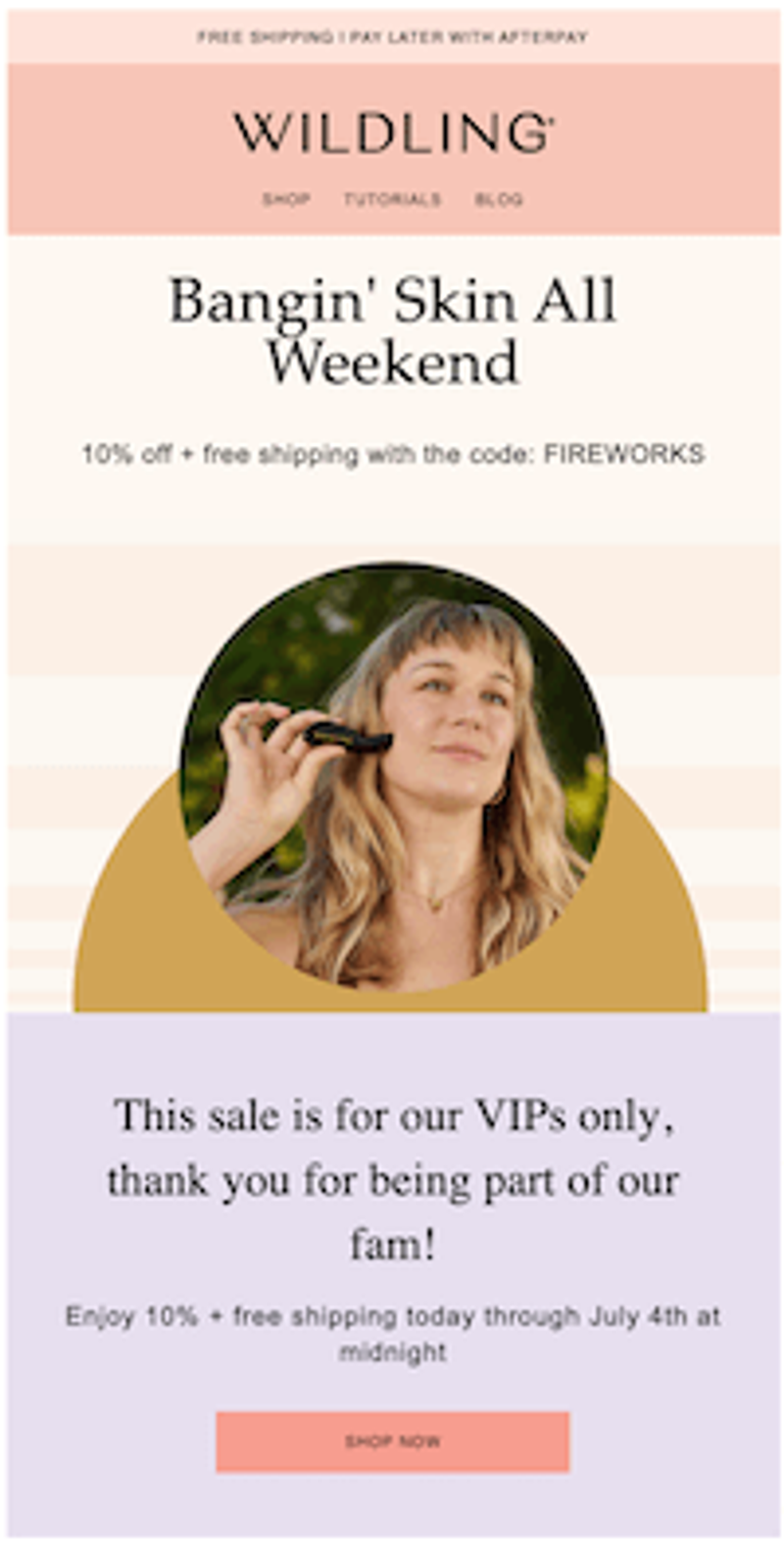
Beauty brand Wildling’s 4th of July marketing campaign offers an exclusive sale for VIPs to thank them for their loyalty. The 10% discount is enough to make a difference when purchasing, and helps VIPs feel like they belong to an exclusive community. The email also offers free shipping through the end of the holiday.
4th of July marketing idea: Use AI-powered predictive analytics to identify high-value customers for VIP promotions. You can find customers who have high average order values (AOV), those with a high predicted lifetime value (LTV), or those who make regular purchases and are likely to shop again soon.
With these audiences, you can afford to offer higher discounts for the 4th without sacrificing your margins because you know these customers are more likely to fill up their carts.
9. Extend your campaign beyond the 4th of July
While most brands focus their marketing efforts on the days leading up to July 4th, there’s significant opportunity in the immediate post-holiday period. Many consumers are still in vacation mode or catching up on emails they missed during celebrations, making this a strategic time to reach them with final offers.
Holidays are a good time to reinvigorate customer relationships, but you don’t want to let them fall off after the holiday spike in engagement. Analyzing post-holiday engagement from previous years can reveal optimal timing for these extended campaigns.
This approach gives you an edge when other brands have already moved on, empowering you to capture additional holiday-related sales while tracking the incremental value these extended campaigns generate.
4th of July marketing example: The Honest Company’s day-after strategy
Subject line: HOURS LEFT: 20% off (almost) everything 😱
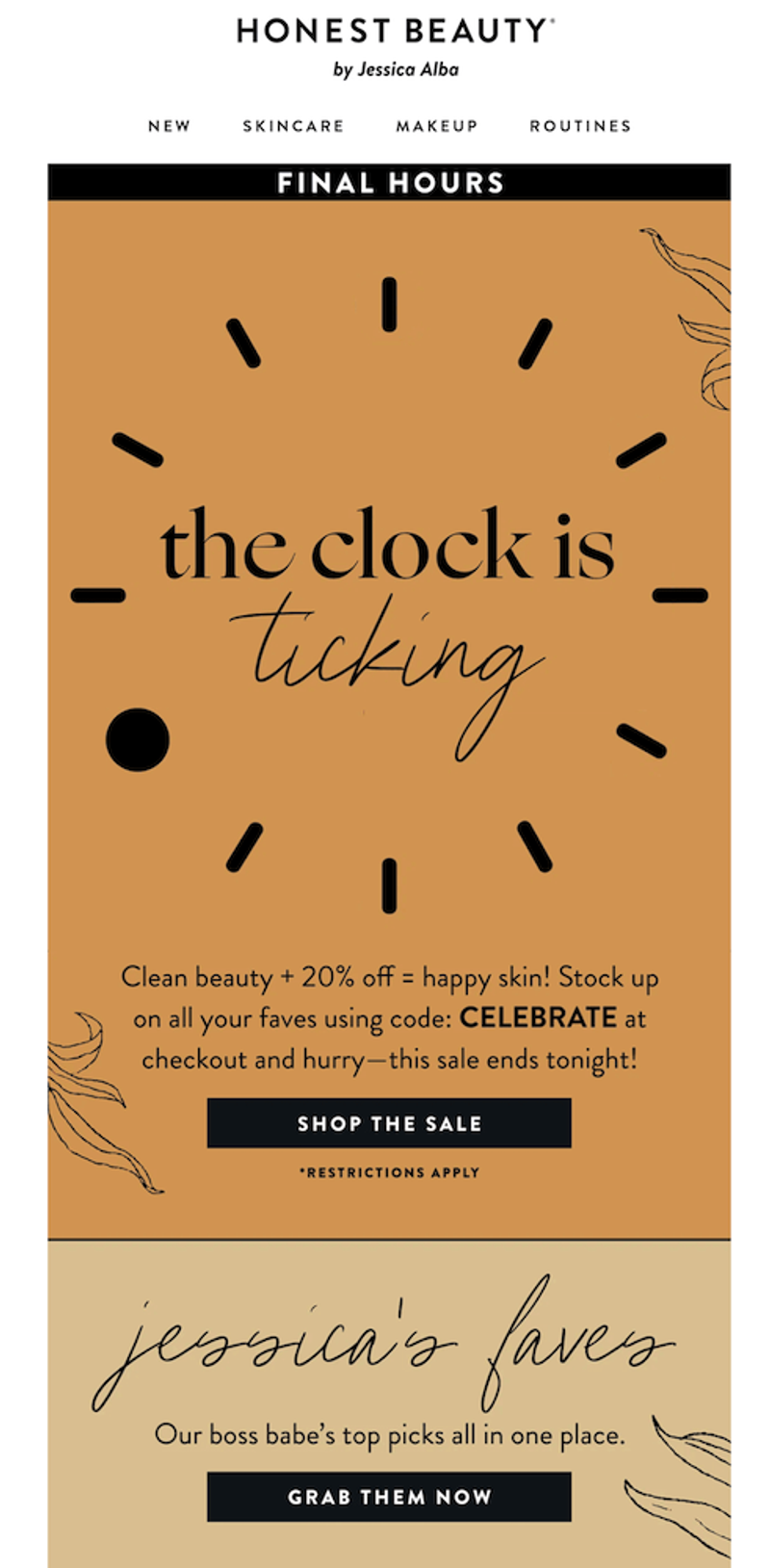
The Honest Company, Jessica Alba’s brand of non-toxic and hypoallergenic baby and beauty products, sent this 4th of July marketing campaign on the morning of July 5. It’s a smart move: customers who are loyal enough to subscribe might want some extra time to buy, especially during a holiday when so many are traveling and relaxing.
This email uses the subject line to spark urgency—there are only “hours left”—on a day when there’s a good chance the average subscriber is back at work, or at least back to their normal schedule and more likely to be checking email.
The design sparks that same sense of urgency. The clock is a GIF, and it literally ticks as a regular clock would. Finally, The Honest Company includes CTA buttons not only to the sale they’re advertising, but also to their founder’s collection, all in one place.
4th of July marketing idea: While you can use an AI marketing agent to create your initial brand 4th of July marketing plan, like we mentioned in the Tecovas example, you can also use it to continue nurturing your customers after the holiday is over.
Keep up with customers with flows and new campaigns that your marketing agent suggests every week, like ongoing education or user-generated content (UGC) and reviews. The more that customers interact with your brand, the stronger your relationship becomes.
Make every holiday campaign count with Klaviyo
During promotional moments like the 4th of July, take the opportunity to connect with your customers through personalized moments.
Klaviyo B2C CRM helps you create individualized experiences all year long, with:
- K:AI (Klaviyo AI) agents: Use K:AI Marketing Agent to create 4th of July content and keep up with customers on a regular basis. K:AI Customer Agent, meanwhile, can guide shoppers to purchase with confidence, and take a load off your customer service team.
- Automated cross-channel flows: Reach customers with personalized messaging across channels like email, text messaging, and push notifications at the right time, using logic based on customer actions.
- AI-driven analytics: Identify segments of your customer base, like those likely to shop soon or those with high predicted LTVs.

Related content