How to prevent routine support tickets
Generated by Klaviyo AI
This guide explains how ecommerce brands can use customer feedback and order events to anticipate enquiries before shoppers get in touch. It covers automated updates, self-service and AI support, as well as how to route enquiries that still need a person.
- Spot recurring complaints: Use AI to analyse customer feedback and identify where product guides, policies or help centre articles need updating.
- Automate post-purchase updates: Use order events to send delivery updates, refund information and product care tips before shoppers ask.
- Offer self-service: Give shoppers a portal to track orders, update delivery details or manage subscriptions without contacting the support team.
- Resolve routine enquiries: An AI customer service agent can answer questions around the clock and pass the full conversation to a person when needed.
- Route escalated tickets: An AI-powered helpdesk can prioritise tickets and route them to the right person with the shopper’s order history and past conversations.
At a good restaurant, you ask for sparkling water once, and your glass stays full without asking again. If the kitchen runs late, someone tells you before you wonder what’s wrong with your order, and maybe a small plate arrives on your table, on the house, as an apologetic gesture.
In ecommerce, proactive customer service relies on similar instincts: anticipating needs, communicating early, and acting fast when something goes wrong. For a brand facing feedback complaining that your service is slow, proactiveness may start by stopping the enquiries your human agents don’t need to see from reaching their inbox in the first place.
A spike in low customer satisfaction (CSAT) scores, especially about slow customer service, can point to a problem with how you’re handling enquiry volume as much as staffing. A proactive approach to customer service means preventing some issues from ever becoming enquiries, handling others with agentic AI, and prioritising the ones that matter most. This way, shoppers needing support from your customer service team won’t have to wait as long.
In this guide, you’ll learn how to spot the signals that predict an enquiry, and create the flows, self-service, and AI support necessary to deliver the attention and care your customers expect.
What is proactive customer service?
Reactive service, the kind most people picture when they think of customer service, typically waits for a shopper to write in. Proactive customer service reaches the shopper first with information, a fix, or an option, using the behavioural data your CRM already stores.
Consider the most common reasons customers contact B2C brands with complaints. For example, a 2025 Citizens Advice survey found that 37% of UK adults who received a parcel between late August and late September 2025 had a problem with their latest delivery. Late arrivals were a top issue, the kind that prompts a “Where is my order?” message.
Those are the easy-to-answer questions proactive customer service can resolve before they reach your support team. Here are some examples showing what that could look like in practice:
- An automated delivery delay notice that gives shoppers a new date
- Back-in-stock alerts that tell customers a product is available again
- Subscription renewal reminders that flag an upcoming charge before it lands
- Post-purchase how-to guides that answer set-up questions for complex products
- Return updates that confirm when a return has arrived and when the refund will follow
- A self-service portal that lets shoppers track or change order and account details
- An AI customer service agent that answers pre- and post-purchase questions from customers, with responses personalised based on their data and your product catalog
- An AI-powered helpdesk that routes escalated tickets to the right person in your team
Benefits of proactive customer service in ecommerce
With agentic AI working from each shopper’s profile, brands of any size can anticipate what each shopper needs and act before the question comes in, and that pays off in 4 ways:
- Fewer tickets: An AI customer agent can resolve routine questions on its own, at any hour, so they don’t land in your team’s inbox. In Klaviyo’s 2026 State of B2C Customer Service report, 62% of service leaders rated AI and automation very successful at resolving general FAQs, and 57% said the same about order status and delivery tracking.
- Faster replies: 92% of shoppers expect a response from customer service within 24 hours, according to Klaviyo’s Future of Consumer Marketing report. AI answers instantly. When a question needs a person, the AI hands over the full conversation, so your human customer service representative can reply without starting from scratch.
- A more personal experience: When your messages and your AI agent draw on each shopper’s orders, preferences, and past conversations, you can reach out first with something that fits: a delay notice with a discount code before they chase you, care tips for what they just bought, or recommendations based on what they’ve already loved.
- More time for the conversations that need a person: With routine questions handled, your team can focus on the high-value ones, where their touch makes the difference.
How to implement proactive customer service
If the AI that reads your reviews, the flows that message your shoppers, and your AI agent all draw on one customer profile, you can spot a complaint in your reviews, address it with a product care tip in your post-purchase flow, and give your AI agent the answer before anyone asks.
1. Use AI to analyse review sentiment, and update your product documentation accordingly
Written customer feedback, such as product reviews and survey responses, is a great source for understanding which shoppers are satisfied and which are close to walking away. Now, AI can help you analyse review sentiment, so you don’t have to do it manually.
Let’s say you sell raw denim. You filter your customer and product reviews, set aside any that look fake, and spot recurring complaints like shrinking, dye rubbing off on sofas, and early fading. All of those complaints trace back to washing, and they’re a signal that your pre-purchase product information isn’t doing its job.
Before those complaints turn into enquiries your support team has to deal with, write a guide to washing raw denim, publish it in your help centre or knowledge base, link to it from the relevant product pages (or include care tips directly on the product pages themselves), and add it to your post-purchase flow (more on that later).
Or let’s say you find customers complaining that they don’t understand your return policy, that your privacy policy is confusing, or that two of your help articles contain conflicting information. That’s your signal to invest in updated policy language across your website and help docs.
You can also train your AI customer agent on this kind of product and policy information so that it knows what information is important to share with shoppers before they buy, or when they’re comparing products on your site (more on that later, too).
- Proactive service strategy: AI review sentiment analysis
- What makes it proactive: identifying and fixing the cause of recurring complaints in advance
2. Resolve problems pre-emptively with post-purchase flows across channels
Delayed fulfilments may lead to “When will my order ship?” questions, failed delivery attempts may lead to “Where’s my parcel?” questions, and return initiations may lead to “When will I get my refund?” Instead of waiting for those enquiries to arrive, set up transactional order and shipping updates that automatically notify customers when something has changed with their order.
Of course, good post-purchase messaging goes beyond transactional updates. Once their product arrives, customers may be grateful for aftercare instructions, tips on product usage, and reassurance that they chose wisely in the form of social proof or user-generated content.
Whether a post-purchase message is transactional or educational, choose your channel mix carefully. Ofcom’s Online Nation 2025 report found that 92% of UK adults use WhatsApp.
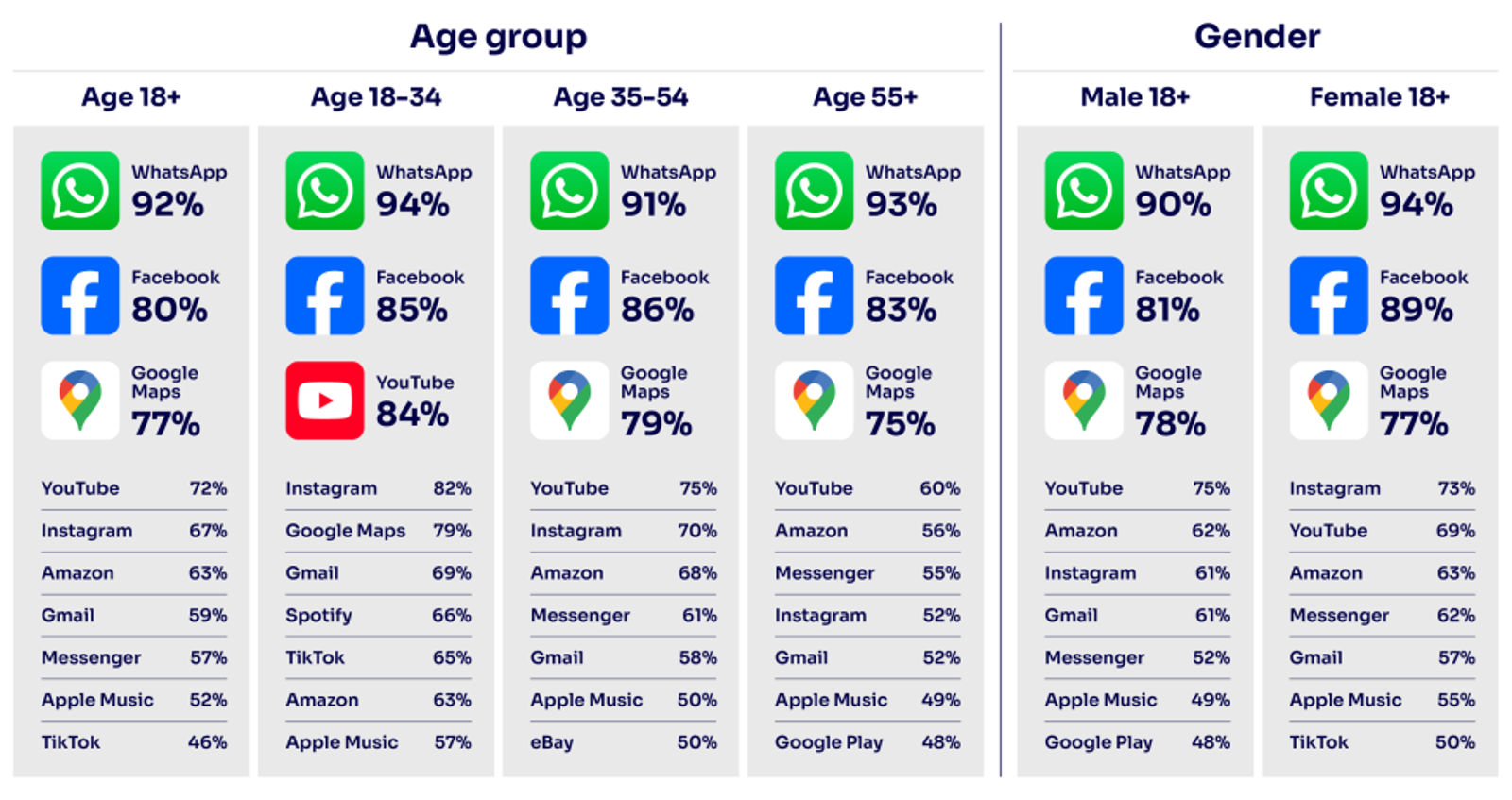
As long as you have explicit consent to send someone messages on mobile channels like WhatsApp and text messaging, you can use AI-powered channel affinity to route your post-purchase messages to the channel where each individual subscriber is most likely to engage with it.
Within each automated flow, conditional splits let you tailor the message by sending shoppers down different paths based on what you know about them. You can split flows by channel affinity or content. For instance, a first-time buyer might receive a how-to guide, while a repeat buyer of the same product gets a quick thank-you and a simple reorder option.
In this post-purchase email from beauty brand The Body Shop, a shopper who just bought the Ginger shampoo gets a quick reminder of how the formula soothes a dry, itchy scalp, along with two 5-star reviews from customers whose dandruff cleared up. That reassurance answers “Did I choose the right product?” before it can turn into an enquiry or a return. The email then suggests a scalp care bundle and travel-size products to complete the routine, so the message that reassures a shopper also gives them a reason to buy again.

- Proactive service strategy: automated post-purchase flows across channels, triggered by order events and other customer data
- What makes it proactive: information about the product arrives before the shopper asks for it
3. Give customers a self-service route
Many post-purchase enquiries come from shoppers who want to track a purchase status, update a delivery address, or pause a product subscription. These days, lots of shoppers prefer to sort these out without a person.
These are the conversations an AI customer service agent trained on your customer data, product catalog, and brand guidelines can proactively handle from start to finish. Shoppers are ready for it, too. Over 40% of consumers would rather use an AI agent for order questions, changes, and returns, according to Klaviyo’s 2026 State of B2C Customer Service report.
Shoppers at women’s intimates brand Thirdove completed more than 40,000 self-service interactions through the brand’s customer portal in 2025. With product recommendations and loyalty points in the same place, the hub also generated over $200,000 in revenue that year, showing that self-service support can pay their way while also lightening the queue.
- Proactive service strategy: a self-service customer portal that empowers shoppers to answer their own questions
- What makes it proactive: the answer is waiting before the shopper writes in
4. Launch an AI customer agent that can escalate to a human when necessary
The enquiries that come through after on-site documentation, post-purchase flows, and self-service options have done their job are the ones that need a more tailored response. Maybe a shopper needs reassurance about materials before buying a mattress, wants expert advice before choosing an instrument, or simply needs a little extra conversation to decide.
These are the conversations an AI customer service agent trained on your customer data, product catalog, and brand guidelines can handle from start to finish.
An AI agent works differently from an old-school chatbot built on a fixed decision tree, where shoppers pick from preset options. An AI agent understands what the shopper asks in their own words, works out the next step, and takes it, drawing on the same customer profile as your flows.
With access to each shopper’s profile, an AI customer agent can anticipate what they need and act on it. For example, it can:
- Recommend products based on each shopper’s browsing behaviour and purchase history
- Reach out to shoppers who browse without buying or abandon their cart, and answer whatever’s holding them back
- Answer shoppers who reply to your marketing messages, like a sizing question in response to a back-in-stock text
- Let shoppers add products to their cart without leaving a web chat
- Handle “Where is my order?” questions, returns, order edits, and subscription changes
- Check loyalty points and apply promotions mid-conversation
- Add a shopper to a back-in-stock flow when they ask about a sold-out product
- Save the preferences and intent shoppers share to their profile in real time, like who they’re shopping for
- Remember each shopper across web chat, email, text messages, and WhatsApp
- Stay on-brand and on-policy, with the tone, persona, and guardrails you set
Then, when a customer enquiry needs a person, the AI customer agent hands it off to your helpdesk with complete conversation context preserved (more on that next).
When apparel brand Folk Clothing implemented an AI customer service agent to answer common questions on their website, the AI agent resolved 53% of support conversations in 90 days.
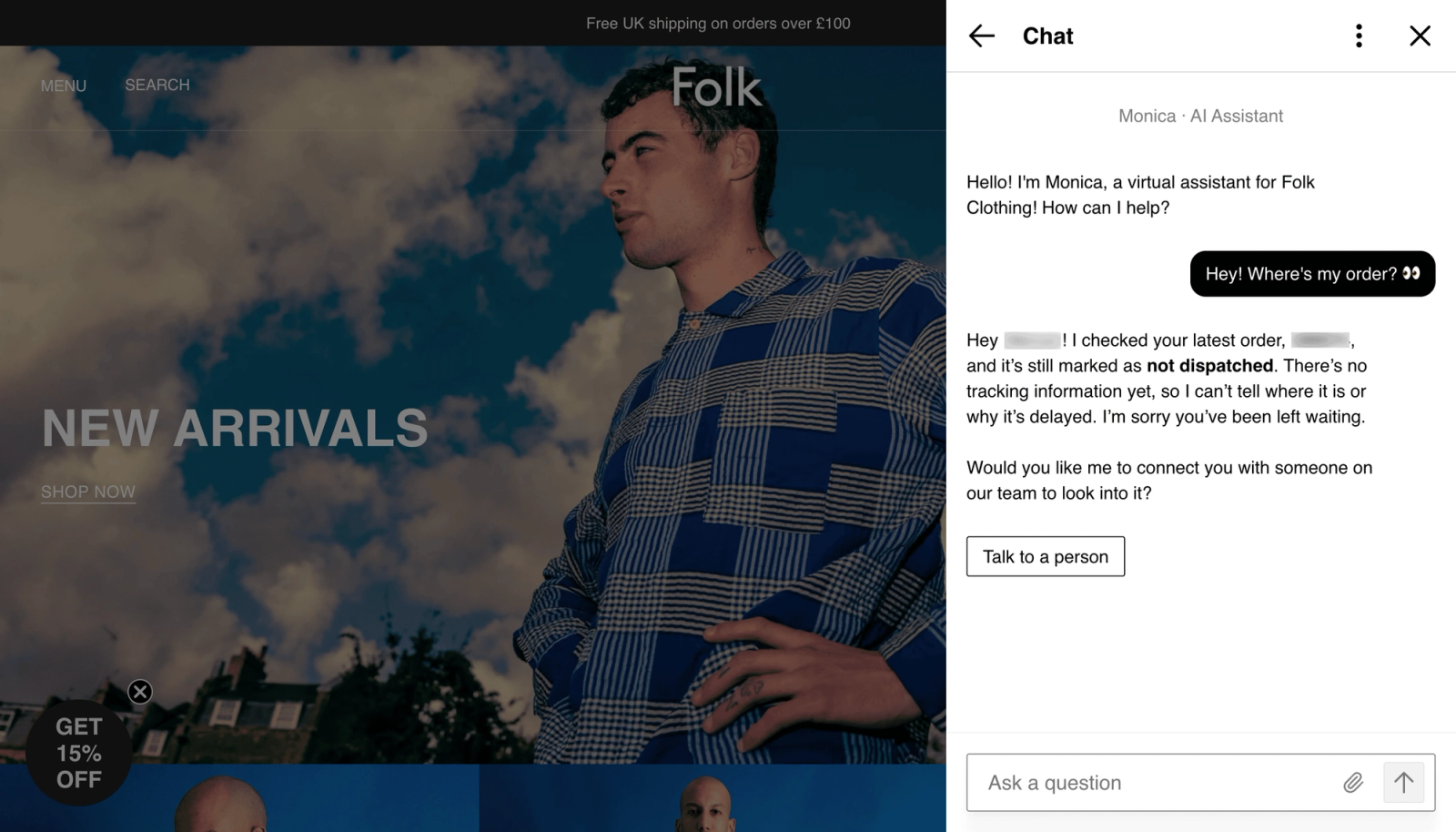
When the AI agent couldn’t resolve something, it handed the conversation over to Folk’s new AI-powered helpdesk. In 30 days, the brand’s average ticket resolution time fell 75%.
- Proactive service strategy: an AI customer service agent that answers pre- and post-purchase questions for customers
- What makes it proactive: shoppers get fast answers to their questions, 24/7/365
5. Use an AI helpdesk to route the enquiries that need a person
Some customer enquiries still need a person. For those, proactive service means getting each one to the right person fast, with everything they need to resolve it on the first reply.
When your AI agent hands a conversation over, or a shopper writes in, an AI helpdesk tags and routes the ticket based on its topic, the shopper’s order history, and profile data like VIP status. A refund question goes straight to whoever handles returns, and a VIP complaint gets flagged as urgent.
Because the AI-powered helpdesk draws on the same customer profile as your marketing, reps see each shopper’s orders, loyalty status, and past conversations next to every message, so they don’t have to switch between platforms or ask the shopper to repeat themselves.
Service conversations can also shape what the shopper hears from you next. Say someone writes in because you sent the wrong size. While the ticket is open, you can pause promotional campaigns for that shopper. Once the rep closes it, an automated flow can follow up with an apology discount or a small gift before the shopper leaves a bad review.
- Proactive service strategy: an AI-powered helpdesk that tags and routes tickets by topic and priority
- What makes it proactive: urgent enquiries reach the right person fast, and follow-ups go out before frustration turns into a bad review
Proactive customer service runs on agentic AI
Agentic AI can spot the recurring complaints in your product reviews, send post-purchase messages on the channel each shopper is most likely to engage with, answer and act on questions around the clock, and route the enquiries that need a person to the right one. And because it works from the same customer profile as your marketing and service teams, each answer and action reflects what that shopper has bought, asked about, and done.
Klaviyo, the autonomous B2C CRM, puts marketing, customer service, and customer data on one platform. Shoppers hear about a problem from your brand first, sort out requests on their own or with an AI agent that knows their order, and reach someone from your team when they need a person. Your team, meanwhile, sees which enquiries keep coming in and what to prevent next.

Related content