One of the world’s biggest consumer brands recently ranked last for cultural relevance among UK consumers.
In a 2026 Lokalise study, respondents rated the localisation efforts of leading global brands (Amazon, Apple, Coca-Cola, McDonald's, Nike, Netflix, and Samsung) across cultural relevance, communication style, and understanding of local customer needs. Apple received a score of just 3.71 out of 5 on cultural relevance among the UK shoppers.
Even when communicating with a different market, Apple's marketing tone, product launch energy, and creative direction stays rooted in California. The UK market may speak English, too, but it’s built on dry wit and distinctly British sensibility. American-oriented campaigns feel out of sync with local expectations.
If you’re selling internationally, there’s an important lesson here. Localised marketing strategies driving ecommerce growth today are shaped as much by customer psychology and regional buying behaviour as they are by translation itself.
Why localisation has become an ecommerce growth strategy
Apple's result points to a challenge many brands encounter when they expand into new markets: getting multilingual marketing right is important, but it's rarely enough on its own.
On paper, the approach seems reasonable. As long as the copy is translated correctly, prices are displayed in the right currency, and customers can check out in their preferred language, your marketing should work.
But although localisation may start with language, it doesn’t end there. A campaign can be perfectly translated and still feel like it came from somewhere else. Customers can tell when you didn’t create your campaign with them in mind, whether it's the tone, the timing, the offer, or the channels you’re using. Even small disconnects can make your brand feel out of touch.
The humour may feel unfamiliar, or the urgency may come across as overly aggressive. The messaging may emphasise benefits local customers don't particularly care about. Nothing is technically wrong, yet the campaign never quite lands.
That disconnect has real commercial consequences. The Lokalise study found that 36% of consumers have chosen not to buy from a brand because it felt poorly adapted to their country, language, or culture, whilst 47% said they're more likely to purchase from well-localised brands.
That's one reason localisation has become such an important driver of ecommerce growth: buyers compare every experience against the brands they already know and trust.
The companies that grow successfully across borders understand that you build relevance through hundreds of small decisions. They think about how local expectations influence every stage of the customer journey, from the first advert a customer sees to the post-purchase experience that keeps them coming back.
The strongest localised marketing strategies help brands make those decisions with local customers in mind whilst staying recognisably themselves.
Did you know?
Roughly 1.5 billion people worldwide speak English, making it the most widely spoken language on the planet. But only around 360 million people are native speakers, which means native English speakers account for roughly 5% of the world's population.
Many brands treat English as a shortcut to international growth, but even among English-speaking markets, customer expectations can vary dramatically. Global buyers respond to tone, cultural references, buying habits, seasonal moments, and trust signals that are meaningful to them.
5 localised marketing strategies that drive international ecommerce growth
Expanding into a new market comes with a long list of decisions. Which campaigns and flows should be adapted? How much should you change? Which customer behaviours actually matter? How do you stay consistent as a brand whilst making your marketing feel relevant locally?
Of course, there isn't a single playbook that works everywhere. But here are a few localisation marketing strategies that consistently help ecommerce brands connect with local customers:
1. Adapt tone instead of directly translating copy
When a marketing activation underperforms in a new market, marketers tend to look at the offer, the channel, or the audience segment first. Brand tone is easy to overlook because it feels less measurable.
Research helps explain why. A 2025 academic study on advertising effectiveness across cultures found that consumers in different markets often value similar things from brands, such as quality, trust, convenience, or value for money. What varies is how those benefits are communicated.
Tatcha provides a useful example. Across its US, UK, and Japanese websites, the skincare brand maintains a consistent visual identity and premium positioning, but the emphasis changes:
- At the time of writing, the US homepage led with aspiration and transformation through lifestyle imagery and emotional, benefit-led messaging. "Flood Your Skin From Within" leads with a direct product benefit, using outcome-focused language and lifestyle imagery to communicate transformation.
- The UK homepage shifts attention towards promotional offers and product discovery. "20% Off Sitewide" puts a promotional offer at the centre of the experience, highlighting value and product discovery.
- The Japanese homepage places greater emphasis on craftsmanship, product innovation, and brand heritage. "Gently, yet powerfully, weaving beauty into the future"* takes a more brand-led approach, using aspirational and emotional language to introduce the product through the lens of beauty and longevity.
*Tagline translated with machine translation.
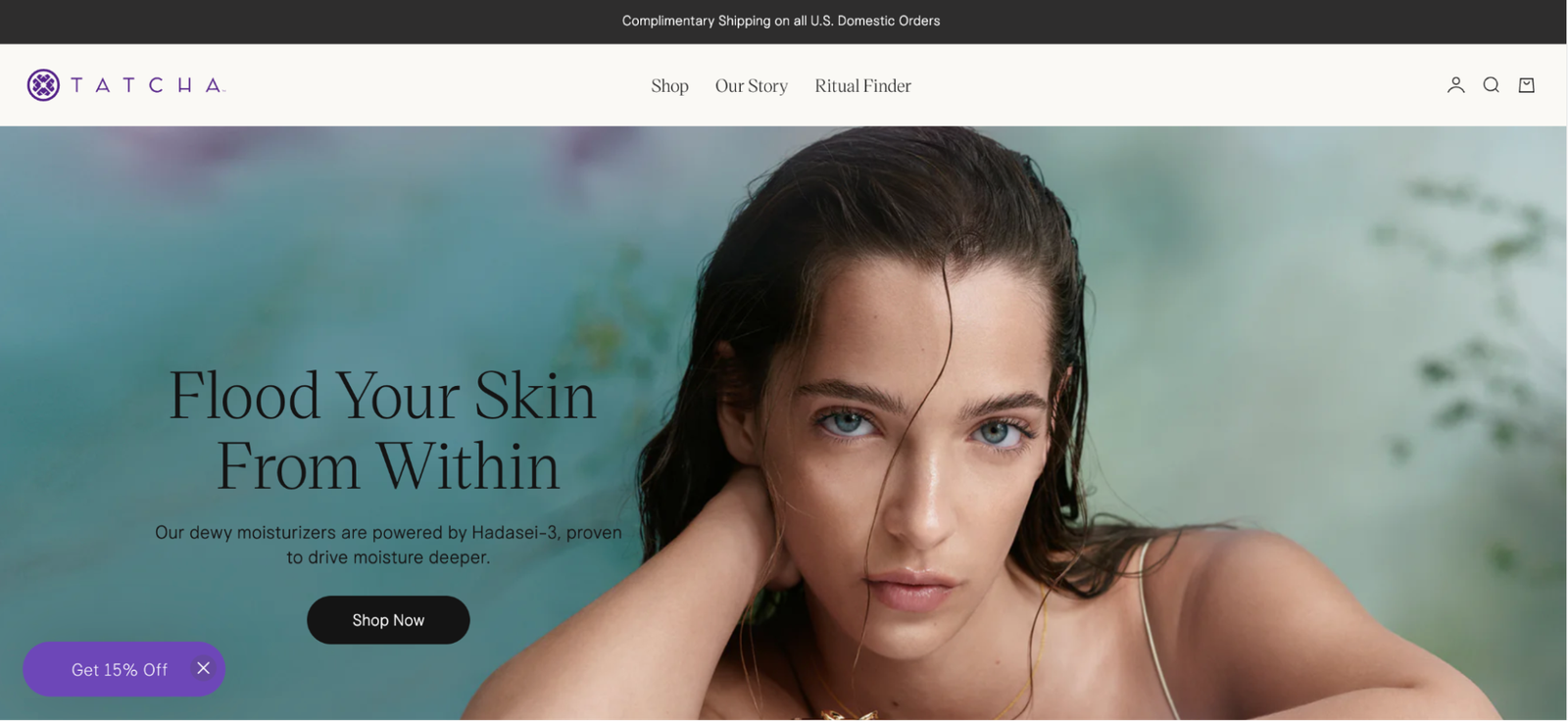
Image source: Tatcha US homepage
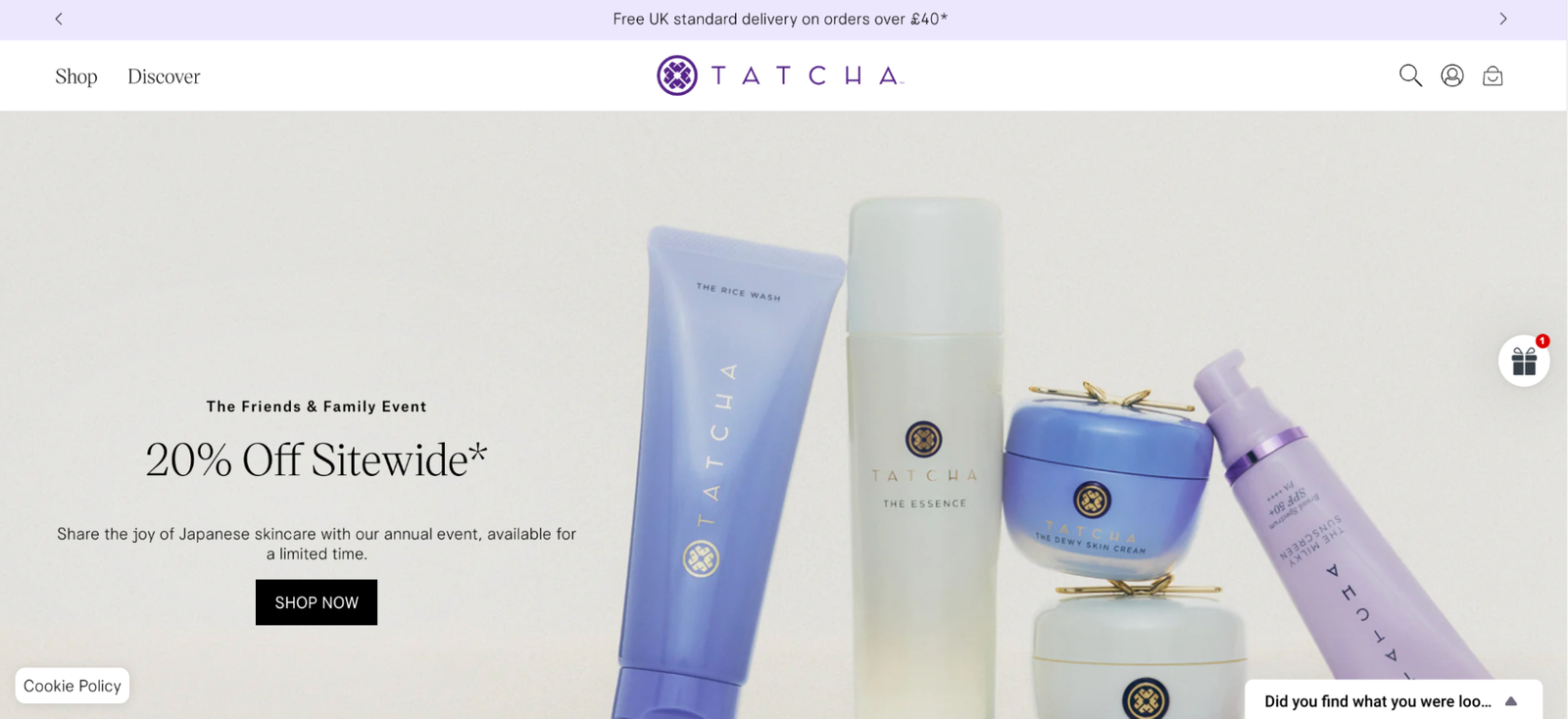
Image source: Tatcha UK homepage
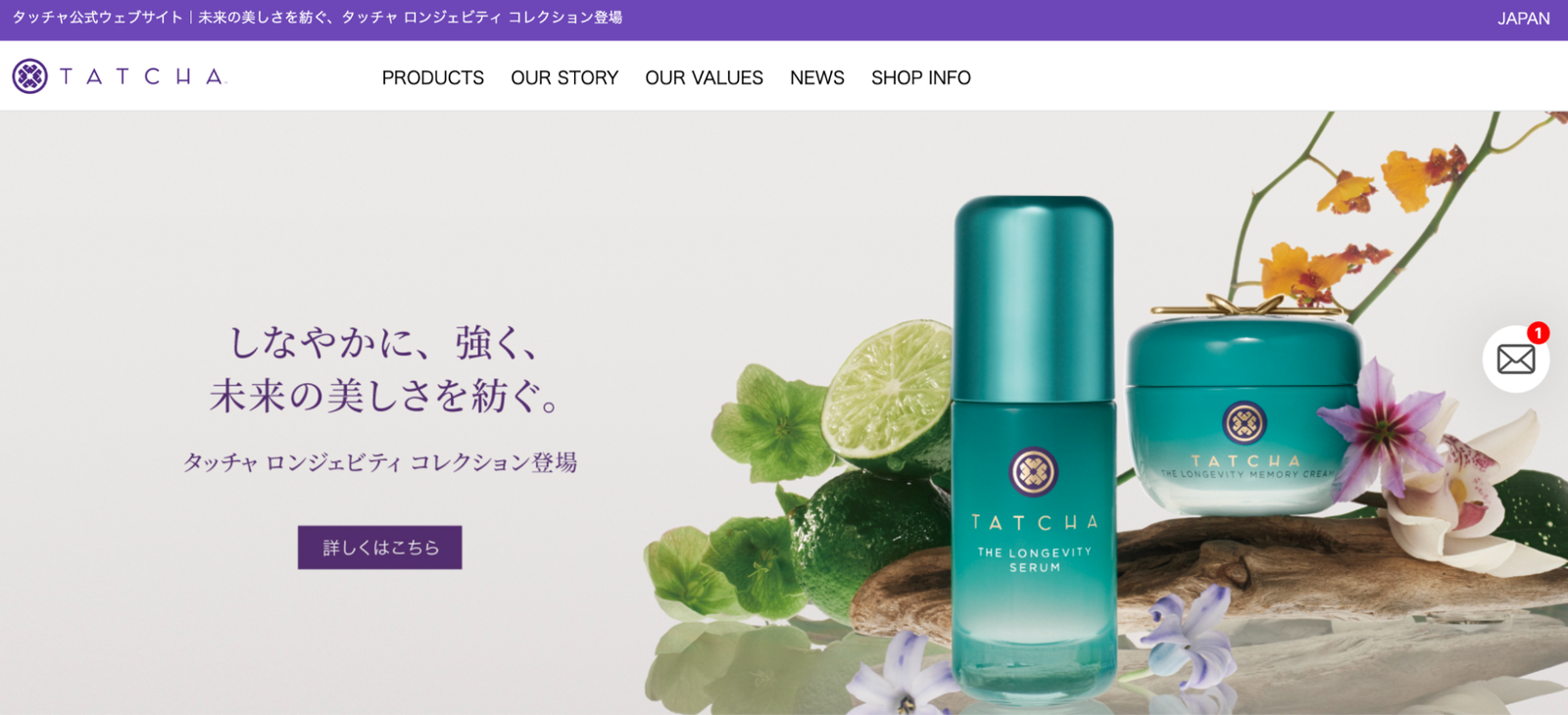
Image source: Tatcha Japanese homepage
Tatcha’s products, brand identity, and overall positioning remain consistent across all 3 markets. What changes is the message that receives the most emphasis. This illustrates an important localisation principle: customers may value many of the same outcomes, but the way they want to learn about those outcomes varies from market to market.
Adapting your tone doesn't require creating a completely different brand voice for every market. In most cases, it comes down to documenting how to express your existing voice locally. Start by creating market-specific messaging guidelines that cover:
- Preferred communication style with guidelines
- Urgency and promotional language
- Humour and cultural references
- Customer testimonials and social proof
- Words, phrases, or messaging patterns to avoid
It’s smart to include local reviewers in marketing approvals and build localisation briefs that explain the goal of each activation, the target audience, and the intended emotional response. That context often matters as much as the copy itself.
Localised marketing strategy: For email marketers, testing market-specific subject lines, promotional language, or calls to action (CTAs) can quickly reveal which communication styles resonate most with local audiences. Use an AI marketing agent to come up with multiple options, fast, then see which performs best. |
2. Build marketing around regional buying behaviour
It's difficult to localise effectively if you don't know what drives purchasing decisions in a specific market.
You might start adapting campaigns and flows, only to discover later that customers shop much differently than you expected. Maybe they’re more price-sensitive. Maybe they rely more heavily on mobile devices, or expect faster delivery, or place greater importance on reviews and social proof.
Segmenting by geography is a good start, but local buyer behaviour is shaped by far more than demographics. Small behavioural differences can shape major marketing decisions, affecting where you invest budget and which channels you choose to prioritise.
Rather than adapting campaigns and flows based on assumptions, use customer data to understand how people actually shop in each region. Start by identifying the localisation variables that genuinely influence customer experience in each market. For most ecommerce brands, that's language, currency, promotions, product availability, and seasonality.
Then, take the time to answer a few key questions before localising your marketing:
- How price-sensitive is this market?
- Which devices do customers typically use to browse and buy?
- What delivery expectations are considered standard?
- Which trust signals influence purchasing decisions?
- When are customers most likely to buy?
- Which channels drive the highest engagement and conversion?
The goal is to identify the behavioural differences most likely to influence marketing performance. Fortunately, you’re already sitting on a lot of data that can help you out, or at least fetching this data is within reach via:
- Customer surveys that reveal purchasing motivations and expectations
- Support tickets that highlight recurring concerns around delivery, pricing, returns, or product fit
- Regional analytics that uncover differences in traffic sources, device usage, and conversion behaviour
- Repeat purchase data that helps identify which products, offers, and retention tactics resonate most in specific markets
Insights like these help you build more accurate buyer personas and create genuinely personalised campaigns and flows that reflect local customer needs rather than broad assumptions about a region.
3. Adjust your channel mix market by market
A campaign can be perfectly localised and still underperform. One reason is that localisation often focuses on the message while overlooking the channels you’re using to deliver it.
Mobile message adoption, opt-in expectations, and message frequency can vary significantly between countries, which is why understanding the cultural fit of SMS marketing in Europe matters as much as the campaign or flow itself.
Take this SMS marketing statistic, for example: according to Klaviyo’s 2024 Global Texting Takeaways Report, Europeans are the most likely to have made an SMS purchase 4-5x in the last year (23%, compared to 18% of North American consumers and 17% of APAC consumers).
Or consider Black Friday in Europe. In the UK, Germany, and many other European markets, consumers have become accustomed to receiving a high volume of promotional emails and text messages during the shopping period. Outside those peak moments, however, the same communication frequency may feel excessive.
Localisation is also about understanding when customers expect to hear from you and when they don't. Evaluate each market across the following areas:
- Preferred communication channels
- Average engagement by channel
- Message frequency expectations
- Peak purchasing periods
- Device usage patterns
- The role of creators, influencers, and social proof in the buying journey
This information can help you determine where to focus your marketing efforts and how to coordinate your campaigns and flows across channels.
Strong localisation requires cross-channel consistency as well. Customers should encounter the same core message whether they arrive through email, text messaging, WhatsApp, social media, or paid advertising. The execution may vary, but the experience should feel connected.
Check out these omnichannel marketing examples to see how brands coordinate email, text messaging, in-store experiences, and other channels around actual customer behaviour.
Localised marketing strategy: Even within regions, people have different communication preferences when it comes to where they want to receive messages from your brand. Use AI-powered channel affinity to automatically route messages to the channel each individual subscriber is most likely to engage with next. |
4. Tailor consent at checkout, not just campaigns and content
It would be easy to stop localisation efforts at the parts customers can see, such as campaigns, landing pages, and product copy. But some of the most consequential localisation decisions happen somewhere far less visible: the consent checkbox at checkout.
A single opt-in flow doesn't always work everywhere. The EU's GDPR requires consent to be freely given, specific, informed, and unambiguous before you can send electronic marketing. Meanwhile, in the US, text marketing sits under a single federal law, the TCPA, layered with a growing landscape of separate state privacy laws that each set their own requirements.
Loop Earplugs, which ships to customers worldwide from warehouses in the UK, US, Australia, Belgium, and Canada, ran into this challenge directly. Their default checkout consent checkbox in Shopify treated every shopper the same, regardless of location. This meant losing subscribers at scale in higher-regulation markets like Europe, whilst missing growth potential in markets with more flexible rules.
Now, Loop pairs its CRM with a consent-management layer that automatically adjusts opt-in language and legal requirements by shopper location, and replaces its post-purchase SMS opt-in step with instant verification at checkout. According to a Dataships case study, the changes lifted consent rates by 62% in Europe and 25% in the US within 48 hours of testing, and improved SMS opt-in at checkout by 10x.
The specific tools required to localise these steps will differ by brand, but the principle is worth considering for any company selling across regions. When your CRM can act on consent data by region, a consent flow can be part of a localisation strategy instead of just a compliance task bolted onto the end of it. Design it that way, and it can pay off across every channel you use, since shoppers only see messages they've actually agreed to receive.
Localised marketing strategy: Once consent is captured, consider using conditional splits (branches within a single flow, based on a subscriber's profile or location) to tailor which channel or content someone receives next, whether that's multinational SMS marketing, email, or WhatsApp. It's a lighter lift than building separate flows for every market from scratch. |
5. Use local creators, partnerships, and communities to build credibility
When you’re entering a new market, people don't know who you are yet. They haven't seen your products in stores, heard friends talk about them, or interacted with your brand over time. Even if your reputation is strong elsewhere, you're often starting from scratch locally.
Local creators, ambassadors, and partnerships can speed up growth. They allow brands to “borrow” trust that already exists.
A recommendation from a creator, a customer review from someone in the same market, or a partnership with a familiar local brand can often do more to build confidence than another promotional campaign.
The mistake many brands make is treating influencer marketing as a standalone tactic. The strongest programmes are actually built around ongoing relationships and integrated into the wider customer journey.
Here’s how to test several trust-building channels early:
- Partner with a small group of local creators rather than a single large influencer.
- Build an ambassador programme with loyal customers in each market.
- Collect market-specific reviews, testimonials, and user-generated content.
- Explore partnerships with complementary local brands.
- Sponsor events, communities, or initiatives that already have credibility with your target audience.
Remember, the goal is to find the most relevant audience, as fast as possible.
Localised marketing strategy: Before scaling creator partnerships in a new market, test 3–5 micro-influencers with different audience profiles. Bear in mind that the creator with the highest engagement isn't always the one sending you the most valuable customers. |
Scaling localisation with one customer data platform
Localisation helps brands stay relevant as they grow into new markets, but staying relevant requires more than translation. Customer expectations, buying behaviour, and regional trends change over time, so you need customer data to understand what's working, personalise experiences, and improve every campaign and flow.
Klaviyo, the autonomous B2C CRM, brings that work into one place, with customer data, omnichannel marketing automation, and agentic AI that make it easier to build relevant experiences across regions as your brand grows. Across the strategies covered in this guide, Klaviyo can help you handle:
- Omnichannel marketing across email, push and in-app messaging, SMS, RCS, and WhatsApp: Each channel pulls from the same unified customer profile, so every message reflects the same data and stays consistent no matter where it lands.
- Market-specific segmentation: Build segments from any combination of demographic data, purchase history, and channel preferences, so campaigns reach the right audience in each market without manual list building.
- AI-powered testing, and messaging optimisation: Run A/B tests on subject lines, send times, and content, then let Klaviyo AI (K:AI) apply what performs best in each market automatically.
- Unified customer profiles: Klaviyo Data Platform brings every interaction, click, purchase, and engagement into one real-time profile so that marketing and service teams see the same view of every customer regardless of location.
- Cross-market performance insights: Dashboards and custom reports show how campaigns, flows, and channels are performing market by market, allowing you to see where to invest without exporting data to a separate tool.
- Agentic AI: Composer, Klaviyo’s AI marketing agent, drafts end-to-end cross-channel marketing campaigns from a simple goal or prompt, then recommends segments and channel orchestration. Nothing goes live without your approval.
- Accurate local pricing and product data: Sync Shopify Markets catalogues with Klaviyo so prices, currencies, and product availability stay accurate for every market you sell in, without maintaining separate catalogues by hand.
The more you understand your customers, the easier it becomes to make localisation decisions that are grounded in real behaviour rather than guesswork.
Ready to improve your localised marketing strategy with Klaviyo?
Localised marketing strategy FAQs
What’s the difference between localisation and translation?
Translation focuses on converting content from one language to another. Localisation goes further by adapting content, imagery, promotions, tone of voice, product positioning, and customer journeys to make them feel relevant to local audiences. A campaign or flow can be accurately translated and still fail if it does not reflect local expectations.
Why are localised marketing strategies important for ecommerce brands?
Localised marketing helps ecommerce brands create more relevant customer experiences, improve engagement, and build trust in new markets. As brands expand internationally, localisation can help them address differences in customer behaviour without sacrificing overall brand consistency.
How do you create a localised marketing strategy?
Start by analysing customer data, purchase behaviour, best-performing markets, and market-specific trends. Identify differences between regions, create audience segments, adapt messaging and offers where necessary, and continuously test performance. Effective localisation strategies are guided by customer insights rather than assumptions.
How can customer data support localisation efforts?
Customer data helps marketers understand how audiences differ across regions. For example, brands can identify which products are most popular in specific markets, which channels drive the most engagement, and how purchasing behaviour changes by location. These insights can then inform messaging and the type of promotions worth launching.
How do you maintain brand consistency while localising marketing campaigns?
A reliable approach is to keep core brand values, visual identity, and positioning consistent while allowing flexibility in orchestration. This means adapting language, examples, promotions, seasonal campaigns, and channel strategies to local audiences without changing the fundamental brand message.
What tools can help scale localised marketing?
Customer data and marketing automation platforms can help brands scale localisation across multiple markets. An AI-powered B2C CRM like Klaviyo allows marketers to learn about their audiences, personalise messaging, automate region-specific flows, and deliver more relevant experiences without managing every market manually.
Related reading

Related content