Build effective multilingual campaigns
Generated by Klaviyo AI
This article explains how to plan and execute multilingual marketing for international growth, from market selection to channel execution. It covers localisation levels, SEO and site structure, and how to adapt email, SMS, and WhatsApp programmes for different languages and regulations.
- Market and language selection: Use existing analytics, order data, and keyword demand to prioritise markets, then weigh factors like market size, AOV, competition, and localisation complexity before investing.
- Cultural localisation: Go beyond translation by adapting cultural references, timing, and messaging so each touchpoint feels locally relevant rather than repurposed from a home market campaign.
- Channel-specific content scope: Map what needs adapting across website, email, SMS, WhatsApp, push, paid, and social, including opt-in language, copy, creative, send times, and offers, using location-based segmentation.
- Right level of adaptation: Apply translation, localisation, or transcreation based on content type, using scalable tools for mechanical translation while reserving human input for high-impact creative work.
- Technical and compliance foundations: Set up SEO-friendly site structures with hreflang, collect language and country preferences, and adapt email, SMS, and WhatsApp programmes to local deliverability rules and regulations.
Language preference shapes purchasing decisions in measurable ways.
Nearly 75% of consumers prefer to buy from a site that offers information in their own language, but 59% of global shoppers buy from outside their own countries.
For UK B2C brands with revenue goals that extend beyond the domestic market, those figures represent a hard ceiling on growth that no amount of traffic or ad spend will fix.
The answer, instead, might be multilingual marketing.
Multilingual marketing covers everything from how you structure your site for international search to how you run localised programmes across email, text message marketing, WhatsApp, and more.
What is multilingual marketing?
Multilingual marketing is the practice of communicating with customers in their native language across every marketing channel your brand operates.
Full localisation covers your entire customer experience, from the first ad someone sees to the post-purchase review request they receive, so that each touchpoint feels local regardless of where it appears.
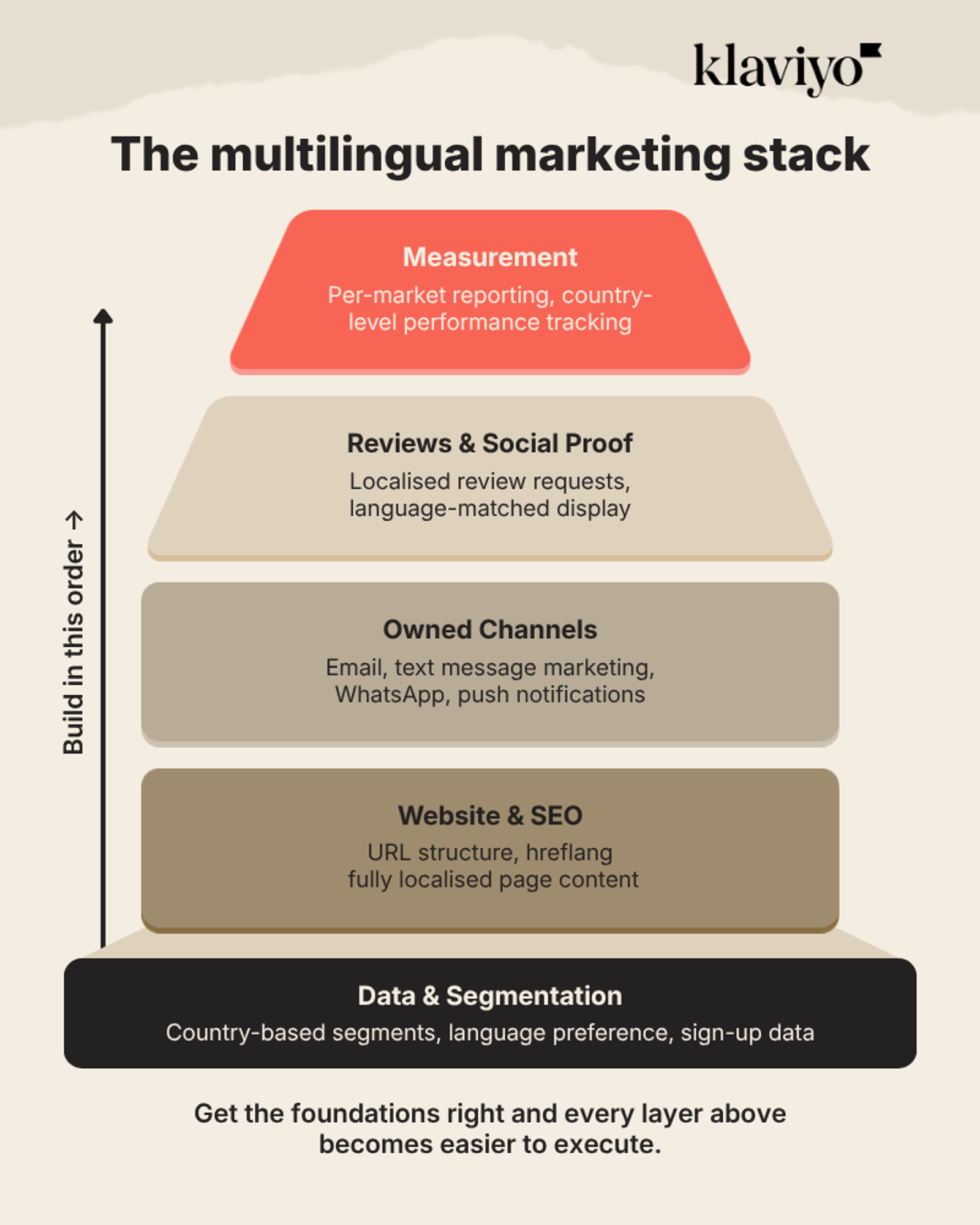
How to build a multilingual marketing strategy
A market-first approach means deciding where you want to compete, understanding what those audiences actually need, and then building content and channel plans around that. Here's how to structure it:
1. Start with market and language selection
The most reliable signal for which markets to prioritise is data you already have. Pull your analytics and look for organic visitors arriving with non-English browser settings, then cross-reference that with your order data to see where purchases are already coming from without any localisation effort. Those are your highest-probability markets.
From there, weigh a few practical factors:
- Market size
- Average order value (AOV) by country
- The competitive landscape in that language
- Localisation complexity for that specific market
If you're already getting traffic or orders from a country without doing anything to attract them, that's a stronger signal than market size research alone.
Before you commit to a market, check whether search demand exists for your category in that language. Inbound traffic tells you people can find you, but it doesn't tell you whether there's an active pool of people searching for what you sell in their own language. A quick keyword volume check can save you from investing in a market where the buying behaviour simply isn't there.
2. Understand your audience's cultural context
Language selection is only part of the picture. Getting the words right but the content wrong still produces messaging that feels foreign. The cultural references you lean on need to shift depending on where your audience is.
An email campaign built around Guy Fawkes Night, the UK August bank holiday weekend, or Glastonbury season, for example, will mean very little to a customer in Berlin or Lyon. Those moments don't exist in that audience’s calendar, and a newsletter timed around them signals immediately that your brand isn't thinking about them.
That disconnect compounds across each touchpoint: your email copy, your text messages, your push notifications, your paid ads. Each one is a chance to feel genuinely local or visibly out of place.
The goal across each touchpoint is for customers to feel like you built that experience for them, not like you translated something you built for someone else.
3. Define your content scope by channel
Before you start producing localised content, map out exactly what needs adapting across each channel. Your website is the obvious starting point: product pages, category pages, and landing pages. But the full scope of an omnichannel programme is wider than most brands plan for initially.
Across channels like email, text message marketing, WhatsApp, mobile push, paid ads, and social, here's what you'll need to think about consistently localising:
- Opt-in language
- Copy, including headlines/subject lines and body copy
- Creative
- Send times
- Message types
- Content
- Offers
Using location-based audience segmentation across channels empowers you to send market-level campaigns without rebuilding your entire marketing structure.
Translation, localisation, and transcreation: what's the difference and when to use each
These 3 terms get used interchangeably, but they describe meaningfully different levels of work. Using the wrong one for a given piece of content will cost you either money or effectiveness.
- Translation converts content from one language to another as accurately as possible. It works well for product specifications, legal copy, shipping information, and anything where precision matters more than tone.
- Localisation adapts content so it feels native to the target market, adjusting cultural references, formatting, units of measurement, and tone alongside the language itself. Take a promotional email built around a UK sale event: a localised version for the German market wouldn't just swap the words. It would rethink the timing, the references, and what actually motivates that audience to buy.
- Transcreation is closer to copywriting than translation. A transcreated piece starts from the brief and the desired emotional response, not from the original text. The output might share very little with the source material while still delivering the same feeling. It's the right approach for taglines, campaign concepts, and brand storytelling, and it costs more as a result.
For brands managing omnichannel programmes across multiple markets, applying the right level of work to each content type is a practical challenge. Some platforms handle the more mechanical translation layer at scale, with options to protect brand names and key terms from being automatically translated. Transcreation still needs human input, but straightforward localisation doesn't have to be a bottleneck.
Multilingual SEO and site structure
Getting your localised content in front of the right audience in each market requires more than publishing translated pages. Search engines need clear signals to understand which version of your site is intended for which audience, and the technical decisions you make early on will determine how well each market performs in organic search.
URL structure options for multilingual sites
Google recommends separate URLs for each language version of your site rather than using cookies or browser settings to serve different language content. That narrows the decision to 3 structural options, each with different trade-offs:
Structure | Example | Geotargeting signal | Best for |
Subdirectory | example.com/de/ | Good | Most brands entering a first international market |
Subdomain | de.example.com | Strong | Brands that need technical separation per market |
ccTLD | example.de | Strongest | Established markets where local trust is critical |
For most brands starting out, subdirectories are the right call. They sit on your existing domain, inherit its authority, and are straightforward to maintain.
Subdomains are worth considering when you genuinely need technical separation—for example, if a market requires different infrastructure, a local payment gateway, or separate compliance requirements.
ccTLDs make sense when you're fully committed to a market, you have the resources to build domain authority independently, and local trust signals matter commercially. That’s more likely in sectors like finance or regulated industries than in general ecommerce.
Hreflang, crawlability, and what Google actually reads
An hreflang tag is a small piece of code you add to each page of your site to tell Google which language and country that page targets. Without it, Google has to guess, and it often guesses wrong.
A basic hreflang tag looks like this:
<link rel="alternate" hreflang="de" href="https://example.com/de/product" />
A full implementation includes one tag per language version, each pointing to the others. So your English page, your German page, and your French page each contain a set of tags referencing all 3 versions. This tells Google that these pages are the same content in different languages, rather than duplicate pages competing against each other.
Two technical mistakes catch brands out most often:
- Dynamic language switching: If your URL stays the same but the content changes based on browser settings, Googlebot will likely never see your translated versions, since it crawls from the US without language preferences set. Each language version needs its own URL.
- Partially localised pages: Google reads the visible text on your page, not the code behind it, to determine its language. A German product page with English navigation and footer copy may confuse Google's language detection and hurt your rankings in that market.
The safest approach is to give every language version its own URL, localise all visible content on the page, and implement hreflang tags that reference every language variant.
Multilingual owned channel marketing
The right site structure and SEO gets you found. What happens after that, across email, text message marketing, WhatsApp, push notifications, and every other channel, is where most international programmes either build a genuine relationship with a new market or quietly underperform without anyone knowing why.
A few foundations apply across every owned channel before you get into the channel-specific decisions:
- Collect language and country preference at sign-up. Adding a language or country field to your sign-up form means you can segment from day one rather than retrofitting later. Customers are willing to share basic preferences when they understand they'll get a more relevant experience in return.
- Build location and language-based segments to power market-level campaigns. Once preference data sits in your subscriber profiles, country-based segments become the audience you send campaigns to in each market. A French-segment campaign goes to French subscribers, a German-segment campaign goes to German subscribers, and so on, all from the same account. Segmentation works for campaigns specifically, so the cleanest setup runs market-level campaigns in each language rather than trying to localise content inside a single flow.
- Map channel receptivity per market before you invest. Different markets favour different channels. WhatsApp leads as the top messaging app in 70 of 100 countries Similarweb examined, including Germany and the United Kingdom. Build your channel mix around where the audience already spends attention, not around what worked at home.
- Check consent requirements per market before launching. Rules vary across the EU and apply to email, text message marketing, and WhatsApp differently. Each channel section below covers the specifics, but the principle of checking local regulations before a market launch is universal.
Get this layer right and the channel-specific work that follows becomes execution rather than rebuilding.
Email: subject line localisation, deliverability, and template structure
With language preference data flowing into country-based segments, email becomes the channel where you can run market-level campaigns at the lowest marginal cost. A few email-specific points worth building in from the start:
- Subject lines and preview text need localising, not translating. A subject line that performs in English will lose its hook in literal translation. German is the obvious one: "Last chance: 20% off everything" becomes "Letzte Chance: 20 % Rabatt auf alle Produkte" and runs past the mobile preview cutoff before the offer is visible. French often needs restructured word order to keep the verb or offer early enough to land in the preview. Spanish frequently shifts the most clickable word from the start of the line to later in the sentence. Write subject lines from scratch per market with the preview pane in mind, rather than translating the English winner and hoping it holds.
- Warm up sending per market, not just per domain. Engagement signals (opens, clicks, complaints, spam reports) feed inbox placement, and those signals are generated by recipients, not by you. A French segment that has never received a marketing email from your domain will not engage at the rate your warmed-up UK list does, even though the sending infrastructure is identical. Send to your localised list in stages, starting with your most engaged subscribers in each market, before scaling volume. This is the same warm-up logic you'd apply to a brand new list, applied per country segment.
- Template structure may need adjusting per language. German compound words and longer French phrases break button widths, headline layouts, and pre-header truncation that were designed around English copy. Build template variants that accommodate longer translated strings rather than forcing all languages into a UK-designed layout.
- Localise the unsubscribe and preference centre. A French subscriber clicking unsubscribe on a French email and landing on an English preference centre is a broken experience. The compliance footer, unsubscribe link, and any preference management pages need to match the email language.
Text message marketing: sender IDs, character encoding, localised opt-outs, and France quiet hours
A UK text message marketing programme cannot simply be exported to a new market and expect it to perform. UK consumers are the most open to SMS messages out of the most prominent European markets, with 64% saying businesses should use SMS more than they already do, and channel preferences shift further across the rest of Europe where messaging apps often carry conversational load that SMS handles in the UK. The first decision when expanding is whether SMS belongs in your channel mix at all in the new market. Once it does, structural differences in how SMS works across borders affect whether your messages get delivered:
- Sender ID rules vary by country. In the UK, branded sender IDs are widely supported, meaning your brand name appears on the recipient's phone rather than an unknown number. In other markets, sender IDs must be pre-registered with a regulatory agency before use, including India, the UAE, and Saudi Arabia, which adds meaningful lead time to any international launch.
- Character encoding changes with accented characters. When a message includes accented characters, the encoding switches from standard GSM-7 to Unicode, cutting the character limit from 160 to 70 characters per message. French, German, Spanish, and Italian messages typically trigger this. A message that fits comfortably in one SMS in English may become 2 to 3 in another language, directly affecting both cost and readability.
- Opt-out keywords need to be supported in the local language. Under GDPR, withdrawing consent must be as easy as giving it. In practice, that means recognising opt-out keywords in the subscriber's local language rather than relying on the English STOP keyword alone. Configure your platform to accept market-appropriate keywords before sending the first campaign in a new country.
- France enforces wireless carrier quiet hours. Under French law, marketing SMS cannot be sent between 10pm and 8am on weekdays, all day Sunday, or on public holidays (CNIL). Messages sent outside the permitted window may not be delivered regardless of whether they meet other compliance requirements. Schedule French sends inside the permitted window rather than relying on UK-default timing.
When running text message marketing across multiple markets, make sure your platform has international SMS capability built in so you don't have to manage separate providers or accounts per country.
WhatsApp marketing: what changes by market
WhatsApp has more than 3 billion monthly active users globally and is the dominant messaging app in regions like the UK, France, Germany, Spain, Italy, Singapore, and Australia. For UK brands expanding into continental Europe, that means WhatsApp often belongs alongside or instead of SMS in the retention stack, particularly in markets where consumers expect to interact with brands the same way they interact with friends and family.
"Countries like Germany, the UK, Spain, and Italy are very WhatsApp-native, whereas the nordics are using SMS and Messenger more," as one Klaviyo partner agency put it.
In markets where SMS open rates are lower and WhatsApp usage is high, the latter channel belongs in your retention stack. But it’s not a drop-in replacement for SMS.
While language and location-based segmentation are important here, too, WhatsApp operates under a different set of rules than text messaging, and understanding them shapes how you plan the channel:
The WhatsApp Business API: Businesses communicate via the WhatsApp Business API. You must submit any outbound message templates to Meta for approval before you can send it. You cannot send ad-hoc campaign messages the way you would with email or text messaging. Plan and get approval for content in advance.
- The 24-hour messaging window: When a customer messages your business, a 24-hour customer service window opens during which you can reply freely with any message type. Outside that window, you can only send messages that adhere to pre-approved templates.
How to measure multilingual marketing performance
Blended metrics across all markets obscure what's actually happening in each one. A strong performance in one market can mask underperformance in another, and without market-level visibility, you're optimising for an average that doesn't reflect any single customer's experience.
The metrics worth tracking per market are the same ones you'd track overall, just broken out by country or language segment:
- On-site: bounce rate, conversion rate, and AOV by language version
- Email: open rate, click rate, conversion rate, and revenue per recipient by market segment
- Text message marketing: delivery rate, opt-out rate, and conversion rate by country, since delivery issues often surface first in these numbers
- WhatsApp: read rate, reply rate, and block rate by country, since WhatsApp's two-way nature means engagement patterns and template performance vary meaningfully across markets
Using language- and location-based segments in your reporting makes it easier to spot which markets are underperforming and whether the issue sits in the channel, the content, or the localisation itself.
Make sure you set up your audience segmentation strategy with this reporting use case in mind from the start, rather than adding it as an afterthought once you're already live in multiple markets.
Start building your multilingual marketing strategy
In multilingual marketing, the orchestration layer is where the right platform makes the difference. Klaviyo is a B2C CRM that goes beyond marketing automation, combining customer data, omnichannel marketing, customer service, agentic AI, and analytics in one place, so you don’t have to stitch your multilingual programme together across multiple tools.
Here's how Klaviyo supports a multilingual programme across every channel:
- Segmentation: Sophisticated audience segmentation lets you build language- and location-based segments that update automatically and power both marketing and reporting.
- Translations: Smart Translations handles localisation across email, text messaging, WhatsApp, and push notifications in more than 60 languages, with a Do Not Translate option to protect brand names and key terms.
- Text message marketing: International SMS marketing supports regional phone numbers, multiple sending number types, and region-specific compliance across Europe and Australia.
- Reviews: Multi-language reviews collect and display social proof in the right language for the right market.
- Customer service: Klaviyo Service lets you manage localised customer support conversations alongside your marketing, so the post-purchase experience is as relevant as the pre-purchase one.
- Enterprise scale: Klaviyo for enterprise brings marketing automation, analytics, customer service, and data into one AI-powered platform, with role-based permissions, region-specific compliance support, and dedicated implementation services for brands running across multiple markets.
- Ecommerce integrations: Klaviyo connects with Shopify, WooCommerce, BigCommerce, Magento, and more. For Shopify brands, Shopify Markets Locale Aware Catalogs automatically syncs localised product data across channels, keeping language, currency, pricing, and region-specific URLs correct for every market without managing separate catalogs.
If you're ready to take your first international market seriously, Klaviyo gives you the tools to do it from a single account.
FAQs about multilingual marketing
What is the difference between multilingual marketing and international marketing?
International marketing is the broader discipline of selling and promoting products across multiple countries. Multilingual marketing is a specific component of it, focused on communicating with customers in their native language across every channel. You can run an international marketing strategy without localising your language, but you'll probably convert less effectively.
How much does it cost to launch a multilingual marketing programme?
The cost varies significantly depending on the approach. Translation is the lowest-cost option and works well for product information and functional copy. Localisation requires more investment, typically involving native-speaking reviewers or agencies with in-market expertise. Transcreation, used for brand campaigns and creative copy, is the most resource-intensive. On the technical side, subdirectory-based URL structures are the lowest-overhead starting point. Most brands start with one market, validate demand, and scale from there, rather than attempting a full multilingual launch across several markets simultaneously.
Do I need a multilingual digital marketing agency or can I manage it in-house?
It depends on the scale of your programme and the languages involved. For a first market, an in-house team with access to native-speaking reviewers and a platform that handles translation at the channel level can get a programme off the ground without agency support. Where agencies add the most value is in transcreation, cultural strategy, and markets where your team has limited in-market knowledge. A hybrid approach that uses in-house tools for implementation and agency expertise for creative and cultural oversight tends to work well for brands scaling across multiple markets.
How do I localise a marketing campaign without losing brand voice?
The answer lies in the distinction between translation and transcreation. A brand voice guide that clearly defines tone, values, and off-limits language gives whoever is localising your content the guardrails to adapt it without drifting. For high-stakes content like campaign headlines or taglines, transcreation by someone who understands both the brand and the target culture is worth the investment. For operational content, translation with a native-speaker review step is usually sufficient. The risk of losing brand voice is highest when copy is translated literally without cultural context, so the review step matters more than the translation method itself.
Which European markets respond best to multilingual email marketing?
There's no universal answer here since the right market depends on where your existing demand already sits. The strongest starting point is always your own data: look at which countries are already sending you traffic, orders, or sign-ups without any localisation effort. Those are the markets most likely to respond well to a localised email programme because demand is already there. Using email segmentation by location to separate audiences by market from the start lets you measure performance per country and optimise send timing, content, and offers independently.
How does multilingual customer service affect retention in international markets?
Customer service is often the weakest link in an otherwise localised experience. A shopper who browses in French, buys in French, and then receives English-language support emails has their experience broken at a critical moment. For brands scaling into the EU, localising your customer service communications is as important as localising your marketing. Klaviyo Service supports localised customer conversations alongside your marketing programme, so you can keep the full post-purchase experience consistent across markets.
Related reading

Related content