10 takeaways from K:BOS 2026
Generated by Klaviyo AI
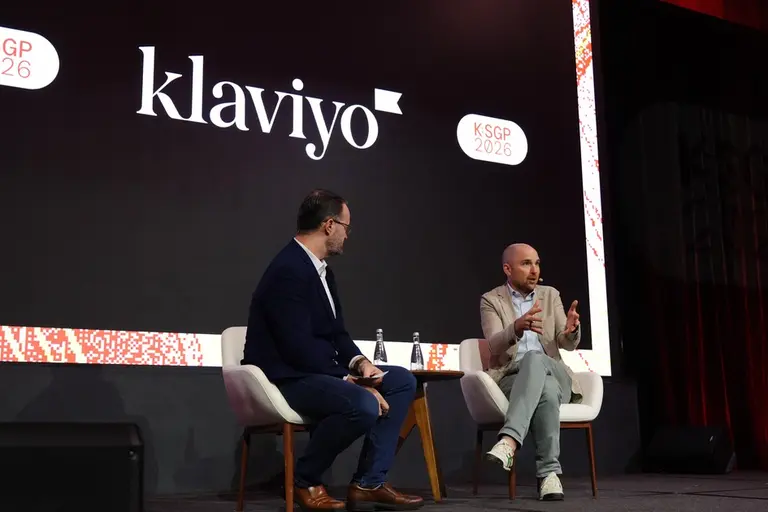
K:BOS 2026 wrapped in Boston this week, headlined by Klaviyo going headless and opening its platform to Claude, ChatGPT, and any AI system a team already uses. Across 10 sessions, raw model access mattered less than the quality of a brand's customer data and how intentionally it's used. Results ranged from a 13x jump in AI-search orders to a loyalty program that recouped $56,000 a month by rewarding identity over discounts.
- Context beats the model: Klaviyo's platform updates argue that an agent is only useful when it understands a brand's own data, reaches that understanding anywhere it runs, and acts on it for every customer, not which model powers it.
- Agentic commerce is already reshaping discovery: Orders originating from AI search are up 13x year over year, and identification, not messaging, is now the real bottleneck to reaching customers.
- Ambition on agentic AI is outpacing the data to support it: 73% of merchants call agentic AI a top priority, but only 28% have an actionable, real-time view of the customer to build it on.
- Consolidation beats adding more tools: Marketing teams running campaigns across 25+ tools lose an estimated 25% to opportunity cost, and fewer tools, not more AI, is what teams say would help most.
- Community and identity outperform discounts: A loyalty program built on status and recognition instead of purchase totals made members 3.3x more likely to place a second order.
K:BOS 2026 wrapped in Boston this week after two days centered on how brands build lasting customer relationships. As AI models become standard across the market, competitive advantage now depends on customer data quality and system integration.
Klaviyo anchored this message by going headless, allowing teams and agents to access live CRM data and run workflows directly inside Claude, ChatGPT, or custom software.
Across every session, a consistent theme emerged. Real growth happens when companies unify their customer data and make intentional choices about how and when to act on it.
Here's what stood out, session by session, and what's worth carrying into 2027.
1. Customer context beats the model
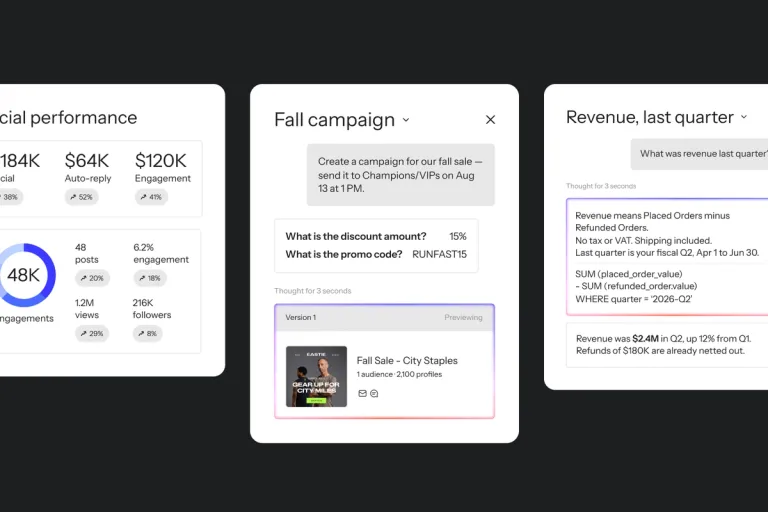
Klaviyo co-CEO and co-founder Andrew Bialecki opened K:BOS by making the case that raw model intelligence matters far less than customer context. Watch the full opening keynote below, or read on for the highlights. Klaviyo backed up that thesis with major platform updates, including Klaviyo Headless, a new SQL engine, an evolution of Marketing Analytics to Personalization, and upgrades to Composer and Customer Agent. Together, these updates allow systems like Claude or ChatGPT to read customer data and run workflows from wherever a team already works, without needing to log into Klaviyo's own interface.
Bialecki noted that an agent is only useful when it can comprehend brand data, access that context anywhere it runs, and deliver personalized experiences to every customer.
Takeaway: The market is dividing into systems that unite data, reach, and action, and tools that only offer disconnected pieces. That structural gap will separate useful software from simple novelty in 2027, as well as which approaches to AI produce real revenue and business outcomes.
2. Build the knowledge layer, buy the rest
Publicis Sapient’s Duke Marr shared a 5-layer framework for building a brand-specific AI agent that can handle sales, service, and advice across channels. He recommends buying the parts that are already standard across the industry (the experience, data, and commerce layers) and building the two that actually make a brand unique:
- The knowledge layer: Your specific product, policy, and brand content data.
- The orchestration layer: The reasoning rules and guardrails that guide how the agent acts.
While retailers are eager to adopt agents, winning consumer trust comes down to providing the deep brand knowledge that generic tools lack.

Takeaway: Closing the gap between retailer ambition and consumer trust starts with data accuracy. Focus your engineering effort on training agents to answer complex, brand-specific questions reliably before worrying about full checkout automation. Klaviyo is here to help, too. We’ve built transparency, choice, and experimentation into Composer and Customer Agent so you can leverage the pre-built agents, while training them to your specific brand.
3. Agentic commerce is reshaping how customers arrive
Shopify reported that orders originating from AI search are up 13x year over year, AI-referred average order value is running 30% higher, and AI-driven traffic to Shopify stores overall is up 8x, with younger buyers leading adoption of AI shopping assistants. Because these buyer journeys frequently bypass traditional website landing pages, brands have to find new ways to collect customer preferences before a shopper ever reaches their site.

Takeaway: Modern buyer journeys increasingly start off-site, before a brand's own website ever gets a chance to capture anything. Getting more out of the forms, quizzes, and sign-up moments already running matters more now than optimizing what happens after someone lands on the product page.
4. Marketing and service are becoming one continuous journey
S&P Global used industry data to project how marketing and service will converge over the next 3 years in Agentic ambition: How marketing and service become one journey in an agentic world. The research found 73% of merchants rate deploying agentic AI a top priority, but only 28% have an actionable, real-time view of the customer to build it on.
Takeaway: S&P Global said it plainly: "Ambition is close to universal. Architecture is not." Stop planning marketing and service as separate roadmaps. The brands ahead of this are already building one customer journey on one data foundation. Take a quick quiz to see where you land on the AI maturity curve.
5. You can’t personalize for a customer you can’t see
Wunderkind, AMB Interactive, and Lake Pajamas tackled a problem most marketing programs don't talk about: over 95% of site traffic arrives anonymously, which means even the best-built Klaviyo flows only reach a fraction of the people already engaging with a brand. Lake Pajamas closed that gap and saw email revenue per send climb 38% year over year, with a smarter 24-hour abandonment cadence lifting cart conversion 168% over the old 5-day version.
Takeaway: Solve identification first, since a better flow only helps once you know who it's reaching. Identity resolution feeds more recognized shoppers into the Klaviyo flows already running, no rebuild required.
6. Composer is finding revenue teams don’t know they’re leaving on the table
Snake River Farms joined the Composer team to show how the tool surfaces hidden opportunities and prioritizes high-impact fixes automatically, rather than waiting for a marketer to go looking.
Takeaway: Composer brings the data and the ideas. You bring the judgment to decide what to do with them. The biggest wins are often hiding in the gaps of the campaign you already have. And now, SQL is available in Composer, too.
Need ideas on getting started with Composer? Check out our prompt library.
7. Community is beating discounts, again
Nutrition Warehouse and Okendo shared how Nutrition Warehouse built a loyalty program around community and recognition rather than discount stacking, rewarding the workout, not just the checkout. When they swapped a 10% discount code in their welcome email for a free shaker and towel instead, they recouped an estimated $56,000 a month, and loyalty members are now 3.3x more likely to place a second order than non-members.
Takeaway: The same lesson as last year is still true: a discount buys the order in front of you, but as the session put it, "status, access, and identity buy the next 3 years." Check what your loyalty program actually rewards. If it's only purchase totals, it's a discount program with better branding.
8. Fewer tools is the fix marketers actually want
Forrester research shows the average marketing team runs a single campaign across 25 tools and 23 data sources, losing an estimated 25% in opportunity cost due to operational friction. Unsurprisingly, 46% of marketing leaders said their biggest priority is consolidating the software they already own.

Takeaway: Adding another tool rarely fixes a scattered data foundation. Simplifying your stack yields faster productivity gains than adopting new software. Klaviyo built the autonomous CRM to help consumer brands consolidate across marketing, service, and AI.
9. Creators are becoming founders, and brands need a different playbook for them
A panel of creators turned business founders—including Sweet Addison's, Shelter Skin, and Lighthouse Keepers Pantry—shared what actually makes brand partnerships work as AI reshapes content discovery. They warned marketers that vague or overly rigid campaign briefs are the fastest way to drive away quality creators.
Takeaway: Write creator briefs like you are pitching a strategic partner, not purchasing ad placement.
10. Shoppers want AI, but not everywhere
Kevin Indig, growth advisor and author of Growth Memo, analyzed over 1 million AI responses and found a clear boundary in consumer behavior. Shoppers welcome AI for product research and price comparisons, but prefer to make taste-based choices and actual purchases themselves. Ridge Wallet backed this up, reporting that 70% of their sales still originate from direct or search traffic rather than AI recommendations.

Takeaway: Use AI where consumers actually want it, such as answering routine support questions and simplifying research, rather than forcing automated buying on customers who aren't ready for it.
The model was the easy part
Giving software the technical ability to read data and execute tasks across systems is only the starting line. Automated capabilities quickly lose value without strategic direction.
Moving into 2027, long-term growth will come from pairing connected platforms with rich customer context and active human guidance over the customer experience. And Klaviyo is here to help you usher in that next era for your brand.

Related content