Predictive marketing: how to use AI-powered analytics to anticipate customer behavior
Generated by Klaviyo AI
Jessica Fontanilla, Senior Digital Strategist on Klaviyo's Professional Services team, explains predictive marketing: using AI and machine learning to forecast individual customer behavior (next order date, lifetime value, churn risk) rather than relying on static, one-size-fits-all rules. She walks through five core predictive metrics and five tactics for using them, backed by real brand examples from Klaviyo customers.
- Static rules don't adapt, predictive models do: Static timing (like a 30-day win-back or 60-day repurchase email) treats all customers the same and requires manual upkeep, while predictive models recalibrate continuously to each customer's own behavior.
- Five core metrics power the strategy: Predicted LTV, expected date of next order, churn risk, next best product/cross-sell date, and RFM analysis are the built-in Klaviyo predictions she uses most, though next best product and RFM require Marketing Analytics or Advanced CDP and a minimum data threshold (500+ customers, 180+ days of order history, etc.).
- Real brands show measurable results: Examples include Smile Brilliant's 39x platform ROI using predicted next-order-date replenishment flows, GourmetGiftBaskets.com's 42% MoM email and 88% MoM text revenue-per-recipient growth from RFM segmentation, and Tibi's win-back flows driving 2x the revenue of prior campaigns by triggering on RFM category movement.
I've spent almost a decade in lifecycle marketing and CRM, and I've noticed that most brands have tons of customer data they don’t use.
As a senior digital strategist on Klaviyo's professional services team, I help brands act on all their data. Purchase history, browsing behavior, and engagement signals can tell them when a customer is about to buy again or leave for good.
Instead of guessing when to send a replenishment reminder or which customers deserve a win-back offer, AI-powered predictive analytics can look at each customer's actual behavior and tell you what's likely to happen next.
In this article, I walk through what predictive marketing actually is, why it outperforms a static approach, and the specific tactics I recommend to the brands I work with, including real examples.
What is predictive marketing?
Predictive marketing is using AI and machine learning to forecast what individual customers are likely to do next, then triggering messages based on those predictions.
These forecasts can include when customers might place their next order, how much they may spend over their lifetime, how likely they are to churn, and more.
Non-predictive segmentation groups customers by what they've already done, like bought in the last 90 days, opened an email this month, or spent over $100. Predictive analytics goes a step further and estimates what each specific customer will do based on their own patterns. This is data you already have in your CRM.
Each purchase, browse session, and email click is a predictive signal that can inform some of the most effective automations in your program.
Why static marketing rules can’t keep up with predictive models
Many lifecycle programs run on static numbers that were chosen more or less arbitrarily, like a win-back flow that triggers after 30 days of inactivity or a repurchase email that sends 60 days after a first purchase.
When I ask brands where those numbers came from, the answer is usually some combination of an internal average, a market benchmark, or a common practice someone heard about at some point.
Static rules create two problems:
- They treat all customers the same. If a makeup artist going through products on a weekly basis and a casual customer restocking twice a year get the same 60-day reminder, it's not timed well for either of them.
- They don't adjust themselves. With static timing, refinement is on you. You have to keep looking back, asking whether the window is working, and constantly be testing and adjusting. Predictive models do that continuously, recalibrating to each customer's behavior without anyone touching the flow.
With static numbers, you're saying: I haven't seen this person in 30 days, and I need to contact them. Based on what? Maybe market averages, maybe what you once heard was a best practice. With predictive marketing, you're actually messaging shoppers based on what you know about every individual customer.
Where to start with predictive marketing: core predictive metrics to know
Klaviyo's predictive analytics are built-in machine learning models that analyze customer data to predict the likelihood of certain events. These are the ones I use most with brands:
- Predicted customer lifetime value (LTV): This combines historic LTV with predicted future spend, so you can identify your most valuable customers earlier.
- Expected date of next order: This is a per-customer forecast of when the next purchase is likely, based on that individual's cadence rather than a store-wide average. You can even customize prediction windows to match your business's purchase cycles.
- Churn risk: This is the probability that a customer is slipping away, modelled on their own order frequency.
- Next best product and cross-sell date: This is what each customer is most likely to buy next and when they'll be most receptive to a cross-sell, based on actual purchase sequence data across your catalog.*
- Recency, frequency, monetary (RFM) analysis: This sorts customers into categories like “Loyal,” “At risk,” and “Needs attention” based on how recently they bought, how often, and how much they spent, and tracks how customers move between those categories over time.*
*only available with Marketing Analytics or Advanced Klaviyo Data Platform
These predictions function like any other profile property in Klaviyo. Having worked with several other marketing platforms before joining Klaviyo, I can confirm this isn’t the norm. With many other platforms, acting on predictive insights often requires extra tooling and can have a narrower predictive capability. In Klaviyo, marketers can use built-in predictions directly in segmentation and flows.
One important note: When an account doesn't have enough data yet, some predictions lean on averages. In Klaviyo, you need to have:
- At least 500 customers who have placed an order
- At least 180 days of order history that contains orders within the last 30 days
- At least some customers who have placed 3+ orders
- An ecommerce integration or Klaviyo API connection for placed orders
5 predictive marketing strategies that drive retention and revenue
Here’s what I recommend most often, roughly in the order I'd prioritize them:
1. Replenishment flows timed to each customer
This is the first thing I set up when a brand sells anything consumable. Instead of 5 different flows with 5 different timelines for 5 different products, build one flow triggered by each customer's expected date of next order. Klaviyo already knows which product they need to replenish and when they'll need it.
If a customer finishes your product and you're not in their inbox at that moment, someone else is. A well-timed replenishment email or text keeps you top of mind at exactly the moment they’re ready to buy.
Oral care brand Smile Brilliant uses Klaviyo's predicted next date of order to create replenishment flows based on past purchases. This and other personalization efforts drove a 39x platform return on investment in a year. “We have so much data in Klaviyo to work with and visualize,” says Brendon Alaniz, project manager at Smile Brilliant.
2. Cross-sells triggered by predicted readiness
Next best product plus predicted cross-sell date is my favorite combination. Rather than sending your full list a generic promotion, send each customer the product they're most likely to buy next, at the time they’ll most likely be ready to buy it. Add a next best product block to your post-purchase flow, and you get AI-recommended cross-sells based on real purchase data.
Consider this email example from clothing brand Princess Polly, which shows the customer suggested items to add to their cart. With next best product, there's no manual recommendation logic, and you don’t have to guess which products pair well together. The recommendations reflect what customers like this one actually bought, not what you assume they should buy.
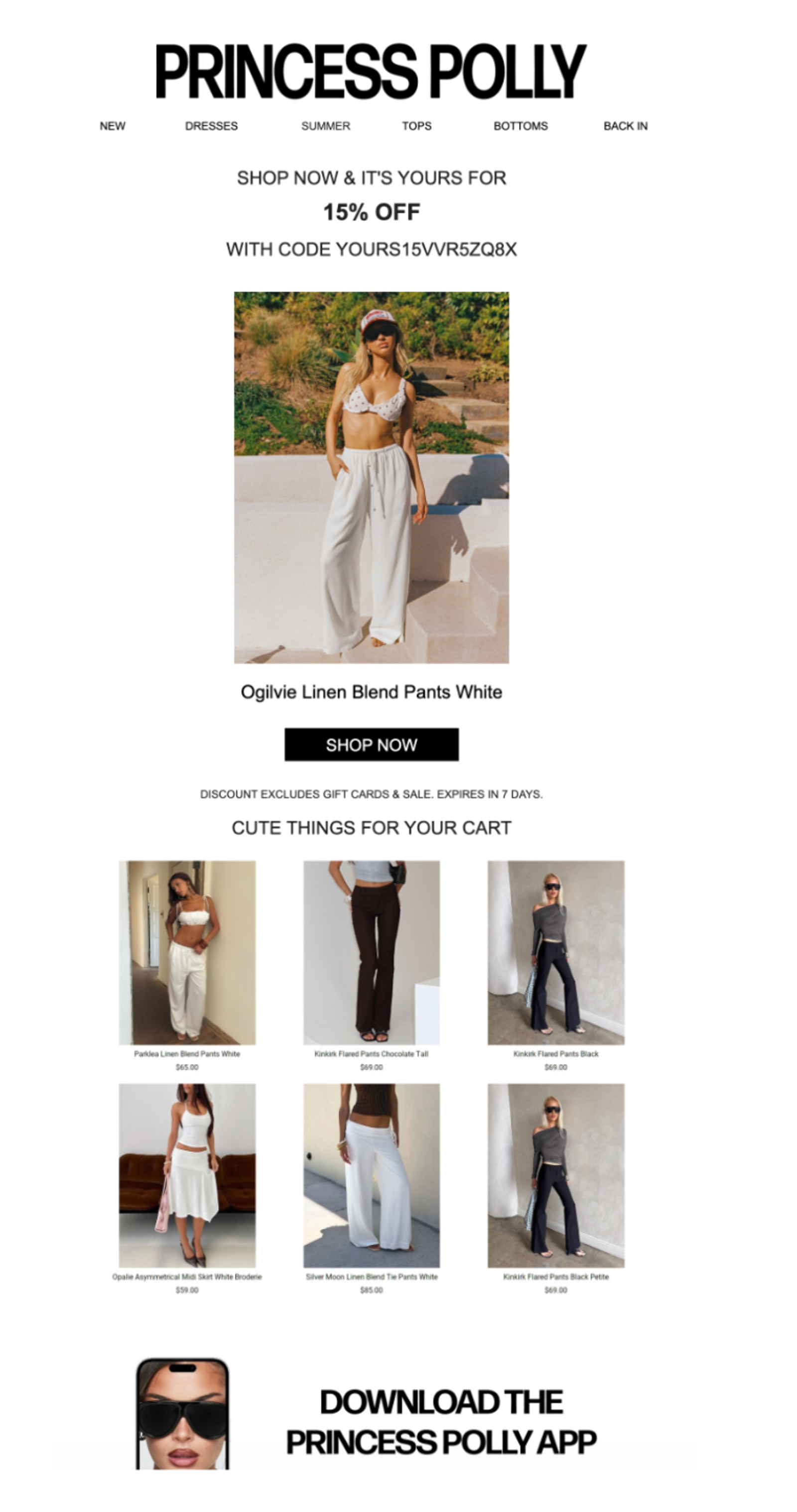
Source: Princess Polly
3. Churn prevention that starts before the churn
Here's the problem with most win-back sequences: by the time churn is visible in your revenue data, it's too late. The customer has already moved on, and you're trying to win back someone who really left months ago.
With predictive churn risk, you can build a segment of customers with high churn probability and launch a personalized win-back flow before they churn. Better yet, use predicted LTV to find high-value customers likely to churn and prioritize winning them back first.
4. Messaging frequency matched to RFM segments
Not all customers should hear from you at the same rate. RFM analysis can tell you who should hear from you more and who needs a lighter touch. Your loyal, high-frequency customers can handle (and often want) more frequent messaging. Your at-risk customers need fewer, more carefully chosen sends.
Adjusting frequency and messaging by RFM category also protects your sender reputation while making each send more relevant. And with an AI marketing agent, you can generate distinct messaging for each RFM category, with different offers for loyal customers vs. at-risk customers.
After artisanal gift basket brand GourmetGiftBaskets.com adopted RFM segmentation and cohort analysis, they can now send text message campaigns to the customers most likely to convert—and skip the ones most likely to be annoyed. In their first full month using RFM segmentation, revenue per recipient grew by 42% MoM for email and 88% MoM for text messages.
“Since we started using RFM segmentation with GourmetGiftBaskets.com, literally every single metric that we care about is up, from click rate to open rate to revenue per recipient,” says Evan Corliss, owner of the brand’s lifecycle marketing agency eCora.
5. RFM movement as your early warning system
Predictive analytics can also help you keep a pulse on how customers move between RFM categories. If you see a wave of customers shifting from “Loyal” to “At risk,” that's your signal that something isn't working.
Look at what those customers have been receiving and what changed. Category movement lets you diagnose problems while they're still fixable, and intervene with the specific customers who are slipping. You can track this movement over time in Klaviyo's analytics dashboard.
Fashion brand Tibi uses Klaviyo to run multi-channel win-back flows that trigger when “Champions” and “Loyalists” exit to lower-value segments. The refreshed timing and targeting has been impactful: Tibi’s top RFM-triggered win-back flows drove more than 2x as much revenue in their first full month as the brand’s prior win-back flow.
“I am referencing customer data from Klaviyo daily,” says Allison Gagnon, director of ecommerce at Tibi. “The consistent and cohesive reporting is impactful, and watching customer behavior change over time has been really helpful for learning where new opportunities exist.”
How to get started with predictive marketing
If you're new to predictive advertising and marketing, here's the progression I recommend:
- Look at what the models already know. Open a few customer profiles and review predictive attributes like LTV, churn risk, and expected next order date. This is to get a sense for what a predictive marketing campaign would look like from a customer’s point of view. Then, ask your AI marketing agent where the opportunity lies.
- Start with one flow (repurchase or churn prevention). Pick whichever maps to your bigger problem. If repeat purchase rate is your struggle, build a replenishment flow on the expected date of next order. If churn is the bigger issue, build a win-back triggered by churn risk.
- Layer in RFM analysis. Review your category distribution, adjust messaging frequency for loyal vs. at-risk segments, and set a recurring check-in on category movement.
- Retire your static flows in favor of predictive ones. Each manually timed flow you replace is maintenance you can stop doing for good.
Turn predictive marketing into your growth engine with Klaviyo
To improve your customer retention, act on your own data instead of relying on benchmarks. Look at who's about to buy, who's about to leave, and what each customer wants next.
Klaviyo, the autonomous B2C CRM, maintains a real-time, lifetime view of every customer, with every interaction, purchase, and preference in one place. With Klaviyo, you can:
- Access predictive analytics for every customer, powered by Klaviyo AI. With AI embedded in the CRM, no existing machine learning infrastructure is required.
- Segment and personalize emails, texts, mobile app messages, WhatsApp conversations, and push notifications based on predicted LTV, order date, churn risk, and more.
- Automate highly relevant replenishment and cross-sell messages based on each customer’s predicted next order date and recommended next product.
Ready to create better personalized experiences for your customers?

Related content