How to use AI for email marketing as a Klaviyo revenue engine
Generated by Klaviyo AI
Dispatch founder Elliot Kovac argues that the biggest untapped Klaviyo revenue lever for most brands isn't a new tool, but simply sending more campaigns — since campaign revenue scales with volume of good sends, not list size, while most brands aren't using the sending capacity they already pay for. He breaks down why brands under-send (limited time and not knowing what to send on non-obvious days) and distinguishes between AI as a one-off copywriter versus AI as a "campaign operating system" that holds context on a brand's products, audience, and past performance to drive a full campaign calendar.
- Flows vs. campaigns work differently: Flows are built once and pay off passively, while campaigns require new content every time and only generate revenue when brands actually send them — making campaigns the bigger opportunity for most brands.
- Two real constraints hold brands back: Kovac points to time (often one person or a small team juggling every channel) and not knowing what to send on the roughly 140-plus days a year that aren't tied to an obvious launch, sale, or holiday.
- Context is what separates useful AI from a "faster typewriter.": Kovac lists five inputs a genuinely useful AI campaign system needs — commercial goals, product priorities, seasonal relevance, past performance, and audience segments — and cites Dispatch client results (including a 161.4% KAV lift for Young Nails and a 400% lift for Craighill) alongside a simple math example showing one extra weekly campaign at $500 average revenue adds roughly $24,000 a year.
My agency, Dispatch, has sent more than 2 billion emails for ecommerce brands doing up to $50 million in revenue. Across that work, one pattern shows up in almost every account I open: the ROI a brand is missing is right in plain sight, in the calendar.
Where your Klaviyo revenue comes from
In my experience, the majority of Klaviyo-attributed revenue (KAV) comes from flows or campaigns, and the two behave completely differently.
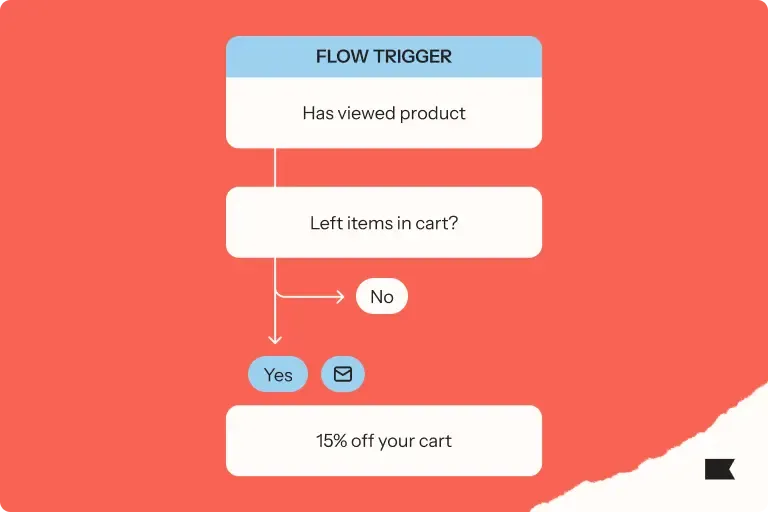
Flows get built once. You set them up, and from that point on they pay you daily without any ongoing work. They're generally evergreen, so once you perfect them, they keep doing their job in the background.
Campaigns are the opposite. You build them every single week, and they only pay off when you actually put in the work to send them. There's no evergreen version of a campaign, so it needs new content, every time.
That difference matters because it points to where the upside is. You can't get more out of a flow without rebuilding it. But you can almost always get more out of campaigns, because campaign revenue scales with how many good sends you put out, not with how big your list is.
You can almost always get more out of campaigns, because campaign revenue scales with how many good sends you put out, not with how big your list is.
Most brands I work with also aren't using anywhere near the sending capacity already included in their Klaviyo plan each month. And that's not a strike against Klaviyo. You're already paying for that capacity, so the fastest lever available to most brands is simply using more of what they already have.
Why brands aren't sending enough good campaigns
I see two constraints show up over and over:
- Time: It's usually one person, a founder or marketer, doing strategy, copy, design, and implementation, while also owning every other channel. Or it's a small team with enough hands to get things done, but not enough time to give email the attention it needs when every other channel is also asking for it.
- Knowing what to send: Everyone knows the obvious sends: a new product launch, a flash sale, a big holiday moment, a back-in-stock notification. But that's maybe 20–25 days a year. The other 140-plus sends are the hard part.
What do you send on a random Tuesday with no launch and no sale? What goes out Thursday when there's nothing new to announce?
Most brands don't have an answer, so most brands send nothing on those days.
There are more than 30 decisions in a single good email
Even once you know you're sending something, a single high-converting campaign involves a long list of decisions:
- The marketing angle
- Which products to feature
- The design layout
- What the copy says
- Where the buttons go
- Where those buttons link to
- What images to use
- The subject line
- Which segments should receive it
Historically, brands that didn't want to make all of those calls alone would hire an email marketing agency to make them. That works, but good agencies typically charge a minimum of around $5,000 a month, which puts them out of reach for a lot of growing brands.
Those brands end up figuring it out on their own, which brings us back to our first two constraints: time and knowing what to send.
Where AI actually changes the equation
I think about AI’s role here in two very different modes:
- AI as a copywriter: Ask it for a subject line, and it gives you one. But it has no memory of your brand or how past campaigns performed. The output still needs a designer, a reviewer, and someone to build it in Klaviyo. It's useful, and it saves you minutes or even hours. But you still need to spend time on the other skills that build the email.
- AI as a campaign operating system: This is a different job entirely. Instead of answering one question at a time, it holds context on your brand, your products, your audience, and how past campaigns actually performed, and it uses that to tell you what to send next to maximize revenue. It carries a campaign all the way from brief to copy to design to a scheduled send. Done well, that saves days, not minutes.
The difference comes down to what context the system is working from. To build a genuinely useful campaign calendar, you need 5 things:
- Commercial goals: Sends should line up with revenue targets and the broader brand calendar.
- Product priorities: This could mean feature launches, bestsellers, new arrivals, and overstock.
- Seasonal relevance: Tie campaigns to holidays and cultural moments that matter to your audience.
- Past performance: Know which angles, offers, and layouts have actually earned revenue before.
- Audience segments: Understand who each email is really for.
Without that context, AI is a faster typewriter. With it, AI starts to look more like a strategist that never forgets what worked last time.
AI-driven Klaviyo email marketing in practice: 4 brand results
At Dispatch, we've run more than 1,000 campaign A/B tests and driven roughly $100 million in KAV for fast-growing brands across pretty much every category.
A few examples:
- Young Nails, a professional nail care brand built around educational content, saw a 161.4% lift in KAV after Dispatch rebuilt their lifecycle flows and leaned into their YouTube tutorial content to sharpen campaigns.
- Craighill is a Brooklyn design brand that makes machined everyday objects meant to last a lifetime. Dispatch rebuilt their flow ecosystem from scratch and shifted campaigns toward brand storytelling, driving a 400% lift in KAV.
- Multi-generational regenerative DTC farm White Oak Pastures nearly tripled their sign-up rate and rebuilt flows around real performance data with Dispatch’s help, driving a 96.5% lift in KAV.
- Corridor, an independent NYC menswear brand, saw a 60.5% lift in KAV after Dispatch rebuilt their flow foundation and activated their loyalty program with tier-based journeys.
The math on just one more email campaign a week
Here's a simple way I walk clients through the upside of sending a bit more.
Say you're sending two campaigns a week and you move to 3. If your average campaign brings in around $500 in revenue, that one extra send a week works out to roughly $2,000 more a month, or about $24,000 more over a year.
And that's before you improve anything else about the emails themselves. It's just volume, applied to sends you're already capable of making.
Where to start with AI for Klaviyo email marketing
If you take one thing from this, look at your own send calendar and count how many of your emails last month fell into the "obvious" bucket of launches, sales, holidays, and re-stocks, vs. everything else.
For most brands, that second bucket is nearly empty. It's also where most of the untapped revenue lives.

Related content