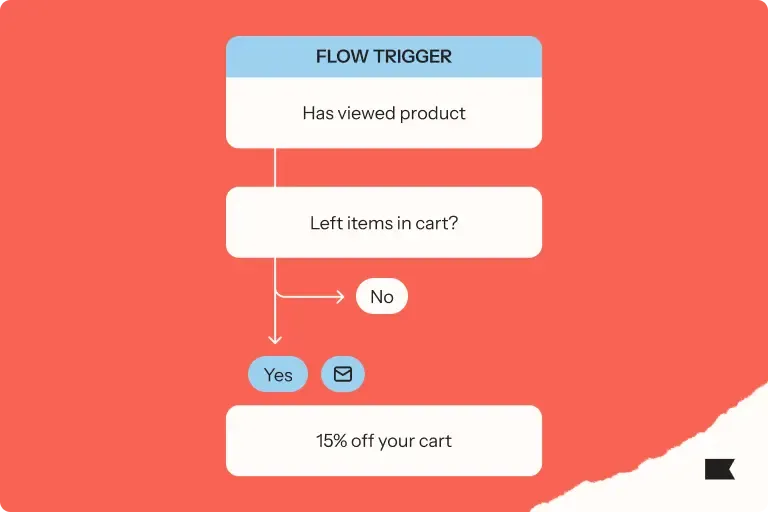
Quickly audit revenue-driving flows
Generated by Klaviyo AI
This article outlines a practical, 10–15 minute checklist to audit and optimize lifecycle flows. It explains how to use analytics, coverage, triggers, and RPR to identify high-impact opportunities and turn findings into a prioritized action plan.
- Analytics first: Sort flows by revenue, document RPR and conversion rate, and focus on high-volume flows with weak performance for the biggest gains.
- Confirm flow coverage: Verify that core flows like welcome, abandoned cart, abandoned browse, post-purchase, and win-back or sunset are live and not duplicated.
- Deep audit one flow: For a high-intent or high-revenue flow, review triggers, filters, delays, channels, splits, and content to ensure data quality and relevance.
- Use RPR diagnostics: Evaluate revenue per recipient to spot content, targeting, or profile quality issues affecting flow efficiency.
- Actionable prioritization: Translate audit findings into a plan ranked by revenue impact, ease of implementation, and strategic importance, and revisit flows regularly.
In my decade of experience as a digital marketing leader, I’ve seen top-performing flows convert around 3x more recipients than average flows.
That gap usually comes down to optimization. If you haven’t audited your flows recently, you’re likely leaving revenue on the table.
This is the checklist that my team and I at Klaviyo Customer Experience use with brands. In this blog, I’ll show you how to audit your flows in 10–15 minutes, prioritize the right fixes, and turn your highest-volume automations into stronger revenue drivers.
Step 1: Start with analytics
Focus on facts, not opinions. First, sort your flows by revenue.
Be sure to document:
- Revenue contribution
- Revenue per recipient (RPR)
- Conversion rate
- Benchmark comparison (if available) or YoY performance
Focus first on flows that combine high volume and weak performance. Small improvements in a major flow will outperform perfect optimization of a minor one.
A few red flags to look for: |
|---|
High revenue + declining RPR |
Below-benchmark performance |
Sudden drops in conversion |
Step 2: Confirm coverage (what’s live and what’s missing)
Before you optimize, confirm your foundation is solid. Identify which flows are live and which are missing.
Core revenue-driving flows typically include:
If a high-intent flow like abandoned cart or abandoned browse isn’t live, prioritize building it.
Step 3: Prioritize abandonment flows by purchase intent
Not all abandonment flows are equal. If you’re auditing or building from scratch, prioritize based on buying intent.
Flow | Intent level | Targets | Key opportunity | Core filter | Priority |
|---|---|---|---|---|---|
Check-out abandonment | Highest | Started check-out, no purchase | Strongest conversion opportunity | Placed order = 0 since entering flow | 1 |
Cart abandonment | Mid to high | Added to cart, no check-out, no purchase since starting flow | Re-engage high-interest shoppers | Placed order = 0 since starting this flow AND started check-out = 0 since starting this flow (be sure to include any third-party versions of the abandoned checkout) | 2 |
Browse abandonment | Lower | Viewed product, no cart | Capture early interest | Placed order = 0 since starting this flow AND added to cart zero times since starting this flow AND started checkout zero time since starting this flow (be sure to include any third-party versions of the abandoned checkout or cart) | 3 |
Viewed Collection | Lower | Viewed collection page, no viewed product, cart or check-out | Capture early interest | Placed order = 0 since starting this flow AND added to cart zero times since starting this flow AND started checkout zero time since starting this flow AND viewed product zero time since starting this flow (be sure to include any third-party versions of the abandoned checkout, cart or browse) | 4 |
Start where intent is strongest. That’s where optimization drives the fastest return.
Step 4: Check freshness
Update your core flows 2–3x times a year. If you haven’t updated a flow in 12 months or more, assume it’s under-optimized. Offers change. Creative fades and fatigues. Subscriber behavior shifts. Flows should evolve with your brand.
Step 5: Deep audit one opportunity flow
Choose one opportunity flow (ideally high revenue or high intent) and review it end to end.
1. Review the trigger
The question to ask is: Is the flow triggered by the right action?
Actions include:
- List
- Segment
- Metric
For ecommerce brands, a metric-based trigger (like “added to cart”) is often more intent-aligned than a list-based trigger.
For ecommerce brands, a metric-based trigger (like "added to cart") is often more intent-aligned than a list-based trigger.
Trigger pro tip: Confirm your event hierarchy. Not all triggers are created equal. When auditing a metric-based trigger, confirm the event source.
For Shopify brands, prioritize first-party Shopify events whenever possible. Best practice event hierarchy:
- Shopify (first-party)
- API-based custom events
- Third-party tools (e.g., browse tools like Elevar)
This matters because Shopify data is direct and tied to actual store behavior. It syncs faster and more reliably, reducing discrepancies between automation and reporting. It also supports stronger privacy compliance.
For example, if you’re triggering an abandoned cart flow from a third-party tracking tool but Shopify’s “added to cart” event is available, you may be introducing unnecessary complexity and data drift.
During your audit, confirm:
- The trigger uses the highest-quality available data source.
- Events are firing consistently.
- There are no duplicate or competing triggers.
Strong flows start with strong data. If the trigger is flawed, everything downstream suffers.
2. Review filters and exclusions
Check:
- Are recent purchasers since starting this flow excluded?
- Are filters too restrictive (hurting volume) or too loose (hurting relevance)?
3. Review time delays
Does timing match buying intent?
For abandoned cart flows, for example, best practice often includes a first send around 30–45 minutes after abandonment.
Always test timing. Never assume.
4. Review channels in use
Which channels does the flow include?
If you have consent for text message marketing but the flow is email-only, that’s a missed opportunity. Think through your flows and consider which of them makes sense as a cross-channel series.
5. Review conditional splits
Every customer journey is tailored to one factor or another. So, think through your approach.
Do you tailor your journey based on a subscriber buying for the first time or being a repeat customer? Or on a product category? Cart value? Engagement level?
Even one strong conditional split can add a level of personalization that can materially improve relevance and performance.
6. Review content and CTAs
Check for:
- One clear message per touch
- Mobile optimization
- Clear, obvious CTA
- Tested offer strategy
If the content doesn’t match the moment, performance will suffer.
Example audit: abandoned cart
Use this as a fast checklist to optimize your abandoned cart flow:
Trigger | Metric-based (Added to Cart), often from Shopify or another ecommerce platform |
|---|---|
Timing | First send 30–45 minutes after abandonment |
Exclusions | Placed zero orders since starting this flow; also exclude “started checkout” via Shopify and third parties if applicable |
Touchpoints | 2–3 emails, 1 text message, 1–2 push notifications |
Offer | Test with and without an incentive. |
Expansion rule | If the last touch has click rates above 2%, test adding another touchpoint. |
Auditing pro tip: The goal of an audit is verification. Don’t assume you’ve already implemented these best practices correctly.
Step 5: Use RPR to diagnose flow health
RPR tells you how efficiently your flows are working to create revenue.
If RPR is low or declining, you may have:
- A content issue: weak messaging or offer
- A targeting issue: wrong subscribers entering the flow
- A profile quality issue: low-intent subscribers entering your lifecycle program
Step 6: Turn your findings into a prioritized action plan
The whole point of an audit is to take action. For each opportunity flow, document the area, your recommendation, why it matters, who owns it, and the ideal implementation timeline.
Here’s an example of an action plan:
Trigger | Shift from list-based to metric-based trigger to better match intent. |
|---|---|
Timing | Test 1- vs. 3-hour delay. |
Channel | Add a text message touch where you have consent for one. |
Content | Simplify to one CTA and align copy to buying intent. |
Then, prioritize your next steps by:
- Revenue impact
- Ease of implementation
- Strategic importance
10-minute rapid flow audit checklist
Performance
- Sorted flows by revenue
- Documented RPR and conversion rate
- Compared to benchmarks or YoY performance
Coverage
- Core flows live (welcome, abandoned cart, abandoned browse, post-purchase, win-back or sunset)
- No duplicated or conflicting logic
Set-up
- Correct trigger
- Proper exclusions
- Delays match intent
- Smart Sending reviewed
Channel strategy
- Email optimized for mobile
- Text message marketing used where appropriate
- Push used where appropriate
- Sequencing tested
Content
- One clear message per touch
- CTA obvious and linked correctly
- Offer strategy tested
Remember: flows aren’t “set and forget.” Audit regularly, prioritize by revenue, and treat your lifecycle program like the growth engine it is.

Related content