See true incremental subscription revenue
Generated by Klaviyo AI
The article explains how standard placed order reporting can misattribute recurring subscription renewals to marketing messages. It shows how to set up and use a non-recurring placed order metric in Klaviyo to isolate incremental revenue and improve decision-making for subscription brands.
- Misleading standard metrics: Recurring subscription renewals can make flows and campaigns appear to drive revenue that would have happened anyway, inflating performance reports.
- Non-recurring metric definition: A non-recurring placed order metric filters out recurring subscription contract orders and can optionally include new subscription creations to focus on incremental purchases.
- How to implement: In Klaviyo, marketers can either select the non-recurring placed order metric via Advanced KDP and Marketing Analytics or build it using placed order events excluding recurring subscription orders.
- Sharper subscription insights: Using this metric clarifies whether marketing is converting leads, turning first-time buyers into subscribers, and winning back canceled subscribers, instead of just tracking renewals.
- Better reporting alignment: Defaulting dashboards, campaign views, and flow reporting to non-recurring placed orders supports more accurate internal conversations about performance, budgeting, and lifecycle priorities.
If you’re a subscription brand, you’ve probably had this moment: you open your Klaviyo reporting, and everything looks great. Flows are driving revenue. Conversions are up. The dashboard’s all green.
Then you dig in and realize something awkward: a chunk of those “conversions” were going to happen anyway.
That’s where a non-recurring placed order metric becomes a total hidden gem.
In my role as CRM consultant at Unified.co for 3 years, I’ve used this metric across several subscription accounts. Every time I show someone, they say, “Thank you. But why is this so buried?”
The problem: placed order rate can blur what’s new vs. what was inevitable
A lot of subscription brands manage recurring orders through integrations like Skio and Recharge.
When you integrate Skio or Recharge with Klaviyo:
- A subscriber’s next order is scheduled automatically.
- They don’t need to read an email.
- They don’t need to click anything.
- The order happens, and you still get a placed order event.
So if Jane receives an email today, and her subscription order goes out tomorrow, and she happens to open the email, your reporting can make it look like that email drove the purchase.
But it didn’t. The order was already happening.
As Marika Tselonis, director of retention at digital and performance marketing agency Kulin, puts it: “Counting revenue that was already guaranteed is a waste of a marketer’s time. When you separate recurring from incremental performance, you force yourself to ask better questions about what actually influenced behavior.”
To clarify: integrations that streamline your subscription orders are absolutely worth using. But if you aren’t careful with your reporting, you’ll give marketing messages credit where it just isn’t due.
Personally, I don’t want any purchases misattributed. I want to know what’s actually working, so I can be proud of it, improve it, and scale it.
Counting revenue that was already guaranteed is a waste of a marketer's time.
Where standard reporting gets messy: flows that aren’t meant to drive purchases
First, let’s look at a review request flow: it can look like it’s printing money because it’s hitting people who’ve got an order coming up anyway.
In one account I work with, flows looked like they were driving about £11,000 in revenue, and the email prompting a review alone looked like it was responsible for around £8,000–£9,000 of that.
Reviews were the goal, and that part was working. But the “conversion” story was inflated. We were basically taking credit for sales where we shouldn’t have been.
And review flows aren’t the only message that creates this problem. Subscription brands often send messages to remind a subscriber of an upcoming order. Of course, you don’t want your metrics telling you that those messages drove purchases.
“Marketers that depend solely on standard reporting risk measuring activity instead of actual impact,” says Tim Martin-Harvey, head of ecommerce at The Bottle Club, an online multi-brand alcohol retailer. “The true benefit comes from defining specific metrics based on how your business operates.”
Marketer's that depend solely on standard reporting risk measuring activity instead of actual impact.
The fix: report on non-recurring placed orders instead
Marketers should use a metric that answers questions like:
- Did someone make a one-time purchase?
- Did someone place their first subscription order?
- Did someone add something new, rather than just renew?
That’s what the non-recurring placed order metric helps you see.
It’s simple, but it gives you a much clearer guide for what’s actually moving the dial.
How to set up the non-recurring placed order metric in Klaviyo
In Klaviyo, if you have access to Advanced KDP and Personalization, and you have certain integrations, you can simply go to your metrics and select the non-recurring version of the placed order metric.
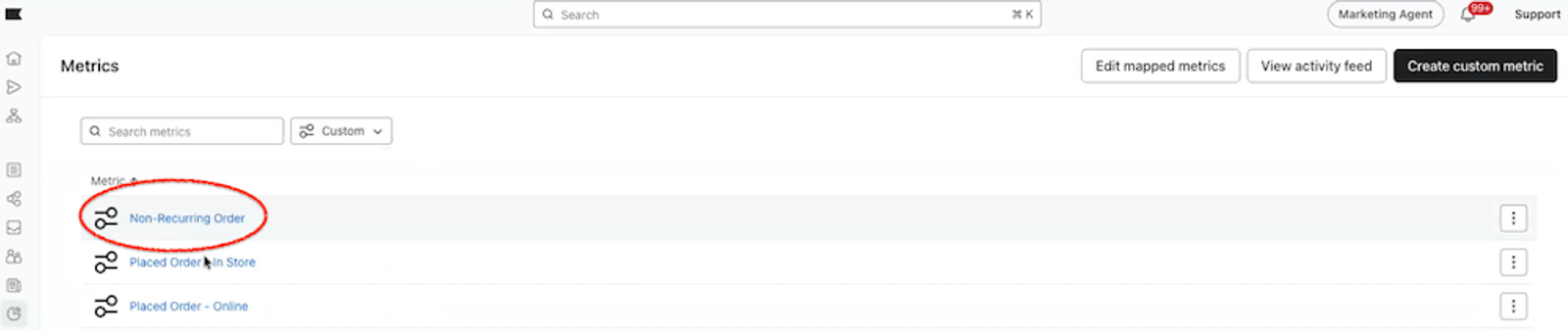
Otherwise, you’ll need to create the metric yourself.
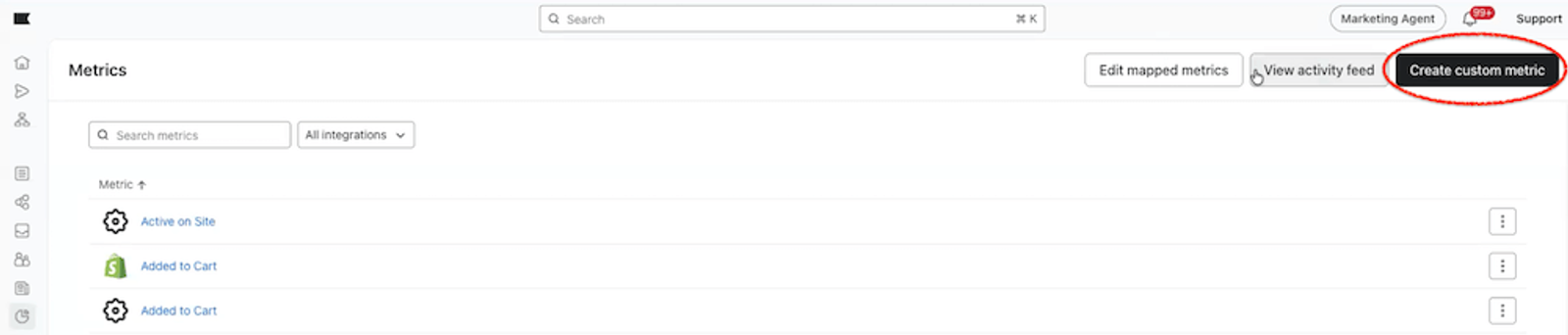
To create the custom metric yourself, use these parameters:
- Placed order AND
- Not a recurring subscription contract order PLUS
- Optionally include new subscription created value (so you still capture that first subscription moment)
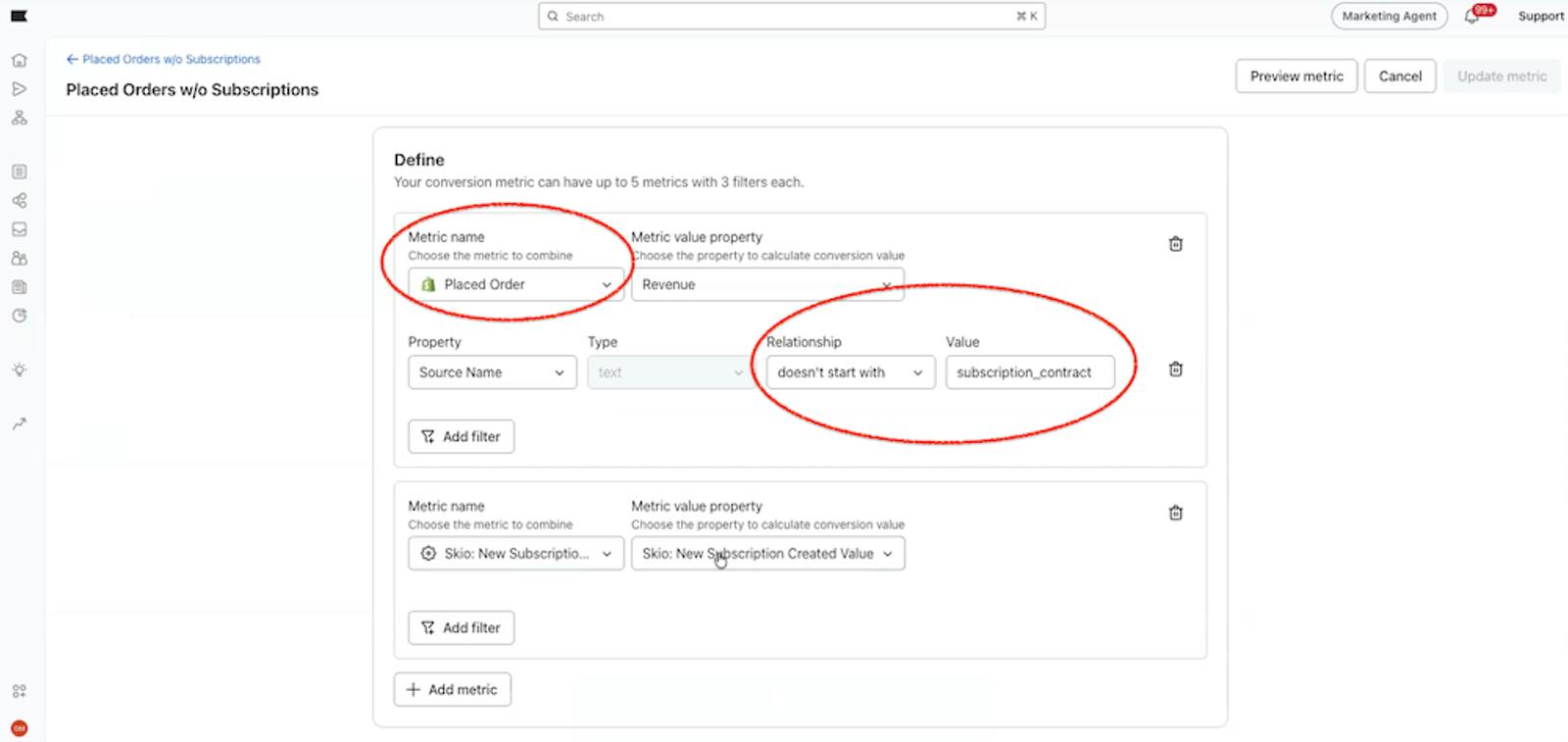
The goal is straightforward: filter out recurring renewals, so you can focus on what’s incremental.
Why the non-recurring placed order metric helps you uplevel
Once you switch to this metric, your reporting starts telling a truer story.
For subscription brands, I’m usually focused on 3 core questions:
- Are we converting leads?
- Are we converting first-time purchasers into subscribers?
- Are we winning back people who canceled into subscribing again?
If you’re only looking at the standard placed order metric, it’s really hard to see any of that clearly at an overview level.
You can end up thinking, “Flows are performing really well,” when actually you’re just watching recurring revenue roll through.
And if you’re a fast-moving acquisition brand, this matters even more.
It’s easy to stay stuck on acquisition. But at some point you’ve got to ask: “Okay, they opted in. Now what?”
This metric helps you answer that honestly.
“Klaviyo’s flexibility with custom metrics is powerful because it lets brands tailor reporting to their operational truth,” Martin-Harvey explains. “The goal isn’t more data. It’s more accurate and meaningful data that supports confident decision making.”
Where to use it: dashboards, campaigns, and flow reporting
Here’s how I work with the non-recurring placed order metric:
- In my Klaviyo dashboard, I set it as my default site-wide metric.
- When I send a campaign, I’m looking at performance through that lens first.
- I still flip back to overall placed order sometimes, just to compare, but my main view is non-recurring.
Tselonis shares that she and her team default to the non-recurring placed order for clarity, but she flips back to overall placed order to see where active subscribers actually clicked. “The one-click toggle is a Klaviyo feature that can get overlooked, but it’s a real differentiator in understanding engagement,” she says.
Any way you use it, it’s a clean way to check: Is this marketing message doing what I want it to, or is it just getting boosted by renewals?
The one-click toggle is a Klaviyo feature that can get overlooked, but it's a real differentiator in understanding engagement.
The bigger win: better reporting, better internal conversations
When marketing and finance are talking about performance, budget, and what to do next, clarity matters.
If your reporting is inflated, it’s harder to:
- Prove what’s truly working.
- Spot what’s not converting.
- Justify investment in lifecycle improvements.
- Prioritize the right flows for retention and subscription growth.
This is one of those changes that saves you from a painful detangling exercise later.
If you get a few years down the line and realize you’ve been reading the wrong story, it takes longer to fix.
And honestly, once you start using it, you’ll wonder how you ever looked at anything else.

Related content