Even though friendliness, product knowledge, and responsiveness are what customer service is made of, customer enquiries will pile up across your shared inbox, WhatsApp, Instagram DMs, web chat, and text messages. But how high that pile of enquiries gets may have more to do with how your ecommerce brand approaches customer service than with how good your team is.
You’ll notice the pile of enquiries often fall into 3 buckets: answers the customer couldn’t find, actions the customer couldn’t take without you, and judgement no public policy text covers.
Answers and actions already exist inside your business before the customer writes in. Answers are information you’ve published somewhere the customer didn’t look. Actions are for permission only your staff can grant. Both of these are work your store could’ve resolved before a person got involved. Judgement is the exception, because there’s no resolution for the customer to find or be pointed to, and weighing each case is the work your customer service team is there for.
Citizens Advice found that 37% of UK adults had a problem with their most recent delivery. Problems on that scale reach your team as chases, complaints, and refund requests, which is a large share of your total enquiry pile before you count anything that isn’t about delivery.
Here’s a set of 5 best practices for resolving routine answers and actions before they reach your customer service staff, settling the cases that do need a person, and counting what changes.
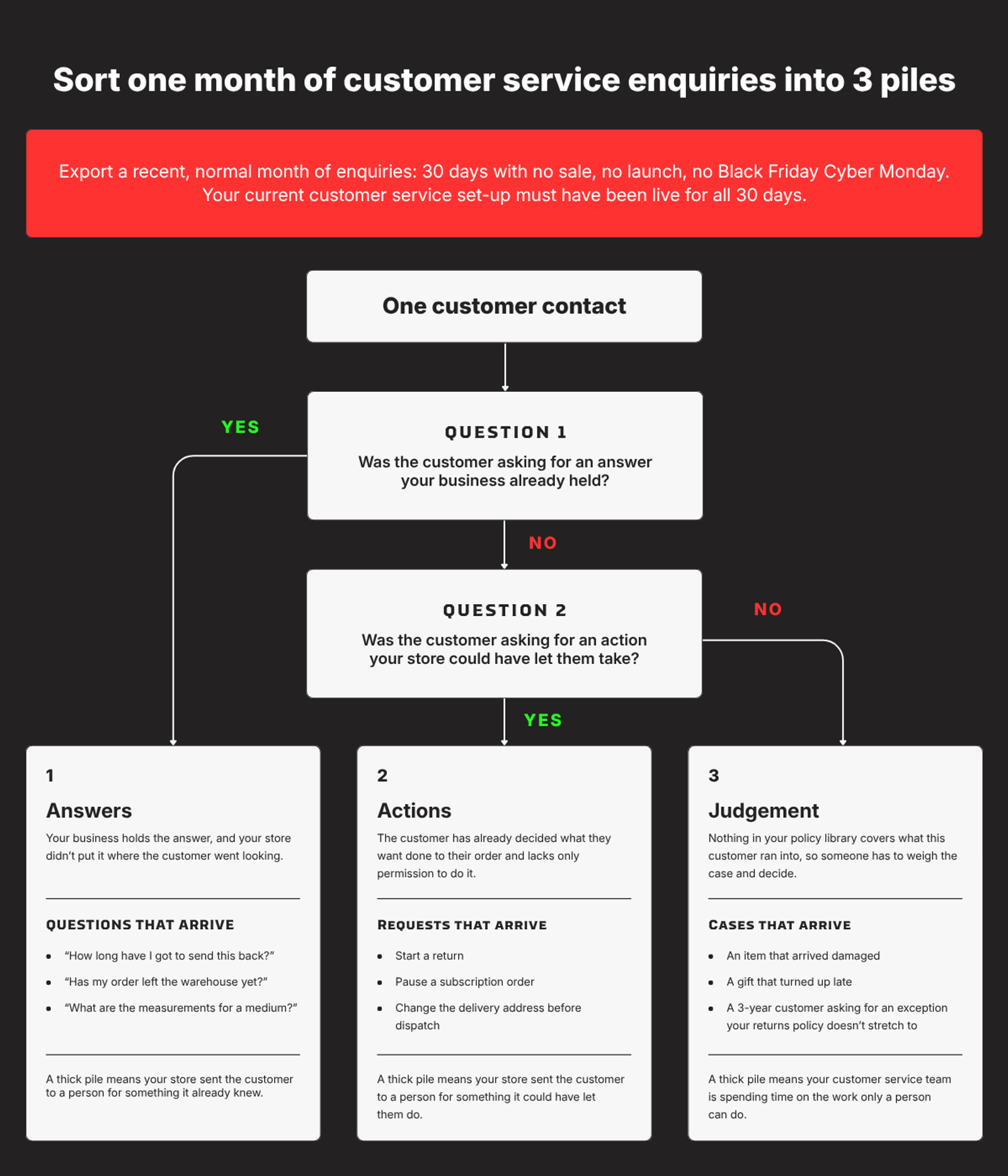
1. Sort the enquiries from a recent normal month
“Recent normal month” meaning a 30–day period with no sale, no product launch, no Black Friday. Pick a month where your retail customer service set-up was live the whole way through.
Then, in your helpdesk, tag enquiries by what would’ve satisfied the customer:
- Answers. Your business holds details the customer wants to know, and your site didn’t put it where that customer went looking. Your help centre or FAQ covers returns windows and product specifications. Order status sits in your tracking data. Either way, the question reaches a person. “How long have I got to send this back?” “Where’s my order?”
- Actions. Customers in this pile have already decided what they want done to their order and lack only the permissions to do it. Your store gives them no way to self-serve, and a queue forms for whoever on your team can step in for them. Starting a return, pausing a subscription order, and changing a delivery address before dispatch all belong here.
- Judgement. Nothing in your help centre and policies addresses what this customer ran into, and someone on your customer service team has to analyse the case and decide what to do. A person has to make that call when an item arrives damaged, a gift turns up late, or a 3-year customer asks for an exception your returns policy doesn’t stretch to.
Once you’ve tagged the month’s enquiries, compare the piles. A thick answers or actions pile can show where your store sent a customer to your team instead of resolving the contact itself, whether that’s through a help centre, a self-service hub, or an AI customer agent. A thin pile could mean your store is already settling that kind of customer contact without a person. And then the judgement pile is the one you want your retail customer service team spending time on.
London fashion brand Folk Clothing used to run a busy shared inbox before they added a self-service hub, for instance, to take the answers pile off their retail customer service team. Order confirmations and tracking chasers made up the bulk of what arrived, all of it information the customer could’ve had automatically. With that contact volume coming in daily, the cases that did need a person waited longer, and it wasn’t that obvious who was handling which ticket.
2. Clear the answers pile before a customer asks
A “where’s my order” (WISMO) message could arrive days before a parcel is due at anyone’s door. Your fulfilment can be going as planned, while the customer has only a confirmation email with a tracking code and nowhere else to check since check-out. With no update from your store, they start wondering whether the order got stuck somewhere.
Common delivery issues people experience start with the carrier. Ofcom’s 2025 parcel firm satisfaction data found 68% of parcel recipients in the UK had at least one problem with a delivery: 28% reported a delay, 26% had a parcel left somewhere inappropriate, 20% said the driver didn’t knock loudly enough, and 19% weren’t given enough time to answer the door.
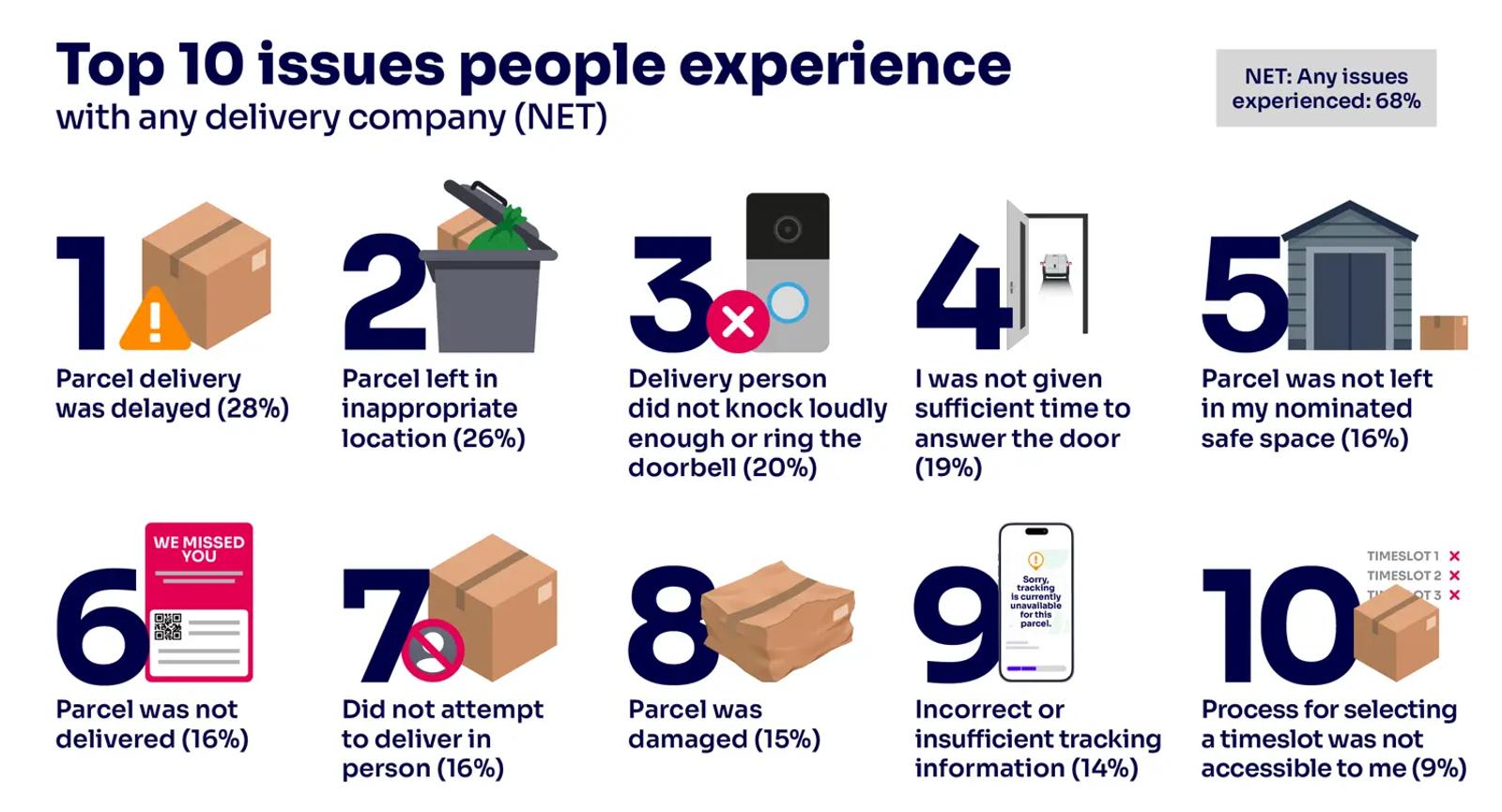
So, a parcel left in the wrong place, a driver who didn’t knock loudly enough, and a shopper given little time to answer the door all happen on a doorstep where the carrier’s driver is the only witness. Those 3 situations account for 3 of the 4 Ofcom issues, and your order data captures none of them. But shoppers write to you about those problems anyway, because you’re the brand they bought from and the carrier is a logistics company they had little say in choosing.
Delivery messaging shrinks the answers pile from both ends. Some updates stop a contact forming, and the rest at least reach a shopper who already knows which carrier has the parcel. Message shoppers at dispatch, in transit, and upon delivery. Integrate the key information from the carrier, tracking status, and next steps in a self-service customer hub, alongside the orders, returns, subscriptions, and loyalty balance that shoppers also enquire about.
For the information-related issues your messaging can prevent and resolve, consider:
- Proactive order tracking: Show the current status on demand. Your carrier-triggered notifications cover dispatched, out for delivery, attempted, and failed, and a self-service hub covers the gaps between them, where a shopper who wants to check again can look instead of enquiring. Naming the carrier also tells people whose tracking page to check and whose safe-place instructions apply, so they know whether to wait or rebook.
- Answers placed at the point of the question: FAQ content belongs where the question forms, not only in a help centre the shopper has to visit. Delivery windows and product specifications could go on the product page, cut-off times from the product page through to check-out, the returns window in the order confirmation, and the carrier and tracking link in the dispatch notification, with the full versions in your self-service customer hub.
- Returns and refunds policies and rewards in the same places: Put your policies on the product page, in the cart, at check-out, and in the self-service customer hub rather than just in the fine print of your online store’s footer alone. Loyalty balances and promotion exclusions go in that self-service group, too. For example, a customer seeing their points balance, or which items a promotional code excludes, is at least less likely to contact you.
- An AI customer agent working from live order and product data: Unlike a chatbot with canned auto-replies, an AI customer agent answers from your policy text, the customer's order, and your product catalogue. Womenswear brand Naked Wardrobe reached 86% of queries resolved in 90 days with an autonomous agent running on store data. Beyond status and policy lookups, an AI agent for retail can also handle pre-purchase questions.
3. Give customers the controls to self-serve
The actions pile is full of customers who already know exactly what they want done to their order or account, whether that’s starting a return and refund, swapping an item, pausing a subscription order, or changing a delivery address before dispatch. Those customers reached that decision on their own, and they’re still queuing for someone on your customer service team to do something they could’ve sorted themselves in a self-service hub, if your store provided this.
Enquiries in the actions pile, meaning the ones that reached your staff, exist either because of a customer experience decision or the lack of one. In both cases, something in your store stands between the customer and the change they want to make. Is that friction intentional? If you don’t have a rationale, revisit that friction point, agree on what it’s for, and adjust things.
With subscriptions in general (from streaming services to meal kits, food and drink, and household products), customers who can’t self-serve may stay stuck. The Department for Business and Trade’s response to consultation on the new subscription contracts regime counts roughly 9.7 million unwanted active subscriptions in the UK at a cost of about £1.6 billion a year.
Those unwanted subscriptions are what the Digital Markets, Competition and Consumers Act 2024 (DMCCA) sets out to prevent, through 3 requirements for retailers selling subscriptions:
- Straightforward cancellation. Ending a subscription can’t be harder than starting one.
- Online sign-up, online exit. Anyone who subscribed on your site can cancel there.
- A 14-day cooling-off period. It follows a trial or a 12-month-plus contract auto-renewing.
Regulation aside, those 3 requirements describe a subscription order management dashboard worth building anyway. A brand whose customers can already pause, skip, and cancel without enquiring has nothing to change, and takes those requests off your retail customer service team in the meantime, at least from the customers who’d rather sort it themselves.
These controls take the common actions off your team:
- A self-serve returns portal: The portal should let the customer do the whole thing. That is, going to your store, selecting the item they’re returning, choosing a reason, generating the label, and tracking the refund through to resolution. Now picture that very same journey ending at “We’ll be in touch.” A few days’ delay, another email to chase, and a customer whose opinion of your returns management process has just dropped a notch.
- Subscription controls customers can use themselves: Pause, skip, swap, and change the next delivery date, all handled by the customer, on the same screen where they manage the subscription. Skip-and-swap is a retention tactic in ecommerce that lets a customer miss an upcoming delivery or exchange a scheduled item for a different product. A cancellation request is often a timing or variety problem in disguise.
- Pre-fulfilment order edits: These are changes customers ask for between check-out and dispatch, such as correcting a delivery address, changing product size, or adding an extra item to the parcel. An AI customer agent, for instance, connected to your ecommerce software through integrations, can update an address, cancel an order, or modify items before fulfilment, with no customer support ticket in the middle.
- Self-serve loyalty and reward redemption options: Show customers their points balance, loyalty tier, and points expiry date. Someone who can’t find it asks your customer service team, then again when the balance changes. Put redemption on the same screen, so a customer sitting on 400 points can spend them. A customer who asks anyway gets the same options from an AI customer agent, in the conversation they’ve already started.
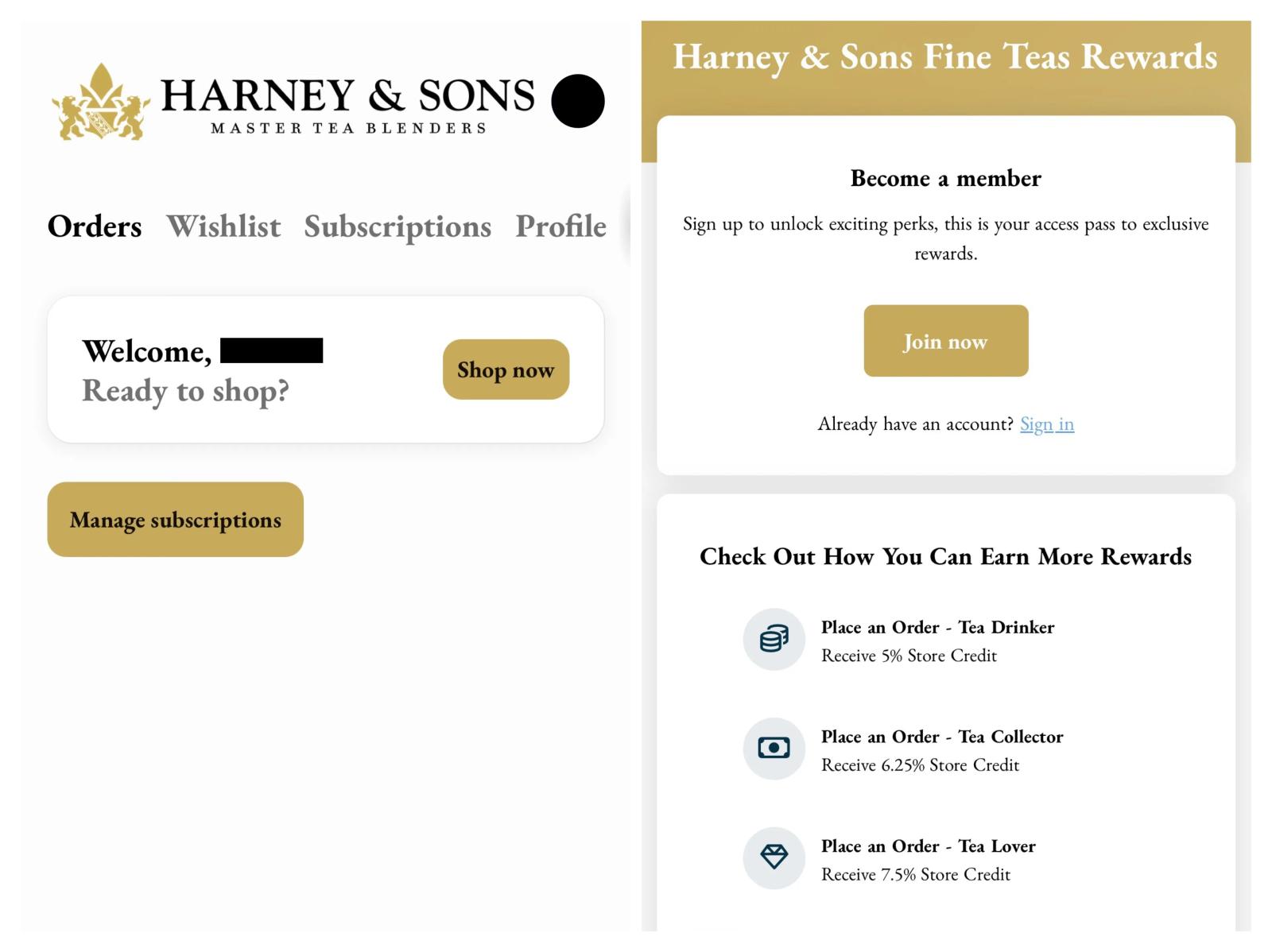
Harney & Sons have experimented with giving customers control firsthand. Over their first quarter using a self-service customer hub, the company saw over $120K in revenue, with 12% higher average order value (AOV) from those customers in particular than from shoppers overall.
4. Settle hard cases with context and one set of answers
Judgement cases are the ones no policy covers, where someone on your team has to read the situation and decide what to do, whether that’s de-escalating a complaint, refunding on the spot, or taking a shopper over from the AI customer agent when they ask for a person.
In a cluttered shared inbox, those enquiries get answered by whoever reaches them first, with whatever scattered information that person can dig up in a few minutes before replying. And your ecommerce marketing data already tells you what a customer has bought, opened, and clicked or tapped but it’s on the other side of a wall from the service person answering them.
Consumer law has partly decided who’s responsible for resolving a judgement call. The House of Commons Library briefing on retailer responsibility for deliveries sets out that where the retailer arranged delivery, the retailer stays responsible for the goods under the Consumer Rights Act 2015 until they reach the buyer or a nominated safe place, and has to resolve any delivery issue.
That same briefing settles the timing, too. Where your delivery terms don’t say how and when you’ll deliver, a default 30-day delivery period applies. If you miss whichever deadline, the customer may have grounds to cancel and claim damages for losses caused by the late or failed delivery, though the briefing notes that “much would depend on the facts of the individual case.”
Even so, the answer a customer gets shouldn’t depend on who picks up the message, whether it’s about a late parcel, a faulty item, or a subscription they want to change. In a lot of set-ups, a different staff member answers each channel, with no sight of what their colleagues have said. Pulling all the channels into one conversation per customer reduces the likelihood of your team giving the same customer two answers, regardless of the channel someone enquired through.
In practice, that takes a helpdesk with omnichannel capabilities that brings email, web chat, text messages, WhatsApp, and Instagram into a single inbox with your customer’s history attached.
“I’d spend my day going through our email inbox and if another colleague had jumped on enquiries, it was almost impossible to keep track,” says Hayley Scott, ecommerce coordinator at Folk Clothing. “It was messy and was distracting us from our roles.” Combining an AI customer agent and a helpdesk together cleared the routine enquiries out of Folk Clothing’s inbox, gave cases that needed a person a named owner, and cut average ticket resolution time by 75%.
For the cases that, again, do still need a person, 4 things might help:
- A unified order and marketing history: Whoever picks up the case should see the order, the delivery events, the return status, and the customer’s history centralised. Without that, a 3-year customer could spend a few messages overexplaining themselves, which defeats the purpose of having an ecommerce CRM. If your marketing data already hosts that history, the avoidable part would be that your customer service staff can’t see it.
- A goodwill limit your team can honour: Set an amount that anyone from your service team can apply on their own, then name the common situations where it applies by default, no questions asked, such as a damaged item or a parcel that missed a date you’d promised. Review your team’s goodwill spend monthly, so no judgement call waits on a manager.
- A single source of policy answers: One library, owned by one person, covering delivery, returns, exchanges, subscriptions, and faults, with your team and your AI customer agent both reading from it so the answer stays accurate across channels. Give each entry a last-updated date and an owner, and check anything older than a season before peak.
- A written escalation route with a named owner: One document that sets out what escalates, who it goes to, and when the customer is told to expect a resolution. That timeframe is a target your retail customer service team measures itself against for hard cases, and a promise to the customer, so it only holds if someone owns the case.
5. Count the enquiries you stopped receiving
Measuring the success of customer service best practices consists of tracking enquiries per representative (how busy your team is), and enquiries per order (how many orders led a customer to contact you). The latter moves when you send order updates before the customer asks, hand customers a self-service portal, or publish help resources where customers actively look for it.
Give your contact volume base line one month of data. Allocate a week to sort a month of enquiries into the answers, actions, and judgement piles, then spend 2–4 weeks analysing: enquiries per 100 orders, the split between those 3 piles, how many enquiries got resolved without a staff member, and how often the same order generates a second contact.
Run those counts periodically against the month you used as your baseline.
At the moment, there’s no publicly available benchmark for what enquiries per 100 orders should be. But your first month serves as the line. Like starting a workout routine, the useful comparison is whether you’re healthier 3, 6 or 12 months from now, with fewer enquiries per order, more enquiries resolved automatically or agentically, and fewer repeat enquiries on the same order.
Faster response or resolution time doesn’t mean fewer customers had to write in, though. To measure the impact of customer service best practices, count these 4 things instead:
- Enquiries per 100 orders: Normalises volume against growth.
- Enquiries split by kind: The same 3 piles from the sort, reported monthly.
- Self-serve resolution rate: Enquiries that don’t end up reaching a staff member.
- Repeat enquiries about one order: Usually a sign your first answer didn't resolve it.
Enquiries per 100 orders can drop because your store answers questions before customers need to contact you, or because your retail customer service contact details are harder to find. Pair your contact counts with customer satisfaction score (CSAT) to track improvements over time.
One month of enquiries. Start there.
The retail customer service best practices broken down here depend on knowing what your customers contact you about, automating the routine work, and routing the enquiries that need a person. So export last month’s enquiries, tag enquiries in batches as piles of answers, actions, or judgement, and see what the split tells you about the status quo of your customer service.
Klaviyo, the autonomous B2C CRM, ties service and marketing interactions to a single customer profile. Customer Hub gives your clients a self-service portal for orders, returns, subscriptions, and loyalty, with Customer Agent answering and acting on your policy text, live order data, and product catalogue behind it. And when a case needs a person, Helpdesk brings email, chat, text messages, WhatsApp, and social into one workspace with the customer’s full context attached.
What could your customer service do with what marketing already knows?

Related content