How ecommerce CRMs power B2C growth
Generated by Klaviyo AI
The article explains what an ecommerce CRM is, how it differs from traditional B2B CRMs, and the core features it needs to support modern online retailers. It outlines key benefits like unified data, scalable personalisation, faster responses, and time savings, illustrated with real brand use cases.
- Ecommerce CRM definition: An ecommerce CRM is a customer-centric platform that unifies data from every touchpoint so marketing, data, and service teams can deliver personalised experiences at scale.
- Key feature pillars: Effective ecommerce CRMs combine a robust data layer, marketing automation, customer service tools, and reporting and analytics—including predictive insights—into one system.
- Limits of traditional CRMs: Conventional B2B CRMs struggle with B2C speed, scale, channel fragmentation, data silos, limited personalisation, and weak ecommerce integrations.
- Core business benefits: Using an ecommerce CRM helps brands unify customer data, enable 1:1 personalisation, respond quickly to behaviour changes, improve customer experience, and save team time through automation and AI.
- Real-world use cases: Examples from brands like Tata Harper, Svenfish, Loop Earplugs, and Folk Clothing show CRMs driving revenue growth, tighter segmentation, operational efficiency, and AI-powered customer service.
One viral bad review can snowball into a major threat to your ecommerce business.
But even before social media, customer satisfaction was key to longevity. Just ask Dell.
In 2005, Dell limped through a major PR debacle at started with a single unhappy customer: writer Jeff Jarvis. He blogged about his frustrations with his “lemon” laptop, an expensive in-home repair service that never materialised, and slow customer service that drove him online.
Dissatisfied customers flocked to his comments section. A mini-movement was born. Over the next year, Dell’s stock price dropped 42%.
Since then, the risk of a “Dell Hell”-style news cycle has only grown. For B2C brands, that risk is tenfold, since their audience of customers is an even larger pool of people.
How do you thrive in despite that risk? By managing customer interactions and relationships at scale with an ecommerce CRM: a platform designed to make customer success inevitable, even when your team can’t respond right away.
8 out of 10 consumers in the UK and Germany shop with an online-only retailer, according to McKinsey’s State of the Consumer 2025 report. That much interaction is a big opportunity, but only if you can connect every touchpoint back to the same customer.
What is an ecommerce CRM?
Think of a customer relationship management system (CRM) as your company’s living, annotated Rolodex.
It’s a searchable digital log where sales and customer service teams can manually enter updates from conversations with individual customers, or log them automatically if your company is using a B2C CRM like Klaviyo.
The goal of an ecommerce CRM is to help you deliver personalised experiences by consolidating data from multiple touchpoints. The ideal solution is built for your entire organisation, from data to marketing to customer service.
But ecommerce CRMs aren’t the same as B2B CRMs. B2B CRMs have been around longer (think Zoho, Salesforce, or HubSpot), but they manage contacts at an account level. That isn’t how consumers shop with ecommerce brands.
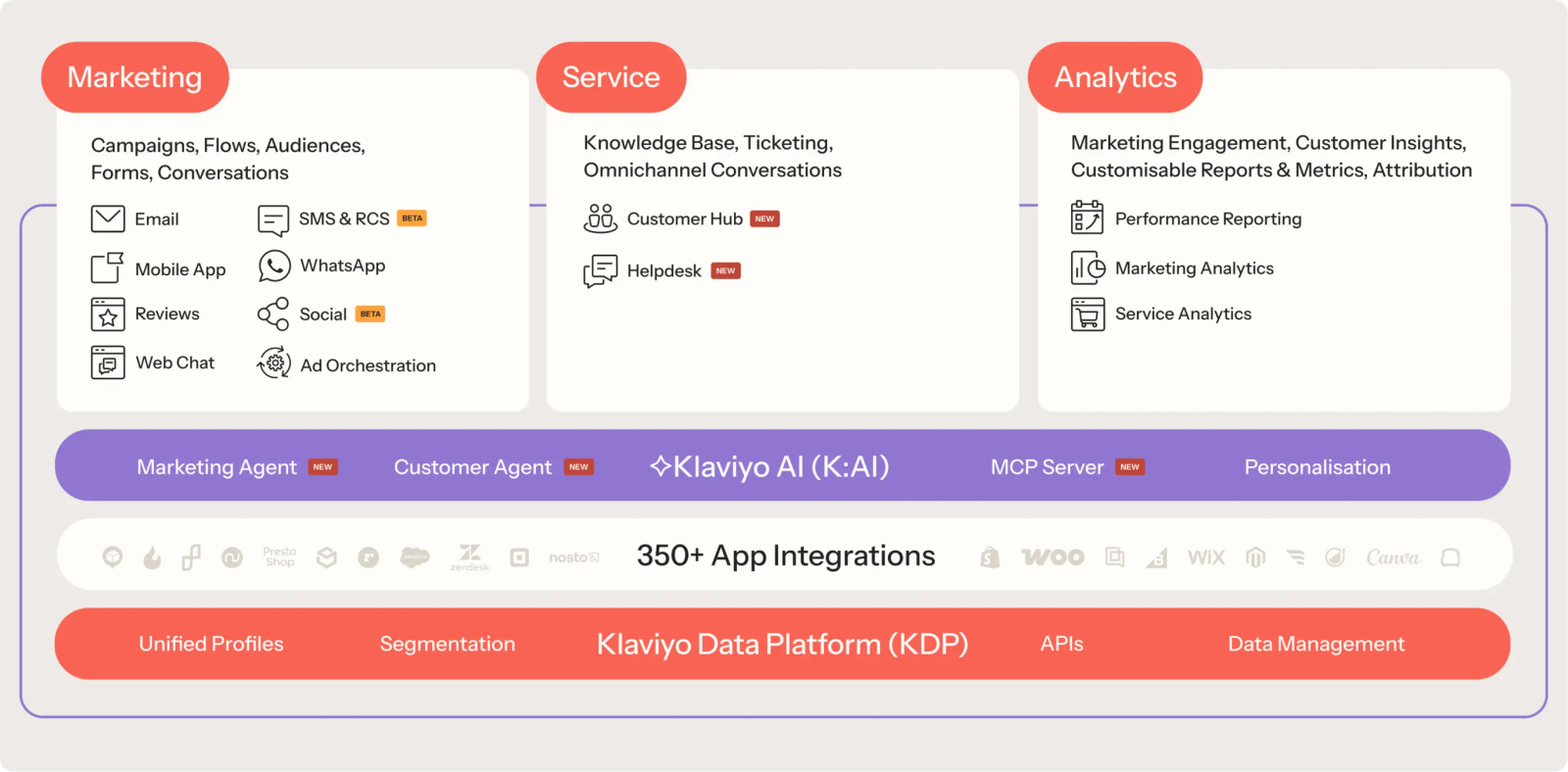
Instead, retailers need a CRM based on individual customers, with built-in marketing automation, customer service, and analytics that personalise the customer experience at scale.
That’s a mouthful, so let’s visualise it instead. Here’s a view of Klaviyo’s tech architecture, the CRM built for B2C.
What are the features of an ecommerce CRM?
A great B2C CRM is powerful. The right solution:
- Centralises each customer’s contact information and browsing, purchasing, and customer service history in one accessible profile
- Lets users from marketers to customer service reps make decisions and communicate based on complete customer data, like past purchase history, message engagement, tickets and resolutions, etc.
- Helps leadership forecast revenue, predict customer behaviour, and break down silos across departments
The right B2C CRM features go well beyond a contact database. They give marketing, service, and analytics teams a shared view of all customer interaction, so each touchpoint feels personal and connected.
In terms of features, there are 4 main pillars:
1. Data layer
A data platform is the core of any good ecommerce CRM. None of the other features or functionalities of a CRM will work if the platform doesn’t aggregate all customer data into a single profile, and let marketing and service teams access and act on that data to personalise the customer experience. Many brands refer to this foundation as a customer data platform (CDP).
That’s the entire point of an ecommerce CRM, and it’s why a built-in ecommerce CDP is so important.
2. Marketing automation
Marketing automation is the action layer of any good ecommerce CRM. It’s what powers the customer lifecycle in ecommerce, and it’s where you go to send campaigns and flows across email, text messaging, WhatsApp, and mobile push.
This is also typically where acquisition live, too, via integrations with social media advertising platforms and forms for list building.
3. Customer service
Most ecommerce customers want self-service options, like FAQs, product guides, and AI assistance. They want to know where they can reach a human if necessary, but they don’t necessarily need that to be their first option.
An ecommerce CRM comes with built-in customer service functionality like:
- Self-serve customer hub: a personalised on-site experience where customers can track orders, initiate returns and exchanges, and get personalized product recommendations based on their unique profile
- AI customer agent: an AI agent that provides 24/7/365 support across channels, resolving common issues like order tracking, product questions, and brand policy inquiries
- AI-powered helpdesk: a shared workspace that surfaces every customer detail right in the ticket, then routes it to the right person automatically for faster, more personal support
4. Reporting and analytics
Finally, an ecommerce CRM needs to have robust reporting and ecommerce analytics capabilities, including predictive analytics. This shows how your campaigns and automated flows are performing. You also want insight into RFM models, and a sense of when a segment might purchase next.
What are some fields in an ecommerce CRM?
On an account page, you’ll often find fields like:
- Customer name
- Email and phone contact information
- Personal communication preferences (e.g., if they have opted into your emails text messages, WhatsApp messaging, or push notifications, and when they opted in)
- Browsing history
- Purchase history
- Predicted purchases and product preferences
- Message history across email, texting, WhatsApp and push notifications, including engagement with those messages
- Customer service history, including ticket information, conversations across channels, and any resolutions
Why do traditional CRMs fall short for ecommerce companies?
CRMs have traditionally been associated with B2B companies managing lengthy sales cycles, but that’s not the reality for B2C companies. B2B CRMs manage contacts at an account level, with far fewer accounts and higher order values. Today’s ecommerce brands, by contrast, manage relationships with millions of customers across multiple touchpoints.
When you consider this, here’s where traditional CRMs fall short:
- Speed and scale mismatch: B2C companies have millions of customers making rapid purchasing decisions. Since most CRMs are built for B2B companies, they can’t handle that complexity and scale because they were meant for lower-volume account management.
- Channel fragmentation: B2C customers interact with brands across multiple channels likeemail, SMS, social media, website, and in-store. But traditional CRMs weren’t designed to unify these touchpoints. Instead, they rely on manual entry and intensive data hygiene practices, leaving your team to do most of the work.
- Data silos: Your typical CRM is sales-focused, so your marketing, customer service, and ecommerce teams don’t have the insights they need to make smarter decisions. This fragmentation makes it impossible to deliver the unified experiences B2C customers expect.
- Limited personalisation: While B2B relationships focus on account management, B2C success depends on scaled personalisation. That’s something traditional CRMs weren’t built to handle.
- Ecommerce integration gaps: Traditional CRMs lack pre-built integrations with ecommerce platforms, loyalty programs, review platforms, subscription management systems, and more. Without these integrations, it’s hard to see the full picture of each customer’s experience or interaction with your brand.
5 benefits of using an ecommerce CRM
Alexandra Barlowe, DTC email and SMS marketing director at Tata Harper Skincare, faced a problem familiar to many ecommerce brands: her customer data was scattered across multiple platforms, and each platform spoke its own language. “It was just a clunkier experience,” Barlowe says.
To address this fragmentation, Tata Harper consolidated their email and SMS marketing in Klaviyo, growing their total revenue from flows 139% YoY.
That’s the power of tech consolidation, and it’s just the tip of the iceberg of what an ecommerce CRM can deliver. Here are a few more benefits you can expect:
1. Unify your customer data from across your tech stack
Your CRM for ecommerce automatically consolidates all your customer data into one reliable database, giving every team a 360-degree customer view. Whether a customer is browsing on your ecommerce site or reaching out for help with a product, all of that data is collected and stored in their customer profile.
So any team member can view a customer’s complete history and personalise their interactions, so that customer feels seen and understood, no matter who they’re talking to.
Ecommerce CRMs also eliminate reporting problems by maintaining consistent attribution and tracking across all channels. When a customer makes a purchase, you’ll know exactly which touchpoints influenced their decision so you can re-invest in the channels that matter.
This is in stark contrast to point solutions, which offer siloed views of attribution, often over-indexing on their own platform’s impact on your bottom line.
2. Deliver true 1:1 personalisation at scale
The “at scale” part here is really important for ecommerce brands. They often keep records for thousands or millions of customers, and they need to personalise the customer experience for every single one of those customers based on their browsing patterns, purchase history, service history, and more.
That’d be a lot for a large team to manage, much less the typically small ecommerce marketing team.
An ecommerce CRM should make it easy for ecommerce marketers to build dynamic messages and automated flows that send the right personalised message to the right person at the right time without touching every single message, every single time.
AI is helpful here, too. It analyses patterns in browsing behaviour or engagement data to predict what your customers need, prompting you to create new segments, send new campaigns, or optimise messages, soyou’re always one step ahead, and your customers get what they want, when they want it.
UK brands should also look for a CRM with built-in tools to help you meet your GDPR obligations.
3. Respond faster to consumer needs
Let’s say there’s a sudden surge in cart abandonments for a specific product line. Ideally, your ecommerce CRM alerts you immediately so you can take real-time action to address the problem, instead of finding out weeks later, after it’s been impacting your bottom line.
Or, let’s look at a simpler, and more common situation: a customer needs help with a product they’ve just received. With an ecommerce CRM, they can log in to their self-serve hub to see their purchase history and all FAQs related to the product, and easily chat with an AI agent that can escalate to your team if needed. This addresses your customer’s need for fast, self-service answers while making it clear your team is there to help.
Finally, since you have everything in one place—like customer segments, message templates, and campaign performance data—you can also set up A/B tests, monitor outcomes in real time, and roll out personalised campaigns much faster.
An ecommerce CRM with a built-in AI marketing agent can help with these optimisations after spinning up cross-channel marketing assets quickly for your review and approval. And newer, prompt-based versions take this to the point where you just describe the campaign you want in plain language, and the agent drafts the segments, email, text, and message.
4. Improve the customer experience
Your customers might not know your CRM exists, but they can feel it. When you choose the right ecommerce CRM for your store, customers get:
- Personalised shopping experiences: Use your customer’s past purchases, browsing history, and self-described interests to provide product recommendations and send messages that actually speak to them.
- Better customer service: Access all of a customer’s contextual information, from browsing behaviour to conversion data, in one place, so your team can quickly personalise customer communications and resolve issues. Self-serve customer hubs and AI customer agents speed up resolutions for ecommerce customers, and an AI-powered helpdesk preserves context so your human agents don’t waste time digging for information or asking customers to repeat themselves.
- Smarter customer journeys: With all your customer data in one platform, there’s an opportunity for marketing and customer service teams to deepen their understanding of the customer journey. And with the right B2C CRM, you can drill down even more by using an AI marketing agent to uncover new segments in real time, recommend new flows, and refine existing messaging to improve future customer experiences.
Overall, the ecommerce CRM helps create a feeling of forward momentum for customers.
5. Save your team valuable time
Because an ecommerce CRM consolidates all customer data in one spot and lets your team easily use that data to personalise the customer experience, you spend less time exporting data between point solutions or relying on developers to create SQL queries just to send a single message.
Built-in agentic AI across marketing and customer service, meanwhile, handles repetitive tasks and makes smart recommendations, freeing up your teams to focus more on the kind of creative, strategic work that makes a difference for customer retention.
How are ecommerce companies using CRMs?
Now that you know how an ecommerce CRM benefits your business, let’s explore a few use cases from real brands:
1. Scale personalisation with precise segmentation
Seafood brand Svenfish faced a common challenge with their “catch of the day” promotions: the small batches sold out quickly, and they needed to tightly target their promotional emails to avoid disappointing customers.
To do that, Svenfish uses an ecommerce CRM to segment customers based on past browsing behaviour and purchase patterns, so promotions reach those most likely to be interested. It’s part of how the CRM drives 70% of their ecommerce revenue.
“We’re making Klaviyo our central CRM. It’s easy to use, it’s modern, and it makes our lives simpler with AI,” says Sreevats R., product manager at Svenfish. “You don’t want to waste time, especially at a small business like Svenfish, where we’re all wearing multiple hats. Klaviyo makes life easier.”
2. Streamline operations with a central, user-friendly CRM
Loop Earplugs sells across the US, EU, Australia, India, and Japan, but their previous platform couldn’t integrate customer data from multiple Shopify accounts in a functional way. That delayed event tracking for key flows and required custom development for basic form changes.
After migrating to an ecommerce CRM in one month, Loop centralised data through a pre-built Shopify integration, revitalised their welcome flows with real-time triggers, and started capturing more data at the point of sign-up. They’re running 10x more experiments, according to Ryely Newman, global digital commerce and expansion senior manager at Loop Earplugs, and they achieved 46x ROI in their first two full quarters on the CRM.
“These results could only have happened with a platform that was working with us, not against us,” Newman says. “Our revenue and performance is night and day compared to before.”
3. Solve problems faster with AI-powered customer service
The customer service team at London fashion brand Folk Clothing used to rely on a basic email inbox and a phone line that was easily overwhelmed. Tracking customer enquiries was difficult and confusing, and the email inbox often filtered important requests into spam, leaving both staff and customers frustrated.
When Folk implemented a self-serve customer hub, an AI customer agent trained on their entire storefront, and an AI-powered helpdesk:
- 1,400+ customers engaged with the self-serve hub in the first 3 full months.
- The AI customer agent resolved 53% of support conversations in a 90-day period.
- Average ticket resolution time dropped 75% PoP in 30 days with the new helpdesk.
How to choose an ecommerce CRM: 6 key questions to ask yourself
As of 2026, there are more than 152 CRM providers in the UK, and they have their own constellation of features. When sifting through your options, ask yourself these 6 questions to make sure you choose the right CRM for your business:
1. How easy is it for non-technical team members to use?
As you explore your options, think about the user experience (UX). Are the CRM’s key fields and functions clearly labelled? Can marketing and customer service teams access and act on the data?
Intuitive UX is one part of the equation, but what it opens up is the real question. Your CRM can’t be a source of dread or confusion. Every team should be able to access the same data. If they can’t, your CRM isn’t doing its job.
2. Will it scale with my business?
A small business can do a lot of things manually that a larger one can’t. So as you shop, pay attention to each CRM’s automation options, even the ones you won’t need right away.
“The most valuable feature in a CRM to our clients is by far workflow automation,” says Jay Larson, VP of engineering at Domaine. “Having the ability to automatically perform a specific action based on triggers or events can take the legwork out of menial tasks.”
It also reduces the need for expensive custom developer work. That’s a big win for your bottom line.
3. Does it integrate well with my existing tech stack?
As you’ll be pulling in data from different sources, choose a CRM that has pre-built integrations for the platforms you use. This is especially important if you’re using an ecommerce platform like Shopify, WooCommerce, or BigCommerce, as these tools hold lots of rich customer data.
“The most valuable feature of a CRM is its ability to keep track of all customer information and the relationship history in one place,” says Kenneth Ott, co-founder of Metacake. “It must do this automatically, without much human intervention, and it must allow the information to be easily actionable by our teams and systems.”
4. Can it handle B2C data volume and speed?
Most B2B companies have lower volumes and higher order values. But B2C brands can expect to process thousands of ongoing interactions across channels.
Assess if your CRM can consistently process these interactions in real time, especially under peak load. Even an hour of interruption can cost you serious money. For example, Best Buy's website went down for several hours on Black Friday 2014, potentially affecting online sales during one of the year’s busiest shopping days.
In other words, if your ecommerce CRM can’t reliably connect those two events to the same customer in real time, you may lose visibility into a growing share of the purchase journey.
B2C also means handling far more personal data than a typical B2B setup. So if you’re a UK brand, look for a CRM with built-in features to help you meet your GDPR obligations.
5. Does it offer ecommerce-specific features?
A CRM for B2C businesses should understand how online retail works, out of the box. This includes native support for essential ecommerce metrics like average order value, customer lifetime value, repurchase rates, and product affinity scores.
You should also have the option to build abandoned cart recovery automated flows, browse abandonment triggers, post-purchase engagement sequences, and product recommendation engines. And your agentic AI should come with pre-built ecommerce skills: an AI customer agent should have a pre-built skill for order status tracking, for example, while an AI marketing agent should know how to draft, build, and optimise the aforementioned ecommerce flows.
6. How well does it support personalisation?
Evaluate potential CRMs to understand how deep they go in terms of personalisation. Can you get a complete view of your customer data, such as browsing history and category affinity across channels? If not, personalisation at scale will be tough.
“The ability to access data without having to put in a formal request is amazing,” says Grace Robinson, senior content marketing manager at X Agency. “It definitely helps support an agile marketing strategy.”
That said, your ecommerce CRM should let even non-technical users view, analyse, and act on customer data. Look for platforms that make it easy to set up automated flows,build segments, and create detailed reports without looping in your data team.
Put your customer data to work
If you’re running a store with your customer data spread across 3, 5, or 10 platforms, the fragmentation might cost you revenue in missed personalisation, slower response times, and fewer opportunities to retain and grow your most valuable customers.
Klaviyo, the autonomous B2C CRM, was built from the ground up to solve this. It unifies your data in one place, automates your marketing across email, text messaging, WhatsApp, and mobile push, speeds up your processes with smart agentic AI, and equips your customer service team with the information they need to solve problems faster.
Want to see how a B2C CRM helps you act on your store data?

Related content