Connecting channels with shared data
Generated by Klaviyo AI
The article explains the difference between multi-channel and omnichannel ecommerce for B2C marketers, focusing on how data connectivity shapes customer experience. It outlines when each approach makes sense, what signals indicate it’s time to prioritise a shared data foundation, and how an omnichannel strategy changes planning, measurement, and reporting.
- Consumer behaviour shift: UK shoppers increasingly blend in-store, online, and social commerce, making disconnected channel strategies misaligned with how they actually buy.
- Multi-channel defined: Multi-channel ecommerce uses multiple, often siloed channels to reach customers, which can create fragmented experiences when data is not shared.
- Omnichannel defined: Omnichannel ecommerce connects all channels to a single, real-time customer profile so every interaction feels like part of one continuous conversation.
- Data foundation role: A unified B2C CRM acts as the central source of truth, reducing gaps between systems and enabling coordinated experiences across channels.
- Impact on marketing: Moving toward omnichannel shifts teams to plan around customer journeys, prioritise lifecycle metrics like CLV and retention, and report with omnichannel attribution.
83% of UK consumers prefer a blend of in-store and online shopping, according to the latest Shopper Experience Index from Bazaarvoice.
The report also found that 70% of UK shoppers research online before heading in-store to buy, and 60% do the reverse: browse in-store, then complete the purchase online. The high street and the browser tab are part of the same decision, just at different stages of the process depending on the person.
Social commerce, meanwhile, adds a third dimension: according to the Bazaarvoice report, the UK leads Europe on direct social purchases, with 33% of shoppers buying through social media and 59% doing so at least once or twice a month. That means transactions are happening frequently on a channel many brands treat as an awareness channel.
Online spending alone rose 14.7% YoY in January 2026, according to the Office for National Statistics. For UK brands, the implication of all this is straightforward: multi-channel ecommerce won’t cut it at a time when your customers are already living omnichannel lives.
What is multi-channel ecommerce?
Multi-channel ecommerce means selling through more than one channel: your website, a marketplace like Amazon, social media, a physical store. Each channel operates as its own presence, reaching customers wherever they happen to be.
When you do it well, multi-channel ecommerce lets you meet customers where they already are. You can launch on a new channel quickly, test what works, and build your brand presence across multiple touchpoints without committing to a single approach.
The challenge arises when those channels grow without a shared data foundation underneath them.
Take a shopper who spends 20 minutes on your site comparing trainers, then walks into your store the next day ready to buy. To your in-store team who has no access to your web data, that person’s a stranger. Or consider a customer who buys something via social on Sunday, then gets an abandoned cart email for that exact item on Monday, because your marketing platform has no visibility into your purchase data.
That’s an inconsistent, frustrating customer experience. The fragmented data at the foundation of a multi-channel ecommerce strategy means the customer's experience can look very different depending on where they find you.
What is omnichannel ecommerce?
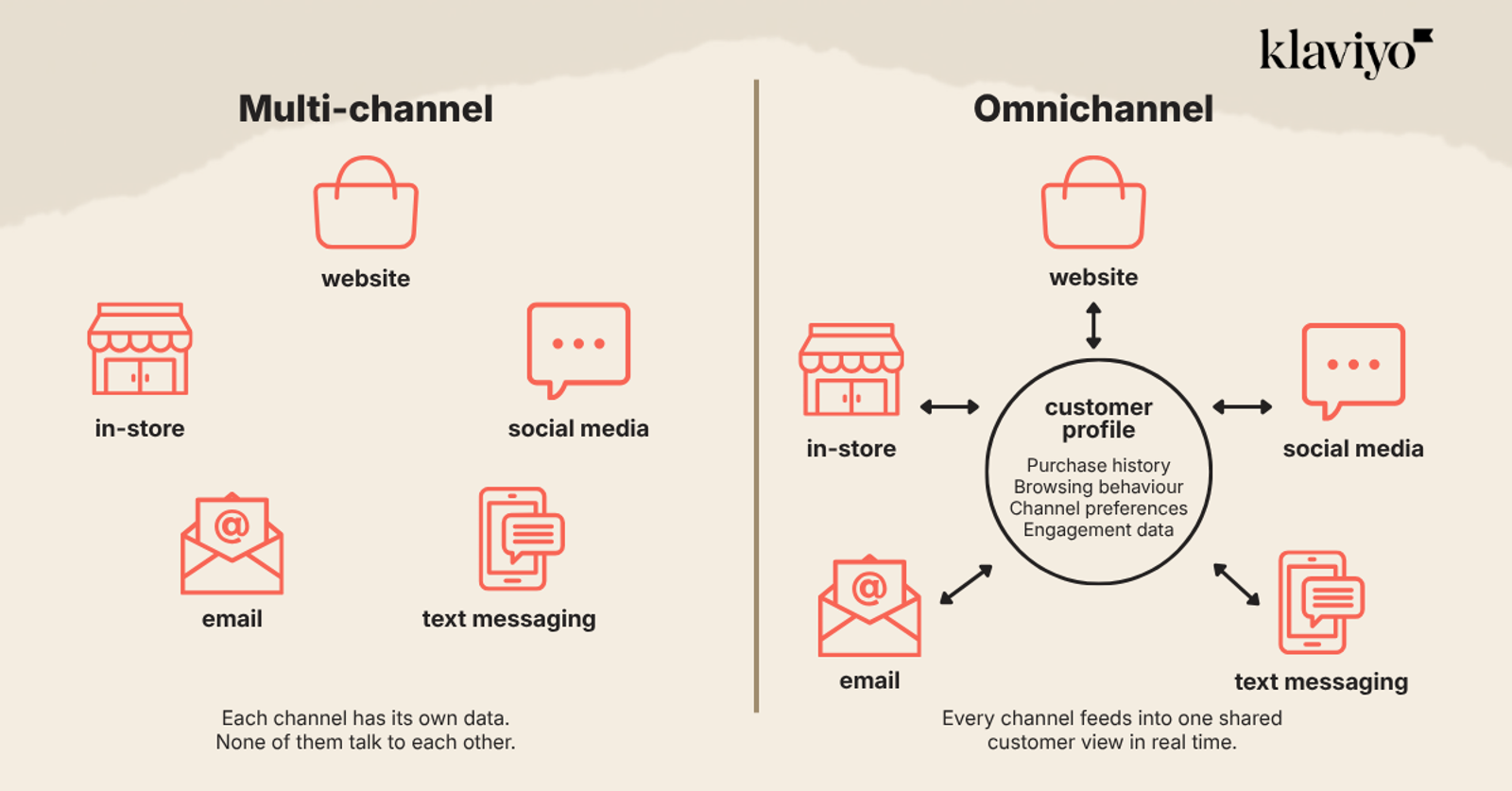
Omnichannel ecommerce connects all your channels into a single customer experience based on a shared data foundation. The distinction from multi-channel is not about being present on more channels. A brand on 10 disconnected channels is still multi-channel. A brand on 3 fully connected channels is omnichannel.
The foundation of omnichannel ecommerce is a single profile view of each customer: one record that brings together their purchase history, browsing behaviour, channel preferences, engagement patterns, predictive properties, customer service interactions, and more, all updated in real time across every touchpoint. Every channel draws from that same record and feeds back into it.
That shared view is what makes the experience feel continuous. A shopper browses on their phone during their commute, walks into a store at the weekend, and opens an email on Monday morning. To them, it feels like one ongoing conversation with a brand that knows them. To you, it's every channel finally working from the same page.
Remember the multi-channel ecommerce examples above? In an omnichannel set-up, all of that information flows into one place. So when the same person opens an email, browses your site, and walks into your store, the experience feels joined up. Underneath, it actually is.
Multi-channel vs. omnichannel ecommerce: the key differences
Both multi-channel and omnichannel ecommerce can involve the same channels: the same website, the same physical store, the same email list. But the channels communicate differently:
Multi-channel | Omnichannel | |
Organising principle | The channel | The customer |
Data | Separate per channel | Shared across all channels |
Customer experience | Varies by channel | Consistent across channels |
Brand messaging | Can differ per channel | Unified across channels |
Personalisation | Limited to channel history | Based on full customer history |
Operational complexity | Lower to start | Higher upfront investment |
Most brands land somewhere between multi-channel and omnichannel ecommerce. They might have integrated email and text messaging but a disconnected in-store POS system, for example. Or they might have shared inventory data but separate systems for various marketing channels, all running with no awareness of each other.
The path to omnichannel runs through your data foundation. Without a single source of truth at the centre, every integration you add stitches together what should already be connected, and the gaps and errors compound. A B2C CRM gives your channels one customer record to draw from, so the experience holds together as you grow.
What omnichannel ecommerce means for your marketing team
Many ecommerce teams are organised around channels, each with their own metrics, calendar, and definition of success. Email has their targets, and they’re different from social, which are different from in-store.
That structure works well for orchestration, but it can create blind spots at the customer level, where every team optimises their slice without visibility into what the others are doing.
Shifting from multi-channel ecommerce toward omnichannel ecommerce starts with a conversation, often with your marketing leadership, about how your team measures success and who owns the customer view. A few questions worth bringing to that conversation:
- Who in your organisation has visibility across all channels at once?
- If a customer buys today, does that change what they receive from your marketing team tomorrow?
- Are your channel teams working from the same customer data, or separate reports?
If those questions surface gaps, they’re good starting points. In practice, moving toward omnichannel tends to mean 3 key changes in how you work:
- How you plan: Rather than building a campaign calendar per channel, you start planning around where a customer is in their journey with the brand. Someone who just bought for the first time needs something different to someone who bought 3x last year and has gone quiet. Customer lifecycle marketing is the framework that makes that possible.
- How you measure: Channel metrics like open rates and click rates still matter, but they only tell you how a single touchpoint performed. Repeat purchase rate, customer lifetime value, and retention tell you whether the relationship is actually growing. Both matter, but the latter shapes better decisions.
- How you report: Revenue that touched email and then text messaging, then converted through another channel shows up as 3 separate wins when teams report in silos. Omnichannel attribution pulls that into one picture, which changes how you talk about what's working and why.
Omnichannel vs. multi-channel: which is right for your business?
Most brands sit somewhere on a spectrum between the two, and where you land depends less on ambition than on what your current infrastructure can support.
Omnichannel is a more connected version of multi-channel, so the real question is how much integration makes sense for where your business is right now. If you’re still establishing your channels and your customer data is only just starting to accumulate, focus on getting customers through the door first.
A few signals that suggest a shared data foundation is worth prioritising sooner:
- Your best customers buy across more than one channel, but your data treats them as separate people depending on where they purchase.
- Retention metrics are plateauing despite strong acquisition numbers.
- Different teams are claiming credit for the same revenue.
These are signs that fragmentation is starting to cost more than it would take to address. Moving to a B2C CRM connects your customer data in one move rather than stitching it together system by system. From there, every integration you add layers onto a foundation that's already unified, instead of compounding the gaps.
How to get started with omnichannel ecommerce
UK consumers are already moving between channels fluidly, expecting continuity, and completing transactions wherever it suits them.
That’s where Klaviyo comes in. As an AI-first B2C CRM, Klaviyo pulls customer data from across your tech stack, including your ecommerce platform, loyalty programme, payment tools, and more, into unified real-time profiles, then activates them across email, text messaging, WhatsApp, mobile push, and customer service. Every interaction a customer has with your brand feeds back into their profile and informs what happens next.
In practice, that might look like an automated flow about a loyalty milestone that’s triggered when a customer achieves a certain loyalty tier or number of points, or a post-purchase text message that links the customer to a how-to video for their recent purchase.
A customer who converts through one channel, meanwhile, finds the reactivation flow running on another has already stood down. The coordination happens at the data level, so it feels effortless at the customer level.
Ready to move from channel-first to customer-first?
FAQs about omnichannel vs. multi-channel ecommerce
Can a small UK ecommerce brand realistically implement an omnichannel strategy?
Yes, and the starting point is simpler than most brands expect. Omnichannel ecommerce does not require a complete technology overhaul. It starts with connecting the systems you already have: customer data from your ecommerce platform, your owned marketing channels, and more, so everything shares information in real time. A small brand selling through Shopify and running email and text message marketing through Klaviyo already has the foundation they need for omnichannel ecommerce. The next step is making sure those systems talk to each other, so customer behaviour in one place informs what happens in another.
What is the difference between cross-channel and omnichannel ecommerce?
Cross-channel ecommerce sits between multi-channel and omnichannel on the integration spectrum. In a cross-channel set-up, channels reference each other and share some data, but the integration is partial. A customer who abandons a cart online might get a retargeted ad on social media, but their in-store purchase history still lives separately. Omnichannel ecommerce takes that further: every channel draws from and feeds back into a single unified customer profile, so the experience feels continuous regardless of touchpoint.
How does omnichannel ecommerce affect customer lifetime value?
Omnichannel ecommerce creates more opportunities for your brand to be relevant at the right moment, which drives repeat purchase behaviour. A customer who receives communications that reflects their actual history with the brand, rather than generic messaging, has more reason to come back. Brands that connect their channels around a single customer view can identify at-risk customers earlier, personalise retention flows, and measure the full value of a customer relationship rather than the performance of individual channel interactions.
What tech stack does a brand need to run an omnichannel ecommerce strategy?
At minimum, 3 things need to work together: an ecommerce platform that captures purchase and browsing data, a customer data layer that unifies that data into profiles in real time, and an activation layer that uses the information in those profiles to personalise messaging across email, text messaging, WhatsApp, and push notifications. For most UK ecommerce brands, that means an ecommerce platform like Shopify, connected to a B2C CRM like Klaviyo, which handles the data unification and cross-channel marketing in one place, along with customer service and reporting. Loyalty programmes, subscription services, and POS platforms can then feed additional data into that central database as the stack matures.
Is multi-channel ecommerce still worth investing in for UK brands in 2026?
Yes, for the right reasons. UK consumers shop across more touchpoints than almost any other market globally, so adding channels where your customers already are remains commercially important. But a multi-channel approach is not the foundation for an omnichannel one. The foundation is shared customer data, and that does not get built incrementally as you add channels. It comes from a B2C CRM that unifies customer data across systems from the start. Once that's in place, every channel you add slots into a connected experience rather than a fragmented one.

Related content