How relationship marketing drives growth
Generated by Klaviyo AI
The article explains customer relationship marketing as a data-driven, personalised approach to building long-term customer relationships across the full lifecycle. It contrasts this with traditional batch-and-blast marketing, outlines key strategies and examples from UK brands, and highlights the metrics that show whether relationship marketing is working.
- Lifecycle-based approach: Customer relationship marketing structures communication around acquisition and onboarding, active relationship, and retention and re-engagement, adapting messages to each stage.
- Beyond traditional marketing: Unlike traditional campaigns that treat everyone the same, relationship marketing uses customer actions and history to inform personalised, behaviour-led messages and offers.
- Segmentation and automation: Effective strategies combine behavioural, demographic, and predictive segmentation with automated flows and campaigns to deliver timely, relevant communications at scale.
- Loyalty and churn signals: Using loyalty data and early warning signals like changing engagement or purchase intervals enables targeted post-purchase, win-back, and sunset flows to protect retention and deliverability.
- Compounding performance metrics: Tracking LTV, repeat purchase rate, retention, and engagement by segment shows how relationship marketing compounds over time through more relevant communication and higher engagement.
Think about what it means to be a regular at your local pub. The landlord knows your name, remembers your usual is a pint of bitter, and doesn't try to sell you something you'd never order. That familiarity didn't happen after one visit. It built up over time, through consistent, relevant interactions that made you feel known rather than just served.
That's the logic behind customer relationship marketing. You're not just selling to someone once. You're building familiarity over time, and the way you communicate needs to reflect where you actually are in that relationship. A customer who bought from you yesterday needs something different from one who hasn't opened your emails in 4 months.
That journey maps to 3 stages:
- Acquisition and onboarding: The first purchase opens the relationship. This is where you set expectations, introduce your brand, and give the customer a reason to come back.
- Active relationship: This is where you deepen engagement through relevant customer lifecycle marketing in ecommerce, communicating based on what customers are actually buying and browsing rather than what you've scheduled to send.
- Retention and re-engagement: Customers go quiet before they churn. This stage is about spotting the early signals, a longer gap between purchases, a drop in engagement, and acting before they're gone.
Customer relationship marketing vs. traditional marketing
Traditional marketing treats everyone the same. You write one message, send it to your whole list, and hope enough people buy. Think of it like a billboard: it reaches a lot of people, but it says the same thing to all of them regardless of who they are or what they've already bought from you.
Relationship marketing works the other way around. A customer buys a product, and that purchase tells you something useful. Maybe they need a refill in 30 days. Maybe they'd love a product that pairs with it. Maybe they haven't shopped in a while and a well-timed message would bring them back.
Traditional marketing campaigns still have their place, but in relationship marketing they're informed by what each customer has actually done, not just who you want to reach.
The difference shows up in which customer engagement metrics you pay attention to. Billboards count impressions. Relationship marketing counts repeat purchases, retention, and LTV.
Benefits of customer relationship marketing
Most marketing budgets focus on reaching more people. Relationship marketing focuses on doing more with the people you already have.
Here are 3 core benefits of that approach:
- Higher LTV. According to Twilio, 75% see increased customer spend from personalization efforts.. Customers who receive relevant, personalised communications tend to buy more often and spend more each time.
- Better retention. Repeat shoppers drive 45% more revenue than new shoppers during peak season. Your retention marketing strategies become far more effective when they're based on what customers have actually done rather than generic messaging.
- Better email deliverability. Inbox providers like Gmail watch how people interact with emails from your domain. If a large portion of your list never opens or clicks, Gmail interprets that as a signal your emails aren't wanted and starts routing them to spam—not just for the unengaged contacts but for everyone, including your best customers. Relationship marketing is more engaging because it's based on real customer behavior, not guessing, and higher engagement means your emails are more likely to land in inboxes rather than spam folders.
What is customer relationship marketing?
Customer relationship marketing is the practice of building personalised, long-term relationships with customers to increase retention and lifetime value (LTV) over time. This guide covers what it is, how it works, and what it looks like when UK brands get it right.
Customer relationship marketing strategies that really work
Each strategy below represents a deliberate decision about how to communicate with customers based on what they've actually done, and why that decision produces better results. The brands that grow through retention tend to apply these principles consistently across the full customer lifecycle.
Campaigns vs. automated flows
A campaign is a single message you plan and send at a time that suits you, either to your whole list or to a specific segment. An automated flow is a series of automated actions triggered by something a customer does, like signing up for your marketing list, abandoning a cart, making a purchase, or reaching out to customer service.
Both campaigns and flows have an important place in your customer relationship marketing and personalisation efforts. Here’s how they differ:
Campaign | Automated flow | |
What it is | A single message sent through one channel | A series of automated messages triggered by customer behaviour |
When it sends | When you schedule it or send it manually | Automatically when a customer takes a specific action |
Who receives it | Your whole list or a defined segment | Each customer individually, when their action triggers it |
Examples | Sale announcement, product launch | Welcome series, post-purchase sequence |
Email flows generate nearly 41% of total email revenue from just 5.3% of sends, according to Klaviyo's 2026 Benchmark Report. That's average revenue per recipient nearly 18× higher than campaigns.
Behavioural segmentation vs. demographic segmentation
Segmentation involves dividing your audience into different groups so you can better personalise your messaging. With dynamic segmentation, this happens automatically as customers act or update their preferences, empowering you to communicate with your highest-value repeat buyers differently from first-time purchasers without anyone manually making that change.
The examples of customer segmentation that tend to drive the most revenue combine who a customer is with what they've actually done and what they're likely to do next:
- Demographic segmentation gives you a useful foundation for personalised customer relationship marketing. Knowing that a customer is a woman in her thirties based in Manchester helps you tailor tone, timing, and product relevance from the start.
- Behavioural segmentation builds on that by telling you what customers are actually doing. Someone who has bought 3x in the last 90 days, always in the same product category, needs something very different from someone who browses regularly but has never converted, or a customer who bought once 6 months ago and has gone quiet since.
- Predictive segmentation builds on that even further by using historical data to forecast what subscribers are likely to do next. That might mean how much they’re likely to spend in the future, or when they’re likely to place their next order.
Using customer data to personalise communications
Personalisation in marketing exists on a spectrum. At one end is using someone’s first name in a subject line. At the other is a communication so relevant it makes the subscriber feel like the brand read their mind.
Whether you’re sending a flow or a campaign, the difference is in the data. Here's what that looks like in practice:
Surface personalisation | Behaviour-led personalisation |
"Hi Sarah, we thought you'd like this" | A replenishment email timed to when Sarah's vitamins are likely to run out |
"Thanks for your recent purchase" | Cross-sell product recommendations related to what that specific customer actually bought |
"We miss you, here's 10% off" sent after 90 days to everyone | A win-back triggered the moment that specific customer's engagement starts declining |
"You might like these" showing the same bestselling products to everyone | A price drop alert for the trainers that specific customer browsed 3x without buying |
New product drop announcement sent to everyone | Different campaign content based on what each customer has ordered in the past, or early access to a new drop only for your VIPs |
Whether they’re behaviour-triggered flows or segmented campaigns, ecommerce personalisation strategies built on personalised marketing data convert better than broadcast messaging because they feel more relevant.
Using loyalty data to drive repeat purchases
The post-purchase window is one of the highest-value moments in the customer relationship. If you go quiet after delivery confirmation, you’ve paid to acquire a customer and done nothing to keep them.
A well-built post-purchase flow, running across multiple channels such as email, SMS, WhatsApp, and push notifications, turns that window into the start of a long-term relationship. For B2C CRM teams specifically, this is often where the biggest retention gains are hiding.
One type of post-purchase flow that’s important for customer relationship marketing: the loyalty programme communication. A loyalty programme generates more data than most brands use. Beyond points balances, it tells you how quickly customers are earning, whether they redeem rewards or let them expire, which reward types they choose, and how their purchase frequency changes after joining.
Each of those signals is worth acting on. For example:
- A customer whose points are about to expire needs a nudge before they do. That might look like an email 14 days before expiry showing exactly what they could redeem right now.
- A customer who’s 10% away from the next tier is primed for a message showing them how close they are and what they unlock when they get there.
- A customer who consistently chooses a free product rewards over discounts is telling you what motivates them. Early access to a new collection might land better than a percentage off.
Building a customer loyalty programme with this level of data connection means every customer interaction with the programme becomes an opportunity to deepen the relationship.
Identifying and re-engaging customers at risk of churning
A common set-up for a re-engagement campaign in certain industries is to wait until a customer has been inactive for 90–180 days, by which point they’ve often already moved on. The signals that someone is drifting away appear much earlier than that, and acting on them early is what makes the difference.
Early warning signals worth tracking include:
- A drop in engagement rates for a previously active subscriber
- Purchase intervals getting longer for a regular buyer
- A previously high-value customer visiting your site multiple times without adding anything to their basket
- A predicted next order date that has passed without a purchase
- A churn risk score rising based on historical behaviour patterns
Once you can see those signals, you can act on them. For example:
- Trigger a re-engagement flow after someone doesn’t click on text messages for 90 days.
- Trigger a win-back campaign to customers a few days after their predicted next order date passes.
Trigger a sunset flow for customers who don't respond to any re-engagement efforts, removing them from your active engaged segment to protect deliverability before they damage it.H2: Customer relationship marketing examples from real B2C brands
Many UK brands are already putting some of these strategies into practice. Here are 3 examples of what customer relationship marketing actually looks like when it's working:
Dr. Martens moves from batch-and-blast to behaviour-led personalisation
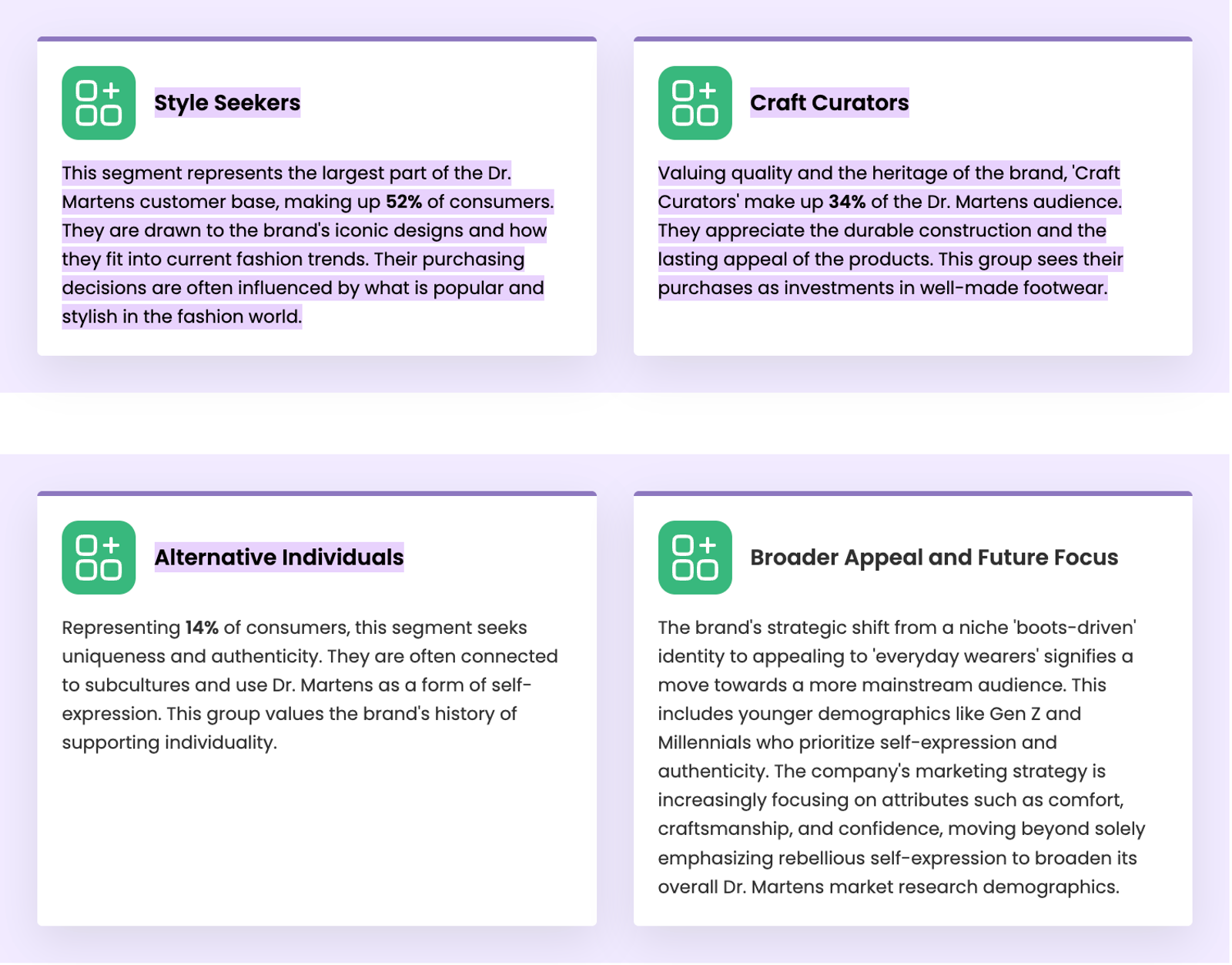
Dr. Martens has been building towards behaviour-led personalisation for over a decade. In an interview with Marketing Week, their global digital marketing manager described the shift explicitly: rather than sending the same email to everyone, they use behavioural data to serve relevant content to individual customers. A customer who consistently browses boots, for example, receives a dynamic email featuring boots rather than a generic promotional send.
More recently, the brand segmented their entire customer base into 3 behavioural cohorts defined by how customers actually shop, not who they are demographically: Style Seekers, Craft Curators, and Alternative Individuals. As CEO Ije Nwokorie explained in a June 2025 investor presentation, "we're not sending everything to everybody. We're sending relevant things to relevant people over time."
Grind builds a segmentation model around how customers actually buy
London coffee brand Grind serves customers across very different buying journeys, from one-time purchasers to active subscribers to previously active customers who have since gone quiet. Rather than treating them the same, Grind's CRM team ran RFM analysis to score customers based on their recency, frequency, and monetary value. With a better understanding of what actually distinguishes an engaged customer from an unengaged one, Grind re-built their entire segmentation model.
The result was 4 engaged segments that receive regular product updates and recommendations, and 7 re-engagement segments Grind uses to recapture lapsed customers with targeted offers and new product launches. The brand now has 53 always-on flows that deliver highly targeted messages to their customers..
The Body Shop connects loyalty data to personalised communication
The Body Shop built the Love Your Body Club loyalty programme with personalisation as its explicit purpose. Victoria Mason, then UK head of CRM, told Cosmetics Business that the scheme was designed to give members a "more personalised loyalty experience", with communications tailored to individual preferences and purchase history rather than broadcast to the full member base.
That personalisation extends into stores, too. As chief digital officer Harriet Williams explained to InternetRetailing, store staff use iPads to access each customer's purchase history during in-store consultations, giving them the same data picture that drives the brand's digital communications. The result is a customer relationship that follows the same person across every channel rather than treating their online and in-store behaviour as separate.
Customer relationship marketing metrics worth tracking
Relationship marketing calls for a different set of metrics than traditional campaign reporting. Rather than measuring how a single send performed, you need to measure the health and direction of your customer relationships over time.
Here are some of the most useful metrics to track:
- LTV: how much a customer is worth over the full course of their relationship with your brand
- Repeat purchase rate: the percentage of customers who buy more than once, which is one of the clearest signals of whether your post-purchase strategy is doing its job
- Customer retention rate: the percentage of customers you keep over a given period and how that changes over time
- Engagement rate by segment: how different customer groups interact with your communications, which tells you where your relationship marketing is working and where it needs attention
A customer relationship marketing system that compounds
Customer relationship marketing gets more effective over time. Every purchase, every interaction, and every signal your customers give you makes your communications more relevant. That drives higher engagement, which improves your deliverability, which means more revenue from the customers you already have. The system compounds in your favour the longer you run it.
Klaviyo is built specifically for this virtuous cycle. The autonomous B2C CRM unifies your data from your online store, marketing channels, customer service interactions, and more into single customer profiles, so every automated flow, every segment, and every campaign draws on the full picture.
With Klaviyo, predictive analytics surfaces churn risk and expected next order dates before you need to act on them. RFM analysis turns your customer base into actionable groups you can communicate with more effectively. And because email, SMS, WhatsApp, and mobile push all live in one place, your cross-channel flows and campaigns are more likely to complement each other and less likely to cause message fatigue.
Ready to start your sophisticated customer relationship marketing strategy?
FAQs about customer relationship marketing
What are the most effective customer relationship marketing examples for small ecommerce brands?
The most accessible starting points for smaller ecommerce brands are a post-purchase sequence, a replenishment flow for consumable products, and a basic re-engagement campaign for lapsed customers. None of these require large budgets or complex technology. A post-purchase email that arrives within 24 hours of a delivery, asks for a review, and suggests a complementary product is a straightforward example of personalised communication that builds repeat purchase behaviour. For brands selling consumables, timing a follow-up email to when a product is likely to run out is a very popular flow. A re-engagement campaign works on the same principle, identifying customers who haven't purchased in 60 or 90 days and sending them a tailored offer or product update based on what they bought before. These are the customer loyalty and repeat purchase mechanics that compound over time.
How does the GDPR affect customer relationship marketing strategies for UK brands?
The GDPR requires that UK brands collect explicit consent before sending marketing communications, and that they handle customer data transparently and securely. In practice, this requires building your relationship marketing strategy on zero- and first-party data you collect with clear consent. This is actually an advantage: customers who have opted in tend to be more engaged and more likely to respond to personalised communications than broad cold audiences. The constraints GDPR places on data push brands toward exactly the kind of permissions-based, relevant communication that customer relationship marketing is built on.
What is the difference between customer relationship marketing and brand loyalty programmes?
A loyalty programme is one tactic within a broader customer relationship marketing strategy. Relationship marketing covers every communication and interaction across the full customer lifecycle, from the welcome sequence after a new marketing list sign-up through re-engagement flows for lapsed customers. A loyalty programme specifically rewards repeat behaviour with points, tiers, or perks. The two work best when you connect them: loyalty data informing personalised communications, and communications reinforcing the value of the loyalty programme. A loyalty scheme that operates in isolation from your broader CRM and retention strategy generates points but misses the opportunity to deepen the customer relationship through relevant, timely communication.
Which customer relationship marketing metrics should ecommerce brands prioritise over open rates?
Metrics to prioritise include repeat purchase rate, lifetime value (LTV), customer retention rate, and engagement rate by segment. Repeat purchase rate shows whether your post-purchase strategy is converting one-time buyers into returning customers. LTV tells you whether the relationships you’re building are becoming more or less valuable over time. Churn rate tells you how quickly you’re losing customers. And engagement rate by segment shows which parts of your customer base are responding to which communications.
Can customer relationship marketing work for low-frequency purchase categories like furniture or appliances?
Yes. In some ways, the lower purchase frequency makes relationship marketing more important, not less. When customers buy infrequently, the post-purchase window is even more valuable because it’s the primary opportunity to build a relationship before the next buying cycle begins. A furniture brand, for example, can use the post-purchase period to share care guides, styling inspiration, and complementary product suggestions that keep the brand present in the customer's mind long before they’re ready to buy again. Re-engagement and long-term customer lifecycle management become the focus rather than replenishment, and the goal is to be the brand a customer returns to when the next purchase occasion arises rather than starting their search from scratch.

Related content