How UGC Builds Trust and Loyalty
Generated by Klaviyo AI
User-generated content gives shoppers authentic evidence from real customers, helping build purchase confidence, trust, and brand advocacy. The article explains four main UGC types, their business benefits, and practical ways to collect and use customer content and feedback.
- Four UGC types: Visual content, social posts, reviews and testimonials, and Q&As help customers understand products and brands.
- Authentic social proof: Real customer experiences can bridge the online shopping gap and make purchase decisions feel more credible.
- Community and advocacy: UGC encourages two-way communication and can turn customers into loyal brand advocates.
- Efficient content creation: Organic or paid customer content can be repurposed across marketing channels while reducing production demands.
In January 2019, when the company was much smaller, italist received “one of the best unprompted endorsements” from an influencer on Instagram, recalls CEO Diego Abba.
Dorothy Wang, daughter of billionaire Roger Wang and star of reality show Rich Kids of Beverly Hills, shared this photo with her 1 million followers, crediting italist with helping her find the Louboutin So Kate pumps that completed her birthday outfit:
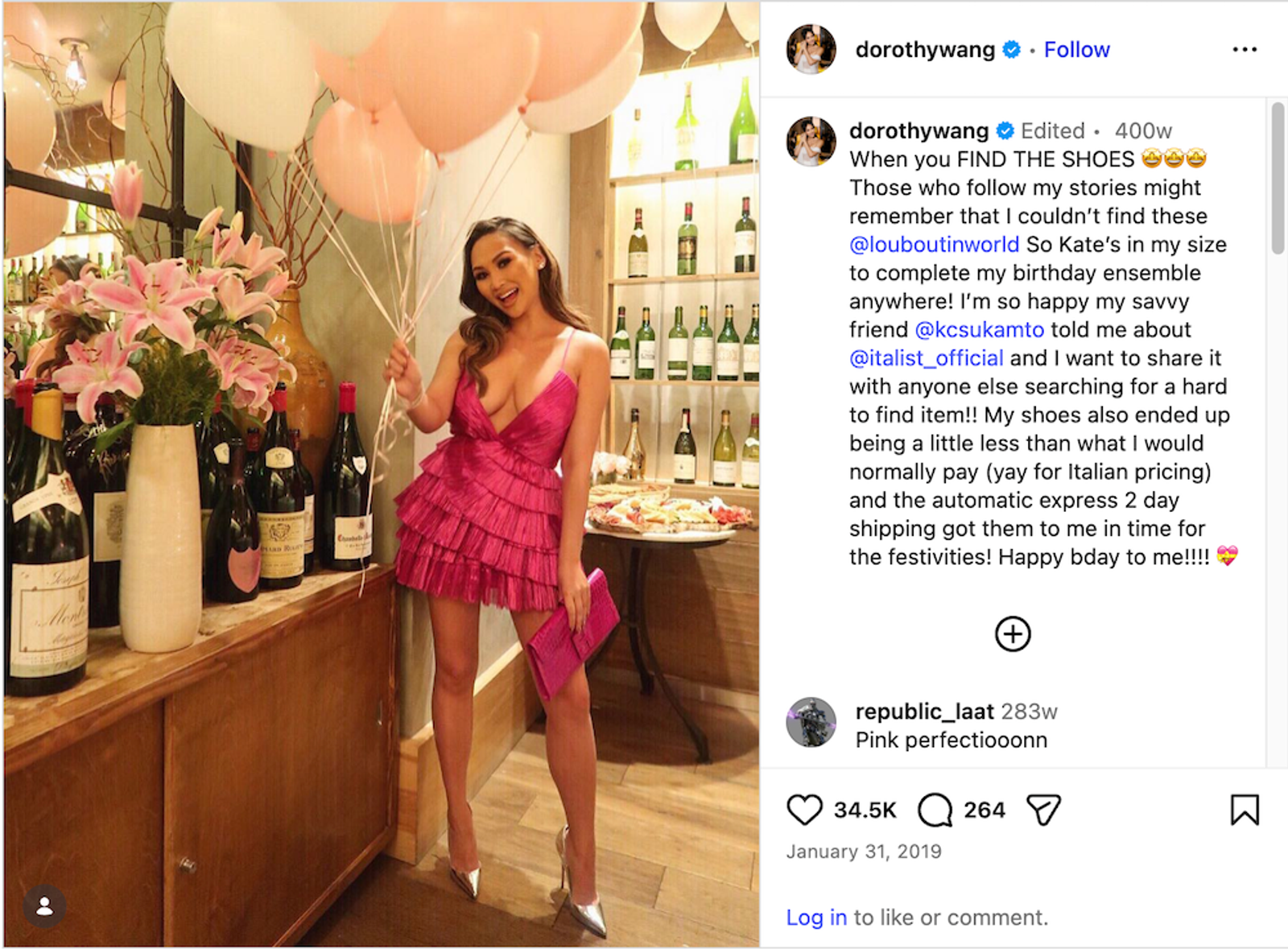
Dorothy Wang’s Instagram
“Those who follow my stories might remember that I couldn’t find these Louboutin So Kates in my size to complete my birthday ensemble anywhere,” Wang wrote in her caption. “I am so happy my savvy friend KC Sukamto told me about italist and I want to share it with anyone searching for a hard-to-find item!”
“My shoes also ended up being a little less than what I would normally pay (yay for Italian pricing) and the automatic express two-day shipping got them to me in time for the festivities,” she added. “Happy birthday to me!”
The thank-you note was spontaneous and completely organic, Abba says: Wang had no prior engagement with italist, but “she highlighted very well the two key advantages of our site: the vast selection from luxury brands, and the lower pricing.”
Wang’s post received nearly 35,000 likes—and it’s a perfect example of the power of user-generated content (UGC).
More than any other kind of marketing, UGC allows you to talk with your customers, rather than at them. It’s “a key part of the two-way communication that we have with our consumers, thanks to technology and social media,” Abba says.
That makes UGC a perfect fit for a brand like italist, whose online store gives shoppers access to when-in-Rome pricing (up to 40% lower than the rest of the world) and 350,000+ SKUs from independent Italian boutiques, from anywhere with an internet connection.
“Not many brands or retailers in the luxury space actively use UGC, in part because the luxury business is built on exclusivity, not inclusion,” Abba points out. “We see our work as democratizing luxury in a small way, making pricey things a bit less pricey, and providing another option for shoppers beyond traditional department stores or having to buy directly from a brand.”
In the same way italist is democratizing luxury fashion, then, UGC democratizes content production by flattening traditional top-down media and advertising hierarchies. “UGC makes sense to recognize and reward new customers, loyal customers, and build a strong community around our business,” Abba explains.
Not all UGC comes from influencers with large social followings. But all of it can be instrumental in turning one-time shoppers into lifelong brand advocates. Read on to learn how.
What is UGC?
UGC is original content customers share that brands can use in their marketing efforts. Essentially, it’s today’s version of word-of-mouth marketing: anything people are saying or showing about your brand, online, to their own followers and networks.
And it’s crucial: according to the 2026 Bazaarvoice Shopper Experience Index (Volume 18), two-thirds of Americans and Canadians rely on UGC to make buying decisions.
Typically, UGC showcases how real people are using your product in their daily lives. Some UGC, however, might fall more into the realm of lifestyle content, stuff that showcases how your customers’ values align with your brand’s ethos.
Since italist, for example, sells 2,500 brands but not products under their own name, UGC that falls into the latter category is particularly valuable: “stories about italist as a useful service and a seamless experience,” Abba says, “rather than simply posts which include an item purchased from italist.”
Most UGC is organic, like Wang’s italist shout-out above. But brands can also pay creators to make it. Both types of UGC have their benefits: the former is more raw and unadulterated, while the latter gives the brand more control over content scripts and visuals.
But either way, with UGC, your audience takes an active, participatory role in your marketing.
Here’s an even easier way to think about it: If the content is associated with your brand but wasn’t officially created by your brand, it’s probably UGC.
The 4 main types of UGC
UGC comes in many forms. “It’s more than just text,” explains Shaun Lin, former director of channel partnerships at Bazaarvoice, a UGC software platform that enables brands and retailers to collect and display several types of UGC on a variety of channels. “It’s images, it’s video, it’s everything.”
“There’s no one size fits all,” agrees Ben Schreiber, CMO at Latico Leathers and co-founder of Forbes-rated boutique ecommerce agency Brand Caffeine, which specializes in paid ads, email and text marketing, SEO, and UGC content creation. “It’s really different for every product and every brand.”
The 4 main types of UGC include:
1. Visual UGC
Visual UGC refers to photos and videos shared by customers who are interacting with your brand or products.
“People want to see real-life photos in addition to the branded photos that companies put on product description pages, and they want to see videos of the product experience: a real person talking about that experience in a real environment, as opposed to a studio-produced video,” Lin explains.
Take a look at how pet apparel brand Wild One uses visual UGC to their advantage on their Instagram account. Their posts are a mixture of branded photography and UGC:

Wild One’s Instagram
Visuals, here, go much further than words would. By displaying a wide variety of pets in various iterations of their products on their feed, Wild One allows potential customers to scroll through for a quick sense of how a Wild One harness might look on their dog, or whether their toys are the right size for their pet.
2. Social media posts
Social UGC refers to Instagram stories and posts, TikTok and YouTube videos, and Facebook posts that involve your brand. Because it was 100% organic, Wang’s italist shout-out would qualify as social (and visual) UGC, as would this post from an everyday Instagram user and italist customer:

Italist’s tagged Instagram feed
3. Reviews + testimonials
Reviews and testimonials refer to any kind of content that involves your customers sharing their opinions and experiences with your brand and products. And they’re particularly crucial for ecommerce brands that do most of their business virtually.
According to Klaviyo’s 2025 Future of Consumer Marketing Report, reviews are the No. 1 factor consumers take into account when making a first purchase.
Check out these examples from the website homepage of nutrition supplement brand Promix. Notice how customer reviews don’t just have to pertain to your product. They can also speak to less tangible things, like brand values and customer goals.
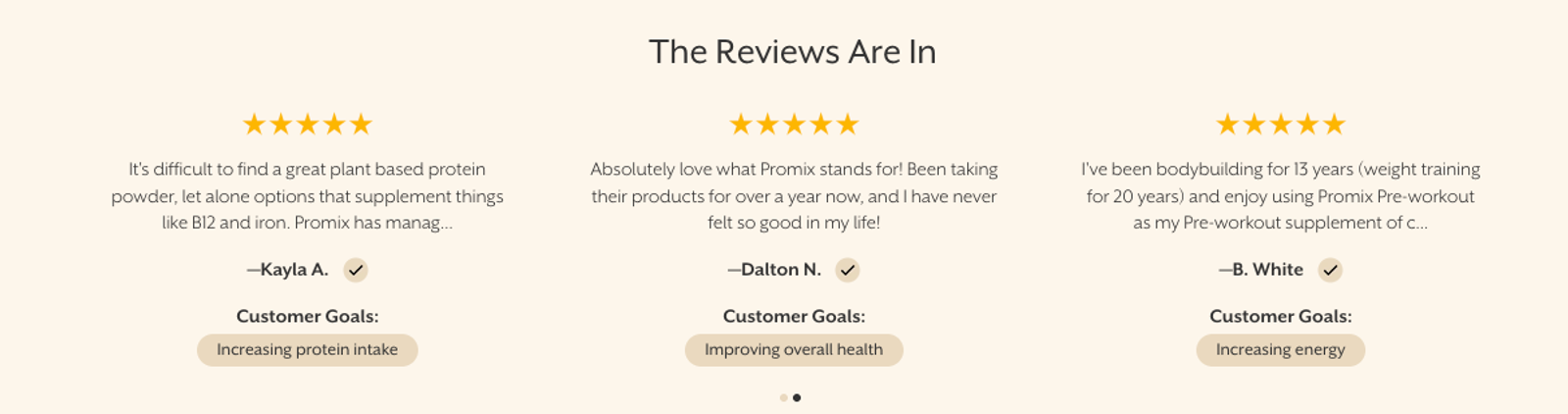
Promix homepage
4. Q&As
Q&As allow shoppers to ask questions about products or brands and receive answers from both other customers as well as the brands themselves. This type of UGC not only gives shoppers access to answers they need from sources they trust, but also builds community by inspiring brand experts and past purchasers to share their knowledge.
Q&As are particularly useful for businesses that sell more complex products, like technology, high-performance sporting equipment, outdoor gear, etc.
How UGC benefits your business
According to the 2026 Bazaarvoice Shopper Experience Index, 9 in 10 shoppers engage with creators before buying.
In other words, UGC is an expected part of the customer journey. Here’s why it matters:
UGC makes potential buyers more confident in their purchase decisions
Consumers love online shopping for one primary reason: it’s convenient. They can browse products from brands anywhere, like on their laptops while they’re at home sitting on the couch, or on their phones while they’re out and about.
Basically, as long as there’s an internet or data connection, shopping is possible. But there’s a downside to such widespread accessibility: it sets up a digital partition between your customers and the products they’re browsing.
“In a traditional brick-and-mortar store, you’re able to speak with a store representative, you might be able to speak with other shoppers. You have that live interaction experience,” Lin explains.
In an online environment, by contrast, shoppers can’t see or touch the physical item. They can’t tell how it might look or function in 3D reality. And for a high-quality leather handbag brand like Latico Leathers, that’s a huge challenge.
“There are certain products which are hard to sell online because people need to touch, feel, and smell them,” Schreiber says. Think verticals like fashion or health and beauty. “So for us and for many other brands like us, it’s about showing, not telling.”
AI customer agents can help bridge certain parts of this digital-to-IRL gap with 24/7 availability to answer detailed product questions based on your brand’s documentation. When that customer agent is available on whatever channels your customers interact with already, it can be a good stop-gap for a real-life shopping experience.
But UGC, coming from real humans, will always be necessary for giving shoppers the confidence they need to buy when they’re really unsure.
UGC builds trust in your brand
As a marketer, you can make all sorts of promises or claims about what you’re trying to sell. But even if they’re valid, it’s hard to corroborate them or play the “take it from me” card when you stand to benefit financially if someone does actually take it from you.
In other words, marketing images and positioning can only get you so far. Most shoppers trust a customer who is reviewing a product over a marketer who’s trying to sell it.
That’s especially true now, when, according to Klaviyo’s 2026 AI Consumer Trends Report, nearly 1 in 5 consumers say they see low-quality or generic AI content from brands weekly. For some, it leaves a meaningful impression: 32% say it makes them trust brands less.
When you share real UGC in your emails, on your product pages, or through social media marketing, you’re not asking shoppers to take your word for it. That brings a level of authenticity and transparency to your brand that marketing or promotional messages simply can’t provide.
UGC turns prospects and customers into brand advocates
Because of that authenticity, UGC also has the potential to build a trustworthy online community of people who’ve graduated from customers into die-hard fans.
Abba explains how UGC serves “a dual purpose” for italist:
- “It fosters a sense of connection and community among our existing customers, whom we call ‘savvy shoppers’ in reference to their saving hundreds or thousands off retail for their favorite luxury fashion.”
- In turn, “their italist-centric UGC provides social proof to anyone new to italist who isn’t familiar with our value proposition. It’s an incredible way to crowd-source marketing content and show appreciation for our most loyal fans.”
UGC saves you resources
On that note, the reason UGC is so cost effective is because it essentially turns your customers into your content creators, either completely for free or through low-cost incentives like discounts and giveaways.
“Creating high-quality content can be time-consuming and expensive,” points out Lindsey Arellano, former director of email and SMS at CURIO. “By incorporating UGC, brands can tap into a vast source of content that is already available and can be repurposed for various marketing channels. This can help brands save time and money.”
“Any quality photography or content that a business doesn’t have to pay for is a win,” agrees Hagar Vander, former director of UX at Domaine. “A brand that has an engaged user base can utilize a lot of really great UGC on and off the site to not only strengthen their community, but also link directly to products from anywhere.”
Even if you opt to pay a creator to make UGC for your brand, it’s going to cost less than hiring professional photographers, video editors, and full-time social media managers. Depending on the creator you’re working with, it’ll also probably cost less than influencer marketing.
Paid UGC creators vs. influencers
Confused about the difference between paying someone to create UGC and working with an influencer? With more micro and nano influencers, the lines are getting blurrier, but here are a few general rules of thumb:
- Paid UGC creators typically create content for your brand to use on your branded platforms.
- Influencers typically create content to promote on their own platforms to their own followings.
- The primary purpose of hiring UGC creators is to produce authentic content and share it with your existing audience.
- The primary purpose of hiring an influencer is to earn authentic content and promote your brand to new customers who may be familiar with the influencer, but not your brand.
The content your customers generate, meanwhile, can help you create an effective content marketing program that builds brand awareness and improves your conversion rates.
UGC helps you figure out what is or isn’t working about your product
Positive UGC shouldn’t be your only focus. Abba reads every single piece of feedback italist receives from customers. “I’m a big believer in engaging in two-way conversations with our customers through storytelling that is compelling and able to incorporate reactions, ideas, and feedback,” he says.
In fact, when italist highlights positive reviews, they look for reviews that have a relatable narrative arc, something like, “I was skeptical at first, but I ended up having a great experience.”
Why? “This messaging performs much better than glowing reviews,” Abba explains. “We have plenty of those, but they’re not as helpful for potential new customers who need some reassurance.”
“We always think it’s so important to display the positive reviews, and it is, but not everyone might have the same experience, and not everyone might have a great experience,” Lin agrees. “Shoppers want to read about that, too.”
In addition to making your brand more credible, negative reviews, email unsubscribes, social unfollows, and other kinds of critical UGC can help make your marketing messages more effective and your audience targeting more efficient.
“Understanding the pain points of your customers gives you not only an opportunity to win back a customer’s trust, but also a chance to correct the course for future customers,” says Drew Himel, CEO and founder of Sunny Road.
In other words, negative reviews are an opportunity to solve a challenge for your customers. “Your internal product development team can gather a lot of insights about your products based on how customers are receiving and reviewing them,” Lin points out.
Take a look at how shoe brand Charlotte Stone features this review by a customer who suggests the brand adopt half sizes. Reviews like these teach the brand what they need to prioritize in their product development.
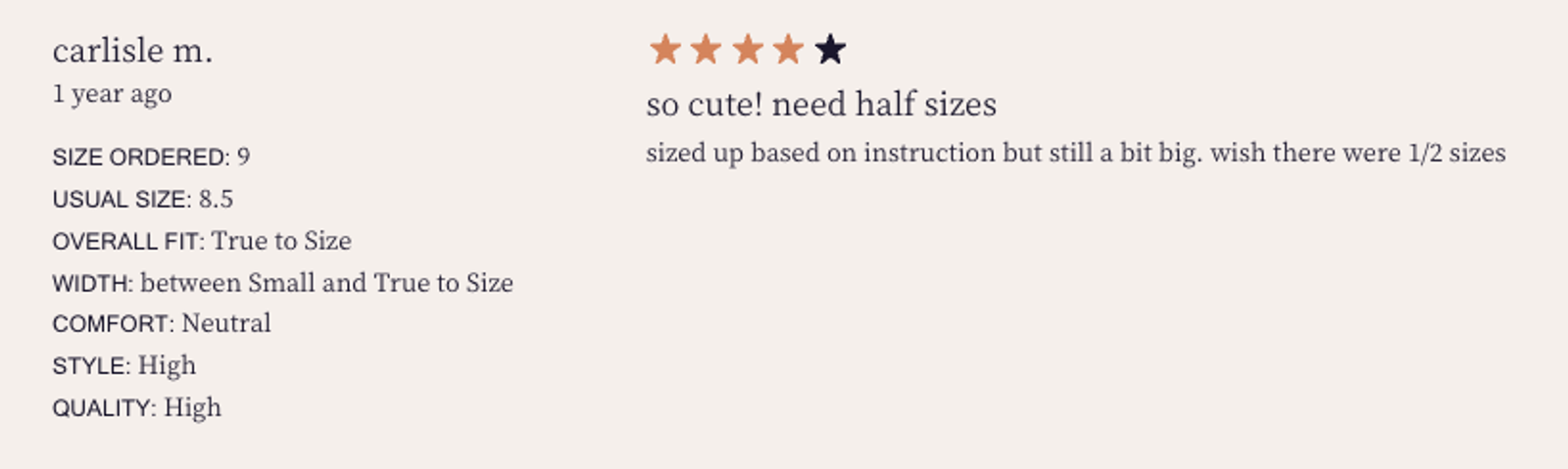
Charlotte Stone Shoes
3 reliable places to find UGC
To source high-quality UGC, italist encourages interaction with the brand’s main social media channels: Instagram, TikTok, YouTube, Pinterest, Facebook, and Twitter.
“We also frequently incentivize our shoppers to participate in contests, become brand ambassadors, and share their experiences with italist however they feel most comfortable,” Abba explains.
Here are 3 reliable ways to collect UGC:
1. In a post-purchase review request flow
A post-purchase automation is an email, text message, or WhatsApp message that goes out automatically after a customer makes a purchase. The ideal timeframe varies depending on your product and its proven time to value, because you have to give someone time to actually try your product and form an opinion on it before asking them to brag about it.
It never hurts to include a little treat for your customers as a way to entice them to take your desired action. And “treat” doesn’t have to mean “discount.” Watch how Credo Beauty incentivizes customers to leave a review without relying on a coupon code:

Credo Beauty
2. Organically on your website
In addition to explicitly asking for UGC, you can also take a slightly more indirect route to the same end goal: allow your customers to leave reviews on your product pages at any time.
Here, you can see how optical brand Raen makes leaving a review as easy as clicking a button on their website. Raen wants customers and site visitors to feel like they have a place to openly share their opinions and experiences, so consumers can decide for themselves if their product is right for them.
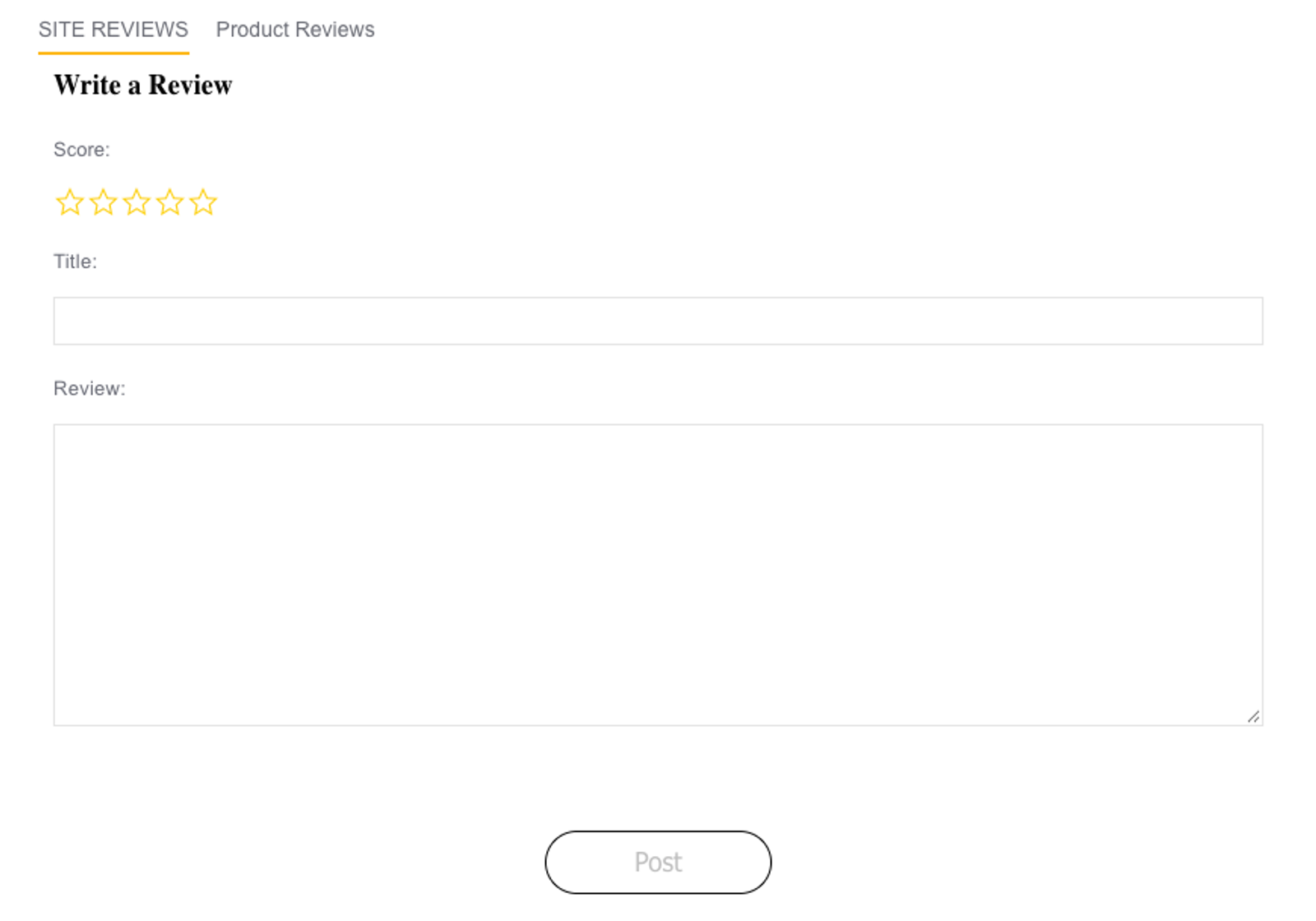
Raen
3. Through Instagram tags, integrated with your CRM
If you’re using a CRM like Klaviyo, you can collect UGC by first gathering marketing consent with Instagram DMs, comments, and tags, then enriching those customer profiles with every post, message, and mention subscribers make on social media.
Swimwear brand Kulani Kinis, for example, asks brand evangelists to sign up for their Sun Chasers ambassador program with a sign-up form. Users input their social handles as well as an email address and phone number, and Klaviyo pulls their social follower count into their customer profile.
After that, Klaviyo can track all mentions of Kulani Kinis, centralizing social UGC alongside browsing and purchase activity. Since adopting this approach, Kulani Kinis has seen nearly 5,000 user-generated social posts tagging the brand and has scaled their program to more than 130,000 global members. That number has grown more than 5x in less than 4 years.
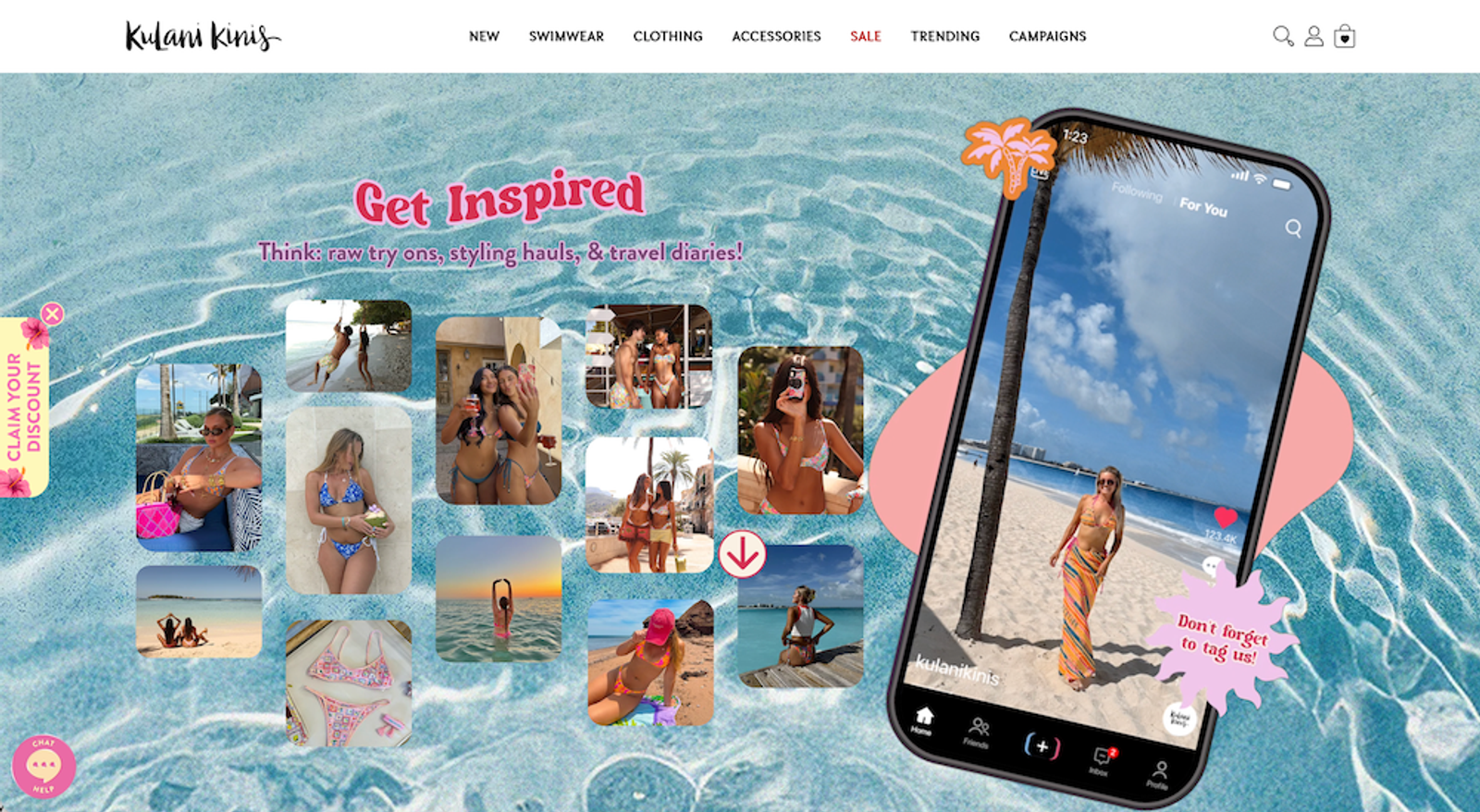
Kulani Kinis Sun Chasers webpage
How to incorporate UGC into your omnichannel marketing strategy
Once you take stock of all the UGC you’ve accumulated, the question becomes: Now what?
Abba puts the answer simply: “We use UGC across all our digital touchpoints.”
Here are a few ways to use UGC to educate your target audience about your products and services, and nurture them until they’re ready to make a purchase.
Share UGC on your organic social accounts
Your social followers are more interested in seeing your products on real people, from diverse backgrounds, than models.
“We regularly re-post excellent UGC in our social media channels as a way to reinforce the sense of community among our shoppers, highlight new faces, and share in the beauty of luxury goods with the savings of being direct from Italy,” Abba says.
Here’s an example from sleepwear brand Parade:

Incorporate UGC into your paid advertising efforts
UGC is also incredibly effective in paid media. Just ask DTC bedding and bath brand Parachute, which historically relied on professional, brand-created editorial content and sleek, eye-catching ads.
Those polished creatives worked well for attracting new customers. But when it came to bringing familiar customers back to their site, Parachute wasn’t seeing the kind of performance they wanted.
So they changed tactics. With help from Bazaarvoice, Parachute incorporated lifestyle imagery from customers who tagged the brand in their organic posts on social media, and created retargeting ads that showed consumers styling and using Parachute products in everyday life.
The results speak for themselves: 35% higher click rates and a 60% lower cost per click.
“We’ve seen that our customers have a higher propensity for clicking on and engaging with rich UGC imagery than traditional product-centric imagery,” Luke Droulez, former CMO at Parachute, told Bazaarvoice.
Add UGC to your website and product pages
Your website is one of the places people spend the most time learning about your products or services. If you’re an ecommerce brand, it’s also where they’re most likely to buy them.
But more and more, shoppers are actually reading the reviews on your website with a LLM like ChatGPT or Google Gemini: 39% of consumers have purchased a product recommended by AI, according to Klaviyo’s 2026 AI Consumer Trends Report.
An LLM sees your website reviews as components it can break down and aggregate in conversational responses during product research. This is why detailed product reviews on your website and across third-party channels are more important than ever: shoppers are using LLMs to compare products with detailed specifications, and your reviews need to contain these details to end up in AI search results.
Latico Leathers incorporates UGC throughout their website, beginning with glowing magazine reviews on their homepage:

Latico Leathers homepage
Similarly, every product page, Schreiber says, includes at least one UGC photo or video:
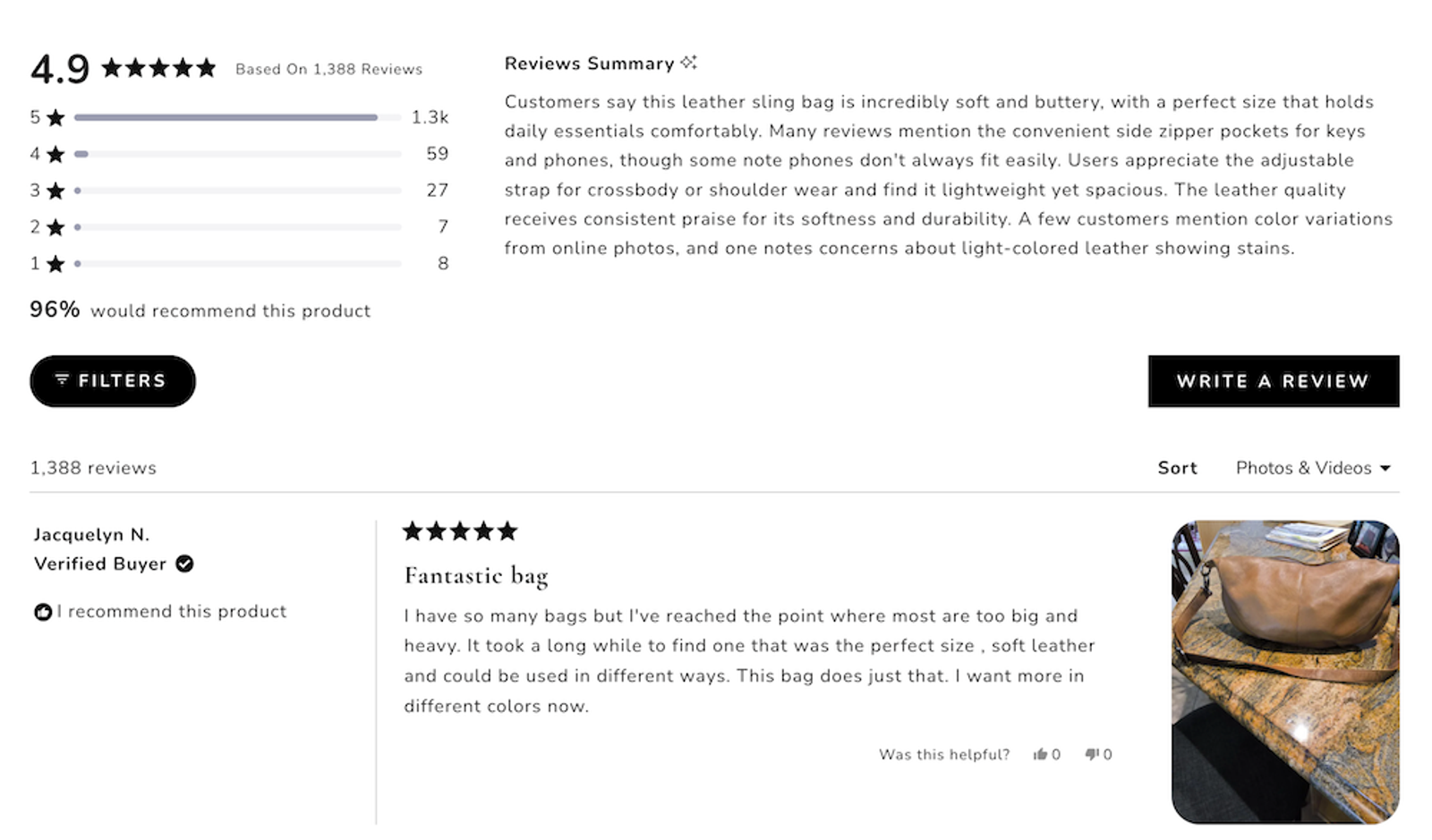
“When people are on your product pages, mainly what they’re trying to do is picture the product on themselves or picture themselves using the product,” Schreiber explains. “If they see 20 people posting a picture of the product with a 4- or 5-star review, that’s relatable and it’s trustworthy. It gives people the extra push they need to buy.”
Weave UGC into your email and text message marketing
Your owned marketing channels, including email and mobile channels like text messaging, WhatsApp, and push notifications, are another natural vehicle for serving up UGC to your audience.
Think of these channels as a low-cost nurture stream. For subscribers who aren’t quite ready to make a purchase, email and text messages can further educate them about a product and brand they’re interested in.
Consider this example from sparkling water brand Aura Bora. Their product launch email uses real customer reviews to entice subscribers to give a new drink flavor a try.

Aura Bora
These product descriptions may be subtly promotional. But from the realness of the taste to the drink’s ability to evoke memories of paradise, they’re also readable, authentic shout-outs from actual people who genuinely love the flavor. Who wouldn’t want what they’re having?
Here are a few particularly effective marketing flows for sharing various types of UGC:
- Welcome flows: Get new subscribers excited about your brand by not only telling your story, but showcasing UGC that tells it for you.
- Browse abandonment flows: Use product-specific UGC to encourage subscribers to click through to your site, or cross-sell them on similar items.
- Abandoned cart flows: Use product-specific UGC to help convince consumers that the item in their cart is worth another look.
- Post-purchase flows: Get new customers excited about their purchase by offering customer content that validates how great the product will be when it arrives.
4 best practices for collecting and using UGC in your marketing
As you’re building out your own UGC strategy, here are 5 best practices to keep in mind:
1. Ask permission and credit the creator
Abba advises being “respectful of all UGC that comes in,” and “gracious about the process of curating what you re-post or re-use.” That means securing permission before you share, and giving credit where it’s due.
2. Stay on trend
Especially if you’re incorporating UGC into your social media strategy, remember: “You have to hone in on what people are looking to do on the platform,” Schreiber says.
On TikTok, for example, that means “thinking about trendiness: what songs are trending, what challenges are trending, and then piggy-backing off current events. That’s going to give you a boost in the algorithm,” Schreiber explains.
“You have to be quick on your feet,” Schreiber adds. “That’s how you’re going to get a ton of views. If you can try to relate that to your product in a humorous or witty way, that’s a plus.”
Brand Caffeine, which Schreiber co-founded with his sister, professional content creator Liv Schreiber, has brainstormed and produced plenty of viral UGC for the DTC clients they manage monthly. Schreiber’s key piece of advice based on those experiences is to figure out a way to stand out.
“You can start a brand in 5 hours,” he says. “The hard part is differentiating yourself and making yourself unique.”
At the end of the day, Schreiber says, “A lot of people forget these are social networks. These people aren’t shopping on your website. They aren’t necessarily in a ‘buy’ mindset. They want to be entertained in an authentic way.”
One final note on video content: “You can’t waste a single millisecond,” Schreiber says. “The hook needs to be right away, and it needs to be thumb-stopping. And a lot of people are consuming content without volume, so make sure you’re using captions.”
3. Be authentic
The whole point of UGC is that it doesn’t feel like a sales pitch. If your UGC feels like a commercial, consumers will see right through it. “The risk of UGC is that it appears too scripted, too staged,” Abba says. “The best UGC is authentic, organic, and honest.”
On a similar note: to prevent inappropriate, fraudulent, or offensive content from being associated with your brand, it’s important to moderate your UGC.
The italist team tries to keep UGC “light, friendly, and focused on the topic: a huge selection of luxury brands below retail pricing,” Abba says. “At the end of the day, the UGC still has to look nice and be in line with our mission in order for it to make sense to re-use.”
4. Understand your strategy and update it regularly
Like all forms of marketing, UGC isn’t right for every situation. You have to be smart about when you’re applying it.
At italist, for example, “UGC lends itself well to brand awareness-level messaging, but is less helpful when communicating about specific brands, items, new collections, or sale announcements,” Abba explains.
And remember: incorporating UGC into your broader marketing plan “is not a one and done,” says Ashlei Valles, senior field marketing manager at Bazaarvoice.
“Once you’ve launched your product and you get your 50 reviews, you’re not just set,” Valles says. “It’s important to have a solid, ongoing strategy of collecting that UGC and then using it across all your marketing channels continuously.”
Klaviyo can help you enrich your customer profiles with UGC
To get the most out of your UGC, bring it into Klaviyo, the autonomous CRM built for B2C brands. With Klaviyo Social, you can:
- Turn followers into real customer profiles by capturing email and text message opt-ins from social DMs and interactions.
- Trigger personalized journeys from DMs, tags, and UGC, and deepen loyalty with integrations across reward, advocacy, and community platforms.
- Bring all your social signals together by consolidating UGC, advocacy, and engagement data in one centralized place.
User-generated content (UGC) FAQs
Why is content moderation important for UGC?
UGC moderation is important for preventing inappropriate, fraudulent, or offensive content from being associated with your brand. In today’s world of fake reviews, robust authenticity standards can protect your balance sheet from reputational backlash that would impact the value of your brand or global legislative fines that would impact your revenue.
Which marketing channels can use UGC as a growth tactic?
Pretty much all of them. Use UGC on your social media platforms, across your website, in paid ads, in SEO programs, in email and text message marketing, and even in-store with QR codes or handheld devices. Across all marketing channels, UGC can instill shoppers with the confidence they need to move forward with a purchase decision.
How does UGC build trust in a brand?
Compared to the claims of ecommerce advertisers and marketers, who stand to benefit financially from making a sale, consumers perceive the opinions of real people as more genuine and unbiased. They’re simply a reflection of someone else’s experience, which tends to be a whole lot more relatable, and reliable, than a pretty, polished ad campaign.

Related content