How to Re-Engage Dormant Customers
Generated by Klaviyo AI
Win-back emails target dormant subscribers with timely, personalized reasons to re-engage. The examples and best practices cover incentives, segmentation, urgency, predictive analytics, omnichannel messaging, and when to stop contacting inactive recipients.
- Time it carefully: Set inactivity windows around the product’s typical repurchase cycle or use churn predictions to reach customers before they disengage completely.
- Personalize each message: Reference past behavior and use conditional splits or RFM analysis to tailor messaging and incentives to different dormant segments.
You spent time (and money) acquiring each and every one of your customers. If they stop engaging, should you take that as a cue to give up on them?
Not necessarily, and there’s no better way to persist than with a win-back email. According to Klaviyo’s 2026 Omnichannel Benchmark Report, they’re worth getting right: the top 10% of win-back emails see $1.60 in revenue per recipient.
That’s significant when you consider rising customer acquisition costs, which 73% of marketers have reported seeing, according to Klaviyo’s 2025 State of B2C Marketing Report.
Whether someone stopped buying because they’re experimenting with a competitor’s products or they had a bad experience with your brand, it’s worth diagnosing and troubleshooting the problem. Win-back emails can help you suss out what caused a customer to lapse and address some of these concerns head-on.
We understand, of course, that win-back emails can feel awkward. It’s hard to develop a creative way to say “We miss you” when you’re picturing an unengaged subscriber on the other end.
Here, we teach you how to be strategic with your win-back email marketing strategy, with some examples and advanced tactics to guide you.
What is a win-back email?
A win-back email is an email you send to existing but dormant subscribers: people on your email list who previously visited your website, clicked on an email, or made a purchase, but haven’t bought from your store or opened your emails in a long time.
The goal is to motivate these people to interact with your brand again by opening or clicking on an email, browsing around your website, and, hopefully, purchasing a product.
Because win-back emails are for subscribers who exhibit certain behavior (or lack thereof), you can set them up in your CRM to send automatically when someone meets certain criteria. When automated win-back emails are firing from the same place where your brand houses your customer data, personalizing your win-back messaging becomes automatic, too.
What are the main components of a win-back email?
Subject line that conveys urgency
The win-back email is a subscriber’s last chance to engage. Keywords like “Last chance” and “Final call” can make them more likely to do so.
Personalized references
To anchor your win-back email in moments specific to the recipient, mention the products they browsed or purchased in the past.
If you’re using an AI marketing agent that’s built into your CRM, it can help you set up your win-back flows. Specify which customer profile elements it should pull from to personalize your emails, or, better yet, ask for suggestions on how best to engage lapsed customers with personalized content.
Incentive to re-engage
Give the recipient a reason to engage again, like a discount or exclusive access to a product. If you’re unsure about whether you should stick to the incentives you’re currently offering, you can ask an AI marketing agent to run a flow audit on your existing win-back series to see where people are dropping off.
Call to action (CTA) with clear next steps
Include this close to the incentive to re-engage. You may also want to add a clear option to switch to text message communication instead. Sometimes, people don’t want to receive emails anymore, but they haven’t given you their phone number yet. Giving them the option to switch channels might be a way to re-engage them.
Unsubscribe option
This is a requirement for all marketing emails, but it’s especially important for win-back emails where you’re making it clear you won’t contact the recipient again if they don’t re-engage.
When should you send a win-back email?
You can generally consider a subscriber or customer dormant after 3–6 months of inactivity, but your timeframe may differ depending on your products and sales cycle.
For example, if you sell mattresses, you wouldn’t mark someone dormant after a year of no purchases since your product is designed to hold up for a few years. On the other hand, if you sell coffee, you may consider someone dormant well before the 3–6 month period.
“Find the timeframe where 75–85% of all customers would repurchase, and tee up your win-back messaging around this time,” suggests Jacob Sappington, head of email at Homestead Studio.
Your CRM should allow you to customize your win-back window based on what makes sense for your product and sales cycle. People who haven’t purchased in 6 months? A year? BFCM-only shoppers from 3 years ago?
And with churn risk prediction, you can send a win-back email before someone completely abandons your brand. Predictive analytics sets you up to send a win-back automation the moment someone moves into an at-risk customer segment (more on that below).
5 win-back email examples that work
Here are a few win-back email examples we love, to help you better understand the strategies you can use to entice subscribers to come back to your brand:
1. Our Place reminds people to re-engage with a considerate win-back email
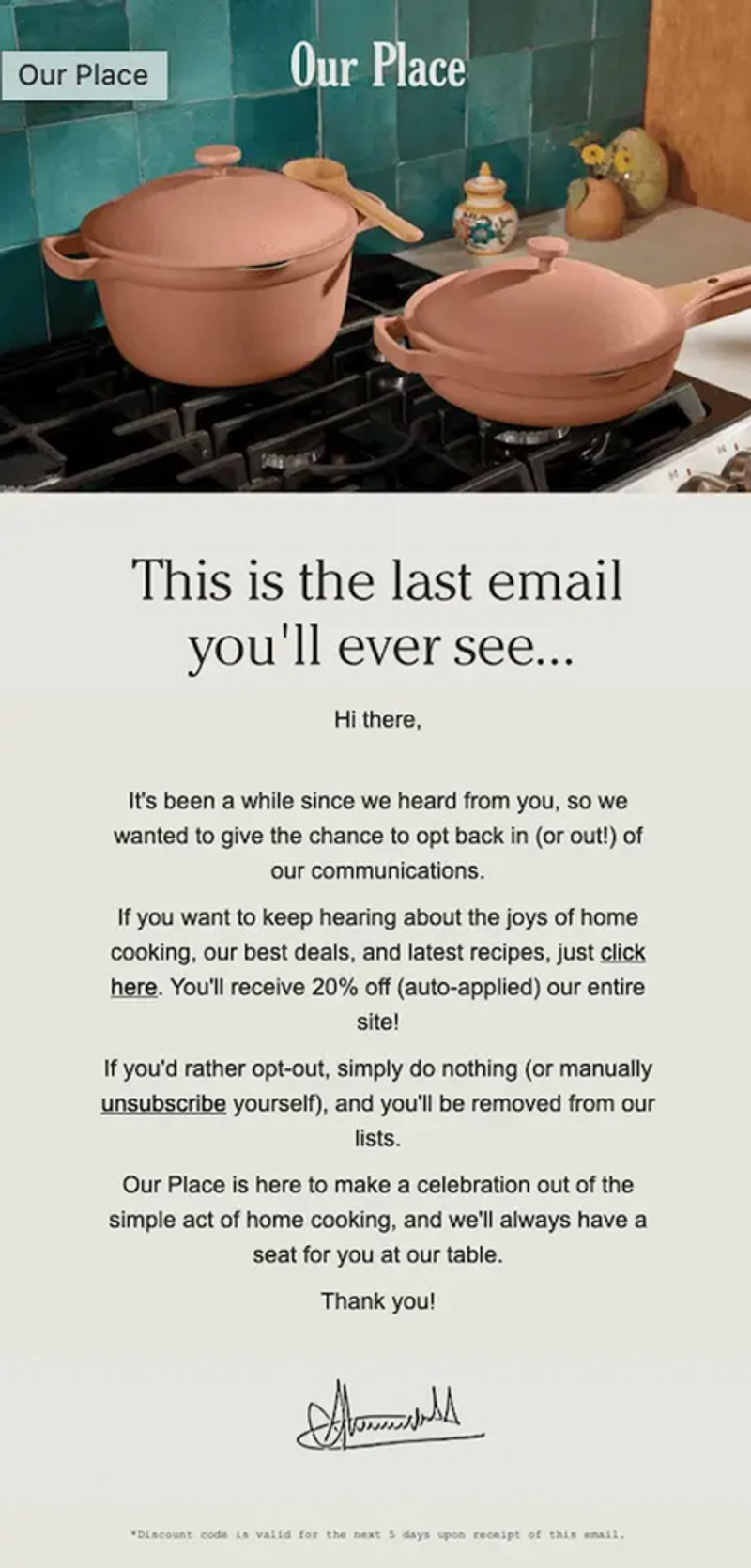
Subject line: This is the last email you’ll see
Our Place
Kitchen essentials brand Our Place flips the narrative of their win-back email so it feels like goodbye, but the recipient also has the option to formally opt out.
First, though, the email also includes a link to opt back in, and sweetens the deal with a 20% discount. In keeping with the personal letter approach, the two CTAs in this email are subtly linked in the text itself, rather than pulled out as buttons.
The copy isn’t typical for a CTA, either. The first says, simply, “click here,” requiring the recipient to actually read the letter to understand what they’re clicking on. The second is an unsubscribe link, emphasizing that the brand wants to give the customer full agency over their decision.
If they wanted to add a third option, they could take an omnichannel approach and add the option to stop the emails in favor of text messages instead.
2. Leading Lady entices people to come back with an incentive-driven win-back email
Subject line: You’ve missed a lot—Let’s catch up 💌
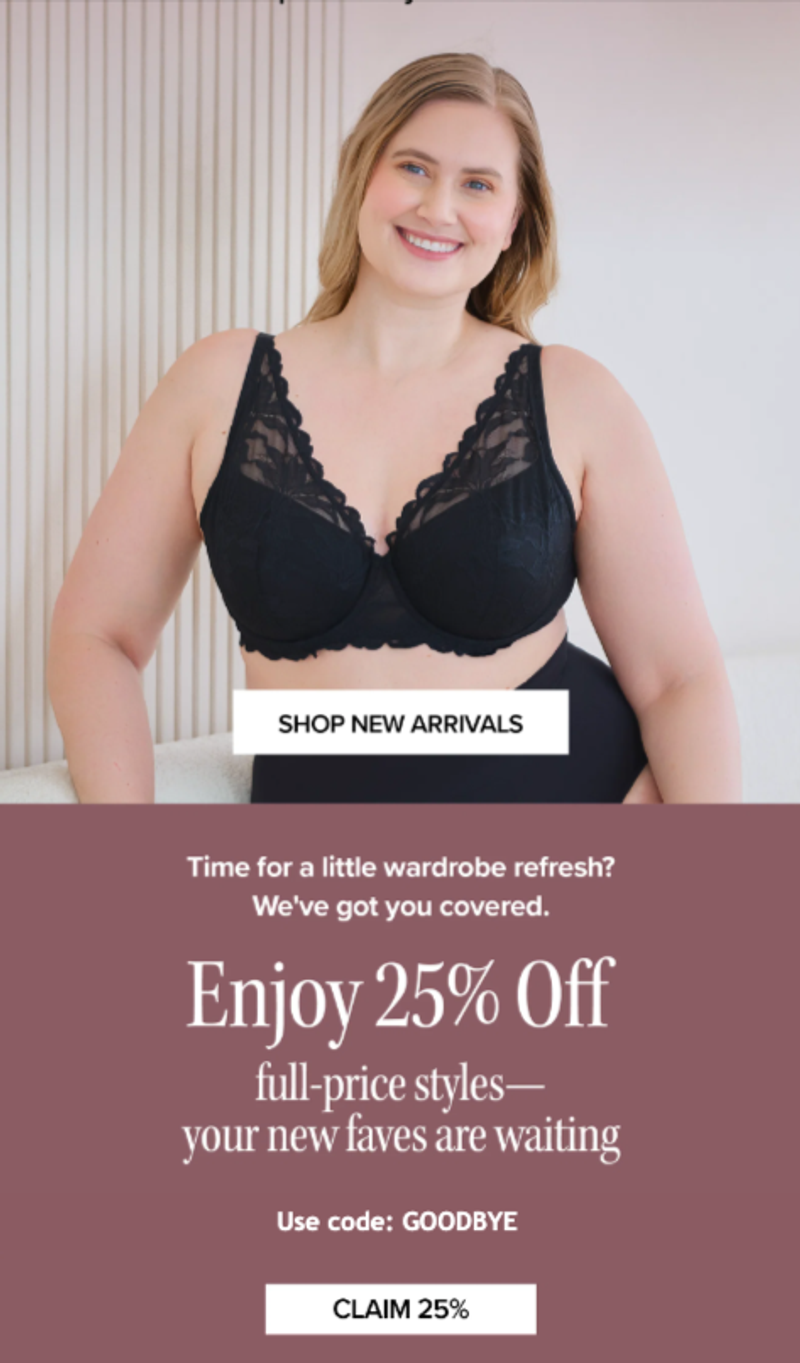
In this win-back email, intimates brand Leading Lady entices people to come back with a hefty 25% discount on all full price styles, framing the message as an opportunity for customers to refresh their entire underwear wardrobe.
Their discount code is even a little cheeky, in that customers need to type “goodbye” at check-out to claim their 25% discount. The CTA is an acknowledgment that this could be goodbye…or the start of a refreshed relationship with many Leading Lady pieces.
3. Printfresh re-introduces their catalog with a product-centric win-back email
Subject line: Let’s get reacquainted
Printfresh
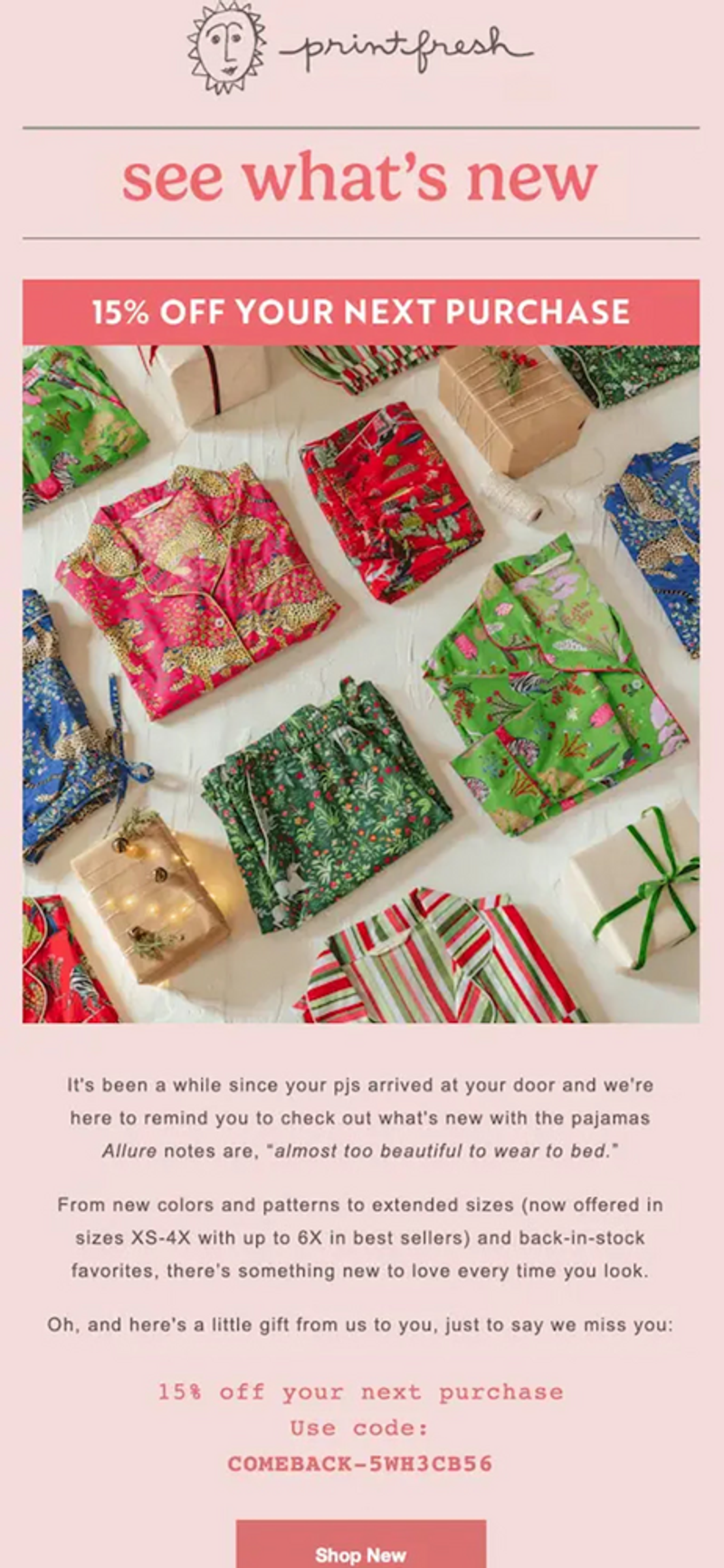
Sleepwear brand Printfresh leads with a 15% off discount in their win-back email, followed by a colorful product shot of various pajama tops and bottoms folded up neatly on a gift-wrapping table. The visual makes it easy for the reader to re-familiarize themself with the brand’s products without clicking through to the website.
The email copy then goes on to explain that the discount offer is a “gift” (something they don’t hand out often) and references social proof in the form of a quote from Allure magazine that calls the brand’s pajamas “almost too beautiful to wear to bed.”
The CTA in this email is center-aligned, simple (“Shop new”), and impossible to miss, making it easy for customers who are ready to use that discount code to do so, right now.
4. Girlfriend Collective keeps it short and sweet with a conversational win-back email
Subject line: We miss you. Here’s $20.
Girlfriend Collective
Activewear brand Girlfriend Collective keeps their win-back email subject line simple and straightforward and immediately tells subscribers that there’s an incentive to buy.
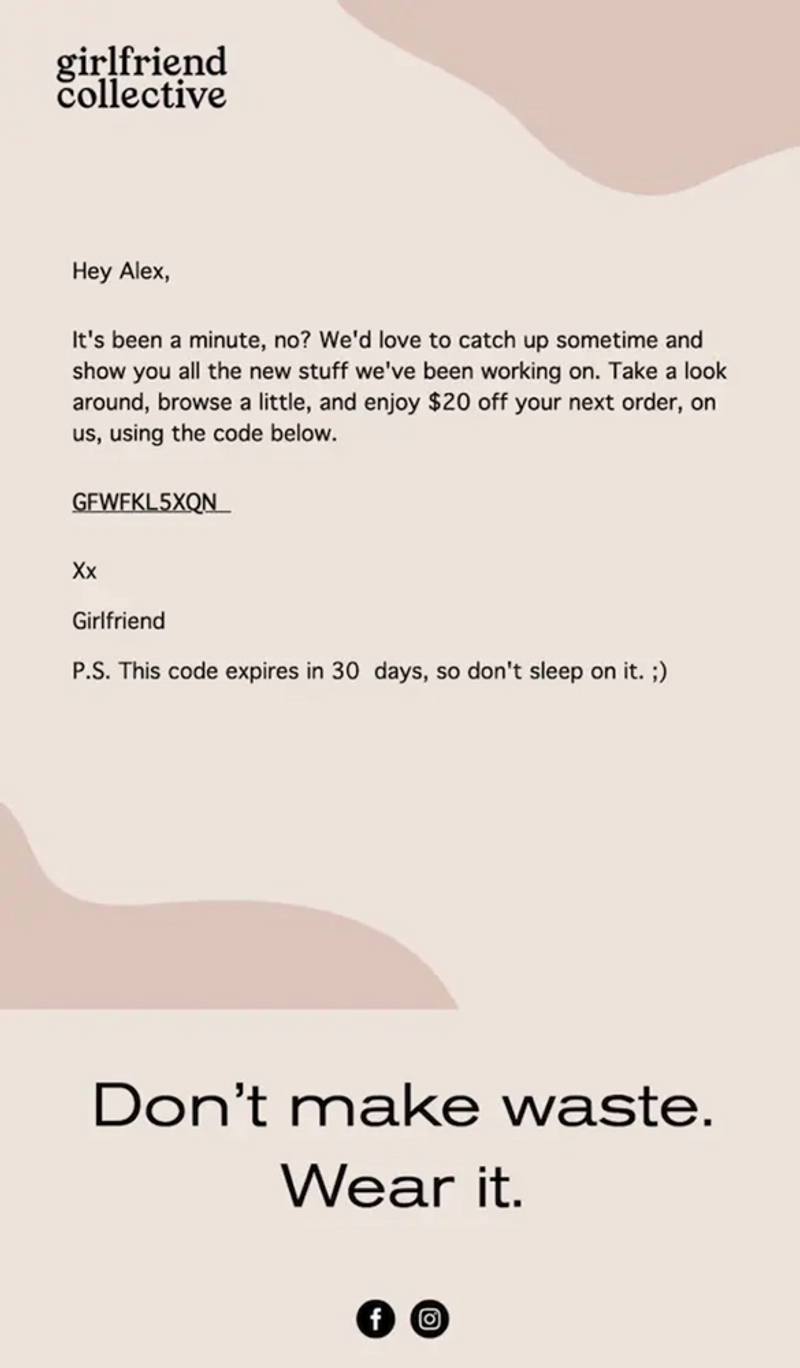
The email itself takes the form of a letter written from the team. It’s addressed directly to the recipient and the copy is informal, as if the brand is speaking directly to the reader. The tone is casual, conversational, and inviting. Girlfriend Collective encourages the reader to check out new products and browse the website, but they aren’t pushy about it.
The only CTA in this email is the discount code itself, which forms the anchor text of a link that takes email subscribers directly back to Girlfriend Collective’s website. And the PS at the bottom, which communicates that the discount code is a limited-time offer, creates a sense of urgency and fear of missing out (FOMO), encouraging customers to act quickly, lest they wait to buy and miss out on the offer.
5. Shhhowercap differentiates from competitors with a benefits-focused win-back email
Subject line: Fancy Seeing You Again
Shhhowercap
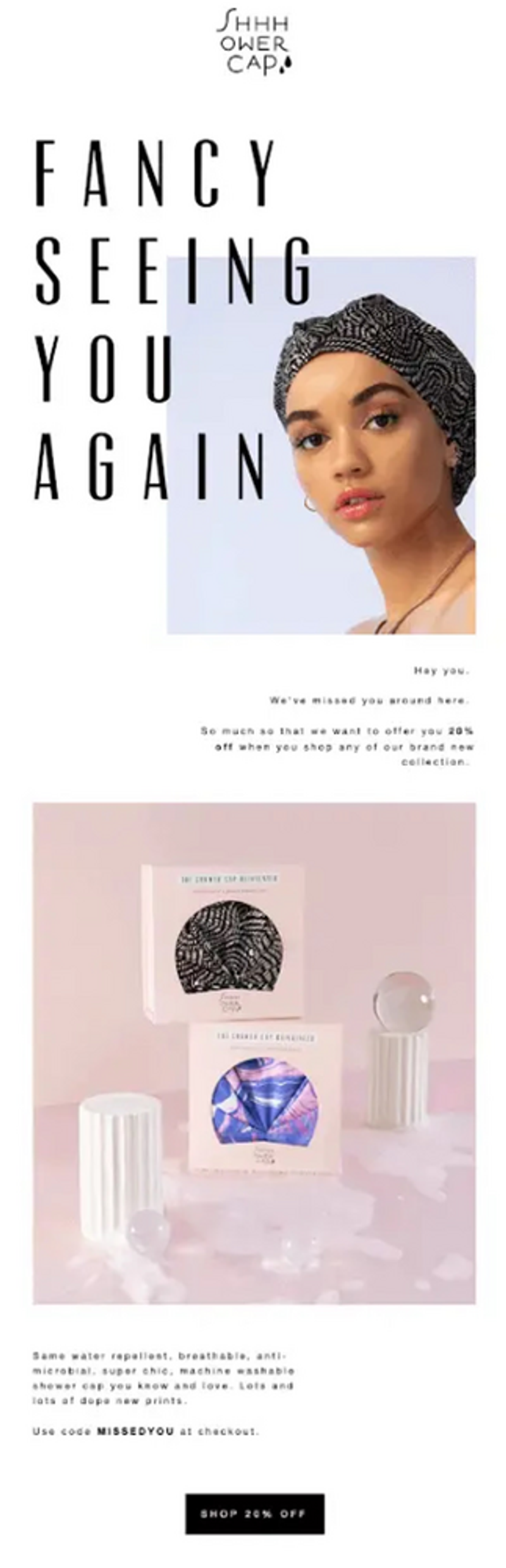
This win-back email from Shhhowercap is visually stunning, using imagery of the main product and its different patterns throughout to highlight exactly what the brand sells. The email does a stellar job of communicating the benefits of the product in the copy and showering readers with reasons to buy.
Instead of just including product pictures, Shhhowercap also mentions how their shower caps are differentiated from similar products by including descriptive details like “water repellent,” “breathable,” “anti-microbial,” and “machine washable.” The “Shop 20% off” CTA makes this win-back email too enticing to resist.
7 win-back email best practices for personalizing re-engagement
1. Use conditional splits to segment your recipient list
Someone who purchased $500 worth of products from you last year isn’t the same as someone who never purchased and hasn’t clicked on an email in 6 months.
Just as we don’t recommend sending email blasts to your entire list, we also don’t recommend sending the same win-back email to your entire dormant recipient list. This is because personalized incentives are your best bet for re-engagement.
In your win-back flows, you can use conditional splits to send different messaging to different types of dormant subscribers. Here are a few suggestions for getting started:
To avoid over-discounting, reserve higher discounts for people who spent more money in the past. You can also use predictive analytics to cross-reference predicted customer lifetime value (LTV) with churn risk to send high predicted LTV customers higher discounts.
Similar to discounting based on LTV, we recommend testing higher or lower discounts for customers vs. non-customers.
One recipient may have engaged with 10 product pages and an abandoned cart, compared to another recipient who only clicked on a few emails.
To increase the relevance of your win-back emails, send product recommendations based on past purchase and browsing history, or incentives related to products someone has wishlisted in their self-serve customer hub.
If your brand is having a real-life event, consider segmenting lapsed customers who live in the same location to encourage them to interact with you IRL.
If you’re using a CRM-embedded AI marketing agent to create your win-back flow, it may suggest segments beyond these recommendations. This is because it will pull from your lapsed segments to find revenue opportunities you may not be considering but are latent in your existing customer data.
2. Acknowledge your past relationship with the customer
Personal relationships create engagement, and acknowledging that relationship in a win-back email can spark re-engagement.
Most win-back emails include language like “We’ve missed you” or “It’s been a while.” The purpose of this language is to let the recipient know you’ve noticed their inactivity, with a compassionate and gentle reminder that you’re still there to offer a product they enjoy.
You can take this a step further when you’re using a CRM that integrates your customer service data with your marketing data. When customer service and marketing are aligned like this, marketers who are trying to re-engage customers can use human and AI support interactions to be specific about where things may have gone wrong and offer personalized incentives.
3. Include a strong incentive to re-engage
Discounts and special offers aren’t necessary for all your email campaigns and flows. But if a customer hasn’t engaged with your brand in 3–6 months, it will likely take some kind of incentive to re-engage them.
We recommend testing discount thresholds and free gifts to see how low you can go in monetary value while still winning re-engagements with lapsed customers.
An exception to the rule: real-life events. If your brand has a physical presence and you’re holding a special event, consider sending a special invite to your win-back recipients. Nothing leads to high-quality re-engagement quite like a real-life interaction, so you may be able to skip the financial incentive if your event is exciting enough.
4. Run a win-back flow audit with AI
Should you be sending more than one win-back email? If so, how many before you’re breaking a promise to stop contacting recipients? Will recipients be more likely to re-engage if you send them a win-back email after 3 months or 6 months?
To answer these questions, ask your AI marketing agent to run a flow audit to identify where customers are dropping off and give you suggestions for what to improve. You may also want to start building your win-back flow with a few business questions as an AI prompt:
- What incentives do my lapsed subscribers engage with the most?
- What incentives might work for lapsed subscribers that I haven’t tried?
- Where do lapsed subscribers drop off the most in my current win-back flow?
From there, your AI marketing agent can pull from existing customer and brand data to build your flow. If you know a bit more about what you want to achieve with your win-back series, you can give your AI agent a brief as a starting point.
5. Use RFM analysis to trigger your win-back flow
A standard win-back flow is triggered when a customer or subscriber hasn’t engaged with your brand within a certain period of time. But what if you could go beyond the basics and trigger your flow based on past purchase behavior, or even predicted future behavior?
This is what RFM analysis accomplishes. “RFM” stands for recency, frequency, and monetary analysis, which is the grouping of customers based on their purchase behavior: how recently they made a purchase, how frequently they purchase, and how much they spend. This data analysis tool helps brands reduce churn.
For your win-back flow, you can use RFM analysis to create a “Needs attention” segment. To go even further, you can separate high-value customers from the rest, so you’re sending a discount only to VIPs who used to spend the most with your brand.
But the deeper power of RFM analysis is that it lets you stay ahead of churn. With an “At risk” segment, you can send multi-step messaging when a customer is close to churning but hasn’t yet, ultimately reducing the need for a win-back automation in the first place.
6. Take an omnichannel approach to your win-back messages
We’ve been focusing on email as a primary win-back channel, but we don’t want to leave the impression it’s your only option. The most effective win-back efforts are omnichannel, meaning that several channels work together to create a cohesive experience for the customer.
Start by reaching out to customers’ via their preferred channel in the first place. With AI-powered channel affinity, you’ll be able to send win-back messages to lapsed customers on the channel they’re most likely to engage with.
7. Know when it’s time to sunset
Win-back emails are the gateway to a sunset email. You can only promise a “last email” so many times before you need to let go.
While it may feel like a loss, email list cleaning is how you maintain good email list hygiene. If you extend your win-back email series for too long, your email deliverability may suffer because recipients may begin to mark your emails as spam.
When this happens, your sender reputation can suffer, too, which can affect your entire email marketing program.
Get ahead of your win-back series with predictive analytics and AI
Klaviyo’s predictive analytics uses a high volume of real-time data to determine when your customers are at a high risk of churning. By comparing individual purchase behavior to similar behavior across your business’s customer population, Klaviyo can group your customers into low-risk vs. high-risk segments, so you can send offers to customers before they stop engaging altogether.
And with Composer, Klaviyo’s built-in AI marketing agent, you can create your win-back flow in minutes. Starting with a goal, a brief, or something Klaviyo AI discovered in your customer data, you can build a win-back series complete with copy, design, segments, and timing.
Ready to build an email list that drives real results?
Get started

Related content