Practical ways to personalize email with segmentation
Generated by Klaviyo AI
The article outlines 13 ways to segment email subscribers using engagement, shopping behavior, customer value, location, and preferences. Brand examples show how these segments inform welcome messages, offers, and follow-ups, while dynamic segmentation and AI help automate targeting.
- Engagement targeting: Focusing regular campaigns on engaged subscribers helps maintain list health and email deliverability.
- Customer journey: Acquisition source, browsing history, and past purchases help tailor welcome emails, product suggestions, and replenishment reminders.
- Value-based offers: Cart value, purchase amounts, lifetime value, and loyalty status can guide discounts and exclusive rewards.
- Support-aware messaging: Reviews and support interactions inform follow-ups, while customers with open support tickets can be excluded from marketing campaigns.
- Automated personalization: Dynamic segmentation updates groups as shoppers interact with a brand, while AI can help create segments and predict individual product interests or reorder timing.
Email segmentation is how you send fewer, more targeted messages to your subscribers.
By splitting shoppers up into segments based on what you know about them, like their browsing behavior, preferences, purchases, spend, and more, you can increase revenue and improve brand reputation just by sending relevant messages.
With dynamic segmentation, all of this happens automatically. When all your customer data is centralized in one CRM like Klaviyo, dynamic segmentation happens automatically as shoppers interact with your brand and fit different criteria. That might mean:
- Behavioral segmentation: Behavioral segmentation groups subscribers based on their interactions with all your channels. This enables you to tailor messaging based on what your subscribers actually do (e.g., engaging with your marketing, shopping in certain product categories, spending a lot or a little, or contacting customer support).
- Psychographic segmentation: Psychographic segmentation groups subscribers based on their interests, values, lifestyles, and personalities. This enables you to tailor your emails based on what people care about, not just the actions they’ve taken (e.g., sending emails about eco-friendly products to environmentally conscious subscribers).
- Demographic segmentation: Demographic segmentation groups subscribers by traits like age and location. This enables you to tailor emails to resonate with specific demographics (e.g., sending shoppers within a certain radius of your store an invitation to an upcoming local event).
And with AI segmentation now available (more on this toward the end), you can consider the email segmentation ideas in this article as jumping off points for prompts that can create more complex segments and more relevant messages.
1. Email segmentation based on marketing engagement
Targeting subscribers based on their engagement with your marketing is essential for maintaining the health of your email list. Consider engagement-based segmentation as non-optional, so your email deliverability stays high and you’re only reaching shoppers who want to hear from you.
When Huda Beauty saw a YoY decline in overall performance, they decided to overhaul their content strategy, clean up their email list, and focus on targeting their most engaged subscribers. They now only send regular campaigns to subscribers who have engaged within the last 120 days, reserving full-list email blasts for major annual sales only.
The results: 2x YoY growth in Klaviyo-attributed revenue. “With simple Klaviyo segmentation, we were able to clean up a lot of the deliverability issues that we had previously,” explains Phuong Ngo, CRM and loyalty manager at Huda Beauty. “It was a small thing that created a really big lift.”
After a while, you’ll be able to use your subscribers’ engagement history to send messages on the channels they’re most likely to engage with. Provided you’re also building your text message, WhatsApp, and mobile app marketing lists, you can use AI-powered channel affinity to build segments based on channel engagement and automatically route campaigns to the channel subscribers are most likely to engage with next.
2. Email segmentation based on acquisition source
How your new subscribers sign up for your email list—on your website, through a referral, via social media, in-store, etc.—tells you something about what they might want next from your brand. And that makes acquisition source a particularly helpful characteristic for segmenting your welcome series.
In flows, you can accomplish segmentation with conditional splits and branching. Try tailoring your first messages to new subscribers based on their probable motivations:
- If they signed up from a promotional offer page, they may be interested in discounts.
- If they signed up for a newsletter before buying, they may be more interested in educational or brand content.
- If they signed up through a referral, they may already trust your brand because someone they know does. So try to entice them to make their first purchase.
- If they signed up when making a purchase, they may be enticed to come back for more. Try offering an incentive to leave a review or make a future purchase.
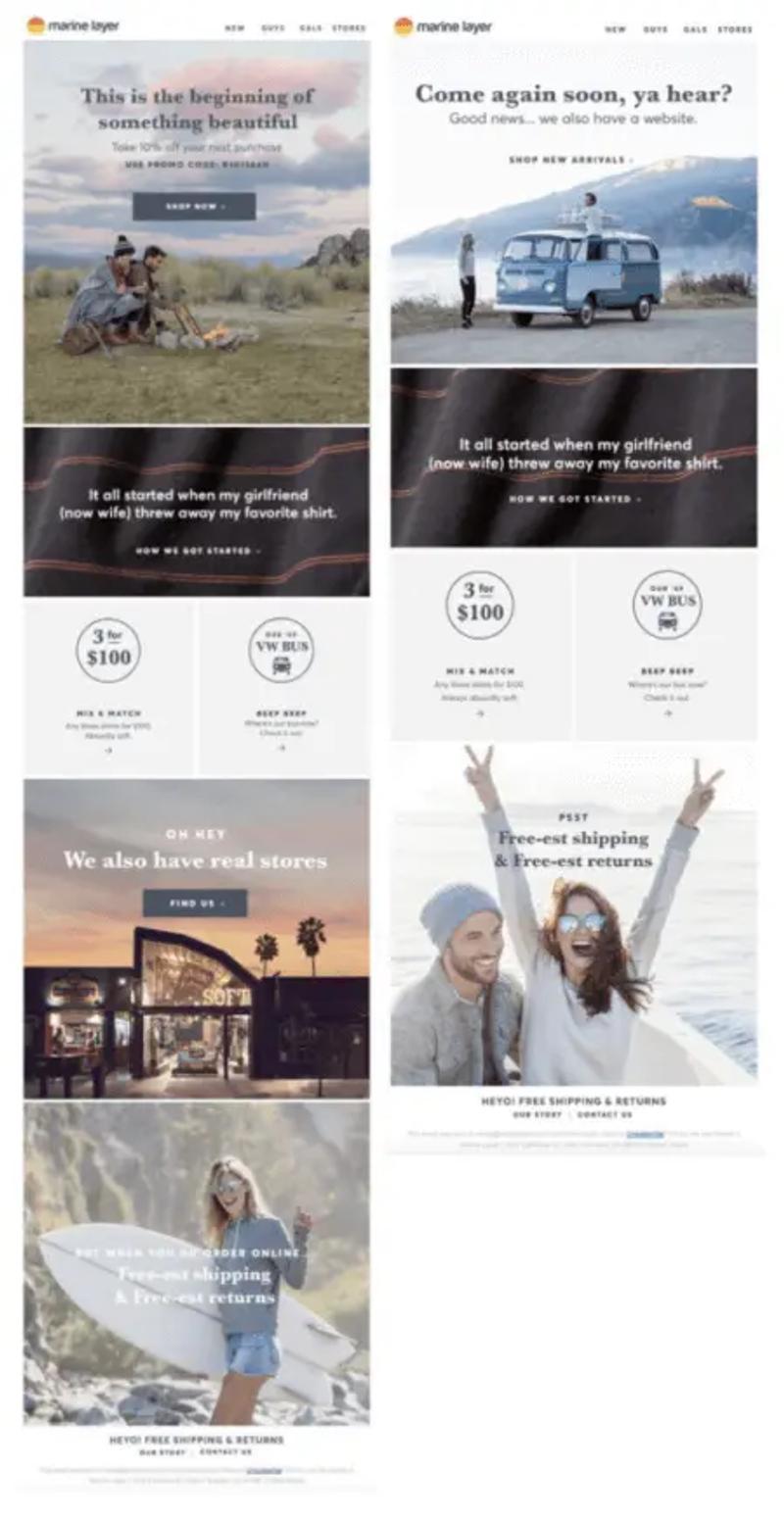
Apparel brand Marine Layer, for example, has one welcome series for in-store subscribers and another for online subscribers. Those who visit a Marine Layer store in person are introduced to the brand’s website. For those who subscribe directly on their website, Marine Layer offers a coupon code for 10% off, and encourages them to locate their closest store.
Marine Layer
3. Email segmentation based on recent sign-ups
New subscribers may not be ready to buy, but they’ve indicated interest in your brand. Affirm their decision to subscribe by sharing top product features, brand storytelling, testimonials, and customer reviews.
In addition to your welcome flow, those first few email campaigns are also great for gathering more data about your subscribers. For example, while new email subscribers may not be ready to download your app and receive push notifications, you may want to present them with the option to subscribe to text messages instead. Or, send a quiz to find out which products might be right for them.
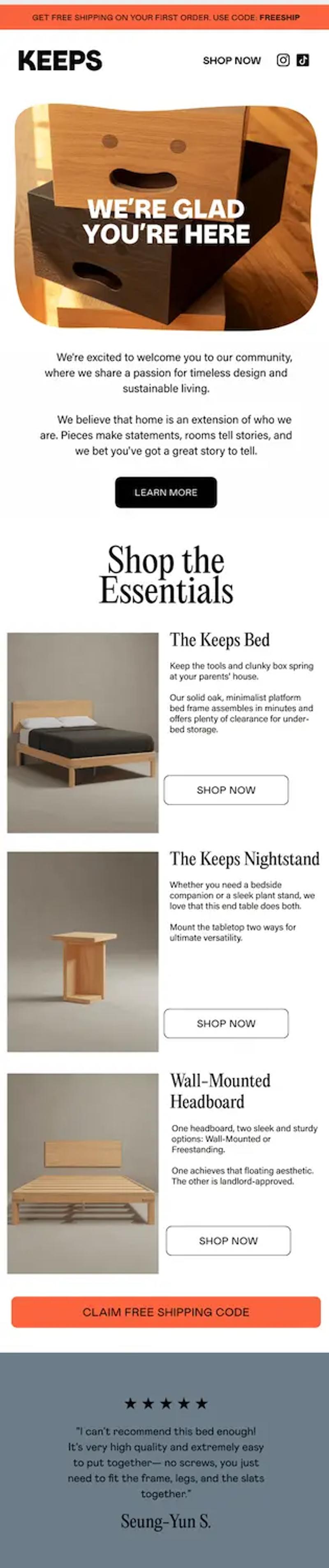
This email from furniture maker Keeps gives new subscribers a sampling of essential introduction content. They may want to click to get to know the mission, or they may be ready to skip forward to learn about the flagship products. Keeps also includes a customer review at the bottom of the email, which may be enough to prompt people to scroll back up and claim that free shipping code.
4. Email segmentation based on browsing history
Unlike when someone places an item in a cart, which signals high intent to buy, someone who views a product page on your website without adding an item to their cart is saying, “Hey, I’m just browsing. I’m not sure if I want to buy just yet.”
That means you have some room to play with what you put in your emails for segments of shoppers who’ve only browsed certain product pages on your website. The goal is to strike a “relevance jackpot” with someone who needs a nudge toward check-out.
One particularly helpful source of data for this type of segment is your self-service customer hub, where shoppers can manage their orders and returns, interact with customer service via web chat, and, most importantly, favorite or wishlist items they may want to purchase later.
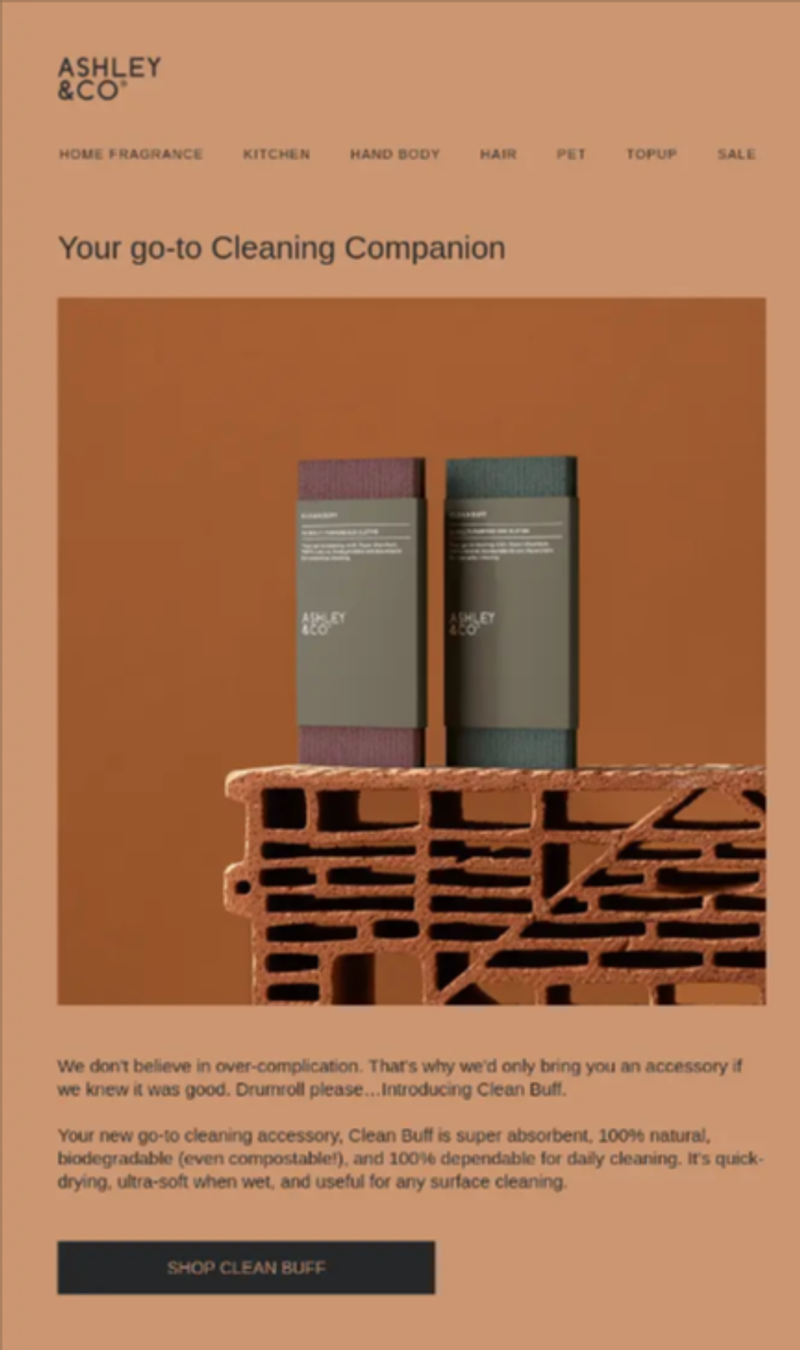
In this email segmentation example, scent brand Ashley & Co. sends a singular accessory offer for their clean buff cloth. It’s perfect for someone who may have been browsing their surface cleanse products, but wasn’t convinced enough to add one of those to cart.
Personalization tip: If you wanted to take personalization a step further here, next best product predicts which product any given shopper is most likely to want next, based on their behavior and profile data. It scores your catalog against each person and surfaces the item they're most likely to buy.
AI product recommendations like this are a more advanced form of 1:1 personalization, because they’re based on each individual’s behavior rather than group behavior. With next best product, you’re zeroing in on one choice and one offer, and demonstrating to the customer that you care about what they need and want.
5. Email segmentation based on abandoned cart value
Abandoned cart emails are one of the most commonly used automated flows for a reason: they work! According to Klaviyo’s 2026 Omnichannel Benchmark Report, abandoned cart flows earn an average of $6.77 per recipient, the highest of any flow.
To increase your profitability, split your abandoned cart flows based on cart value. For customers with low-value carts, send compelling messaging without a coupon. For customers with higher-value carts, you can offer a discount knowing the ROI is worth it.
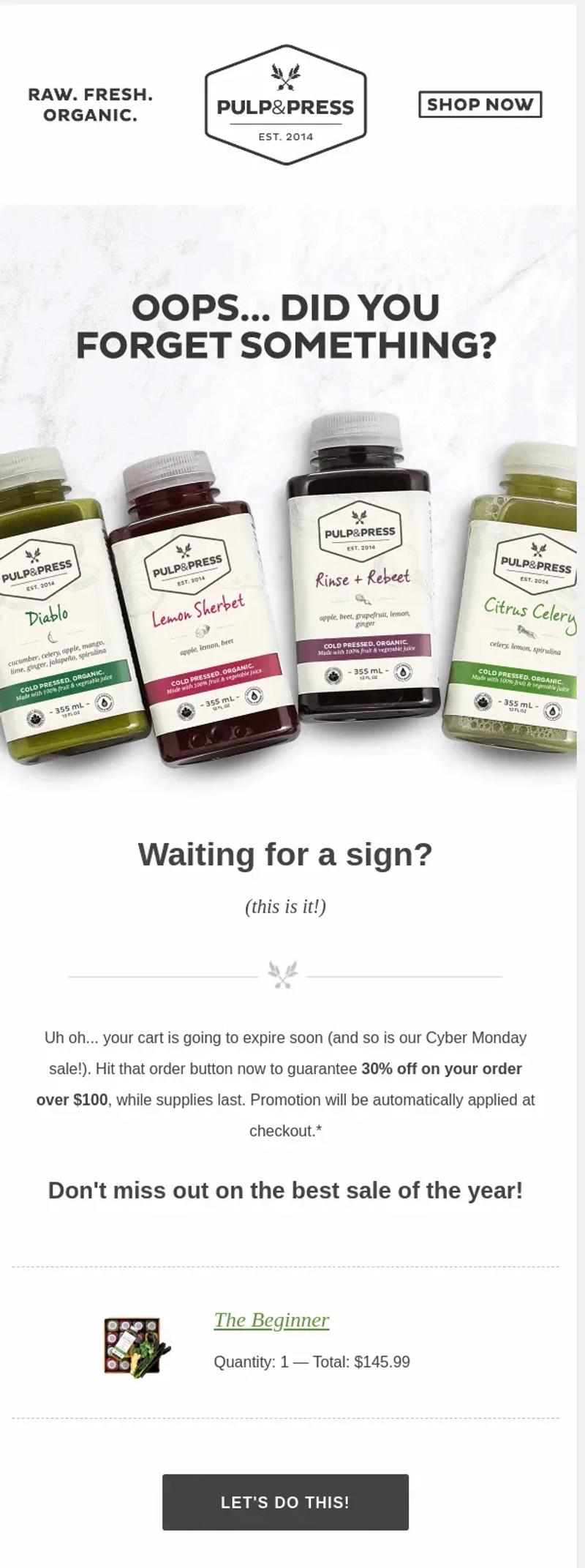
Juice brand Pulp & Press, for example, guarantees 30% off on orders above $100 if recipients “hit that order button now” during their Cyber Monday sale, banking on scale and a higher price to offset any money lost through discounts.
Pulp & Press
6. Email segmentation based on purchase history
After a customer makes a purchase, you have a window of opportunity to deliver timely info or re-engage them to make their next purchase. Use what you know about the product itself to drive your segmentation strategy.
Do your customers need instructions to set up or use the product for the first time? Send them all the required info so they’re ready when the order arrives. Is the product consumable? Try sending a timely message when people are most likely to purchase again.
In this email segmentation example, Graza sends first-time olive oil purchasers a follow-up email with a reminder to purchase a refill, giving people a nudge to try out Graza’s innovative refill bottles.
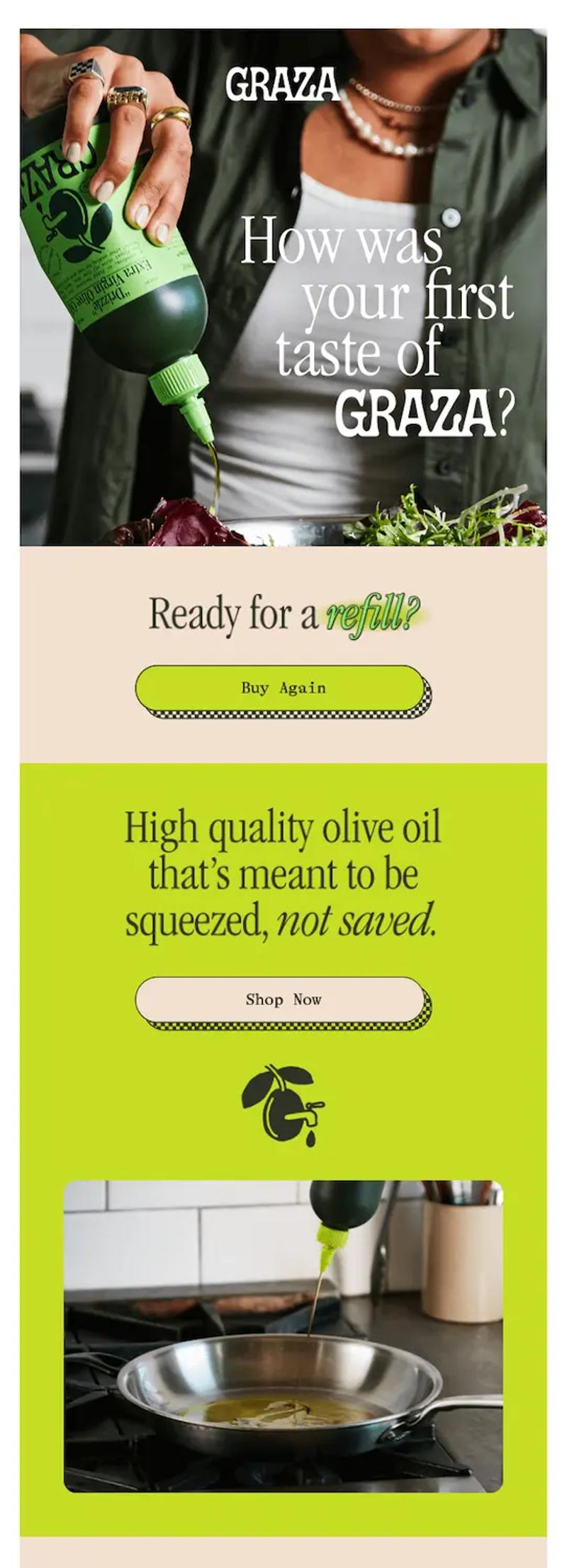
Personalization tip: If you wanted to take personalization a step further here, a replenishment email like this would be a great candidate for predictive analytics that time the email based on each individual customer’s expected date of next order. This is true 1:1 personalization: the closer you can match your email timing to when each customer needs more of your product, the higher the likelihood of a purchase.
7. Email segmentation based on customer reviews
Make it easier to respond to positive and negative ecommerce reviews alike by segmenting customers who have left a review for your products.
Affirm a positive review by sending a note of appreciation, or share an offer to incentivize future reviews and purchases. Always respond to negative reviewers to let your customers know you heard their feedback. You just might get a second chance to win them over.
You may also want to send positive reviewers custom review questions with an incentive to elaborate on their reviews with specific details or photos. Contextual details like these are important for showing up in AI shopping results, which consistently pull from reviews to help shoppers compare products when they’re doing research with large language models (LLMs).
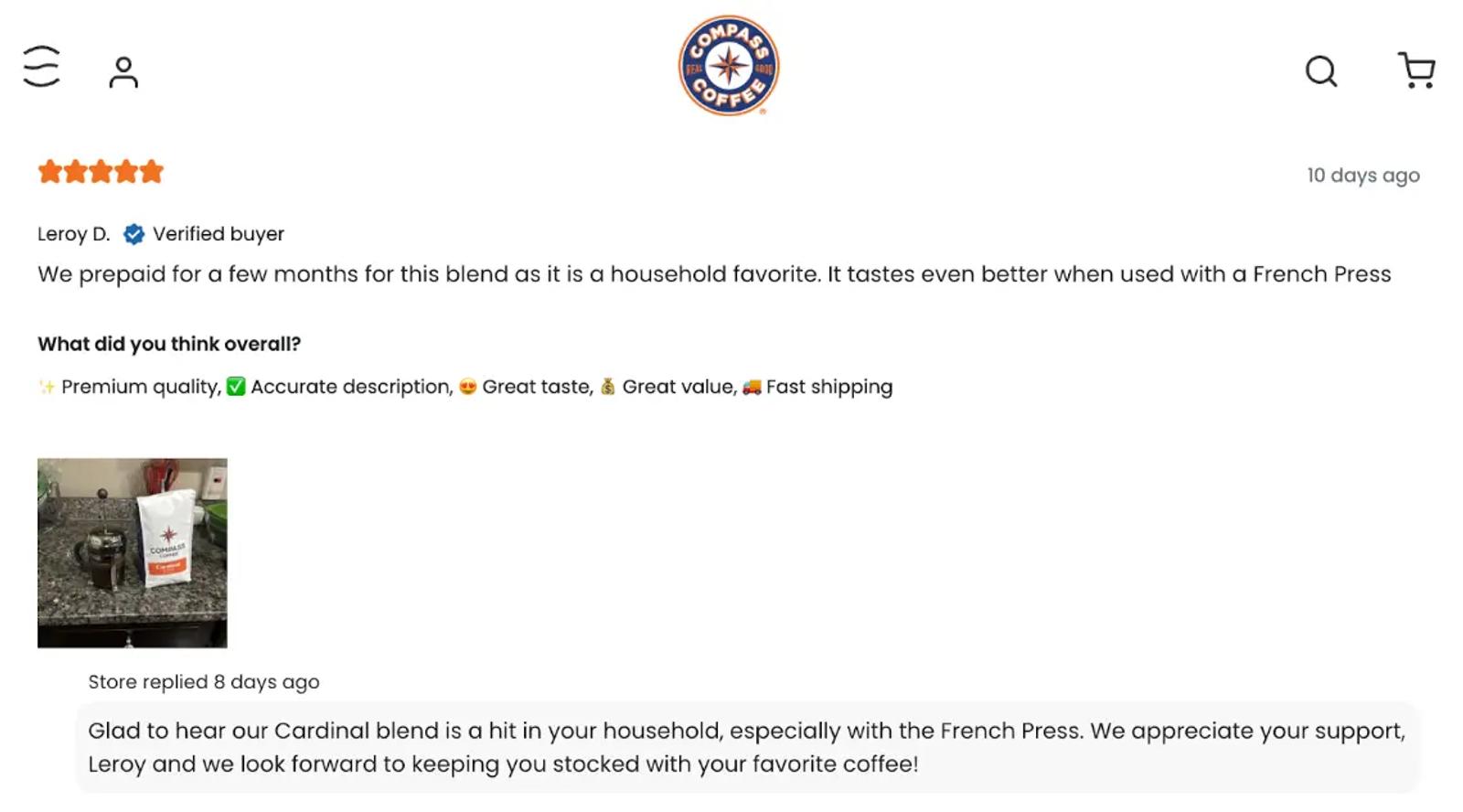
Compass Coffee uses Klaviyo Reviews to incentivize more people to submit a photo with their reviews. Using Klaviyo, Compass was able to set up a conditional split: if a review has a photo, the reviewer gets a 15% discount on their next order; if it doesn’t, they simply get a thank-you email and a reminder to leave a photo next time.
With this strategy, Compass saw a 3.7x QoQ jump in customer photos submitted and a 70.5% jump in total reviews submitted.
Compass Coffee
8. Email segmentation based on customer lifetime value
Customer lifetime value (LTV) is the total value of all purchases a customer has made with your brand. When you segment your customers based on LTV, you can deliver personalized offers based on what they’re most likely to care about.
You can also use AI to segment based on predicted LTV, which estimates how much money a customer will spend based on past behavior. The following segmented offers are a great way to raise your LTV and reduce churn:
- VIP (high total or predicted LTV): early access to new products
- Frequent purchasers: early access to sales
- Big spenders: exclusive product drops just for them
- Unengaged VIPs: deeper discounts on sales
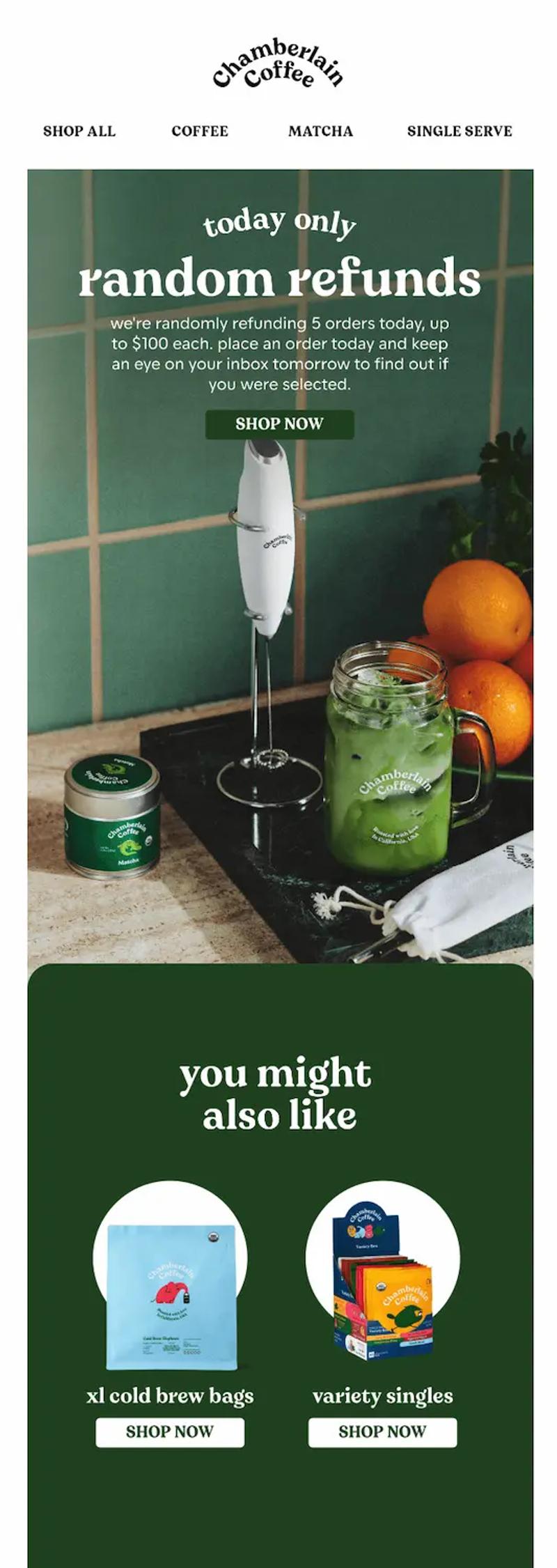
High-value customers are a great target for special offers and creative promotions. Chamberlain Coffee, for example, gives customers a chance to get their entire purchase refunded when they place an order that day. A limited offer like this could be a low-cost way to re-engage frequent purchasers, and may even encourage them to spend a bit more than they normally would.
9. Email segmentation based on purchase amounts
Similar to LTV, you can also segment your customers based on their past purchase amounts and send targeted incentives accordingly. Experiment with the following segments and offers:
- Low spenders: Highlight value-driven offers, free shipping thresholds, or product bundles to incentivize larger purchases.
- Medium spenders: Offer exclusive discounts, early access to new products, or personalized recommendations based on their purchase history.
- High spenders: Express appreciation for their loyalty, and offer VIP rewards or exclusive experiences while showcasing high-end products.
10. Email segmentation based on customer support interactions
Customer support and marketing are both crucial to long-term customer retention. But too often, these organizations don’t have visibility into how customers are interacting with the other.
A CRM that combines customer data, omnichannel marketing, and customer service into one single source of truth empowers your marketing team to curate messaging based on how your customers are interacting with your support team. For example:
- Segmentation based on conversations with your AI customer agent: When Klaviyo Customer Agent fields pre- and post-purchase questions about product details, return policies, and order tracking, the preferences customers share in the conversation (e.g., sizing, skin type, who they’re buying for) feed into their customer profile so you can use them in future segmentation efforts.
- Segmentation based on customer service reviews: Someone who reports a positive customer service interaction might be more in the mood for an up-sell than someone who reports a negative one. A dissatisfied customer is a great candidate for a special offer to keep their business.
- Segmentation based on open customer service tickets: In Klaviyo, you can automatically suppress customers from receiving marketing campaigns when they have an open customer support ticket in process.
11. Email segmentation based on loyalty program status
Your most loyal customers are some of your most valuable, but they’re not all the same. If you run a tiered loyalty program, you can segment by tier to encourage loyalty members to purchase more to reach the next milestone.
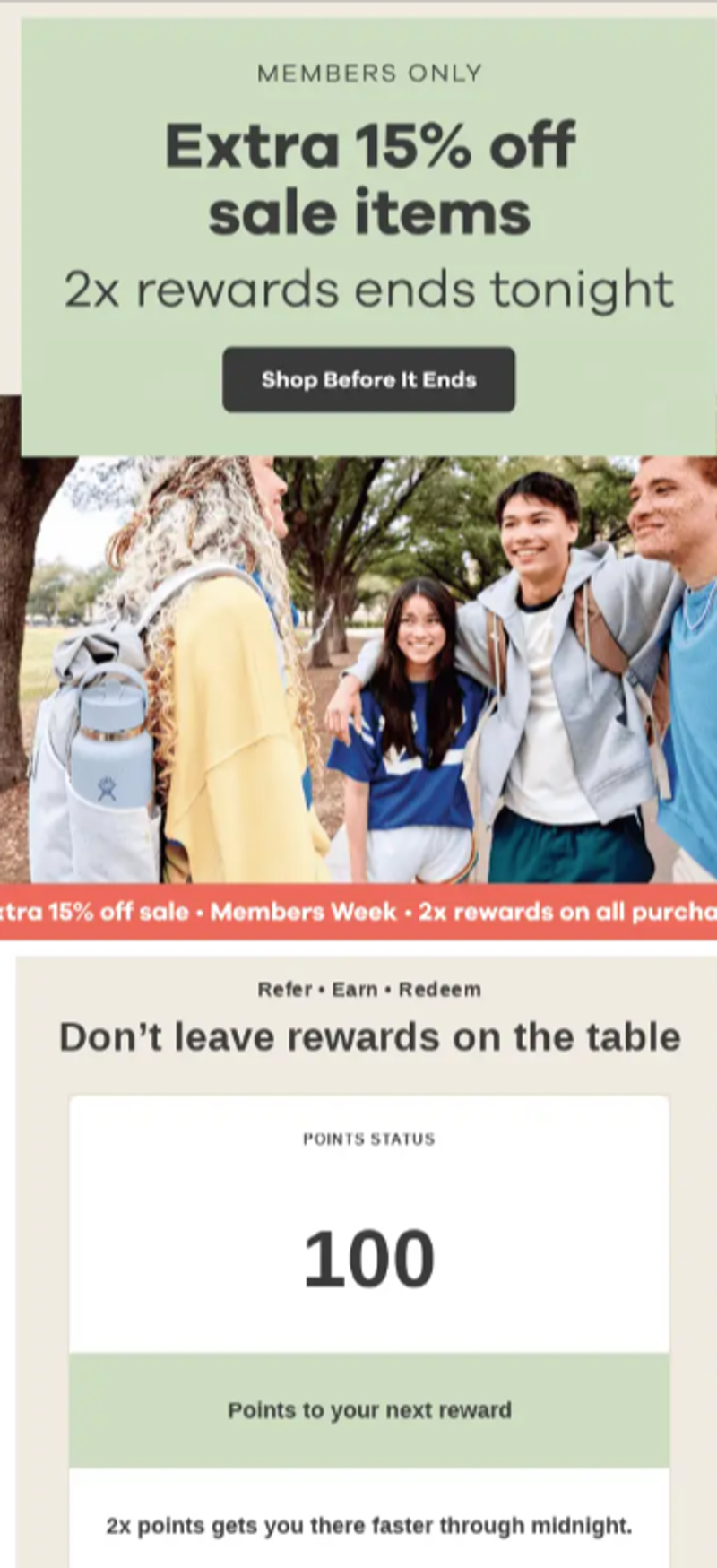
For example, this email by drinkware brand Hydroflask incentivizes purchasing among loyalty members by offering them 2x the rewards for a limited time. By showing people how many points they need to get to their next reward, the brand puts a tangible number on a discounted purchase to sweeten the deal. This is a great way to generate revenue in a short period of time if you need to meet a quarterly goal.
12. Email segmentation based on customer location
Shoppers who live anywhere outside of Florida aren’t likely to open a series of emails about an in-store event in Miami. Similarly, if your winter clothing line just dropped but it’s summer for half your customers, you might want to hold off on sending that promo email.
For international brands in particular, weather or season-specific collections, shipping offers, pricing, and product availability can all range by location.
Location-based segmentation allows you to send more relevant messages based on where people live. With Klaviyo, you can segment your customers based on their country, state/region, zip code, or by radius by creating a geofence around a specific location.
Dagne Dover used AI to quickly generate a geographic segment for an in-person event. They googled zip codes within a certain radius of the event, and copied and pasted the raw results into an AI prompt. Klaviyo generated a usable segment of customers living in those zip codes, saving the team hours on manual set-up.
Note: Geofencing is subject to regional privacy and location-data regulations. Some regions require a minimum geofence radius or place restrictions on how location data can be used. If you’re using Klaviyo for geofencing, make sure your geofence settings comply with all applicable local laws.
13. Email segmentation based on customer preferences
When you understand your audience, you can send them more of what they want and less of what they don’t. Ecommerce quizzes are a great way to collect customer preferences through an interactive experience that feels like fun.
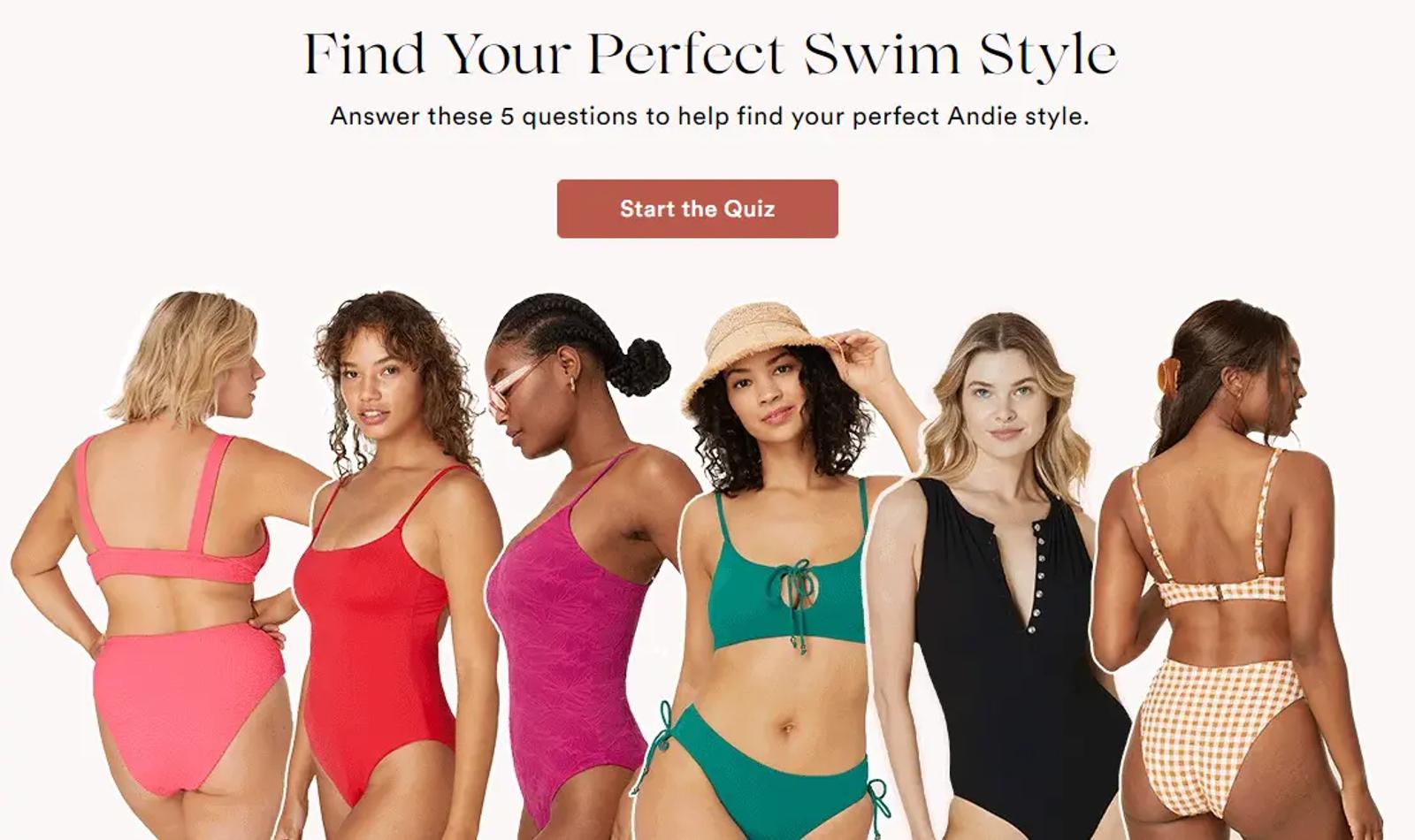
Andie Swim, for example, uses a fit-finder quiz to segment their email list based on style and fit preferences. In just 8 months, their quiz results flow drove over $70,000 in revenue.
Andie Swim
How to get started with AI email segmentation
Now that you have an understanding of basic segmentation, you’re equipped to direct and re-direct an AI marketing agent in putting together more complex segments for more targeted messages.
Before AI segmentation, marketers set up their segments as part of every campaign. When setting up email automations, marketers set criteria and rules about which flows should be sent to which segments. Each segment could dynamically populate itself based on real-time customer interactions, but actually matching segments to messages was still a manual process.
Now, with AI, you can direct your autonomous marketing agent to find segments in your data based on plain-language descriptions and goals. And within the same conversation, you can draft content and set up optimal timing for each email.
Here’s how to get started with AI segmentation:
- Centralize your customer data infrastructure. Comprehensive segmentation depends on real-time customer data. A B2C CRM like Klaviyo acts as a single source of truth and integrations for all customer-facing platforms, centralizing all customer data to unified profiles that update in real time as shoppers interact with your brand. These profiles are the foundation for segments that continue to populate automatically.
- Train your AI marketing agent on your data. This happens automatically with an AI marketing agent like Klaviyo Composer, which is built into the same platform as your customer data. That means it can generate much more effective segments and personalized messages than AI models that aren’t drawing on real customer context.
- Start segmenting with AI. Your AI marketing agent can recommend the right segments based on your goals, performance, and shifts in customer data.
Composer is your always-on AI marketing agent, built directly into Klaviyo B2C CRM. With Composer, you can create on-brand net-new emails in minutes. Start with a goal, a brief, or something Composer uncovered in your customer and performance data. Composer can help build the audiences, flows, and campaigns across email, text message, and mobile push, using your brand and business context throughout the process.
Segment smarter. Grow faster.
Try Klaviyo

Related content