How AI is reshaping B2C marketing
Generated by Klaviyo AI
K:SGP 2026 explored how Asian B2C brands are using AI, unified customer data, and omnichannel personalisation to improve customer relationships. Sessions covered AI maturity, Klaviyo’s product roadmap, real-world brand strategies, and the growing importance of retention.
- AI-led shopping: Singapore shoppers are rapidly adopting AI for product discovery and purchasing, changing how brands earn visibility and trust.
- Better data first: Clean, consistent zero- and first-party data is essential for relevant personalisation and reliable AI outputs.
- From doing to directing: AI agents such as Composer can analyse performance and build workflows while marketers set outcomes, context, and approval guardrails.
150 B2C marketers from across Asia spent Tuesday afternoon at K:SGP, Klaviyo's first event in Singapore. It was built for the kind of quality, peer-level conversation that can only happen IRL.
The room was full of marketing managers, heads of ecommerce, CRM leads, founders, and CX leaders from Singapore, Japan, Korea, China, Hong Kong, and Southeast Asia, along with the agencies and technology partners who work with them.
One idea kept surfacing in conversations throughout the day: most brands are using AI to get through their to-do lists faster, but the ones pulling ahead are using it to actually make things better for their customers. That means fewer irrelevant messages, quicker answers, and remembering what someone bought last time.
Here are the highlights you can take back to work.
Your shoppers are already using AI
Brian Kealey, Klaviyo's managing director for Asia-Pacific and Japan, opened the day by explaining why Klaviyo is investing in the region and what shoppers here are already doing:
- 76% of Singapore consumers have already used AI to help them find or buy a product, according to Klaviyo’s 2026 State of the Holiday Buyer Report, which surveyed 6,750 shoppers across 8 markets.
- The same report found that 81% of Singapore consumers plan to use AI to shop this holiday season—the highest of the 8 markets surveyed, ahead of Australia, France, Germany, the UK, and the US.
That's the backdrop for Klaviyo opening its Asia headquarters in Singapore in August. The team now has more than 150 people working across Asia Pacific and Japan and plans to add about 30 more. That’s because, as Kealey pointed out, a decision about a brand in Bangkok, Tokyo, or Manila should be made in this time zone by people who live and work in the region, alongside partners those brands already trust.
AI is changing how brands work, not their goals
In a fireside chat with Kealey, Ed Hallen, Klaviyo's co-founder and chief strategy officer, talked about why he and Andrew Bialecki started Klaviyo in 2012, what’s stayed constant as the company’s grown, and how AI is changing the way brands build relationships with customers. AI may be changing almost everything about how businesses operate, but the goal is still the same, and it’s better customer relationships.
Then Jamie Domenici, Klaviyo's chief marketing officer, took the stage to show what that looks like for marketers: Klaviyo, the autonomous CRM built for B2C, where real-time customer data, intelligence, and AI agents work together so teams can focus on outcomes rather than operations.
Domenici argued that AI is moving faster than the way most teams work. She walked through a 5-step maturity model, from experimentation, to applying AI to individual tasks, to AI-powered workflows, to redesigned processes, and finally being truly AI-native, where AI runs the workflows. The shift she asked marketers to make is from doing to directing. You set the outcome, the context, and the guardrails, and an AI agent does the work while you review it.
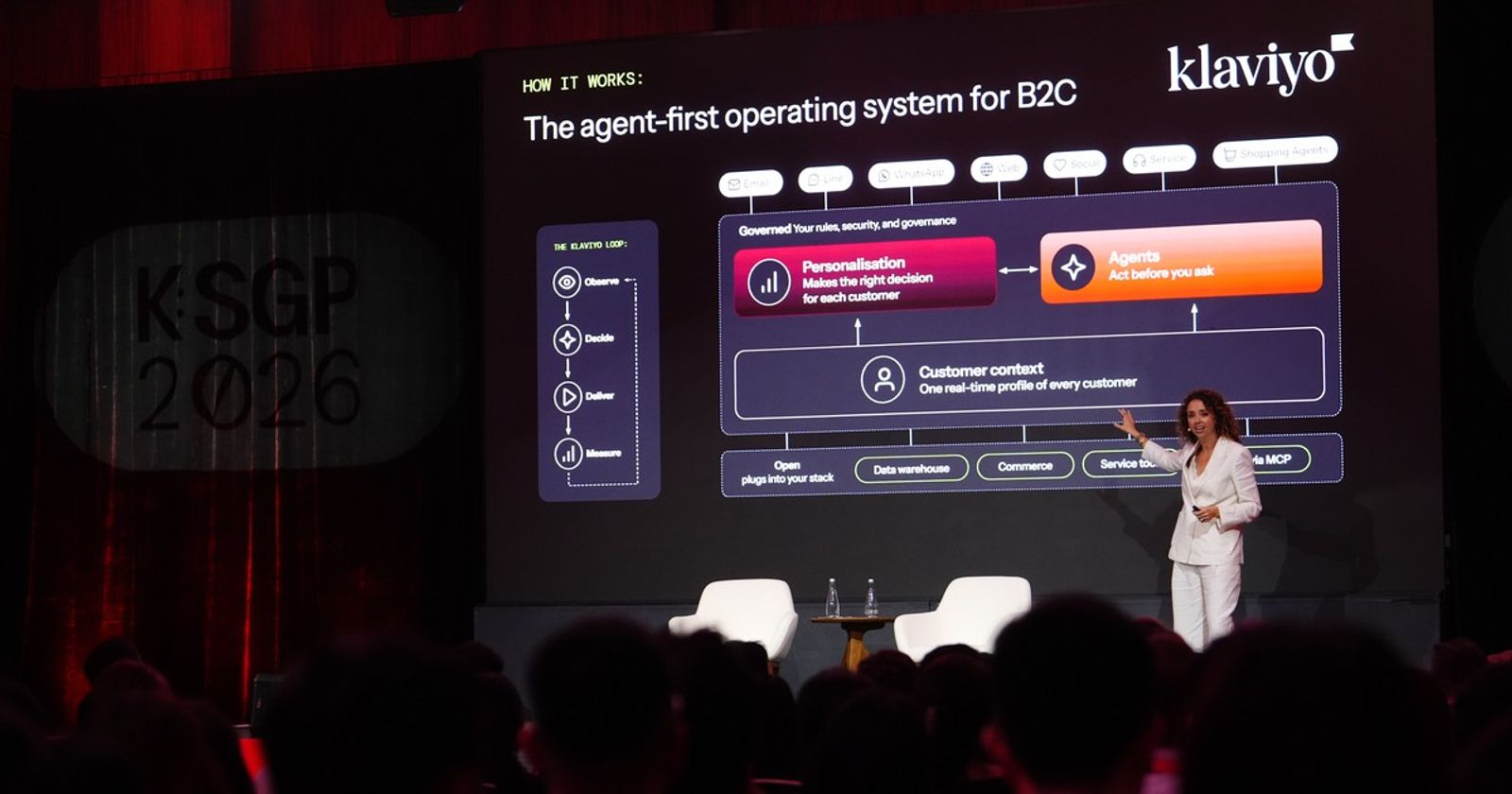
For example, you might ask Composer, Klaviyo's AI marketing agent, to analyse the last 90 days of campaign and flow performance. It benchmarks every programme, finds the gaps, and ranks the top 3 fixes for you to approve before building anything. Composer's built-in guardrails keep you in charge: nothing goes live without human approval.
To show what the 5-step maturity model looks like outside a slide, Domenici invited Ying Tze Her, Saturday Club’s chief operating officer, to the stage to chat through what it’s like to be working with these tools already. Their journey started with using ChatGPT to catch grammatical errors in emails. From there, they moved to more complex workflows like localisation and personalisation, and finally to improving the customer experience. It’s the maturity scale in real life: start small, then build AI into the workflows that matter.
How real brands are using AI to build better customer relationships
Paul Mah, journalist and adviser, moderated a peer conversation with Sangun Jung, DTC marketing specialist at FILA, Steven Angkasaputera, head of user communications & community at Plaud, and Tanya Mar, ecommerce and digital marketing manager at Dermalogica.

Key takeaways:
- Shoppers are asking AI before they ask you. Angkasaputera said people now ask ChatGPT and Claude questions like ‘What note-taking app should I buy?’ and get recommendations pulled from several sources. Plaud is making their website easy for AI to crawl, and some customers find the product through Reddit threads. That means email is no longer the first touch, and reviews and customer feedback matter more than ever. Jung agreed marketers need to control what they can control, and that’s their website. The FILA team moved to more text and more relevant use cases so their site can be a primary source of information, and it’s optimising for answer engines, the AI tools that give shoppers a direct answer instead of a list of links.
- AI enables 1:1 personalisation at scale. Mar discussed Dermalogica’s face mapping tool, where a customer takes a selfie on the website and receives a personalised skincare routine. The brand uses that zero-party data to make its marketing more personal. Angkasaputera said Plaud takes it further: every message is tailored to a person’s lifecycle stage, across so many personas that everyone in the room would receive a different email.
- Clean data comes first. Klaviyo’s research with Forrester found that B2C marketers use an average of 25 marketing tools in a single campaign, and that tool sprawl can push costs up by as much as 26% a year. Angkasaputera described how Plaud keeps their data useful: they trigger a campaign review when a customer hits a key onboarding milestone, such as first logging into the app or finishing set-up. The team then reviews metadata, not the content of conversations, and feeds it back into Klaviyo.
- When budgets are tight, AI needs to earn its place. As Mah put it, ‘The blank cheque days are done’. Marketers are being asked to account for every cent, and they’re leaning on AI to reduce friction and drive more profit. Klaviyo's 2026 State of the Holiday Buyer Report backs up why: 58% of consumers will willingly share more personal data in exchange for relevant marketing.
To take action, audit your data before you add more AI. List every tool that touches a customer profile, then check that identity, attributes, and consent are defined the same way across the board.
The Klaviyo roadmap: what's shipping and what's next
Gil Hsu, product lead, Composer at Klaviyo, and Nik Hendel, solution engineer at Klaviyo, took the room through the Klaviyo roadmap in 4 parts:
- AI agents: Composer is becoming more proactive and flexible, with SQL support so you can ask questions about your own data in plain language, citations so you can see where an answer came from, custom skills, scheduled and recurring tasks, and MCP connectors that bring in context from your other tools. Customer Agent, Klaviyo’s AI agent for customer support, handles service conversations across email, web chat, text messaging, and WhatsApp, runs on the same customer profiles as your marketing, and lets you build your own skills by describing what you want.
- Data: The case for SQL is simple. Ask something like 'Revenue last quarter?' and there are several right answers depending on the metric, tax, refunds, and date range. One shared definition ensures consistent answers, and you can see exactly how each one is calculated. It's the same point the panel kept coming back to: AI is only as useful as the data underneath it.
- Omnichannel marketing: Each channel has a job. Email drives revenue, text messaging speeds up conversion, WhatsApp handles conversational commerce, push notifications build loyalty, and social brings in new customers. Channel affinity, which predicts where each subscriber is most likely to engage next and leads with it, is live. So are RCS with rich media, geofenced push for mobile apps, and auto-replies for social.
- Personalisation: Hsu and Hendel framed personalisation as 4 decisions: who gets the message, what they see, when it arrives, and where. Klaviyo empowers you to customise these decisions at the individual level, with personalised send time in campaigns, audience optimisation, next best product, multiple RFM models, and more coming soon.
Behind the brand: how Castlery built loyalty in a category people buy from once every few years
Kristina Radosevic, director of customer success at Klaviyo, sat down with Leah Howatson, general manager, international markets at Castlery, for a fireside chat.
Castlery, a Klaviyo customer for more than 5 years, spent its first decade focused on winning new customers. The Singapore-born furniture retailer is now 12 years old and has grown from an online-only business into a true omnichannel brand across the US, Europe, Singapore, and Australia. It now treats retention as a priority on par with acquisition. That's a hard sell in a category where the same customer might not need another sofa for years.

In marketing, Howatson's team starts with a hypothesis, then uses the data to prove or disprove it. They start with what they know about how people buy furniture, based on ecommerce data, third-party sources, average time on the showroom floor, and even delivery drive-alongs.
One assumption was that first and second orders would sit close together, with life changes prompting repeats a few months later. Another was that a 7-year repeat cycle would show up clearly in the numbers, but the signal was weaker than expected.
What the data did show was that customers are comfortable buying some categories from a brand they don't know yet, while they hold off on higher-trust categories until they've built confidence. That finding shaped Castlery’s post-purchase flows built around category behaviour, part of a retention-first approach that has delivered more than 100x ROI on Klaviyo spend.
Howatson also made the point that retention is harder to fund than acquisition. It requires different skills, tools, and dashboards, and results take longer to show up.
The online and offline link matters just as much. In-store stylists can push a customer's in-progress cart to their online account, and a flow is triggered if the customer doesn't buy. Shoppers who browse online can walk into a store and have staff pull up exactly what they've been looking at. Add WhatsApp and text messaging in the US, which already account for a double-digit share of triggered revenue, and the common thread is clear: loyalty comes from one consistent experience across channels.
‘Composer is really helpful for me as a senior leader because I can ask really big questions that used to require time and senior analytics teams. Now, I have all the information at my fingertips’.
What to take back to work
Kealey closed the day with 3 key takeaways:
- Your shoppers are ahead of you. 81% of Singapore shoppers plan to use AI to shop for gifts this season, compared with 67% globally, and nearly half prefer to hear from brands somewhere other than email, according to Klaviyo's 2026 State of the Holiday Buyer Report. They're already discovering, deciding, and chatting across channels. Your marketing needs to meet them there.
- The data is the strategy. Shoppers using AI are spending at 3x the rate of non-AI shoppers in Singapore, yet nearly half just want irrelevant messages to stop and to be treated like a loyal customer, according to Klaviyo's 2026 State of the Holiday Buyer Report. AI only works when your zero- and first-party data is good enough to make it relevant. Is yours?
- Be relevant, not everywhere. 1:1 marketing at scale, without increasing headcount, requires a single unified view of every customer, AI agents that act on it, and the right channel for each person.
K:SGP was the first, but it won't be the last. Asia isn't a future opportunity for Klaviyo. It's a present one. Thanks to Recustomer, Seel, Global-e, CWILL, Lumo by Little Help Agency, and Shopify for backing the day, and to everyone who came and made it worth the trip.
Take action: Pick one retention moment you're not owning yet, like the second purchase, and build a flow for it before peak trade.
Ready to dig into what it means for your brand?
Request a demo